Chapter 9: Torres Strait Islanders and Blackbirding in Queensland
Two Histories, One Struggle
While Aboriginal peoples across the continent were subjected to massacres, chains, and stolen wages, Torres Strait Islander communities endured their own form of colonial exploitation. The Torres Strait, a network of islands between Cape York and Papua New Guinea, became a focal point for Britain’s imperial ambitions in the Pacific.
Islanders were drawn – and often forced – into industries that enriched colonists: pearling, beche-de-mer (sea cucumber), and later farming. Their experiences show that colonisation in Australia was not a single story, but many overlapping ones.
What is Blackbirding?
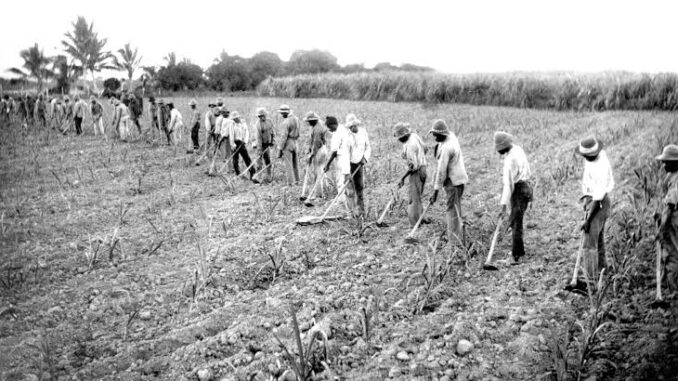
“Blackbirding” was the practice of kidnapping or coercing Pacific Islander peoples to work in Australia, especially in Queensland’s sugar industry from the 1860s. Recruiters lured people onto ships with false promises, or simply abducted them.
Around 60,000 South Sea Islanders were brought to Queensland under these schemes. Many were taken from places such as Vanuatu and the Solomon Islands and they became known as Australian South Sea Islanders, a distinct community that remains today.
Torres Strait Islanders were caught up in similar systems. While not always labelled “blackbirding,” their recruitment into pearling and marine industries shared the same coercive character.
The Pearling Industry
From the mid-1800s, pearling boomed in the Torres Strait. Colonists sought pearl shell for buttons, ornaments, and trade. The industry relied heavily on Torres Strait Islander divers and labourers, who were subjected to:
- Dangerous work: Divers risked drowning, shark attacks, and decompression sickness.
- Low or no pay: Wages were minimal or withheld, echoing stolen wages systems elsewhere.
- Coercion: Islanders were often forced into crews through intimidation or debt.
- Abuse: Physical punishment and brutal working conditions were common.
Pearl shell profits enriched colonial merchants, but left Islander families with little benefit and great trauma.
Queensland’s Control of Islander Labour
In 1879, Queensland annexed the Torres Strait Islands. Islanders came under the Aboriginals Protection and Restriction of the Sale of Opium Act 1897 – a law that controlled nearly every aspect of Aboriginal and Torres Strait Islander life:
- Islanders could not freely choose employment; government officials acted as “Protectors.”
- Wages were seized into trust accounts, often never returned.
- Islanders were moved between islands or industries at the whim of officials.
- Families were separated when men were recruited for maritime labour while women and children remained in villages.
This legal control meant Islanders were not free workers. They were colonial subjects under forced labour schemes.
Cultural Disruption
Labour exploitation was not only economic; it disrupted cultural and family life. Islanders taken onto boats for months or years at a time missed cultural obligations and ceremonies.
Traditional authority structures were undermined by government-appointed “Protectors” and church missions. Children were drawn into mission schools where English replaced traditional languages.
Colonisation sought not only to extract labour, but to reshape Islander identity to fit colonial norms.
Resistance and Survival
Islanders resisted in many ways:
- Strikes: In 1936, Torres Strait Islander workers staged a major maritime strike demanding fairer wages and conditions. The strike is remembered as a turning point in Islander self-determination.
- Cultural survival: Despite church and state suppression, Islanders maintained strong ties to traditional culture, ceremony, and identity.
- Political advocacy: Over the 20th century, Islanders pushed for recognition of their unique status as distinct First Peoples of Australia.
Resistance meant that, unlike in many colonies, Torres Strait Islander identity was never erased. It endured and adapted under pressure.
Blackbirding’s Wider Impact
The blackbirding era had wider consequences:
- South Sea Islanders brought to Queensland under coercion were also subjected to racial segregation, unpaid labour, and eventual mass deportations under the White Australia Policy (1901).
- Torres Strait Islanders witnessed the exploitation of their Pacific neighbours alongside their own, reinforcing solidarity and shared struggle.
The legacy is complex: today, Australian South Sea Islanders and Torres Strait Islanders both carry intergenerational scars from coercive labour systems.
Why It Matters Today
Blackbirding and coerced Islander labour undermine the national myth that Australia was built only by hard work and “fair play.” In reality, industries like sugar and pearling were built on exploitation – of Aboriginal workers, Torres Strait Islanders, and Pacific Islanders.
For Torres Strait Islander communities, the stolen wages, disrupted cultures, and legacies of control remain. Ongoing struggles for recognition, reparations, and land rights cannot be separated from this history.
Where This Leads
Having examined forced labour, stolen wages, and blackbirding, we now turn to another weapon of colonisation: the deliberate destruction of Aboriginal and Torres Strait Islander language, art, and law.
This cultural suppression was not incidental – it was central to the project of assimilation.
Continued tomorrow…
Link to Part 8:
From Ignorance to Understanding: Facing the Truth of Colonisation (Part 8)
Link to Part 10
From Ignorance to Understanding: Facing the Truth of Colonisation (Part 10)
Dear reader, we need your support
Independent sites such as The AIMN provide a platform for public interest journalists. From its humble beginning in January 2013, The AIMN has grown into one of the most trusted and popular independent media organisations.
One of the reasons we have succeeded has been due to the support we receive from our readers through their financial contributions.
With increasing costs to maintain The AIMN, we need this continued support.
Your donation – large or small – to help with the running costs of this site will be greatly appreciated.
You can donate through PayPal or credit card via the button below, or donate via bank transfer: BSB: 062500; A/c no: 10495969


I’d like to draw your attention to Barbara Eisenstein and Arlee Russell Hochschild’s book, “Global Woman”, which shows that women of colour and Asian backgrounds are still being exploited. This is not to take anything from the truly horrendous enslavement of Aborigines, Torres Strait Islanders and South Sea Islanders in this country.
It is only too clear that many of the more powerful people consider people of “lower” situations exist to be exploited by them.