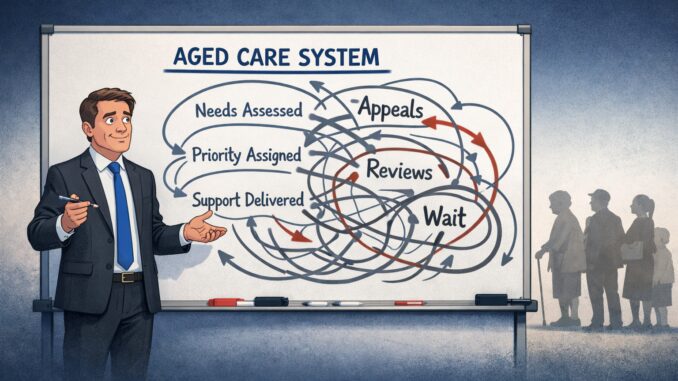
Australia’s aged care reforms were built for consistency and control. But as complaints rise and appeals stall, a familiar pattern is emerging – one seen in similar systems around the world.
Something isn’t sitting right
Across Australia’s aged care system, a pattern is emerging.
Complaints are rising.
Appeals are increasing.
Assessments are being questioned.
Frontline staff are navigating growing complexity.
For older people and their families, the experience is often the same:
- Delays.
- Confusion.
- Uncertainty about what comes next.
None of this, on its own, is unusual in a major reform.
But taken together, it raises more difficult questions:
- What if the system isn’t failing in the way we think?
- What if it is working in line with the priorities built into it?
Why this system exists
The intent behind the current model is clear – and, in many respects, reasonable.
Previous approaches were criticised for:
- Inconsistency between assessors
- Regional variation
- Lack of transparency
Structured tools aim to:
- Improve fairness
- Standardise decision-making
- Support accountability
- Manage finite resources more predictably
The Department of Health and Aged Care has emphasised that the system is rules-based, not AI-driven, and designed to support – not replace – professional judgement.
Those goals matter.
The question is whether the system, as implemented, is achieving them in practice.
CLUSTERF: how systems are built
Many large-scale reforms follow a familiar trajectory – one that begins with complexity, layering, and structured frameworks designed to improve consistency and control.
You could describe this progression as CLUSTERF:
- Complexity
- Layering
- Uncertainty
- Systemisation
- Transformation
- Escalation
- Reform
- Framework
A system built carefully, logically, and with clear intent.
On paper, it works. The challenge comes when that structure meets reality.
What is actually happening
Recent reporting and sector data point to growing pressure.
ABC News has reported that hundreds of people have already applied for reviews of their assessed support levels.
More detailed sector reporting indicates that hundreds of formal appeals have been lodged across:
- Classification levels
- Prioritisation decisions
- Support at Home outcomes
At the same time, the number of review requests continues to grow.
Yet as of early 2026 only two appeals had been finalised: One upheld. One overturned.
That is not enough to establish a success rate.
But it is enough to reveal something else: A system where demand for review is rising faster than its capacity to respond.
Advocacy demand reflects the same pattern.
Older Persons Advocacy Network (OPAN) reports increased demand linked to:
- Delays in accessing support
- Difficulty navigating decisions
- Barriers to reassessment
COTA Australia has raised concerns about:
- Growing frustration among older Australians
- Slow and complex pathways
- Increasing reliance on partial or interim funding
Frontline clinicians describe the disconnect more plainly: “Someone might get a level two… when we felt they truly needed a six.”
Taken together:
- More people are questioning outcomes
- More people are entering review pathways
- Fewer cases are being resolved quickly
A system can appear stable – until you look at how it handles disagreement.
The human cost (often hidden)
The impact is not limited to those receiving care.
International evidence shows similar systems can also affect clinicians through:
- Moral distress when judgement conflicts with system outputs
- Increased administrative burden
- Duplication of work
- Burnout and workforce attrition
As one clinician observed: “You know what the person needs. The system tells you something else.”
When appeals and reassessments are delayed:
- Older people remain under-supported
- Carers absorb additional strain
- Clinicians manage escalating risk without system backing
A delayed decision is not neutral. It is a decision with consequences.
Delays don’t just delay care – they change outcomes
Delays and partial funding are not benign. Evidence consistently shows that when support is delayed or insufficient:
- Functional decline accelerates
- Carer stress increases
- Hospital admissions rise
- Earlier entry into residential care becomes more likely
In hospitals, this contributes to:
- Delayed discharge (“bed block”)
- System congestion
- Higher costs
What is not funded early is often paid for later – at higher cost, and with worse outcomes.
Both Older Persons Advocacy Network and COTA Australia have emphasised that timely, adequate support is not just a service issue – it is a system efficiency issue.
Their recommendations are broadly consistent:
- Reduce wait times
- Align funding with assessed need
- Improve transparency
- Enable timely reassessment
These align closely with recommendations seen internationally.
The design tension
At the heart of this lies a familiar trade-off. Systems like this are designed to prioritise:
- Consistency
- Audibility
- Centralised decision-making
But real-world care requires:
- Flexibility
- Context
- Responsiveness
- Clinical judgement
When a system is optimised for consistency, it can struggle with nuance.
When it is optimised for control, it can become less responsive.
There is also a more difficult reality: Systems do not just measure need – they shape how need is recognised and prioritised.
Questions also remain about how urgency and priority are determined in practice, particularly in time-sensitive settings such as hospital discharge, where needs can change rapidly and require flexibility.
The transparency gap
One of the clearest concerns is transparency. While the system is described as rules-based, there is limited visibility into:
- How factors are weighted
- How urgency is determined
- How competing needs are balanced
This makes it difficult for:
- Clinicians to explain outcomes
- Consumers to challenge decisions
- The system to build trust
The hidden work holding the system together
In practice, systems rarely function exactly as designed.
Frontline staff:
- Interpret
- Adapt
- And sometimes work around processes…
… To ensure people receive appropriate care.
For example, where a reassessment may appear clinically appropriate, the system may instead direct the case into a review pathway – delaying changes while needs continue to increase.
The system may appear to function – because people are compensating for its gaps. Over time, that becomes unsustainable.
Capability, design, and who builds the system
Modern systems are shaped by:
- Policy direction
- Internal public sector capability
- External advisory and consulting input
External expertise can bring real value. But it also influences how systems are built.
When design capability sits partly outside the public service, systems are more likely to reflect standardised models. A strong public service plays a critical role in balancing this:
- Testing assumptions
- Adapting models to local reality
- Challenging what doesn’t fit
When that capability is strong, systems are shaped to fit reality. When it is weaker, systems are more likely to be adopted as designed.
A familiar pattern
Across countries, similar systems have produced comparable outcomes:
- Reduced flexibility
- Increased appeals
- Delayed support
- Opaque decisions
And similar responses:
- Calls for human oversight
- Improved transparency
- Faster access
- Greater flexibility
Different countries. Different systems.
But often, the same problems – and the same solutions.
What happens next (if the pattern holds)
International experience suggests a familiar sequence:
- Reassurance
- Refinement
- Explanation
- Expansion
- Pressure – rising complaints, surging appeals, limited resolution
- Scrutiny
- Adjustment
This does not predict the future. But it does show the present is not unique.
When systems evolve
Left unchecked, systems can reach a point where:
- Feedback slows
- Consequences accumulate
- Complexity increases
- Solutions repeat the same patterns
The system continues. But outcomes do not improve.
Closing reflection
Australia is not alone in facing these challenges.
The patterns are familiar:
- Delayed support
- Rising complaints
- Clinician strain
- Increasing cost
You don’t need bad intent to create harm. You just need a system that consistently produces the wrong outcomes.
The issue is not simply what the system does. It is how – for whom – and by whom – it is designed.
Because a system that forgets who it is for can function exactly as intended – and still fail completely.
The evidence is already there.
The question is whether we are prepared to act on it.
Bibliography / Sources
ABC News (March 2026), Aged care algorithm under fire as hundreds seek reviews
The Weekly Source (Feb 2026), Appeals surge against automated aged care assessments
Aged Care Guide (March 2026), New aged care assessment tool raises concerns about access to care
The Guardian (Feb–March 2026), Algorithm-based aged care system criticised as “cruel” and “inhumane”
Older Persons Advocacy Network (Feb–March 2026), Support at Home issues and advocacy demand updates
COTA Australia (Dec 2025 – March 2026), Aged care reform falling short; interim funding and wait time concerns
Department of Health and Aged Care, Support at Home program guidance and assessment framework documentation
My Aged Care, Assessment outcomes and funding classifications
Anglicare Australia, Home care waitlist and access reports
Juniper Aged Care, Reports on delays and impact on older Australians
Australian Institute of Health and Welfare (AIHW), Aged care data and system performance
OECD, Digital government and algorithmic decision-making frameworks
Lipsky, M. (1980), Street-Level Bureaucracy: Dilemmas of the Individual in Public Services
Peer-reviewed health system research on:
- Delayed care outcomes
- Hospital discharge delays (“bed block”)
- Impacts of wait times on morbidity and mortality
Keep Independent Journalism Alive – Support The AIMN
Dear Reader,
Since 2013, The Australian Independent Media Network has been a fearless voice for truth, giving public interest journalists a platform to hold power to account. From expert analysis on national and global events to uncovering issues that matter to you, we’re here because of your support.
Running an independent site isn’t cheap, and rising costs mean we need you now more than ever. Your donation – big or small – keeps our servers humming, our writers digging, and our stories free for all.
Join our community of truth-seekers. Please consider donating now via:
PayPal or credit card – just click on the Donate button below
Direct bank transfer: BSB: 062500; A/c no: 10495969

We’ve also set up a GoFundMe as a dedicated reserve fund to help secure the future of our site.
Your support will go directly toward covering essential costs like web hosting renewals and helping us bring new features to life. Every contribution, no matter the size, helps us keep improving and growing.

Thank you for standing with us – we truly couldn’t do this without you.
With gratitude, The AIMN Team

As far as I am concerned the primary reason “systems” such as aged care fail is……………privatisation. Anything that is privatised will always be doomed to fail because………..profits. Private companies are in it for the money and the profit and the profit only, they do not care about their “clients”.
IMO there are certain things that should never be privatised because it is in the public interest for them to be government owned and run. Things like aged care, electricity, water, gas, etc and since these things were privatised not only have the companies made massive profits but consumers are now paying a massive amount more in costs.
You are correct, I have said the same thing for many years. Privatisation of public assets has never reduced costs or improved service.
Jeff Kennett sold the SECV and Victoria has suffered ever since.
I totally agree re privatisation and value for tax dollar.
HOWEVER
My experience for my wife and I suggests 2 more things.
1 – the cost and admin burden to be part of the supplier chain for services is a bar set too high. Clearly for professional services, this matters, but yard maintenance, for example, seems almost impossible to get. Assessed November for a range of things – still waiting for anything to happen.
2 – the ridiculously exhorbitant charges for being a middle middle man in a supply chain – this example is around a falls alarm – 100s of dollars over the price to buy direct for the placement of a phone call, and swapping of information for delivery, then related admin work – maybe a total of 20mins actual work time.
.
I loathe with a passion being placed in a position by a system where I have to be complicit with ripping off Australian tax-payers.
.
It is clear again that those who have the money and resource to set up as providers are definitely just in it for the money – way beyond reasonable business return.
Think we all agree privatisation has been the issue, let’s blame Howard and the IPA….other parts of healthcare operate well with hybrid public/private system backed by Medicare.
However, aged care seems designed to enforce a space for private, charity and multinational operators, which does not suit long term aged care with loop holes built in by ‘architects’?