Picture the scene. You’ve spent three days researching, writing, editing and polishing a piece on, say, Australia’s housing crisis, or the slow-motion collapse of the NDIS, or whatever fresh new hell or train-wreck of a dumpster fire in a nuclear power plant the week has served up. But of course that would be if you don’t count issues you have spent your adult life discussing, arguing, living and breathing.
You publish your pearl. You share. You wait. And Google, that ubiquitous digital butler, skims your work, chews it up, reduces it to a lazy, inept summary, and serves it up to the next punter who Googles the topic, Google is now a verb synonymous with cribbing. Clean, no attribution that counts, no click, no visit, no revenue. Your work. Their answer. Your bill.
Google’s AI Overviews are strip-mining independent online writing. It’s institutionalised theft. But don’t expect anyone to make a fuss. Google will sue the pants off you.
The mechanics of the mugging
Google’s AI-generated pablum, launched in earnest in May 2024, is a bog of eternal stench, a mire of slop before you even see any real information. The premise was cute, in the way that most corporate muggings are cute: users get instant answers, a life’s scholarship reduced to a bumper sticker. Google, meanwhile, retains their attention longer, advertisers pay for that eyeballing, and everyone wins. Except the poor sods who actually created the content being summarised.
The facts of the matter speak with brutal clarity. For news-related searches, the proportion of users who didn’t click a single link rose to 69 per cent in the year after AI Overviews launched. Google search traffic to publishers fell 33 per cent globally in the year to November 2025.
By Q4 2025, as they say in bean bag boardrooms, traditional Google web search traffic to news publishers had dipped from 51 per cent to just 27 per cent. That’s a Trumpian effort. When AI Overviews appear in results, click-through rates fall with terminal velocity, to just 8 per cent. And traditional search results? Fifteen percent. Publishers surveyed by Reuters Institute now predict traffic will decline by 43 per cent on average over the next three years. Pollyannas. It may well be worse. Much worse. The Wharton School study by Zhao and Berman, University of Pennsylvania, 2026, is even more downbeat. A peer-reviewed case for pessimism.
The Australian and anything Kerry Stokes has his name on have different business models. They are happy to cop stonking losses for the access to power their fish-wraps grant them. The Australian Independent Media Network cannot. Michael West cannot. Independent Australia cannot. Medium contributors cannot. These are idealistic, progressive operations running on volunteer energy, reader goodwill, and a stale Sao cracker of advertising revenue tied directly to traffic; traffic that Google has now decided it would prefer to keep for itself.
The economics of dispossession
Let us be clear. Our birthright is being destroyed. Independent digital journalism, the type that the brilliant, prodigiously diligent and totally dedicated Michael Taylor and his wife Carol devote all their waking hours to standing up to the top end of town. As with Pearls and Irritations and The New Matilda, these heroes have the courage and the commitment to hold power to account when Murdoch’s mob won’t. Murdoch? A stenographer to the ruling elite. Our heroic independents cover the issues that corporate media finds inconvenient.
Independents empower and platform voices outside the press gallery echo chamber. The others run on page views. Page views generate advertising impressions. Advertising impressions generate revenue. Revenue pays for the next piece. At least that’s the theory.
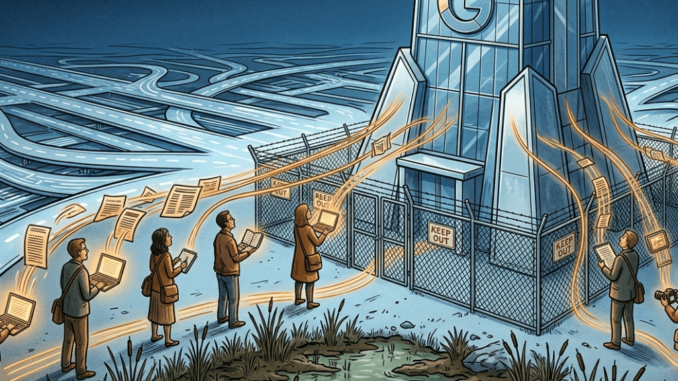
Google understood this model intimately. It built half of it. For two decades, Google Search was the highway and indie publishers were the honesty stalls you find on the side of a country lane. We put our content out and Google sent us clients.
Imperfect, yes. A structural dependency that handed enormous power to a single corporation, absolutely. But it worked. It worked quite well for years. Until it didn’t.
AI Overviews didn’t just change the tolls on that highway. They demolished the highway and built a bypass. Google still earns from the ads surrounding the AI-generated response. The publisher gets nothing. Google disputes this, claiming AI Overviews generate more clicks. Independent data puts the lie to their puffery. Industry figures have told Google to “stop the BS.”
Imagine the corporate communications team took that feedback on board and continued exactly as before. It’s worthy of Clarke and Dawe.
DAWE: So Google was told, by the people whose content it was using, to “stop the BS.”
CLARKE: That’s correct, yes.
DAWE: And did they?
CLARKE: They took that feedback very seriously.
DAWE: Right.
CLARKE: Convened a response team.
DAWE: Good.
CLARKE: Issued a statement reaffirming that AI Overviews generate more
clicks, not fewer.
DAWE: Which the independent data contradicts.
CLARKE: Which makes the statement all the more remarkable as an
achievement, yes.
DAWE: And the publishers?
CLARKE: Still getting nothing.
DAWE: But Google heard them.
CLARKE: Oh, absolutely. Heard every word. The AI summarised it quite
beautifully.
History rhymes, as usual
This is not without precedent. The English enclosure movement of the 16th to 19th centuries converted common land; land communities had farmed for generations, into private property. What had been shared became owned. What had been a right became a fee. The peasants who lost access were told this was progress, efficiency, improvement. The landlords who gained it were told the same thing and believed it rather more comfortably.
Google’s AI Overviews are a digital enclosure. The common land is the open web; decades of publicly accessible human knowledge and journalism. The new landlord is Mountain View, California. The peasants are the rest of us, watching our commons fenced off and monetised by a ruthless, soulless, mindless corporation whose market capitalisation exceeds the GDP of most nations.
The regulatory vacuum
Australia, to its credit, had an early try. The News Media Bargaining Code, legislated in 2021, was the first law of its kind anywhere in the world; a show of concern that briefly made Canberra look like it understood the problem. It did its job. Google and Meta promptly threw their toys out of the pram, howled blue murder and threatened to leave Australia entirely. A few days later they did private deals with the major news organisations. The ABC and SBS were included after public outcry. The small independents? Not so much.
The Code’s big bug was always that it benefited those with enough commercial leverage to negotiate. Of course. It was, in practice, a deal-making framework for the powerful, dressed up as public interest legislation. The AIMN, New Matilda, Crikey at a stretch, these were never going to get a fair go from Google through a voluntary bargaining process. And AI Overviews arrived after that, changing the economic equation entirely while the regulatory framework stood blinking and befuddled, like a National MP up to his waist in a planter trough.
The Albanese government has talked itself up by saying it may be revisiting this. It should be under no illusion about what the stakes are. Google has shifted from being a search engine to an answer engine. That distinction is not piffling. One is an ecosystem that sustains diverse journalism. The other is a wen of toxic slop; a poisoned monoculture that reduces all news to what Google’s algorithm decides to skip through and quickly summarise.
What is actually being lost
AI’s disruption of the media industry gets a lot of puffery. But the human and democratic stakes tend to get abstracted into statistics. Let’s get real, here.
What is being lost, site by site, writer by writer, is the infrastructure of non-corporate, non-Murdoch, non-Nine, or Seven public discourse in this country. The AIMN publishes investigative work, analysis and commentary that the mainstream media ignores. Independent Australia and The New Matilda also do a sterling job. These voices matter. Not because we are indispensable. No-one is indispensable. But the ecosystem is.
A democracy that loses its independent commentariat and leaves the field to the Murdoch family firm and whatever algorithm Google has decided to privilege this quarter is a democracy up shit creek.
So what do we do about it?
Not lament. Laments are for people who have accepted the outcome.
Our federal government needs to go back to the bargaining code with fresh eyes and AI-era urgency. The code must be extended to explicitly cover AI-generated summaries and the revenue they generate. If Google profits from content, the content creators must share in that profit. All of them. Not just the ones who are all lawyered up to cut a side deal.
Publishers, and readers, need to demand transparency. Which content is being used to train these AI systems? Why? Which articles are being summarised? Why? What revenue is being generated from that precis? These are not unreasonable questions. They are the minimum requirements of any honest contract.
And readers, bless you. Do something so old-fashioned it’s almost countercultural: Subscribe. Donate. Share the article, not just the headline. The algorithm is not your friend. The journalist who puts his life on hold, reading, researching, risking everything on a piece designed to ruffle the feathers of the corporate fowl-house in power is in peril.
Google has code that reads the work of ten thousand journalists and returns a paragraph that threatens to destroy integrity journalism. It calls this progress. History has a different word for taking other people’s labour without compensation.
The word is dispossession.
And it has always, eventually, produced a rude awakening.
Tomorrow: what happens when a country with no constitutional protection for free speech, a world-class record of prosecuting whistleblowers, and a media landscape owned by a single foreign billionaire also loses its independent online voices. Part 2 of The Great Digital Enclosure.
This article was originally published on URBAN WRONSKI WRITES
Keep Independent Journalism Alive – Support The AIMN
Dear Reader,
Since 2013, The Australian Independent Media Network has been a fearless voice for truth, giving public interest journalists a platform to hold power to account. From expert analysis on national and global events to uncovering issues that matter to you, we’re here because of your support.
Running an independent site isn’t cheap, and rising costs mean we need you now more than ever. Your donation – big or small – keeps our servers humming, our writers digging, and our stories free for all.
Join our community of truth-seekers. Please consider donating now via:
PayPal or credit card – just click on the Donate button below
Direct bank transfer: BSB: 062500; A/c no: 10495969

We’ve also set up a GoFundMe as a dedicated reserve fund to help secure the future of our site.
Your support will go directly toward covering essential costs like web hosting renewals and helping us bring new features to life. Every contribution, no matter the size, helps us keep improving and growing.
Thank you for standing with us – we truly couldn’t do this without you.
With gratitude, The AIMN Team

Maybe Sergey Brin needs to consider how he got to where he currently is?
Taking information from people to build a ‘knowledge’ base? And doing mental gymnastics with the details?
Well children often give away their ‘knowledge’ by nothing more than pure innocence to the very dark aspects of the bad, such as Brin.
Part 2 cont’d….
As for SEO’s for browsing, there’s more to life than Google, and I refuse to use it for the very reasons that you have explained in details David.
For those who seek further independence from Google here’s a list of SEO’s….took me ages to find it thanks to interference from Google! Unfortunately, my favourite private SEO is also owned by Google.
https://en.wikipedia.org/wiki/List_of_search_engines
Thank you, David. You are too kind.
AI is causing a few headaches. I published an article recently and the first reaction I get is “AI wrote that.” Huh? Carol and I wrote it the night before. For amusement purposes I ran it though an AI checker. The result came back 86% AI written. Whaaaat?!
I continued… checking a few more stuff I’d written.
A poem I wrote in 1993: 90% AI apparently.
A 1997 university paper on the Kartan culture of Kangaroo Island (which was completed without internet access): 86%
A 2014 Christmas message on Cafe Whispers: 100%
An email of complaint Carol sent to a tour group: 85%
Simply ludicrous.
I researched why this was happening. The findings were gobsmacking.
Take my honours thesis as an example: It has been published on two sites and an electronic copy exists in a museum database. I put a section of it through the AI checker and it finds the online copies and the checker thinks “Oh dear. He’s copied that style. Therefore it was produced by AI.” It’s a pity that they don’t check to see who wrote the damn thing in the first place. In a nutshell, I’m guilty of copying myself.
Please feel free to delete this comment if it’s inappropriate but one small way I thought I could support invaluable independent journalists,writers ,etc is to sign this petition created by MEEA
https://meaa.good.do/newsmedia/payup-qualitynews/