By Denis Hay
A calm look at unresolved problems facing Australians
Description
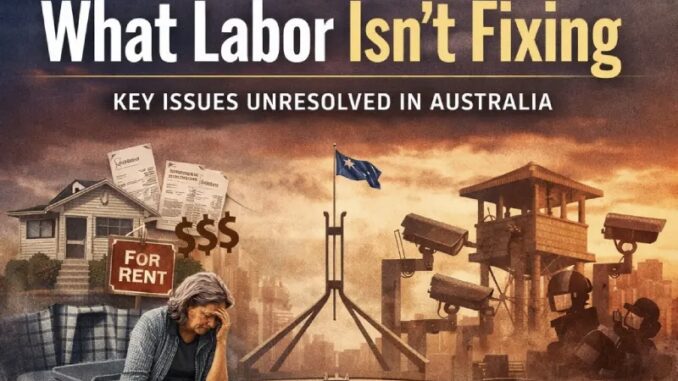
What Labor isn’t fixing in Australia, covering cost of living, housing, outsourcing, media power, and weakened safeguards.
Overview
This article outlines several major issues that remain unresolved under the current federal government. It does not argue party politics. It explains what is not being fixed, why it matters in everyday life, and the policy or structural choices underlying it.
1. Cost of Living Pressures That Go Beyond Inflation
The problem
Many households feel worse off even when headline inflation eases. Rent, insurance, energy, healthcare gaps, and local government charges continue to rise faster than wages and pensions.
Real-world impacts
- Older Australians delay medical care.
- Working families cut essentials, not luxuries.
- Renters face constant insecurity and forced moves.
A retired renter in outer Brisbane describes skipping medical appointments to cover rent increases that arrived twice in 18 months. Their income has not changed, but essential costs now dictate daily choices. This experience is no longer unusual. It reflects a broader pattern in which policy inaction compounds financial stress rather than alleviating it.
Structural causes
- Heavy reliance on private markets to deliver essential services.
- Weak price oversight in sectors like insurance, energy retail, and childcare.
- Income supports are indexed too slowly to real living costs.
Who benefits, who pays?
- Large service providers keep margins.
- Households absorb volatility and risk.
Policy options
- Stronger price monitoring and transparency.
- Index income supports to real costs, not averages.
- Treat housing, energy, and healthcare as services first, markets second.
2. Housing Shortages Without Delivery at Scale
The problem
Housing supply is discussed frequently, but public housing construction remains modest relative to need.
Real-world impacts
- Long social housing waiting lists.
- Rising homelessness among older women.
- Young people are locked out of stable housing.
Structural causes
- Reliance on private developers to meet social needs.
- Planning systems geared toward investor returns.
- Loss of in-house public construction capacity.
Who benefits, who pays?
- Landholders and developers gain from scarcity.
- Renters and first-home seekers carry the cost.
Policy options
- Large-scale public and community housing builds.
- Direct government delivery, not only subsidies.
- Long-term rental security standards nationwide.
3. Outsourcing Core Government Functions
The problem
Governments continue to outsource policy design, IT systems, service delivery, and even detention operations.
Real-world impacts
- Cost overruns and failed projects.
- Reduced accountability.
- Loss of public-sector expertise.
Structural causes
- Decades of shrinking internal capability.
- Contract culture replacing long-term planning.
- Weak consequences for contractor failure.
Who benefits, who pays?
- Consulting firms and contractors.
- Taxpayers fund repeated fixes and renegotiations.
Policy options
- Rebuild permanent public service capability.
- Limit outsourcing of core functions.
- Transparent reporting on contractor performance.
4. Media Concentration and Political Risk Aversion
The problem
Australia’s media ownership is still highly concentrated, shaping political caution and narrowing debate.
Real-world impacts
- Important reforms delayed or diluted.
- Public confusion about policy trade-offs.
- Fear-driven politics rather than evidence-based decisions.
Structural causes
- Weak media diversity rules.
- Dependence on hostile coverage cycles.
- Lack of independent public-interest media funding.
Who benefits, who pays?
- Dominant media companies retain influence.
- Citizens receive less informed debate.
Policy options
- Stronger media diversity laws.
- Stable funding for independent journalism.
- Clear separation between reporting and commentary.
5. Preventive Powers and Reduced Civil Safeguards
The problem
Expanded surveillance and detention powers are introduced with limited scrutiny.
Real-world impacts
- Protest activity chilled.
- Minority communities disproportionately affected.
- Legal standards lowered in the name of security.
Structural causes
- Bipartisan security escalation.
- Limited post-legislative review.
- Emergency powers becoming permanent.
Who benefits, who pays?
- Security agencies gain discretion.
- Citizens absorb long-term rights erosion.
Policy options
- Mandatory sunset clauses.
- Independent oversight with real teeth.
- Clear thresholds for extraordinary powers.
What Labor Isn’t Fixing for Ordinary Australians
These unresolved issues are not abstract. They shape rent, health, job security, and trust in public institutions. The common thread is not intent, but structure: systems designed to shift risk downward and responsibility outward.
This is not a crisis of money, but of political choice.
What the Data Indicates
Available data indicate consistent trends, although precise effects vary by region and income group.
Frequently Asked Questions
What is Labor not fixing in Australia?
This article outlines unresolved issues, including cost-of-living pressures, housing shortages, outsourcing of government functions, media concentration, and weakened civil safeguards.
Why do these unresolved issues matter for voters?
They affect everyday security, access to housing and services, democratic accountability, and long-term trust in government decision-making.
Further Reading
A broader catalogue of unresolved issues is available in the Labor Government Failures list on Social Justice Australia:
https://socialjusticeaustralia.com.au/labor-government-failures/
Call to Action
Share this analysis if you believe unresolved issues deserve scrutiny. Please share it with others who are asking the same questions.
Your voice matters. Your experience matters. And your participation matters.
➡ Share this article with family, friends, and your community
➡ Leave a comment below and join the discussion
➡ Visit the Reader Feedback page and share your view
➡ Share a testimonial if our content has helped you think differently
➡ Connect with us on TikTok, LinkedIn and X
Discuss this article in our Facebook group, where Australians share perspectives and ask questions in a calm, respectful space.
A more informed Australia begins with people willing to discuss the issues that shape our future. You can help lead that change.
Support independent journalism
Operating this site costs approximately $2,000 per year, and reader donations have covered $807 so far. Every contribution helps keep this work online, accessible, and independent.
If you find value in these articles, please consider supporting the site. Even a few dollars help sustain this work.
Donate now, one time or monthly.
Already donated? A quick Google review helps others discover the site.
Evidence & Sources
Cost of living pressures beyond headline inflation
- Australian Bureau of Statistics (ABS) – Selected Living Cost Indexes, Australia
https://www.abs.gov.au/statistics/economy/price-indexes-and-inflation/selected-living-cost-indexes-australia - ABS – Household Expenditure Survey
https://www.abs.gov.au/statistics/microdata-tablebuilder/available-microdata/household-expenditure-survey
Price oversight in essential services (energy, insurance, childcare)
- Australian Competition and Consumer Commission (ACCC) – National Electricity Market Inquiry reports
https://www.accc.gov.au/inquiries-and-consultations/inquiry-into-the-national-electricity-market-2018-26 - ACCC – Gas Inquiry 2017–2030 interim reports
https://www.accc.gov.au/inquiries-and-consultations/gas-inquiry-2017-30 - Productivity Commission – Childcare and Early Learning
https://www.pc.gov.au/inquiries/completed/childcare
Public housing delivery compared to need
- Productivity Commission – Report on Government Services: Housing and Homelessness
https://www.pc.gov.au/ongoing/report-on-government-services/housing-homelessness - National Housing Supply and Affordability Council – State of the Housing System
https://nhsac.gov.au/publications - Australian Institute of Health and Welfare (AIHW) – Housing assistance and homelessness
https://www.aihw.gov.au/reports/housing-assistance/overview
Outsourcing, cost overruns, and public capability
- Australian National Audit Office (ANAO) – Contract management and major project audits
https://www.anao.gov.au/work/audit-reports - Department of Finance – Audit of Employment
https://www.finance.gov.au/publications - State Audit Offices (e.g. Victoria) – Contractors and consultants reports
https://www.audit.vic.gov.au
Media concentration and market structure
- Australian Communications and Media Authority (ACMA) – Media interests snapshot
https://www.acma.gov.au/media-interests-snapshot - ACMA – News media in Australia
https://www.acma.gov.au/publications/news-media-australia
Expansion of surveillance and detention powers
- Parliament of Australia – Parliamentary Joint Committee on Intelligence and Security (PJCIS) reports
https://www.aph.gov.au/Parliamentary_Business/Committees/Joint/Intelligence_and_Security - Attorney-General’s Department – Control orders and preventative detention annual reports
https://www.ag.gov.au/national-security/publications - High Court of Australia – NZYQ v Minister for Immigration
https://www.hcourt.gov.au - Independent National Security Legislation Monitor – Reviews and reports
https://www.inslm.gov.au
This article was originally published on Social Justice Australia
Keep Independent Journalism Alive – Support The AIMN
Dear Reader,
Since 2013, The Australian Independent Media Network has been a fearless voice for truth, giving public interest journalists a platform to hold power to account. From expert analysis on national and global events to uncovering issues that matter to you, we’re here because of your support.
Running an independent site isn’t cheap, and rising costs mean we need you now more than ever. Your donation – big or small – keeps our servers humming, our writers digging, and our stories free for all.
Join our community of truth-seekers. Donate via PayPal or credit card via the button below, or bank transfer [BSB: 062500; A/c no: 10495969] and help us keep shining a light.
With gratitude, The AIMN Team

Labor is not fixing these problems because Labor is totally distracted to the point of being captured by external influences that have never been tested at the ballot box. The current leadership executive are unable to turn their attention to local matters so, perhaps boldly, I will state that US, UK and Israel are at the core of these distractions.
We will have to wait for a Greens/Independent government before any of these things are addressed.In the meantime Albanese will keep putting roadblocks in the way of any alternatives being elected.
We got rid of the liar Morrison,only to replace him with someone more secretive and vindictive, and just as full of shit.
Harry, it is how I feel, after watching the thuggery in Sydney.
As Mediocrates says also…
The leaderships of the Labor Party both Frderslly and in NSW have forgotten who they serve. 123 members and senators but none with guts to tell the leaderships they are getting it wrong.
The principal beneficiaries of the current residential housing policies are about 24,000 MILLIONAIRES who probably vote COALition ….. so why is the SLO ALBO LABOR GOVERNMENT dragging his feet??
Is SLO ALBO trying to make Retched Mediocrity look better than himself by declining to implement the policies that will benefit Australian voters rather than foreign owned multinational corporations??
Thanks for raising this, Mediocrates. External alliances and geopolitical commitments clearly consume a lot of political attention and resources, and that can affect domestic priorities. Where this article tries to stay grounded is on outcomes rather than motives, whether decisions are driven by international pressure, media influence, or internal party dynamics, the result for Australians is the same when local issues remain unresolved.
A useful focus for readers is not which influence dominates, but whether the policy settings affecting housing, cost of living, public services, and civil liberties are actually changing in ways people can feel. That is ultimately what voters are asked to judge at the ballot box
Harry
I understand the frustration behind your comment. A lot of people feel change is being delayed or blocked, and that breeds cynicism. Where this article deliberately stops short is assigning motives or predicting which political mix will deliver outcomes.
The core issue is whether the policy settings themselves change, regardless of who holds power. Housing supply, cost of living pressures, outsourcing, media concentration, and civil liberties can all be addressed within the current system if there is political will and public pressure.
For readers, the useful question is less about personalities and more about what concrete changes are actually put on the table, and whether they survive the political process intact.
RomeoCharlie
Many people share that sense of disconnect between party leadership and everyday concerns. Large parliamentary parties can struggle to reflect diverse views once decisions are centralised at the leadership level.
What matters for the purposes of this article is whether internal disagreement, wherever it exists, translates into different policy outcomes. If housing, cost of living, public services, and civil liberties are not materially improving, then leadership arrangements and party dynamics become relevant questions for voters to consider.
New England Cocky
Housing policy has clearly produced winners and losers over a long period, and asset ownership has benefited a relatively small segment of the population. That’s well documented. Where this article deliberately draws the line is on outcomes rather than motives or voting behaviour.
The central question for voters is whether current housing settings are changing in ways that materially improve supply, affordability, and security for people who need housing to live in, not to speculate on intent. If those outcomes aren’t improving, then it’s reasonable to question why long-standing policy tools, such as direct public housing delivery or stronger rental protections, are not being used more decisively.
THE Ponzi.
Back to the real issues.
Labor operates on brit New Labour doctrines that emphasise understanding and tolerance of business aspirations. A good theory developed generations ago, when trying to cope with the disintegration of (ossified?) trade unions as effective defenders of the masses interests (ecological basis, social infrastructures, employment, honest media and press, education.)
But the conservatives under Howard got the money and Labor only got back to competetive after yielding to bsiness notions and abandoning things like ecology, rainforests, broadsheet media, education, enviro etc.
Labor had to “sell the silver” if you like to big capitalism, to stay competitive. You could say, a little like their abandonment of principle over Palestine.
Not Labor’s fault, but you wonder if there was any effort in some cases to propose or salvage good policy.
The question is, did things sink to allowing the more destructive aspects of capitalism to ride roughshod over need for those choked on greed, including within the ALP itself in return for “donations”?
A bit of donating and stuff under the table but to me, grifters raised through the ranks, lost Labor its one real asset, its reputation for integrity.