By Denis Hay
Description
US threat to world peace, why AUKUS spending risks Australia, and how dollar sovereignty offers a safer path.
🎧 Prefer to listen to this article? Press play
Introduction
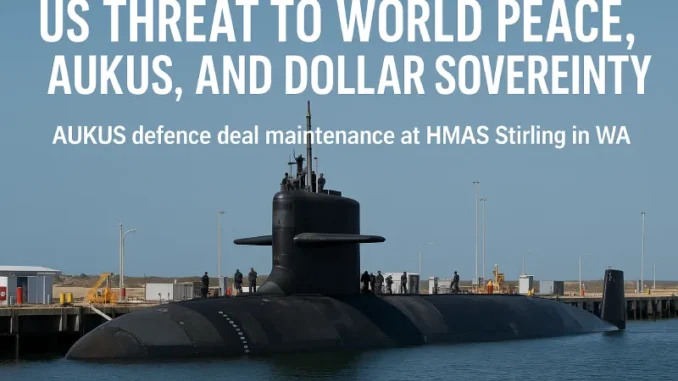
The US threat to world peace sits at the centre of a heated claim that the United States underpins peace in our region. Is that really true, or just easy politics? The facts tell a different story. Australia has pledged hundreds of billions for the AUKUS defence deal, with an additional $12 billion for the Henderson Defence Precinct, enabling the servicing of US and future Australian nuclear submarines in WA.
Australia now targets more than 2.3% of GDP for defence by 2033 to 2034, while NATO’s counting methods inflate figures by adding items like pensions and infrastructure.
Stat box, big picture:
- AUKUS cost envelope, 268 to 368 billion dollars.
- Defence to rise beyond two-point three per cent of GDP by 2033 to 2034.
- Australians’ trust in the US has fallen to record lows in two decades of polling.
Why accept the line that Washington guarantees peace when ordinary Australians see mounting risks, higher costs, and shrinking control?
The Problem: Why Australians Feel Stuck
Root cause, alliance pressure and spending metrics
Pressure to lift spending, often framed in GDP targets, now runs alongside discussion of higher NATO style thresholds and even a five per cent security envelope in Atlantic debates.
The government dismisses a fixation on GDP, yet the headline numbers continue to climb, and new shipyard commitments lock in path dependency.
Reflective question: Are we buying safety or buying into someone else’s strategy?
Power question: Who benefits when accounting rules redefine defence to push the headline number up?
Internal link: See our guide on political reform for real change.
Consequences for citizens
Australians worry the alliance could drag us into conflict in Asia, even as trust in US leadership falls. The truth is that fear and doubt grow when commitments rise faster than accountability. Who carries the risk if a submarine schedule slips or a crisis erupts in the Taiwan Strait?
The Impact: What Australians Are Experiencing
Everyday effects
AUKUS locks in decades of spending, crowding out housing, health, and climate resilience. The WA maintenance push at Henderson aims to support docking and servicing, including for US boats, tying local industry to the US force structure.
Reflective question: Will your family be safer because a US submarine gets serviced in WA next year, or because your town is flood-ready?
Power question: Why should budget rules expand for weapons while social services are told to tighten their belts?
Internal link: Learn about monetary sovereignty to power our future.
Who benefits
Prime contractors and allied militaries gain capacity and access. Communities near critical bases, such as Pine Gap, a joint US-Australia intelligence hub central to US operations, often become a focus of protests.
The Hidden Cost for Every Australian
The AUKUS defence deal is not just an abstract number. It means about $368 billion spread across a population of roughly 26.5 million Australians, which equals $13,900 for every man, woman, and child.
Imagine if every Australian family received the value of this public investment in tangible safety and wellbeing:
- Housing security: Build more than one million new social and affordable homes to end the housing crisis.
- Health and aged care: Expand Medicare to include dental and mental health, and properly staff aged care.
- Education and skills: Abolish student debt, guarantee free TAFE and university, and fund lifelong learning.
- Climate and disaster resilience: Construct nationwide flood defences, bushfire readiness systems, and renewable energy infrastructure.
- Jobs guarantee: Use dollar sovereignty to ensure meaningful work for every Australian, focused on local and sustainable projects.
Reflective question: Which makes your community safer, a nuclear submarine or a flood levy that holds?
Power question: Why does Canberra accept scarcity for health and housing, but never for warships?
Rally line: We can do better. We must do better.
The Solution: What Must Be Done
Australia dollar sovereignty and reform
Australia issues its own currency. That means we can always purchase what is available in our currency, including public purpose jobs and resilience, without needing foreign approval.
Real constraints are inflation, resources, skills, and the exchange rate, not a household budget analogy. So, the choice to pour hundreds of billions into AUKUS defence deal is political.
Use that fiscal capacity for civil security first, such as climate adaptation, cyber defence, and regional diplomacy.
Reflective question: If we can fund subs, why not fund safety at home?
Power question: Who says the only credible path is more weapons?
Doug Cameron’s Warning on Militarism and Sovereignty
Cameron argues AUKUS erodes sovereignty, risks entrapment, and diverts billions from real security.
Entrapment risk, US access: AUKUS ties Australia to US operations, including US submarine use of Henderson, WA, raising escalation and targeting risks. Reuters
Mega-cost, weak timelines: The AUKUS envelope, up to $368b over decades, risks obsolescence as detection tech advances. Who benefits if subs are outdated by delivery? ABC+1
Bases and nuclear exposure: Pine Gap’s role and HMAS Stirling’s US maintenance periods deepen Australia’s role in US war-fighting networks. Is this the path to peace or a bullseye on home soil? Wikipedia+2Defence+2
Accountability gap: Parliamentary intelligence oversight remains constrained, though reforms are proposed. Why spend the most on a kit without thorough scrutiny? Parliament of Australia+1
Opportunity cost: The $12b Henderson spends and broader AUKUS outlays crowd out housing, health, climate resilience, and jobs. Real security starts with people. SBS
Rally line: Prepare for peace, not war. Ordinary Australians deserve safety, not pre-commitments to foreign conflicts.
Source: Australian Sovereignty and the Path to Peace – Doug Cameron | 2025 Laurie Carmichael Lecture
Policy solutions and demands
- Publish complete life cycle AUKUS costs, schedule risks, and opportunity costs in one transparent report each year.
- Cap major platform shares of the defence budget and shift funds to cyber, disaster response, and diplomacy.
- Require independent reviews of US base roles and accident liability at HMAS Stirling and Pine Gap.
- Adopt a regional peace plan with ASEAN and the Pacific that prioritises de-escalation and climate security.
- Use dollar sovereignty to guarantee jobs in housing retrofit, flood levees, and bushfire readiness, with measurable outcomes.
Rally line: We can do better. We must do better.
Frequently Asked Questions
Q1: Does the United States underpin peace in our region?
Evidence is mixed. Military spending surges can raise emissions and tensions, and Australians show record low trust in US leadership while still valuing the alliance, a sign of caution, not blind faith.
Q2: What is the AUKUS defence deal timeline and cost?
Australia plans to buy US Virginia-class submarines in the early 2030s and build later boats, with a total envelope of $268 to $368 billion.
Q3: Why do NATO style definitions make defence look bigger?
They count items like pensions, stockpiles, and some infrastructure, which can push the number above simple GDP share models.
Q4: Are US military activities in Australia expanding?
Yes. HMAS Stirling hosted a US submarine maintenance period, and Henderson in WA is receiving new investment to support docking and sustainment.
Q5: What do Australians think about the alliance right now?
Trust in US leadership has fallen sharply to a two-decade low, yet many still see the alliance as important. This tension calls for independent policy, not blank cheques.
Final Thoughts
The US threat to world peace is not a slogan; it is a data point echoed in global and local surveys, and it coexists with Australia’s pragmatic support for an alliance that must never become a leash. Our path is clear: use Australia’s dollar sovereignty to fund genuine domestic security, invest in diplomacy that reduces risk, and demand proof that any defence dollar truly makes Australians safer, not more exposed.
What is Your Experience
How has the US threat to world peace conversation affected your community, school, or workplace, and what would a safer Australia look like to you?
Call to Action
We’d Love to Hear from You!
Inspired by this article?
See what others are saying on our Reader Testimonials page.
Please share your thoughts via our Reader Feedback form. Your voice helps shape future content.
Scroll down and leave a comment below to join the discussion.
If this article resonated with you, explore more on political reform and Australia’s monetary sovereignty at Social Justice Australia.
Spread the word:
Please share this article with friends, family, or your social networks to keep the conversation going and help build a fairer, more just Australia.
Email this to 3 friends who care about social justice and a fair go for all citizens.
Keep Independent Journalism Alive. Support Voices That Challenge the Status Quo
We’re 100% reader-supported, no ads, no corporate strings, just honest, truth-driven journalism.
If our work informs or inspires you, please chip in.
Donate Now, one-time or monthly. Even $5 helps us keep publishing.
Together, we’re making change possible.
Already donated? Share the love by leaving us a quick review on Google to help others find us.
Reference
Defence spend boost ‘not about appeasing the US’
This article was originally published on Social Justice Australia
Dear reader, we need your support
Independent sites such as The AIMN provide a platform for public interest journalists. From its humble beginning in January 2013, The AIMN has grown into one of the most trusted and popular independent media organisations.
One of the reasons we have succeeded has been due to the support we receive from our readers through their financial contributions.
With increasing costs to maintain The AIMN, we need this continued support.
Your donation – large or small – to help with the running costs of this site will be greatly appreciated.
You can donate through PayPal or credit card via the button below, or donate via bank transfer: BSB: 062500; A/c no: 10495969

Bowing to America has become habit forming, did America really save us?. No, it’s entry into WW2 was to save itself, if Japan had not attack Peal Harbour, America would still be watching from the sidelines.
AUKUS is the greatest con-job of all time, Australia is investing $billions into some thing we may never get and should we eventually get a nuclear submarine it’s likely they will be obsolete by the time we get it!!!
An island nation such as Australia has no need for landing craft, tanks or heavy artillery, we should be investing in long, medium and short range missiles. If the attackers, who ever they may be gets a foot on our ground we’ve doomed (too much land and too little troops), the aim should be to stop the attacker getting here.
We are digging a grave for our country.
The total cost of the AUKUS deal is likely to be close to a Trillion Dollars. When you factor in the purchase price ($400B & climbing with delays and inflation), the development of bases, the ongoing maintenance of the subs, the operational costs, and the armaments, the cost is not simply the headline price.
Then you add the factor that the first 2 0r 3 subs will never be ours. We are paying for the construction infrastructure of the subs. America can only build 1.2 subs per year. They need 20 or so. They cannot build enough in time for their own needs. So we are paying to nearly double their construction facilities. That means they may have around 20 subs in about 15 or more years. However they will need them all for a conflict with China, so we will never receive a sub in quite a while. This has been spelled out by several of the top brass in the American navy.
The key point is that we will still receive nothing for our $400 billion UNLESS we commit to backing the USA in a war with China.
WTF? China is our greatest trading partner and they haven’t put tariffs on us. If we agree to back the USA in this war, it will make Vietnam look like a school picnic. We will lose all our Asian trade (a disaster by itself) and we will become a strategic target for such a war. Henderson, Pine Gap, Jindalee, Townsville (35th Squadron) and our major sea and airports. Plus our capitol cities. Is that what we really want?
Rex Patrick came up with a better use of our money which would leave about half the purchase price for our own social needs, before you add in the other half Trillion $$$ that will go to AUKUS stuff down the track.
Besides which, if we do it the other way, we will not become a strategic target.
https://michaelwest.com.au/could-australia-defend-itself/
No need to fret,Albo & Co will be right on the case,as they are on everything else.Everything is just tickety boo.Isn’t it?