By Dr Dan Steinbock
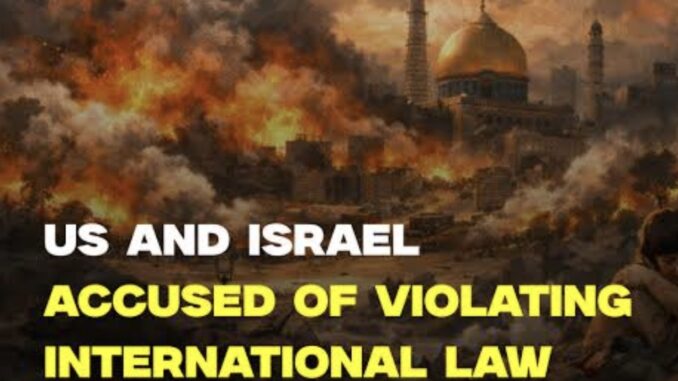
As the US/Israeli strikes against Iran violate the foundations of international law, the economic and human costs will soar.
After three weeks of effective war, the hostilities have caused severe regional spillovers, thousands of deaths, displacements of millions and a massive global energy crisis that continues to expand. If the implications are global, what’s the status of the US/Israeli strikes from the standpoint of international law?
The modern legal order is based on United Nations Charter (1945), Geneva Conventions, Rome Statute (1998) and Customary law from the Nuremberg Trials. The key rules include the prohibition of aggressive war, protection of civilians, individual criminal responsibility for war crimes, crimes against humanity and genocide. Force is allowed only in the case of self-defense and UN Security Council authorization.
The US/Israeli strikes have already violated most of these rules.
War of aggression
Article 2(4) of the UN Charter prohibits UN member states from threatening or using force against the territorial integrity or political independence of any state. It was violated on February 28, when US/Israel launched their joint strikes against Iran.
Typically, the war was launched precisely when and because the peace talks in Oman were advancing toward a successful conclusion.
In the absence of strategic objectives and exit strategy, the U.S. has framed the actions as a campaign to dismantle “the Iranian regime’s security apparatus.”
These efforts go back to the US/Israel 12-Day War against Iran in July 2025, when Masoud Pezeshkian, the new reform-minded Iran president, sought talks to end the conflict with the US and Israel. That was not in line with the “new Middle East” envisioned by PM Netanyahu and his Messianic far-right cabinet.
The UN Charter’s prohibition against force is not absolute, with key exceptions being self-defense (Article 51) and actions approved by the Security Council.
Yet, no such threat existed prior to the US/Israel strikes. And on March 17, 2026, Joe Kent, the Director of the US National Counterterrorism Center, resigned from his position in protest of the ongoing U.S.-led war in Iran. Kent said in no uncertain terms that “Iran posed no imminent threat to our nation.”
This is an illegal war of aggression, instigated by leaders who have been, like Prime Minister Netanyahu, (or should be) charged for war crimes and crimes against humanity.
Preemptive war doctrine
To legitimize the unjustifiable, Washington has resorted to preemptive justifications. In this regard, the US/Israel war against Iran is just the latest link in the 25-year-long effort to sanctify power politics with preventive wars.
Since the Bush Jr. 2002 security doctrine, US administrations have stressed preemption as a central strategic instrument. While Democratic leaders (Obama, Biden) have been more moderate in rhetoric, they have coopted the same ideas.
Relying on force to prevent future threats, preventive war doctrines are often cited as violating international law because they bypass the strict legal requirements for the use of force established in the UN Charter.
Unilateral preventive war is a threat to the principle of state sovereignty, as it allows one nation to judge the “intentions” of another, without objective proof of an upcoming attack. Setting a dangerous precedent, it incentivizes other nations to use similar pretexts for their “preventive” attacks, potentially leading to global instability.
International law allows for preemptive strikes in cases of “imminent” danger. But US strategy improperly expands this to include preventive wars against threats that are not yet fully formed or do not exist – as in the cases of the 2003 Iraq War and the 2025 and 2026 Iran Wars.
Targeted assassinations
The targeted assassination of Iranian leaders is a serious violation of international law, especially when conducted outside of an active, declared war zone. Targeted killings violate the prohibition on the use of force against another state’s territorial integrity and political independence.
Outside of active hostilities, international human rights law (IHRL) applies. Under IHRL, arbitrary deprivation of life is prohibited. Targeted killings are extrajudicial killings for which the acting state is responsible.
In the context of conflict, targeted killings can violate International Humanitarian Law (IHL) principles, including distinction (targeting civilians) and proportionality. Assassinations of state officials often violate the 1973 Convention on the Prevention and Punishment of Crimes Against Persons Under International Protection.
Precedents feature the killing of the famous Iranian general Qasem Soleimani, the right-hand man of the supreme leader of Iran, the late Ali Khamenei. Soleimani was assassinated in a targeted drone strike in Baghdad in January 2020, ordered by President Trump.
From the standpoint of international law, it was an unlawful attack, as was pointed out by Ben Ferencz, the US prosecutor in the Nuremberg trials and pioneer of international law. After Soleimani’s killing, the New York Times printed Ferencz’s letter denouncing the assassination, unnamed in the letter, as an “immoral action [and] a clear violation of national and international law.”
In their first joint strikes against Iran, US and Israel assassinated the 87-year-old Ali Khamenei, the supreme leader of Iran. Demonized in the West, Khamenei supported Iran’s nuclear program for civilian use. Already in the mid-1990s, he famously issuing a fatwa against the acquisition, development and use of nuclear weapons.
The assassination of Khamenei was still another blatant violation of international law. It was also part of the Israeli strategy to eliminate moderate leaders, whose absence is then used as an excuse for replacing peaceful diplomacy with brutal obliteration campaigns.
Crimes against humanity, forced displacement
These crimes are defined in Rome Statute Article 7, as widespread or systematic attack on civilians. Allegations are typical when strikes include targeting civilian infrastructure, economic strangulation, mass displacement, and siege conditions.
A continuity argument – “what we first see in Gaza is now spreading to Iran and, due to spillovers, into the region” – exists because similar patterns can be identified via blockade, disproportionate force, and collective punishment.
The stated efforts at regime change to undermine Iran and fragment the Shi’a state suggest that the boundary between cultural genocide targeting a broad ethnic-religious group and full destabilization is a line drawn in waters.
Allegations of ethnic cleansing, relying on deliberate forced displacement are likely over time. While ethnic cleansing is not a formal treaty crime, it is recognized in jurisprudence. It rests on forced population removal, which is the net effect of the strikes against Iran and a deliberate intention in Israel’s invasion of Lebanon.
Israel’s rapidly expanding buffer zone in southern Lebanon, extending roughly 3 to 14 kilometers north of the Blue Line demarcation, is premised on demographic engineering. In Iran, the objective to fragment the state, instigate inter-ethnic polarization and regional divides is also predicated on identity politics.
At first sight, allegations of ethnic cleansing seemed to be more relevant to Gaza and the West Bank. But with shifting objectives, forced displacement is now an overwhelming reality. The US/Israel strikes have caused displacement of 3.5 million people in Iran and over 1 million in Lebanon, with up to 22,000 killed or wounded in the former and another 3,600 in the latter.
Collective punishment, economic warfare
Combined with illicit strikes, Washington’s decades-long sanctions against Iran, most of which are unilateral, and the underlying warfare is reminiscent of economic warfare premised at collective punishment.
Combinations of economic sanctions and military strikes, particularly when invalid from the standpoint of international law, raise serious issues under humanitarian law and human rights law. In Gaza and in Iran, unilateral sanctions have caused unwarranted mass suffering violating international law.
Ever since the early 1970s, when Beirut was still called the “Paris of the Middle East,” Israel’s wars against Palestinians have destabilized Lebanon’s fragile ethnic mosaic pushing the country to the edge of default. That’s the fate PM Netanyahu would like Iran to share.
In this regard, there is a clear continuity from the Gaza War, carried out by Israel with arms and financing by the US-led West, ICJ provisional measures and ICC arrest warrant debates, to the US/Israel strikes against Iran.
The common denominators feature an inflated self-defense doctrine, weak enforcement of humanitarian law, selective application of international law and ultimately the inevitable US veto in the Security Council.
The more these violations of international law are permitted, the greater will be the costs in economic terms, the more brutal the military destruction and the more lethal the human devastation.
That’s why multilateral cooperation – across all political differences – and the enforcement of international law is so desperately needed today, before it’s too late.
The original version of this article was published by the Informed Comment (US) on March 23, 2026
 Dr Dan Steinbock is an internationally recognized strategist of the multipolar world and the founder of Difference Group. He has served at the India, China and America Institute (USA), Shanghai Institutes for International Studies (China) and the EU Center (Singapore). For more, see https://www.differencegroup.net
Keep Independent Journalism Alive – Support The AIMN
Dear Reader,
Since 2013, The Australian Independent Media Network has been a fearless voice for truth, giving public interest journalists a platform to hold power to account. From expert analysis on national and global events to uncovering issues that matter to you, we’re here because of your support.
Running an independent site isn’t cheap, and rising costs mean we need you now more than ever. Your donation – big or small – keeps our servers humming, our writers digging, and our stories free for all.
Join our community of truth-seekers. Please consider donating now via:
PayPal or credit card – just click on the Donate button below
Direct bank transfer: BSB: 062500; A/c no: 10495969

We’ve also set up a GoFundMe as a dedicated reserve fund to help secure the future of our site.
Your support will go directly toward covering essential costs like web hosting renewals and helping us bring new features to life. Every contribution, no matter the size, helps us keep improving and growing.

Thank you for standing with us – we truly couldn’t do this without you.
With gratitude, The AIMN Team
Why didn’t the Rudd government refer Howard, Bush, and Blair to the ICC for war crimes against humanity?
Why hasn’t Anthony Albanese and Penny Wong been referred to the ICC yet for complicity in war crimes against humanity?
If we can see Trump and his backers are destroying the rule of law in the USA and the dangers of that, then if we apply that on an international level, what on Earth is Labor doing other than being a part of destroying International law, with its support for the genocide in Gaza, USA attacks on Venezuela, silence on US sanctions on the ICC, ICJ, ICC prosecutors and Francesca Albanese, executions of people on international waters, piracy and now support of an illegal war on Iran?
Do we believe in protecting, through International law, smaller nations from the actions of larger nations? Are we such a powerful nation that we can afford to allow the world to sink into the law of the jungle?
Yes, it is clear that observance of international law has been progressively degraded over recent years.
• Russia’s invasion of Ukraine is clearly contrary to international law
• Israel had a completely disproportionate response to terrorism, even before the attack on Iran
• USA under Trump was manipulated by Israel into participating in a war, contrary to international law
The basic issue in debate is which regime/philosophy/government caused the dangerous slide into war and chaos
A Commentator is right to point out that Russia’s invasion of Ukraine was contrary to International law, and what was the reaction of the Labor government to that? condemnation of Russia in the UN assembly, rightly so; sanctions on Russian oligarchs and companies, arguably rightly so; strong representations to the Russian embassy demanding cessation of aggression, rightly so.
What do we see from the Labor government in regard to the USA actions? Not a word in the UN criticizing explicitly USA actions, not a word. Instead, after being the first country in the world to support the USA in its illegal attack on Iran, not one illegal attack but also the one in June, the Labor government condemned Iran for retaliating.
No sanctions on USA companies from Labor, no strong representations to the USA embassy demanding an end to their illegal attack, won’t even bring itself to admit that this is an illegal Israel-USA war, and won’t call a the Israel-US genocide a genocide even after a UN committee has finally done so.
The undermining of International law has been going on for decades, not just recently. USA hegemony has made exceptions of its and Israel’s flagrant breaches of International law.
The Western world turned a blind eye to both the USA’s flagrant breaches but also gave complete impunity to Israel in flaunting International law as far back as the Nakba.
Israel’s atrocities, dispossession and displacement of Palestinians during the Nakba were rewarded rather than addressed. Over the decades, there have been many resolutions in the UN against Israel’s illegal occupation of Palestinian territories. Israel has routinely broken ceasefires and agreements over the past decades, has been systematically dispossessing Palestinians of their lands, running an apartheid state, conducting assassinations, and bombing its neighbours at will.
The USA has run proxy wars, destabilized governments, conducted assassinations and unilaterally applied sanctions at will for decades.
The first step in protecting International law is to apply it fairly and without exception. The UN security council approval of Trump-Israel’s apartheid grab of Gaza ( not a peace plan’s bootlace) shows that UN needs reform and/or protection from US extortion.
The first step Australians can take is to toss out Labor and put into power politicians that will support International law rather than support its undermining as Labor has done.
Thommo, where did you get the idea that “Russia’s invasion of Ukraine was contrary to international law”?
There seems to be a widespread misconception that such law begins and ends with the UN Charter, but that is not the case.
International law has been evolving for hundreds of years.
As far as I know, the UN Charter was designed around that body of law.
It did not replace it.
It was possibly not reported in the West, but Russia just a few days ago warned the US that its actions in Iran could end up in a war crimes tribunal, so clearly Russia believes that it has nothing to fear in that regard.
Steve, I’m no international law expert and have relied on reporting of supposed law experts quoting and interpreting application of the UN Charter.
I’m only too happy to learn more about it. Is this body of law that evolved prior to the UN Charter documented in one place? Which body/bodies was/were responsible for these laws? Which of these laws would protect Russia’s actions?
Steve, that nonsense has been debunked.
As we have established, there is no reputable international law expert, academic or scholar who has published a peer reviewed paper who has argued that Russia’s invasion of Ukraine is legal under international law.
You’ll recall that when I challenged you to cite a few international law scholars in this respect, you provided an opinion piece by someone who is not an international law expert.
The opinion piece you used to justify your claim about legality was significantly based on the “genocide” claim by Russia, and embarrassingly (as you will recall) this was comprehensively refuted by the International Association of Genocide Scholars.
He also used Article 51, as you have previously, even though there are no actual international law experts who support this
May I suggest you leave it at that, I don’t wish bore everyone with a repetition of that exchange
••••••••••
By the way, did you find the links to support your claim that I had (apparently on multiple occasions) misrepresented a United Nations report about Ukraine? No
Thommo, as far as I know that body of law is not documented in one place.
It seems to be a “collection” of agreements and conventions that have been accepted as having universal credibility.
For example, the 1933 Montevideo Convention on the Rights and Duties of States, the Hague Conventions of 1899 and 1907, and the Geneva Protocols of 1928 that were an addition to the Hague Conventions.
All these existed before the UN came into being, and still have relevance.
After World War II, the judges of the military tribunal of the Trial of German Major War Criminals at Nuremberg Trials found that by 1939, the rules laid down in the 1907 Hague Convention IV–Laws and Customs of War on Land were recognized by all civilized nations and were regarded as declaratory of the laws and customs of war.
Under this post-war decision, a country did not have to have ratified the 1907 Hague Convention on Land Warfare in order to be bound by them.
So as you see, international law, because it evolves, is a huge grey area.
To your question “Which of these laws would protect Russia’s actions?”, Putin quoted Section 51 of the UN Charter.
The relevance of S.51 has been challenged because the Donbass republics are not members of the UN, even though an armed attack on the Donbass was occurring.
That argument has no merit.
A number of decisions have been reached under Article 51 by the UN Security Council or General Assembly related to the State of Palestine which is not a member of the UN, and involving the right of collective self-defense, and no party made the argument that a Member does not have the right of self-defense with a State which is not a Member of the United Nations.
There is another provision that applies to your question.
The intervention by Russia is also covered under international law by the Responsibility to Protect, in force since 2005.
There was a rebellion by the people of the Donbass to protect their language, and status as Ukrainian citizens, that had been diminished after the success of the coup in 2014.
The response by Kiev to the protest was to attack the Donbass by any means including shelling, for 8 years.
In Putin’s address to the Russian people on the eve of the intervention, the R2P was foremost in the reasons given.
Steve, thanks for answering my questions. It gives me food for thought.
A Commentator, yyeeaaah, you don’t stalk people on here, do you.
Thank you for illustrating my point once again.
My pleasure Thommo, thanks for the questions.
Thommo you ducked posting a definition of “stalking” that includes posting a single comment on my local councillor’s Facebook page and following it up with an email.
Now you’re suggesting that reminding Steve of his record of commentary here about Russia’s invasion of Ukraine is also stalking?
Which definition of stalking are you using?
The CS Lewis/Humpty Dumpty one? “When I use a word,’ Humpty Dumpty said in rather a scornful tone, ‘it means just what I choose it to mean — neither more nor less.’
•••••••••
But unless Steve is a reputable international law scholar or expert, his wordy options should be regarded as only… wordy opinions, and unsupported by reputable international law experts.
Steve had repeatedly said “blogging isn’t for the faint hearted ”
In this context, I can’t imagine that he objects