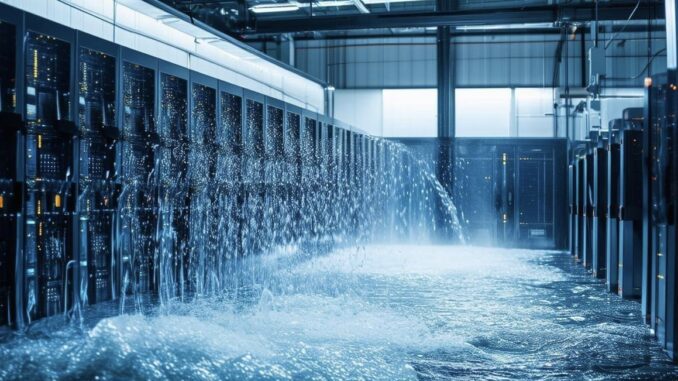
We live in an age of digital miracles, where intelligence is artificial and clouds are not in the sky, but in warehouses. Yet, this ethereal realm has a staggering physical appetite, one that is quietly draining the planet of its most vital resource: water.
The numbers are not just statistics; they are a prognosis.
- A single data centre can consume 1 to 5 million gallons of water per day – the equivalent of a small city.
- Training a single advanced AI model can gulp down 185,000 gallons of fresh, clean water, used to cool the furious processors dreaming of a digital future.
- By 2027, the water footprint of the AI sector alone could reach 4.2 billion cubic metres, a thirst that begins to compete with the needs of nations.
This is not progress. It is a profound and suicidal miscalculation.
Efficiency for What?
The technology giants speak of “efficiency,” but it is a narrow, self-serving metric. It is the efficiency of a faster loading time, a more intrusive advertisement, a more powerful algorithm for predicting our desires. But by what possible measure is it “efficient” to exchange a million gallons of drinking water for a fractional improvement in computational speed?
This is the logic of a parasite that has forgotten its host is mortal. It is the logic of a civilisation that will meticulously optimise a virtual world while making the physical one uninhabitable.
The Path of the Steward: A Call for Conscious Calculation
The solution is not to abandon technology, but to re-forge it in the image of stewardship. We must demand a new calculus, where the true cost of every byte and algorithm is accounted for. This requires:
- A Radical Shift in Cooling: The era of guzzling pristine freshwater must end. Investment must be urgently directed toward air-assisted liquid cooling, the use of recycled or saltwater, and the strategic placement of data centres in colder climates to drastically reduce their environmental burden.
- Transparency and Accountability: The water footprint of digital services must be made as visible as their price tag. Consumers and regulators have a right to know the true ecological cost of their cloud storage and AI queries.
- Licensing to Operate: A social license to operate in the 21st century must be contingent on water neutrality and a demonstrable positive environmental impact. Profit cannot be the sole metric of success when the very habitability of our home is at stake.
The choice is no longer between technology and nature. The choice is between a technology that devours its own foundation, and a technology that exists in harmony with it.
The silicon world is thirsty. But the thirst of children, of farms, of ecosystems, must come first.
See also:
Draining Practices: Amazon, Water Consumption and Data Centres
Keep Independent Journalism Alive – Support The AIMN
Dear Reader,
Since 2013, The Australian Independent Media Network has been a fearless voice for truth, giving public interest journalists a platform to hold power to account. From expert analysis on national and global events to uncovering issues that matter to you, we’re here because of your support.
Running an independent site isn’t cheap, and rising costs mean we need you now more than ever. Your donation – big or small – keeps our servers humming, our writers digging, and our stories free for all.
Join our community of truth-seekers. Donate via PayPal or credit card via the button below, or bank transfer [BSB: 062500; A/c no: 10495969] and help us keep shining a light.
With gratitude, The AIMN Team


Why should tax payer-government funded essential resources be diverted to support a consumptive technology that will principally benefit billionaire tech-bros?
I’m pleased to see more commentary on the use of water by AI. I had a look at this: USA AI in arid areas several months ago. (https://www.alternative-energy.com.au/forum/showthread.php?p=13890#post13890) Your article is important and increased recognition of AI’s impact on arid and non-arid areas is an important contribution.
It is water for cooling so surely it can be recycled?????????????
Pete P: the volume required is enormous and will require frequent top up and re-fill.