How Labor Built Neoliberalism and Betrayed the Workers
The Australian Labor Party has lost its way. Once the party of the ordinary worker, the champion of fair wages and decent conditions, it has become just another conservative party in drag: captured by the very corporations, energy companies, banks, and supermarket monopolies it was built to stand against.
But here’s the thing: Labor wasn’t captured. It volunteered. It didn’t resist neoliberalism; it built it. And understanding how and why this happened is essential to understanding why workers today face conditions that would have been unthinkable to their grandparents.
We’re up shit creek in a barbed wire canoe. And the bloke who was supposed to be rowing sold the paddle to the highest bidder forty years ago.
The Accord: When Workers Voted for Their Own Oppression
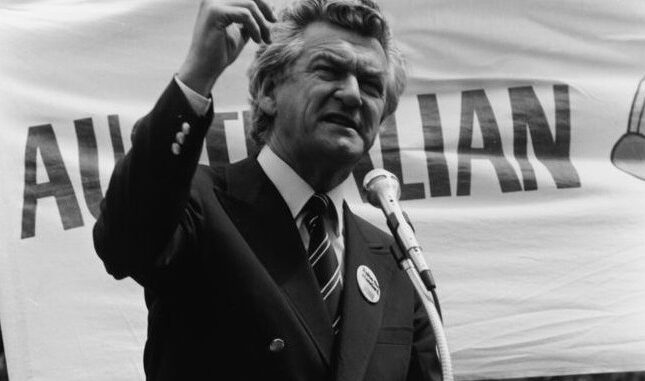
The betrayal begins in earnest in 1983. Bob Hawke’s Labor government, working hand in glove with union leadership through the Prices and Incomes Accord, didn’t resist neoliberalism. It built it. Unlike Britain and America, where Thatcher and Reagan forced neoliberalism upon resistant labour movements, in Australia the labour movement’s own leadership actively constructed the project through a consensual social contract.
Think about that for a moment. As Brecht might have observed, the workers voted for their own oppression and called it progress.
Political economist Elizabeth Humphrys argues that neoliberalism should be understood as a political practice aimed at restoring profitability by disorganising the labour movement and transferring income from workers to capital. The Accord, presented as harmony between workers and employers, embedded within it a systematic programme of wage suppression and self-policing of industrial activity. By unions themselves.
The perversity is breathtaking: the organisations built to fight for workers became the mechanism for holding down their wages. In the 1980s, Labor systematically undermined the award system that had ensured wage equality and allowed improvements won by one group of workers to flow to all. Pattern bargaining, which let unions coordinate across workplaces and industries, was destroyed. The old arbitration system that had been the envy of the world was dismantled piece by piece.
Enterprise bargaining replaced industry-wide awards, atomising workers into individual workplaces where they had to negotiate separately, unable to coordinate with workers doing the same jobs in other companies. It was brilliant, really: you can’t build working-class solidarity when every workplace is an island, every agreement a separate negotiation, every union a service provider rather than an organising force.
The umpire threw the game, then retired on a handsome consultancy fee.
The Collapse of Internal Democracy
By the 1990s, Labor’s Left existed in name only, with no significant policy debates at national conferences. The party’s membership collapsed: 101 branches closed in NSW alone over one decade, many surviving branches became phantoms or paper frauds, and national membership fell to just 53,550 by 2018.
The dissolution of the Communist Party of Australia in 1991 was a watershed. Whatever you thought of the CPA, it had occupied a central position in left culture as an alternative focus to the ALP, providing intellectual sustenance for the Labor Left. When it collapsed, a whole ecosystem of working-class political culture died with it: bookshops, newspapers, publishers, debating societies, reading groups. The proletarian public sphere simply disintegrated.
The body was still warm, but the soul had long since departed.
Labor politicians, once drawn from the working class or at least deeply connected to it, increasingly came from professional backgrounds: lawyers, union officials who’d never worked in the industries they represented, political staffers who’d gone straight from university to Parliament House. The party that once sent shearers and miners to Canberra now sends people with three degrees and no calluses.
These weren’t workers who’d risen through the ranks. These were professionals who’d chosen labour politics as a career path, and they had the class interests of professionals: stable jobs, investment properties, superannuation portfolios tied to the stock market. When your class interests align with capital, it’s awfully hard to fight capital.
The Electoral Consequences
Today, only one in three Australians vote Labor. The party’s primary vote stagnates around 33 to 34 per cent, far below the 45 per cent average during their long stretch out of power in the 1950s and ‘60s. This isn’t just electoral failure; it represents a long-term erosion of Labor’s working-class base.
The party of the worker has been abandoned by workers. There’s a lesson in there somewhere, but don’t expect Labor to learn it.
If the Coalition wins the next election and serves its term, it will have governed for 23 of the last 29 years. That’s not a temporary setback; that’s a fundamental collapse of Labor’s reason for existing. A party that can’t convince workers to vote for it has no claim to be the workers’ party.
The Moment They Could Have Changed Course
When Bill Shorten took a progressive agenda to the 2019 election, including abolishing negative gearing and capital gains tax concessions, taxing capital more heavily, and strengthening workers’ rights, Labor lost. The defeat was crushing. But what was the real lesson?
The Right faction’s interpretation: we were too ambitious, too left-wing, too scary to middle Australia. The correct interpretation: we didn’t make the case boldly enough, didn’t mobilise our base effectively, didn’t build a movement that could withstand the scare campaign from capital.
Current Labor Left PM Anthony Albanese drew exactly the wrong lesson, abandoning that progressive platform for timid accommodation to corporate interests. Better to lose with honour than win as cowards, you’d think. But apparently not.
The “small target” strategy that brought Albanese to power has delivered exactly what it promised: a small government with small ambitions achieving small things. Meanwhile, the cost of living crisis destroys working people, housing becomes unaffordable even for those on good incomes, and real wages continue their forty-year decline.
Labor in government has presided over the continuation of almost every Coalition policy that hurt workers: stage three tax cuts that benefit high earners, no action on negative gearing, no restoration of penalty rates, no serious challenge to the Fair Work Act’s restrictions on industrial action.
The ACTU’s Complicity
The Australian Council of Trade Unions bears its share of blame. Under Sally McManus, the ACTU launched the “Change the Rules” campaign in 2018, identifying correctly that Australia’s industrial relations laws were rigged against workers. The campaign mobilised tens of thousands, built genuine momentum, made the case that the system was broken.
Then Labor lost the 2019 election, and the ACTU quietly shelved its ambitions. When Labor finally won in 2022, the “Secure Jobs, Better Pay” legislation delivered some improvements around same job same pay for labour hire workers, but left the fundamental architecture of Australia’s anti-union laws untouched. Enterprise bargaining remains atomised. Pattern bargaining remains banned. The restrictions on industrial action remain in place.
And the ACTU declared victory.
Union officials occupy a strange class position. They earn comfortable salaries, often well into six figures for senior positions. They attend the same conferences as corporate executives, sit on the same government advisory boards, participate in the same “social partnership” theatre. They have careers to protect, relationships to maintain, a place at the table to preserve.
The revolving door between union officialdom and Labor Party careers creates perverse incentives. Why burn bridges with a militant campaign when you might want a safe Labor seat in five years? Why challenge the party too hard when your next job depends on staying in their good graces?
This isn’t corruption in the conventional sense. It’s structural capture: the union movement’s leadership has been incorporated into a system where their class interests diverge from the workers they nominally represent.
The Financialisation Trap
One of neoliberalism’s cleverest tricks was compulsory superannuation. Sold as workers building their own retirement security, it actually tied workers’ interests to capital markets. Now workers have a stake in keeping corporate profits high, share prices rising, and dividends flowing. Your retirement depends on the same corporations that are casualising your job and suppressing your wages.
It’s the perfect ideological trap. When unions push for higher wages, they’re not just fighting bosses; they’re potentially reducing returns for their own members’ super funds. When they campaign against corporate tax cuts, they’re reducing profits that flow into workers’ retirement accounts.
Housing worked the same way. Once shelter, it became “wealth creation.” Workers were told they weren’t really workers at all; they were investors, property owners, wealth creators. The Australian dream shifted from fair wages and job security to negatively geared investment properties.
Now a worker with an investment property has interests that directly conflict with workers who can’t afford rent. The working class has been financially engineered into opposing itself.
I’m All Right, Jack: Except Jack Isn’t All Right
The old saying went that in Australia, Jack was as good as his master, if not better. It was a promise: that ordinary workers wouldn’t bow and scrape, that they’d look their boss in the eye as equals, that this would be a land of genuine egalitarianism built on the dignity of labour.
The Accord generation believed they were protecting workers through negotiation and compromise, maintaining a seat at the table, being realistic about what was possible in a globalising economy. What they actually did was oversee the systematic dismantling of working-class power whilst calling it partnership.
Now? Jack drives for Uber, lives in a share house at 35, and his master lectures him about aspiration whilst collecting negative gearing tax breaks on six investment properties. Jack’s union, if he’s even in one, is more likely to be focused on workplace compliance than workplace organising. Jack’s supposed political party is more concerned with not scaring the business community than with fighting for his wages.
The brotherhood and sisterhood that built this country, that fought for the eight-hour day and decent wages and safe workplaces, has been systematically dismantled. And Labor, the party founded by that brotherhood and sisterhood, hasn’t just watched the demolition. It provided the blueprints.
What Was Lost
Labor once had a vision: an industrial democracy where workers had genuine power, not just at the ballot box but in their workplaces. A social democratic project where the state actively redistributed wealth, provided universal services, and constrained capital’s worst instincts.
That vision is dead. What replaced it? A managerial approach to government focused on “evidence-based policy,” fiscal responsibility, and not frightening the horses. A politics of small adjustments to a system whose fundamental unfairness is taken as given.
The party that once promised to transform capitalism into something more humane now promises only to manage it slightly more competently than the Coalition. The party that once drew its moral authority from representing the powerless against the powerful now triangulates between focus groups and business councils.
Labor hasn’t been captured by neoliberalism. Labor built neoliberalism, lived in it so long they can’t imagine anything else, and now defends it against anyone who suggests an alternative is possible.
The betrayal isn’t that they compromised. It’s that they forgot why they existed in the first place.
Continued tomorrow… Why You Can’t Strike in Melbourne (But You Can in Caracas)
Link to Part Two:
Building the Cage: How Labor Built Neoliberalism and Called it Partnership (Part 2)
Keep Independent Journalism Alive – Support The AIMN
Dear Reader,
Since 2013, The Australian Independent Media Network has been a fearless voice for truth, giving public interest journalists a platform to hold power to account. From expert analysis on national and global events to uncovering issues that matter to you, we’re here because of your support.
Running an independent site isn’t cheap, and rising costs mean we need you now more than ever. Your donation – big or small – keeps our servers humming, our writers digging, and our stories free for all.
Join our community of truth-seekers. Donate via PayPal or credit card via the button below, or bank transfer [BSB: 062500; A/c no: 10495969] and help us keep shining a light.
With gratitude, The AIMN Team


So true, so very true.
The influence of Margaret Thatcher and Ronald Reagan on our Government has been completely ignored. Hawke and Keating were very well aware of the power of the CIA and MI6 over our political system if they failed to move in a neo-liberal direction. the Whitlam Government had been proof of what those organisations were capable of. It is easy to blame their government and ignore the external influences but it is wrong. It was Howard, a card carrying member of the Mt Pelerin Society, that fully unleashed neo-liberalism in Australia.
Garry. You’re absolutely right that the external pressures and geopolitical realities facing Hawke and Keating deserve recognition. The shadow of 1975 loomed large, and no Labor leader who lived through Whitlam’s dismissal could ignore the message: step too far out of line with Western economic orthodoxy and there are consequences.
But here’s where I push back: acknowledging those pressures doesn’t absolve Hawke and Keating of responsibility for their choices. They weren’t helpless. They had agency. And more importantly, they became true believers. This wasn’t reluctant capitulation to CIA threats or MI6 manipulation. They embraced neoliberalism with the zeal of converts.
Watch Keating talk about deregulation, floating the dollar, smashing tariffs. That’s not a man operating under duress. That’s someone who genuinely believes in the ideology. Read Hawke’s speeches about the Accord, about wage restraint, about getting unions to accept less so business could thrive. These weren’t tactical compromises extracted under threat. They were strategic choices made by people who’d decided Thatcher and Reagan were right.
Yes, Howard was worse. Yes, he went further. Yes, the Mont Pelerin Society connection matters. But Hawke and Keating built the foundations. They legitimised the framework. They made neoliberalism respectable within Labor, which meant the party of workers was now arguing that what’s good for capital is good for labour. That’s not external coercion. That’s ideological transformation.
The CIA and MI6 didn’t make Hawke smash the Pilots’ Strike or abandon full employment as a policy goal. They didn’t force Keating to worship at the altar of budget surpluses or treat unemployment as an acceptable cost of fighting inflation. Those were choices, made by Labor leaders who’d absorbed the economic orthodoxy of their time and decided it was correct.
Could they have resisted more? Probably not without consequences. Would they have faced enormous pressure, both domestic and international, if they’d tried to chart a genuinely alternative course? Absolutely. Does that excuse what they did? No.
Because here’s the thing: if we excuse Hawke and Keating on the grounds that external forces left them no choice, we’re saying progressive politics is impossible in Australia. We’re saying Labor will always capitulate to capital because the alternative is too dangerous. We’re conceding that democracy here operates within boundaries set by Washington and London, and any government that tries to cross those boundaries will be destroyed.
Maybe that’s true. Maybe Whitlam proved that Australia’s sovereignty only extends as far as the US allows. But if that’s the case, we should say it plainly: Labor isn’t a party of transformation anymore. It’s a party of managed decline, tasked with implementing neoliberalism with a human face while pretending it has options it doesn’t possess.
I’d rather hold Hawke and Keating accountable for their choices and preserve the possibility that Labor could choose differently. The alternative is to accept that Australian politics is a charade and our democracy is decorative.
Yes, our politics is a “charade” and our democracy is a weakened form of the real thing.
Legislation makes voting compulsory, our electoral system favours the two party system and the lack of politicaleducation does not help.
Jonangel,
You’re right, it’s the truth. And beneath it all is the convolution. How much is hidden from us. I was a rusted on Labor supporter and now I have no idea where to go! But what I do know is that integrity and honesty count..big time. And hope counts too. Julian Burnside barrister once said to me that without hope we are nothing. He also understood that he could change his own ways, which he did. And he became a brilliant human rights activist. And after reading David’s article we need that more and more. Truth tellers about our grimy politics.
I must say that I am most impressed by this article by David Tyler. It consolidates what I have lived through, and clarifies ideas that I have held for quite a while. It is consistent with my experience as a former member of the Australian Labor Party.
I tend to view Federal Elections as resembling Trolley problems. If you make one choice then something bad happens. If you make the other choice then something even worse happens. Who took away all of the good options?
I look forward to (Part 2).
Andrew Allison
Andrew, thanks, comrade. Your comment matters a great deal to me because it comes from lived experience, not abstraction.
You are right about the Trolley Problem. Our politics has become a machine for narrowing choice down to which damage we will tolerate; not which future we will build. That is the sickness. The oxygen has been taken out of the democratic room by donor capture, media capture and the fossil economy’s refusal to die.
The “good options” did not evaporate. They were carefully engineered out of reach.
Part 2 will go straight at that question.
If we are brave enough to name it, we can design it.
Thank you again for your courage and your honesty.
People tell me that I should resign from the ALP and support one of the minor parties that will get big enough to bring down the two party system in Australia. That has not happened in our parent country, the UK, or in our other ally, the USA. So far since 1900 the only party to have been there all the way through is the Australian Labor Party, a left leaning Democratic Socialist party. They were challenged at the start by the Protectionist Party 1887 – 1909, pro white Australia Capitalist policies and the Free Trade party 1887 – 1909, anti-socialist, capitalist policies. These two became the Liberal Party 1909 – 1916, which failed and was disbanded. The Nationalist party replaced them in 1917 but it fell apart in 1931 and was replaced by the Emergency Committee and the United Australia Party however WW2 saw their demise. Menzies started the Liberal Party again in 1946 because of his abject fear of socialism which he thought was the start of the slide into communism. He preferred the British Royalty and unfettered Capitalism. Since then they have combined with the National (Country) party who gave us fine and honest luminaries like Johannes Bjelke Petersen and the Member for New England.
Over the years there have been many parties trying to force their ideas on everyone especially through the undemocratic format of the Senate. There have been many that were going to take over, the Australian Democrats, the Australia Party (both 1929 – 1931 and 1969 – 1970), the Industrial Socialist Labour Party (it lasted 2 years), The Democratic Labour Party (both 1955 – 1974 and 2010 – 2014 Catholic Right Wing conservatives) and many others (over 40 in fact.)
They were all out to destroy the ALP but it is still there and we are watching the Liberal National Coalition tear itself to pieces – again.
Garry. Brilliantly laid out, my friend, your comment reads like a political archaeology dig with a satirical pickaxe. You’ve mapped the rise and fall of Australia’s party landscape with the precision of a historian and the bite of a seasoned campaigner. The ALP’s endurance isn’t just historical trivia; it’s a testament to its ability to mutate, absorb, and survive every ideological meteor strike since Federation.
The minor party dream is seductive, sure. But as you’ve shown, the two-party system is less a structure than a sedimentary layer; each challenger gets compressed into the bedrock or eroded by time. The Senate, with its Byzantine preferences and micro-party roulette, often amplifies noise without shifting power. And while the UK and US offer cautionary tales of third-party futility, Australia’s own history is littered with the bones of parties that promised revolution but delivered footnotes.
Your reference to Menzies’ fear of socialism is spot on; his Liberal reboot was less about policy than about preserving a cultural hierarchy. The monarchy, the market, and the myth of meritocracy. And the Coalition’s current implosion? It’s like watching a pantomime troupe argue over who gets to wear the Thatcher wig.
So stay in the ALP if you’re fighting for reform from within. Or step outside if you’re building pressure from the margins. But either way, your grasp of history is a weapon; keep wielding it. Kind regards, David
I confess to having voted ALP my entire life. Prior to Albanese’s elevation with the Labor Party’s victory over Morrison, I took the plunge and signed on as a paid-up member. Almost as quickly, I backflipped after the now incumbent ALP signed up for AUKUS in a business as usual fashion… disappointment doesn’t begin to describe my sense of betrayal; that we would commit hundreds of billions of dollars towards war machines when there were so many outstanding and urgent issues right here on the Australian soil, issues that I believed were core to the ALP’s social philosophy and concerns… what a profligate waste of public money.
I quit after a year’s membership. I still get letters from Sussex Street HQ asking me to get on board again. I won’t.
I’d also written to Tanya Plibersek on her elevation as minister to the portfolio of Environment and Water, congratulating her and pointing out the raft of serious issues that lay ahead. That letter was remitted through the Environment and Water website, which indicated a reply would be sent within 14 days. Not a whisper was ever heard back.
A bit like having a fantasy girlfriend, whom you imagine will swoon and fall into your arms when you pluck up the courage to ask her out, but in reality she tells you to ‘get lost, jerk.’ My love affair with the ALP is well & truly over, and I’m now in the wilderness, politically speaking. I’m in the Bennelong electorate and have met Jerome Laxale a few times, he’s a good man and I’ll continue to vote for him unless a decent alternative pops up, but I do so with gritted teeth.
I’m in a similar position Canguro. I will continue to vote for the ALP member for Bruce as he is an effective local member (and possibly a future PM).
At the last election I persevered with the Senate Ballot Paper, numbering each square, and had the fleeting pleasure of putting ‘Prefect Paterson’ last at No. 65.
Great articles engender great responses.
Congrats to all.
Enterprise bargaining was introduced for a range.of reasons.
I won’t detail them all now, but the arbitration system and centralised wage fixation had resulted in a perception among many union members that unions were irrelevant.
Workers routinely received increases without rank and file union involvement or industrial action. Changes in wages and conditions were simply delivered by a governmentauthority.
There was a generation of union officials and delegates who had little exposure to organising workers into industrial action in support of claims.
Rather than it being a means for retarding union activism, enterprise bargaining was seen as a means of reinvigorating traditional activism and making unions directly relevant to the pay and conditions of workers.
It was significantly the left oriented blue collar unions that pushed for enterprise bargaining.
It is arguable that the enterprise bargaining system failed to meet the objectives unions had for it, but it’s introduction was significantly a result of the objectives of the left in the union movement
David, this is a powerful and necessary reckoning. The Accord didn’t just blunt radical change; it embedded wage restraint, dismantled pattern bargaining, and atomised workers into isolated workplaces. What was sold as “cooperation” became the architecture of weak unions, falling real wages, and a labour movement policing itself.
You also nailed the tragedy of financialisation. Superannuation and housing turned workers into unwilling shareholders in a system that suppresses their own wages. When part of your retirement depends on corporate profits, the solidarity that once built Australia is slowly engineered away.
Where to from here? We need a return to sector-wide bargaining, genuine strike rights, firm limits on corporate money in politics, and a labour movement that organises rather than administers. Most of all, we should stop acting like public spending depends on private permission. As a sovereign currency issuer, Australia can fund full employment, public housing, health, and education without seeking market approval.
If Labor ever wants to be a workers’ party again, it has to rebuild power from the bottom up, not just manage neoliberalism with a softer tone.
Great article and the thing I want to know is what made Bill Kelty agree to such a sell-out, he was the author of The Accord? What schadenfreude did he participate in, what deception was built in from that foundation that has now emerged over time?
Then in the 1990’s we had that wonderful thing called superannuation, however the usual argy bargy ensued with Corporations refusing to co-operate, why would they, that had just beaten the crap out of the working population!
That was implemented back to front – most other nations work to live and have higher rates of contribution, not here we live to work and from what I remember those contribution rates should have been hovering around 15+ by year 2010; what you give away so easily you have to fight like hell to get back.
Superannuation for the working man is peanuts except now given the wage theft that occurs prior and it’s now a vehicle for tax evasion by HNW.
And we have seen what recent changes were proposed have met, the usual complaining about their noses in the trough not getting so much and paying their way.
As for that contrarian PM, God help us when it comes to housing, education and climate as he’s in the back pockets of the lobbyists and those industries, otherwise known as conflict of interest.