An analysis of how true power lies in humility, and why so many modern leaders miss the mark
“Go to the people. Live with them. Learn from them. Love them. Start with what they know. Build with what they have. But with the best leaders, when the work is done, the task accomplished, the people will say, ‘We have done this ourselves’.”
This ancient teaching, attributed to the Chinese philosopher Lao Tzu, is more than a pleasant maxim. It is a radical blueprint for effective leadership that stands in stark contrast to the control-driven, ego-centric models that dominate our political and corporate landscapes. It is a philosophy of empowerment that is as vital for governing a nation as it is for raising a family.
Deconstructing the Wisdom: The Tao of True Leadership
At its heart, Lao Tzu’s quote advocates for a leadership of service and humility, deeply connected to the Taoist concept of Wu Wei, or “effortless action.” This is not passivity, but a form of influence that aligns with the natural flow of people and circumstances, like water shaping a canyon over time.
The philosophy can be broken down into a series of actionable principles:
- “Go to the people. Live with them.” This is a call for presence and genuine connection. A true leader cannot direct from a distant, insulated office. They must be engaged on the ground, understanding the reality of those they seek to guide.
- “Learn from them.” Wisdom is not a top-down phenomenon. Those closest to a problem – the citizen, the frontline employee, the child – often hold the key to its solution. The wise leader is first a perpetual student.
- “Start with what they know. Build with what they have.” Effective and sustainable change does not involve imposing foreign systems. It respects and leverages existing knowledge, skills, and culture. It works with the grain of reality, not against it.
- “We have done this ourselves.” This is the ultimate sign of a leader’s success. The people feel such a profound sense of ownership and accomplishment that the leader’s role becomes invisible. The credit is fully ceded to the community.
The Modern Failure: How Leaders Fall Short
Contemporary leadership, obsessed with control, visibility, and short-term metrics, consistently fails this ancient standard. The consequences are failed projects, disenfranchised populations, and broken trust.
1. The Tyranny of Top-Down Control
Many leaders operate under the illusion that they must have all the answers, leading them to impose strategies without consultation. We see this in the corporate world with the high-profile failure of complex IT systems. Companies like Mission Produce and Revlon suffered catastrophic losses when new enterprise resource planning (ERP) systems were forced upon employees without adequate input, testing, or training. The strategy was not built “with what they had,” and the result was a chaotic return to manual processes – the very opposite of empowerment.
2. The Poison of Ego and Fear
When a leader’s identity is tied to their authority, it creates arrogance and a resistance to feedback. This shuts down the crucial “learn from them” principle. In such environments, whether in a boardroom or a government agency, leadership becomes about intimidation and compliance, not inspiration and loyalty. People governed by fear will never feel they have accomplished something themselves; they will only feel they have obeyed.
3. The Communication Chasm
Leaders are often adept at announcing a grand vision but fail to communicate consistently throughout the journey. They fail to “go to the people” to understand and address the natural resistance that arises during change. This neglect allows fear and misinformation to fester, undermining the entire initiative. As change management experts note, unaddressed resistance is the most common reason transformations fail.
4. A Disconnect from Culture and Reality
The most profound failures occur when a strategy is completely alien to the culture it is meant to serve. This is the folly of importing a model that works in one context and forcing it upon another without adaptation. It ignores the fundamental question, “But how do we do things here?” This disregard for local knowledge is a recipe for resentment and failure.
A recent, stark example was the OpenAI board’s attempt to fire CEO Sam Altman. The board made a sudden, top-down decision without building consensus or learning from its key stakeholders—the employees and developers. The people revolted, with nearly the entire company threatening to quit. The board’s action failed because it violated every tenet of Lao Tzu’s teaching; it was a display of raw power that completely disregarded the principle of collective ownership.
Conclusion: A Call for Invisible Leadership
Lao Tzu’s wisdom endures because it speaks to a fundamental truth: true power is not about being seen to lead, but about fostering the capability and confidence of others. The modern world’s crises of trust in institutions and leaders stem directly from the abandonment of this principle.
The challenge for today’s leaders – be they CEOs, politicians, or parents – is to have the courage to be invisible. To listen more than they speak, to facilitate rather than dictate, and to measure their success not by personal acclaim, but by the empowered chorus of their people saying, “We have done this ourselves.” It is in that chorus that a truly resilient and prosperous future is built.
Keep Independent Journalism Alive – Support The AIMN
Dear Reader,
Since 2013, The Australian Independent Media Network has been a fearless voice for truth, giving public interest journalists a platform to hold power to account. From expert analysis on national and global events to uncovering issues that matter to you, we’re here because of your support.
Running an independent site isn’t cheap, and rising costs mean we need you now more than ever. Your donation – big or small – keeps our servers humming, our writers digging, and our stories free for all.
Join our community of truth-seekers. Donate via PayPal or credit card via the button below, or bank transfer [BSB: 062500; A/c no: 10495969] and help us keep shining a light.
With gratitude, The AIMN Team


A great reminder Andrew, and one that many on this planet need to learn or maybe relearn.
Wonderful stuff, congratulations.
And keep in mind that this very teaching is what separates the Chinese system from all others (that I know of) and is the secret to their phenomenal success in bringing the nation out of poverty.
All political leaders spend time living with the least privileged, and are promoted based on their success in poverty alleviation.
Compare that to our directionless system.
It’s a wonder we can maintain the status quo.
Oh yes.
That’s correct.
We cannot.
We go backwards.
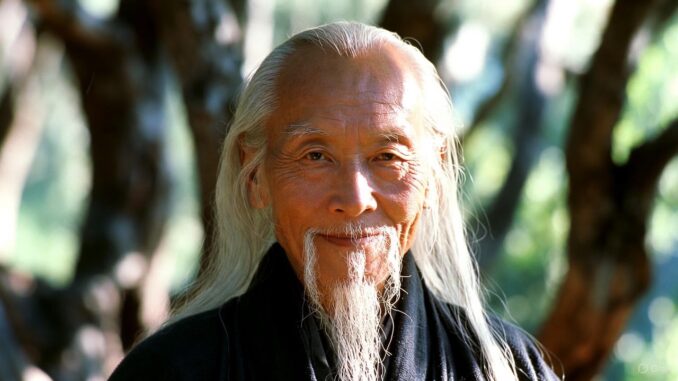
Hard to resist at times, but the head photo is titled ‘Lao Tzu,’ a man who was born around 571 BC, yet he hardly seems a day over 80! I know a picture’s meant to be worth a thousand words, but surely a painting or graphic of the sage, of which there exist many choices, would be better than a pic of some old Chinese dude who verifiably is NOT Lao Tzu?
Nitpicking, yes, but details matter, always.
Much good is suggested here, but, the people of China love Confucius as the greatest patriot and sage. Early Taoism and Confucianism did not satisfy or answer all questions about life after death, but inroads of Buddhism slowly became known in all China. The three teachings continued. And, that photo is of Donnylao Trumptzu, who will live forever, in infamy.
Yeah, good.
I learned the same things from the riparian wilds of the world.
Canguro, as an admin who helps selects pictures for the articles we have to be aware of copyright. If nothing can be found, we create our own.
There’s a great article by Alan Kohler on the ABC site that shows how China has leapt ahead by following principles from ancient Chinese wisdom.
Here’s some snippets — China leads in seven out of eight AI categories, 13 out of 13 advanced materials and manufacturing technologies, in all seven categories of defence, space, robotics and transportation, nine out of 10 in energy and environment and five out of nine in biotechnology, genes and vaccines.
The communists are driving the technology bus, not billionaires as in the US, and the few Chinese entrepreneurs who managed to amass a fortune serve at the pleasure of the party.
Analyst Dan Wang explains what’s behind all this in a book titled Breakneck — China’s quest to engineer the future.
He explains that China is an engineering state, which can’t stop itself from building, while America is a lawyerly society which “has a government of the lawyers by the lawyers and for the lawyers” … and “blocks everything it can”, although Donald Trump is bulldozing regulations now.
“As the United States lost its enthusiasm for engineers, China embraced engineering in all its dimensions,” Wang says.
China’s government spends hundreds of billions of dollars on what it calls a “whole of nation” industry policy, which began with “Made in China 2025” unveiled 10 years ago, and morphed into the 14th five-year plan in 2020 committing US$1.4 trillion over five to six years on new infrastructure, including 5G networks, smart cities, and industrial digitalisation.
Blogger Noah Smith described what “whole of nation” means in a post last week: “Essentially, what China has done is to ditch the standard innovation model, where government, academics, corporations, and financiers all work independently toward their own goals, and to replace it with a model where the government coordinates their interaction toward a single overarching goal from beginning to end.
It could be argued that control by the Party is at odds with Andrew’s point in the article for a need to break free from “top-down control”, but the Chinese have solved that very real concern by their whole of nation approach.
The “whole of nation” aspect is based on the social good and is not interested in quick fixes and immediate gratification.
They work for the future.
And there’s a healthy emotional, intellectual, philosophical and spiritual benefit from working for the future.
It suppresses superficiality at the personal level, and unites society.
https://www.abc.net.au/news/2025-12-08/china-us-technology-engineering-ai-plan-australia/106111696
Thanks SD for your undying commitment to call it as it is. And thanks for the link to the ABC’s Kohler article – another who seeks to call it as it is.
My earlier comment above was a tad cynical, in that the efforts in trudging through the consistent western contrived animus BS about China is so enervating, and does nothing for the ‘west’ who typically fail to learn and adopt the basic elements of leveraging success for ALL!
Exactly so Clakka.
Any system that does not work for “success for ALL” is doomed to fail.
“The all” always outnumber the few, by definition, hence the understandable cynicism in your earlier comment.
There’s a lot of “ageless wisdom” that is actually “ageless common sense“!
Steve, I’d read the Kohler piece earlier this morning prior to your post, and mentioned it to the better half; she’d just returned from China yesterday after a lightning trip, her second in as many months. She told me of a visit to a ‘rural’ district near Jingdezhen in Jiangxi province, to a ‘village’ as she described, and reminded that we visited that town around 2009-10. She said it had been transformed; linked to the high-speed rail network, phone-charging USB and induction chargers installed on public seating, amazed at the extent of the changes.
Further to that, today’s Guardian has a piece on the relative impossibilities of young Americans being able to purchase a home… clearly the same situation that Australians find themselves in.
Two first world countries, the upcoming generations priced out of the housing markets, and no doubt other countries as well. The point is that in China, it is generally de rigueur for a young couple, on marrying, to occupy their own property… the major cities, Beijing, Shanghai, Guangzhou, Shenzhen, being exceptions to that general rule, as too expensive.
The snide western dismissal of the Orient lies exposed, and the falsity of the ‘better than thou’ imperialist nations seems abject and pathetic.
Kanga, thanks for that info, and please give my regards to your better half.
You mention “The snide western dismissal…”
Basically this all stems from the exposure by China of the falsity of claims regarding the superiority of Western civilisation.
Many, perhaps most of the claims are nonsense.
Much of our progress for example, came from Persian civilisation.
Alan Kohler only scratched the surface of China’s achievements.
If things continue on their present course, we will reach a point where the Western masses demand a “China Way” of organising society.
I see no possibility of Western leaders changing course, so by the time the penny drops China will be 30-40 years ahead of the West.
In other words, too late for us to catch up.
Interesting that the Kohler article was removed from the ABC main page after one hour. It’s back again now.