On Labour Day 2026, a Nobel Prize, a Doughnut, and a kitchen table show us how ordinary Australians reclaim what has been taken – and why Labour Day is not a holiday. It’s a template.
By Sue Barrett
A note before we begin
I have never belonged to a union. I am a small business owner, not a party member, and not a radical activist.
What I do know is this: unions built the eight-hour day, the weekend, the minimum wage, and vital health and safety reforms. Small business owners built their communities and kept local economies alive. Both depend on a society where the rules are fair. Both are being squeezed by the same concentrated interests at the top.
Like most people, I believe in purposeful effort, building better, and leaving family and community stronger than I found them – not extracting value, but helping create it. And I have watched those values thrive when the rules are fair and wither when they are not.
The conditions that allow ordinary people to build decent lives – fair wages, affordable housing, accountable institutions – are being quietly stripped away. Not by one side of politics. By concentrated private interests operating across party lines in ways most of us were never taught to see.
This lands on Liberal, National, Labor, Greens, Independent, and One Nation households alike. It is not a partisan issue. It is a fairness issue. A human rights issue. A democracy issue.
You only need to believe the rules of a decent society should work for everyone – and be willing to ask why, increasingly, they don’t.
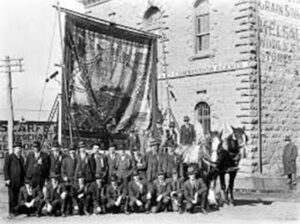
On the 21st of April 1856, a group of Melbourne stonemasons put down their tools and walked off the job at the University of Melbourne.
They were not rioting. They were not burning anything down. They marched from the university to Parliament House, where other tradesmen joined them along the way.
They were asking for something that had been dreamed of but never yet decisively won: an eight-hour working day.
Robert Owen had coined the slogan “Eight hours labour, Eight hours recreation, Eight hours rest” nearly forty years earlier. A New Zealand carpenter named Samuel Parnell had refused to work more than eight hours in Wellington in 1840. British Parliament had taken a tentative step with the Factory Act of 1847. The idea existed.
What had never happened was an organised, collective industrial victory – with a march, a negotiation, and a lasting institutional outcome – that turned the radical idea into the standard condition of an entire trade, and then an entire colony.
The Melbourne stonemasons did that first
Within weeks, builders across the colony had the same conditions. Within a generation, the eight-hour day had spread across the world.
They did not have a communications strategist. They did not have a research firm. They did not wait for a political party to rescue them. They had each other, a shared grievance, and the willingness to act together on their own behalf.
That is the story Labour Day is supposed to remind us of.
Not a holiday. A template.
We Are Living Through a Second Enclosure of the Commons
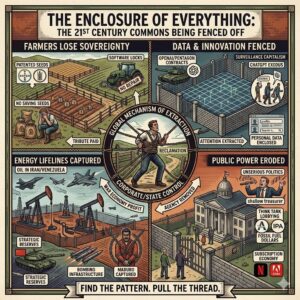
I have been writing recently about the Enclosure of the Commons 2.0 – the systematic privatisation of the shared resources ordinary people depend on to live, work, and participate in democracy. Seeds, software, data, housing, public institutions, and democratic voice itself, all being progressively fenced off by private interests and managed for their benefit, not ours.
This week, two significant pieces of political analysis landed almost simultaneously and sharpened the argument considerably. Both draw on the work of French economist Thomas Piketty, who documented across decades of data how wealth concentrates upward when left unchecked and how centre-left parties across the democratic world were gradually colonised by an educated professional class he called the “Brahmin Left.” Piketty named the pattern.
Two Australian analysts have now shown us exactly where it leads
Kos Samaras of Redbridge Research published The Death of the Brahmin Left, drawing on Thomas Piketty’s diagnosis of how centre-left parties across the democratic world were gradually colonised by an educated professional class. They confused speaking about working people with speaking for them. The original working-class base drifted. In Australia, Samaras argues, Labor executed a substitution: replacing the drifting Anglo-Australian working class with multicultural communities in Melbourne’s outer west and north-west. That substitution has now also run its course. Both working-class constituencies are in motion. The reckoning, Samaras writes, “is arriving ahead of schedule.”
Tim Dunlop’s response, Re-scoring the progressive songbook, makes the crucial leap Samaras stops short of. The crisis is not primarily about cultural distance or demographic drift. It is about the systematic dismantling of the institutions through which working-class people once exercised power. Union halls. Community legal centres. Public sector workplaces. Local party branches with genuine authority. These did not fade naturally. They were enclosed – fenced off, defunded, restructured out of existence – just as surely as the common lands of 15th-century England.
A note of precision: this is not an indictment of every professional, academic, or public servant. Many work in precisely the institutions – community legal centres, public schools, the ABC – that are crucial commons worth defending. The problem is not the teacher or the public health nurse. It is the professional political class that colonised party structures, hollowed out local democracy, and replaced organising with advocacy. The people keeping the remaining commons functioning are often our most important allies in rebuilding them.
Dunlop’s challenge is the right one: stop asking how the managerial class can better adapt to communities. Start asking how communities can build their own organisational capacity.
The stonemasons of 1856 did not ask permission. Neither should we.
The Tragedy of the Commons Was Always a Lie
Before we talk about reclaiming the commons, we need to demolish the myth used to justify enclosing them.
The “tragedy of the commons” – popularised by Garrett Hardin in 1968 – argued that shared resources are inevitably destroyed by individual self-interest. Therefore, resources must be privately owned or state-controlled. This argument has been used to justify nearly every enclosure of the last five decades, from privatising public utilities to patenting seeds.

In 2009, the Nobel Prize in Economics was awarded to Elinor Ostrom for proving it wrong
Ostrom studied how communities actually manage shared resources – fisheries, forests, irrigation systems, grazing lands – across hundreds of contexts worldwide. Her finding was unambiguous: communities can and do govern shared commons successfully, sustainably, and without privatisation or top-down control, when given the conditions to do so.
Her eight design principles are the blueprint:
- The people affected make the rules – not experts, not distant bureaucrats
- Rules fit the local conditions – one size never fits all
- Everyone watches, everyone is watched – monitoring is shared, not outsourced
- Mistakes are met with proportionate responses – not punishment, correction
- When there’s a dispute, resolution is cheap and accessible to everyone
- Outside authorities respect the community’s right to govern itself
- Large systems are built from the ground up – nested layers, not top-down control
- The commons can be governed – Ostrom proved it, repeatedly, everywhere
Her eighth principle is the most important for large cities like Melbourne and Sydney – places too big to govern as a single unit, but not too big to govern well.
The answer is nested layers: street to neighbourhood to suburb to electorate to city.
The Community Independents – Voices for Indi, Goldstein, Kooyong – are Ostrom’s blueprint in action. Kitchen tables feeding into electorate networks feeding into a national crossbench that is now shaping federal legislation. That is exactly the architecture she described. It just looks like democracy.
However, the tragedy we find ourselves in now was never inevitable.
It was manufactured to justify theft.
What We Are Fighting For: The Doughnut Map
Kate Raworth’s Doughnut Economics Model gives us the clearest map of what the Great Reclamation is fighting to restore.
The Doughnut has two rings
The outer ring is the ecological ceiling – the planetary boundaries we cannot breach without catastrophic consequences.
The inner ring is the social foundation – the minimum every human being needs to live with dignity: food, water, health, education, income, housing, energy, democratic voice, social equity, and community.
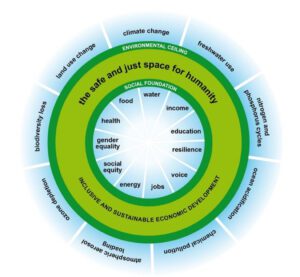
Every item on that inner ring is a commons that has been partially or fully enclosed
- Housing, enclosed by negative gearing and investor-class landlordism.
- Wages, enclosed by union gutting and gig economy casualisation.
- Democratic voice, enclosed by Atlas Network dark money and captured media.
- Energy, enclosed by fossil fuel monopolies.
- Information, enclosed by News Corp’s dominance and the defunding of the ABC.
The ecological crisis and the enclosure are not separate problems. They are the same system.
Private profit requires externalising environmental cost onto the commons we all share.
The Great Reclamation is not just a political project.
It is the project of restoring the conditions for human life on a liveable planet.
The Fastest, Most Powerful Lever: Tax Reform
If you are looking for the single fastest way to break the stranglehold – it is tax reform.
Tax policy is where wealth concentration gets locked in.
Change who pays tax and how much, and you change everything downstream.
Right now the system is rigged in plain sight:
- The top 1% own more than the bottom 70% combined.
- Corporations receive $14.5 billion in annual fossil fuel subsidies while schools beg for supplies.
- Negative gearing and capital gains concessions inflate housing prices for investors while locking out first-home buyers.
- Mining companies extract our shared national resources and return a fraction of the value to the public who own them.
- And when a corporation can donate to political parties and receive hundreds of millions in forgiven royalties in return – that is not a market outcome. That is a purchased one.
The Norway comparison belongs in every conversation about this:
Norway kept its oil and gas revenues in a sovereign wealth fund for its citizens – now worth over $1.7 trillion.
Australia gave its gas to private companies, who export it while Australians pay global prices for energy extracted from their own ground.
That is not market forces. That is a political choice, made by politicians funded by the industry that benefits.
The questions to put to every candidate, at every level of government, are not complicated:
- Do you own investment properties?
- Will you disclose all holdings before voting on housing or tax policy?
- Which corporations have donated to your party?
- Will you support closing loopholes that allow profitable companies to pay zero tax?
- Will you back a resource rent tax so Australians actually benefit from our minerals?
- Will you end fossil fuel subsidies?
- Will you support full campaign finance transparency?
These are not radical questions.
They are the bare minimum of democratic accountability – the Fair Go Test applied directly to the people who write the rules.
Tax reform does not require a revolution.
It requires enough organised citizens to make it a non-negotiable voting issue.
It Is Already Working: Organising, Not Mobilising
The most important thing to understand about the Great Reclamation is that it is not a future aspiration. It is already happening.
The Community Independent Movement
- Voices for Indi, Voices for Goldstein, Voices for Kooyong, Voices for Corio – is the most significant democratic commons reclamation in Australia in decades.

Cathy McGowan did not win Indi in 2013 by running a better campaign. She won because she and her community spent years doing something that looks almost old-fashioned: kitchen table conversations. Neighbours talking to neighbours about what they actually needed and what kind of representation they deserved. The community defined its values first. The candidate stepped forward second.
The Community Independents’ model embodies Ostrom’s principles directly.
Funding came from small donations by many, not large donations by few. The structure was horizontal – and then it scaled. Local kitchen tables became electorate-wide networks; electorate-wide networks became a national crossbench.
This is precisely the “nested layers” Ostrom describes: local autonomy aggregating upward into genuine political power, without a central machine controlling it from above.
Indi is not a wealthy teal seat – it is regional, economically diverse, and was a so-called ‘safe’ Liberal Party seat for decades – until it wasn’t.
If this model works in Indi, it works anywhere
Here is the distinction that determines whether any of this holds:
Mobilising gets people to show up once. It does not build durable power.
Organising builds relationships, institutions, and the capacity to act repeatedly over time. It is slower and far more powerful.
Leverage today is not held at a single point.
For a casual retail worker in Werribee or a gig worker in Broadmeadows, it is built across multiple simultaneous fronts:
- consumer choices that redirect money from enclosed institutions to community-owned ones
- voting behaviour that punishes captured politicians
- demanding tax transparency as a non-negotiable condition of support, and
- withdrawing consent from the cultural story that the enclosure is natural or inevitable.
Scale is built by organising. And organising starts with three people who trust each other enough to act. We started Voices of Goldstein with 6 people.
Where to Start: The Fair Go Test and Reactivating Your Civic Muscle
Much of this may feel unfamiliar – and that is not accidental. The civic muscle that once made collective action ordinary has been slowly and deliberately weakened. Union halls closed. Local branches hollowed out. Community institutions defunded.
We were not born passive. We were managed into it.
The Great Reclamation begins with deciding to use that muscle again – not as an activist, but as something older and more universal: a neighbour who gives a damn.
Apply the Fair Go Test to any politician, policy, product, or institution:
- Who funds this?
- Who benefits?
- What is being enclosed or privatised?
- Who is being silenced or scapegoated?
- Does this expand or reduce human agency?
- Would this pass the fair go test for the least powerful person in the room?
The sixth question is not moral sentiment – it is the operational definition of a commons.
In a true commons, the rules are made by those most affected, including those at the bottom. A fair go is not a gift dispensed from above. It is the structural result of who gets to make the rules. When the least powerful person fails the test, the commons has been enclosed.
Have the kitchen table conversation.
Find the one issue in your community that is live and concrete: housing, a hospital closing, a developer with council in their pocket, a local member who has not held a public meeting in years. Find three people. Build the relationship before you build the campaign.
The goal is not to render the state irrelevant – the state remains the only entity that can legally guarantee the right to organise, prevent enclosure through anti-monopoly law, and fund the institutions the market will not.
The goal is to reclaim the state for the commons:
Elect representatives who answer to communities rather than donors and make the democratic commons ungovernable by those who would enclose them.
Now It Is Our Turn
Piketty named the pattern.
Samaras mapped the collapse.
Dunlop named what was actually destroyed.
Ostrom proved it can be rebuilt.
Raworth showed us what we are building toward.
And on tax, the evidence is unambiguous: the enclosers are not hiding. They are in the donation registers, the lobbying records, the parliamentary votes. We know who they are. We know what they are doing.
The commons have been enclosed before and reclaimed before. The eight-hour day was thought impossible until it wasn’t.
Medicare was thought impossible. The ABC was thought impossible. The teal independents were thought impossible.
The stonemasons of 1856 put down their tools, walked to Parliament House, and changed the world – and the 888 Monument still stands in the city they built as proof that ordinary people, organising together, can do the same.
They were not activists. They were neighbours who gave a damn, using their civic muscle at the moment it mattered most. That muscle is still in us. It has just been waiting for us to use it.
So, find your kitchen table. Apply the Fair Go Test. Demand tax transparency from every candidate. Have the conversation. Build the relationship. Then act together.
The Great Reclamation is not arriving. It is already underway. The only question is whether you are part of it.
You know what to do.
Onward we press
Sue Barrett is founder and CEO of Barrett Consulting Group and the Selling Better Movement, a civic writer, and the organiser behind Democracy Watch AU. She has been a Goldstein resident and community organiser for more than 40 years.
Next in this series: The Eight Commons – a practical map of what has been enclosed and what reclaiming it looks like, community by community.
Further reading
- Elinor Ostrom, Governing the Commons (1990)
- Kate Raworth, Doughnut Economics (2017) – doughnuteconomics.org
- Kos Samaras, “The Death of the Brahmin Left,” Redbridge Research, March 2026
- Tim Dunlop, “Re-scoring the Progressive Songbook,” The Future of Everything, March 2026
- Cathy McGowan, Cathy Goes to Canberra (2021)
- The Australia Institute
- Community Independents Project
This article was originally published on Sue Barrett
Keep Independent Journalism Alive – Support The AIMN
Dear Reader,
Since 2013, The Australian Independent Media Network has been a fearless voice for truth, giving public interest journalists a platform to hold power to account. From expert analysis on national and global events to uncovering issues that matter to you, we’re here because of your support.
Running an independent site isn’t cheap, and rising costs mean we need you now more than ever. Your donation – big or small – keeps our servers humming, our writers digging, and our stories free for all.
Join our community of truth-seekers. Please consider donating now via:
PayPal or credit card – just click on the Donate button below
Direct bank transfer: BSB: 062500; A/c no: 10495969

We’ve also set up a GoFundMe as a dedicated reserve fund to help secure the future of our site.
Your support will go directly toward covering essential costs like web hosting renewals and helping us bring new features to life. Every contribution, no matter the size, helps us keep improving and growing.

Thank you for standing with us – we truly couldn’t do this without you.
With gratitude, The AIMN Team
Explains why we we have ended up with Abalone and his careerist front bench.Neoliberalism 2.0
Can some one get us out of this shit?
Come on Greens and Independents….and soon.
Great article, Sue.
Harry, I’m with you. I’ve always voted Labor but in the upcoming by-election I’m leaning towards the independent (Michelle Milthorpe). I’m in Farrer, btw.
A great article indeed.
Yep!! A great article!!
Uhm ….. WE followed this strategy in 1999 when electing Richard Torbay INDEPENDENT Northern Tablelands (NSW) and promoted Tony Windsor from INDEPENDENT Tamworth to INDEPENDENT New England in 2000.
In the noughties there was a time when seven INDEPENDENTS sat in the NSW Parliament.
REGIONAL INDEPENDENTS GET THINGS DONE FOR THEIR COMMUNITIES.
What do LIARBRAL$, NOtional$, or Only Nutters do??
In Farrer, Michelle Milthorpe INDEPENDENT will represent the community rather than the unelected political party hacks representing foreign owned multinational corporations who make ”political donations” that for those keepers of pre-selection and ministerial promotions to live in the desired very comfortable manner.