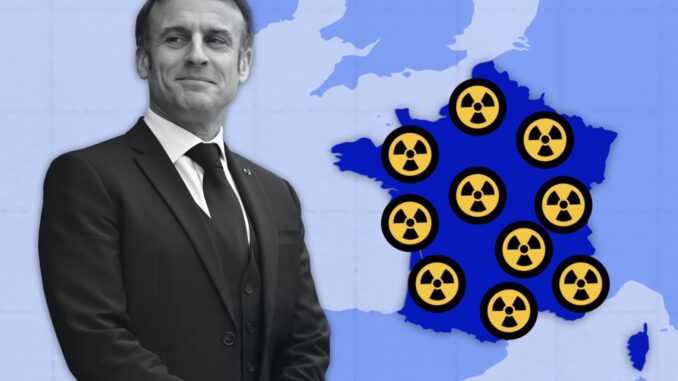
To expand a stockpile of both the useless and the mindlessly murderous in a military sense would seem to be a wasteful exercise best contemplated in the psychiatric ward. But such a ward is increasingly occupied by the world’s leaders, and war is on their lost minds. As Israel and the United States continue their crime of aggression against Iran, other countries are looking at what they have in their inventories. The eyes of militarists are sparkling with anticipation, notably regarding nuclear weapons.
France, which sees itself as one of the eminent nuclear powers, albeit in fourth place behind Russia, the United States and China, is keen to push up the numbers. The wiser thing, surely, would be to discourage the acquisition of more nuclear weapons. But the world is dangerous, and danger is always the alibi for policies that aggravate the disease rather than cure it. “The next 50 years,” France’s President Emmanuel Macron explained in a speech to naval officers in front of a nuclear submarine at the Île Longue base near Brest in Brittany, “will be an era of nuclear weapons.”
In an event that might have garnered more global attention but for the illegal war being waged against Iran by the United States and Israel, Macron was initially flown with an escort to the base, and, with solemnity, addressed military personnel and the top brass in a grim facility that might have excited Ian Fleming.
Platitudes were not to be avoided. “To be free one must be feared, and to be feared one must be powerful.” Accordingly, France would increase its nuclear inventory and “no longer release figures on our nuclear arsenal, as we have done in the past.” (How coquettish.) The president certainly intended the arsenal to be murderously convincing. “Our country possesses exceptional weapons: nuclear weapons, which form the foundation of our security. If we had to use our arsenal, no State, however powerful, could shield itself from it; and no State, however vast, could recover.” To make weapons of this nature surely makes any question of their exceptional quality meaningless. There is a certain point when the contemplation of mass homicide pointing to extinction makes such talk dotty and dangerous.
Given the “resetting of priorities” by the Trump administration and the Russian threat (this included rash rhetoric on the potential use of nuclear weapons), Europe needed “to take more direct control of its own security … of our own destiny.” The Iran War seemed to furnish him with further excuses. “The world has become tougher and this has been further demonstrated by the events of the past few hours.” Bearing in mind “our national and European challenges, we have to strengthen the nuclear deterrent… We must think of our nuclear deterrent on a European scale.”
In his speech, Macron introduced the notion of dissuasion avancée, or “forward deterrence.” While falling short of providing the guarantees of NATO’s nuclear umbrella, he was willing to place France’s own nuclear deterrent at broader disposal for European states. “We must conceive our deterrence strategy within the depth of the European continent … with the progressive implementation of what I will call ‘forward deterrence’.” This concept can hardly count as a daring revision so much as a re-emphasis on the significance of the European continent in articulating deterrence.
France remains sovereign, with the president the ultimate arbiter about the country’s national interests in whether nuclear weapons should be used or not. “France will always assume on her own the responsibility for the deliberate crossing of the nuclear threshold, fully factoring the interests of our allies.” The way its nuclear weapons will be positioned in this new doctrine is also deliberately oblique, though Macron does make mention of the potential deployment of France’s nuclear-capable aircraft on foreign soil.
The open-ended nature of the proposed model, described by Héloïse Fayet of the French Institute of International Relations in somewhat laboured fashion, “rests on structured political and military mechanisms designed to deepen coordination with a first cohort of willing partners, including the United Kingdom (with whom France already have a special security partnership), Germany (with a specific Nuclear Steering Group, the creation of which was announced shortly after Monday’s speech), Belgium, the Netherlands, Denmark, Poland, Sweden, and Greece.”
As Fayet alludes to, one feature of this expansion of the role of French nuclear weapons on European soil, should it come to that, is greater cooperation with Germany. In their joint declaration between Macron and German Chancellor Friedrich Merz, both men noted the establishment of “a high-ranking nuclear steering group that will act as a bilateral framework for doctrinal dialogue and the coordination of strategic cooperation, including consultations regarding the appropriate mix of conventional, missile defence and French nuclear capabilities.”
Claudia Major, Senior Vice President for the Transatlantic Security at the German Marshall Fund of the United States was buoyed with sophomoric enthusiasm by the Franco-German bilateral deal. Germany had reversed an increasingly negative trend to nuclear weapons. “Five years ago we had an election campaign [in Germany] which was about to get rid of weapons,” she told DW, “and now Germany is one of the leading countries in doing the nuclear cooperation with France. So, the synchronization of the bilateral relationship is amazing.” The nuke is no longer outré.
Macron also envisages greater consultation on the issue of nuclear doctrine (job creation is in the air with the establishment of groups for that task) with a focus on managing escalation in a coordinated manner with European partners. The door will also be left open, potentially, to participation in French nuclear exercises. The new doctrine will also be compatible with NATO and is not intended to displace the role played by US extended deterrence. That said, the latter has taken some battering in the hot climate of America First.
Whether it is put down to Russia or the Iran War, neither of which justifies matters, the genie of nuclear proliferation is truly out of the bottle and running amok. Tim Wright, Asia-Pacific Director of the International Campaign to Abolish Nuclear Weapons (ICAN), can be forgiven for his pessimism. “This is a response to the diminished role, I suppose you would say, of the United States in providing European security,” he reasoned on New Zealand television. Nuclear weapons, however, “will never bring security not to Europe, not to any country or region of the world.” Nuclear weapons never did, but those cranks behind formulating doctrines of mass death always think otherwise.
Keep Independent Journalism Alive – Support The AIMN
Dear Reader,
Since 2013, The Australian Independent Media Network has been a fearless voice for truth, giving public interest journalists a platform to hold power to account. From expert analysis on national and global events to uncovering issues that matter to you, we’re here because of your support.
Running an independent site isn’t cheap, and rising costs mean we need you now more than ever. Your donation – big or small – keeps our servers humming, our writers digging, and our stories free for all.
Join our community of truth-seekers. Please consider donating now via:
PayPal or credit card – just click on the Donate button below
Direct bank transfer: BSB: 062500; A/c no: 10495969

We’ve also set up a GoFundMe as a dedicated reserve fund to help secure the future of our site.
Your support will go directly toward covering essential costs like web hosting renewals and helping us bring new features to life. Every contribution, no matter the size, helps us keep improving and growing.

Thank you for standing with us – we truly couldn’t do this without you.
With gratitude, The AIMN Team

For a long time I have been impressed with the decision of Iran to stay out of the nuclear bomb crowd.
When we have progressed to use nuclear bombs in conflicts, then the world has given up hope of any sort of future, so someone has to be remarkably stupid to start this sort of ding-dong, and even sillier to keep it going.
Meanwhile the sabre rattling is holding back any country from developing for the benefit of its taxpayers.
Iran has chosen not to go down down this rabbit hole, but has fallen foul of a couple of criminal leaders who are envious of their wisdom, but put Oil and currency choices before their common sense, and responsible behaviour.
USA is in economic trouble, and its best the rest of us let them sort this out by themselves, while they slip into abject poverty. I think this could be a mindset from China?