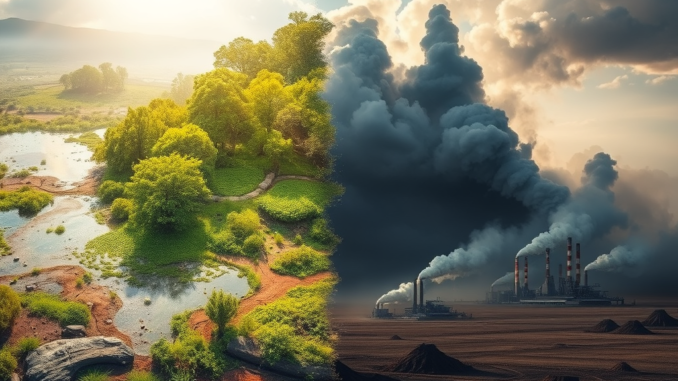
Part Three
When your environmental law explicitly forbids considering environmental catastrophe, that’s not policy. That’s capture.
The Climate Provision That Isn’t There
Here’s the bit that will make you furious: Australia’s new environment law makes it illegal to consider climate change. Not an oversight. Not a gap to fix later. Explicit prohibition.
The Environment Minister cannot use this legislation to reject coal and gas projects on climate grounds. Think about what that means in practice. You’re the Environment Minister. A company wants approval for a massive new gas field. You have the Samuel Review. You have the scientific data at your fingertips. You know this project will pump millions of tonnes of carbon into the atmosphere. You know it will accelerate the climate catastrophe already killing the Reef, burning the forests, displacing billions of animals. And the law says: you cannot consider any of that.
The Black Summer bushfires of 2019-20 killed or displaced 3 billion animals and insects. Six mass coral bleaching events have hit the Great Barrier Reef in the past decade. Climate change is the existential threat to Australia’s biodiversity. Samuel’s review was delivered in 2020. It’s now 2025. The climate crisis has intensified. The science is clearer. We now know we miscalculated. The impacts are far more severe.
Yet a Labor government has passed environmental legislation that makes it illegal for the Environment Minister to even consider climate when approving new global warmers; new fossil fuel projects.
The EDO is blunt: this contradicts international law and the recent advisory opinion of the International Court of Justice, which outlines states’ obligations to prevent environmental harm both within and outside their jurisdictions; including “a requirement of states to regulate all fossil fuel emitting activities.”
Australia is choosing to violate international environmental law. Deliberately. Explicitly. In statute.
The Data Labor Hopes You’ll Forget
Climate Council polling is devastating for Labor’s position. Seventy percent of Australians want climate embedded in environmental reforms. In Canberra, where Environment Minister Murray Watt, himself, sits in the Senate, 80 percent want climate impacts considered.
In the marginal seat of Bean, which Labor held by just 350 votes in 2025, its numbers are apocalyptic. Forty-four percent of Labor voters say they’d be less likely to vote Labor if climate protections aren’t included. That’s 18,555 fewer first-preference votes in a seat decided by 350. Independent Senator David Pocock notes:
“I remain of the view that had Labor announced its approval of the North West Shelf prior to the 2025 election, there may have been a different outcome in the electorate of Bean.”
Labor knows this. They have the polling. They understand the electoral risk. And they chose to exclude climate anyway.
Why? Because the alternative, actually restricting new fossil fuel projects, would trigger a political firestorm from the mining industry, Queensland’s fossil fuel government, and business lobbies. Labor chose industry pressure over majority voter preference.
That’s capture. Textbook capture. An elected government prioritizing industry demands over what seventy percent of voters want on a critical policy question.
What Actual Environmental Commitment Would Look Like
If Labor actually cared about protecting Australia’s environment, if the rhetoric matched reality, here’s what the legislation would contain. This isn’t utopian wishlist thinking. This is what Samuel recommended, what environmental organizations demanded, what the science requires, and what the majority of Australians support.
1. A Genuine Climate Trigger
The Environment Minister asks one question before approving any project: Will this cook the planet faster? If yes, it doesn’t proceed. How hard is that?.
The Climate Council’s position is clear:
“Our environment law needs to require decision-makers to directly consider the climate impacts of all highly-polluting projects, like new or expanded fossil fuel projects. This should be assessed as part of the environmental approvals process, with decision-makers able to curb projects that would cause significant climate harm.”
Not disclosure. Assessment. With consequences. New coal and gas projects that would worsen climate change get rejected, not slowed down, not approved with conditions. Rejected.
2. Full Emissions Accounting
Make them count every tonne. Scope 1, scope 2, and the scope 3 emissions they pretend don’t exist; the coal we mine, the gas we ship, the carbon that goes up when someone else burns it. All of it. No more creative accounting. Cooking the books to let you cook the planet is breach of any MPs duty of care.
The Climate Council notes: “Climate pollution, no matter where it is released in the atmosphere, harms Australians and our environment.” When we export coal to be burned in China, those emissions still warm the planet. When we export LNG to be burned in Japan, that still accelerates climate change.
The current bill requires disclosure of scope 1 and 2 only. It’s deliberately incomplete accounting designed to minimise the apparent climate impact; like measuring the carbon footprint of cigarette manufacturing while ignoring the emissions from people actually smoking the cigarettes. Or, more honestly, like a tobacco company measuring everything except the emphysema and the cancer.
3. No More “Pay to Destroy”
Here’s how it should work: if a developer wants to clear native forest, they can’t. Full stop. Not if they pay a restoration fee. Not if they promise to offset somewhere else. We know full well that a developer’s promise isn’t worth a pinch of cockatoo poo. You don’t get to destroy habitat by writing a cheque.
The EDO is emphatic: restoration contribution payments are “payment for destruction; a regression from current policy.” The Australia Institute’s research shows these schemes don’t work. They create time lags, transfer responsibility to the public purse, and reduce the likelihood of replacing destroyed habitat with equivalent protection elsewhere. Let’s be frank. They are a cynical breach of good faith.
Genuine reform means: protect habitat or the project doesn’t proceed. There is no third option.
4. Mandatory, Enforceable National Environmental Standards
Samuel was explicit: a full suite of specific standards is necessary, and:
“all the Standards are necessary to improve decision-making by the Commonwealth and to provide confidence that any agreements to accredit States and Territories will contribute to national environmental outcomes.”
The current bill provides power to make standards but no requirement that they be made. No specification of what they must address. No guarantee they’ll be finalized before implementation begins.
The EDO’s warning was explicit: show us the standards before we vote. Parliament voted anyway. They bought the car without looking under the bonnet.
5. A Truly Independent National EPA
The bill creates a National EPA. Sounds good. But the Minister retains final decision-making power. The CEO of the EPA can be appointed as a delegate, but the Minister can override whenever it suits.
This isn’t independence. This is a fig leaf.
Greenpeace’s submission is direct:
“An independent national EPA able to make decisions on merit would ensure a more effective approach to decision making to protect MNES, improving nature protection and to addressing the inefficiencies that come with the variability that arises from discretionary decision making.”
Samuel recommended an independent regulator to remove political interference from environmental decisions. Labor gave us a regulator the Minister can overrule whenever a decision might prove politically inconvenient. That’s a grotesquely bad parody of what independence involves.
6. End Native Forest Logging Now
Not in 18 months. Now. Australia is a global deforestation hotspot; we’re on the list alongside countries we normally criticise for environmental destruction. WWF notes that 7.7 million hectares of threatened species habitat has been destroyed since 2000, an area larger than Tasmania.
The 18-month sunset period means another 18 months of logging. Another 18 months of habitat destruction. Another 18 months while the government celebrates having ended practices it’s still allowing to continue. You don’t get credit for eventually doing what should have been done immediately.
7. Proper Indigenous Heritage Protection
Samuel found that “national-level protection of the cultural heritage of Indigenous Australians is a long way out of step with community expectations.” He called for comprehensive reform, co-designed with Indigenous peoples, based on Best Practice Standards in Indigenous Cultural Heritage Management and Legislation.
Five years after Juukan Gorge. Five years after Samuel’s report. And the EDO’s assessment: “In our view there is nothing in the current Bills that would effectively strengthen the role of First Nations in environmental decision making under the EPBC Act.”
Nothing. After everything.
8. Proper Funding for Enforcement
An independent EPA with real teeth requires real funding. The capacity to conduct rigorous environmental assessments. The resources to prosecute corporate environmental crimes. The personnel to actually scrutinize projects rather than rubber-stamp them.
None of this happened. Because it would require a government willing to say no to the industries that fund its campaigns and define its political economy.
The Political Calculus – And Its Cost
For Labor, this deal is brilliant politics. They can claim they fought for environmental protection. The Greens can claim they held the line on forests. Environmental groups can claim incremental progress. The mining industry can claim it defended jobs. Everyone gets a political win.
The only loser is the actual environment.
But there’s a cost to this calculus. Forty-four percent of Labor voters said they’d be less likely to vote for the government if climate was left out. Climate change ranks in the top three electoral concerns. Labor is banking that people won’t remember that they exempted coal and gas from climate considerations in environmental law.
They’re probably right. News cycles move fast. By the next election, most voters will remember “Labor reformed environmental laws” without remembering the reforms explicitly forbid considering climate damage.
But somewhere in the electoral base, voters will remember. They’ll remember that the government they voted for to take climate seriously made climate considerations illegal in environmental law. They’ll remember that Labor talks about climate leadership while approving new gas fields. And they’ll remember that the only party willing to actually push back was the Greens.
For a government banking on climate-conscious voters in inner-city and marginal seats; seats such as Bean, decided by 350 votes, where 44 percent of Labor voters are already wavering—that’s not just a liability. That’s electoral suicide in slow motion.
They’re counting on you forgetting. Don’t.
To be concluded in Part Four: The Real Question – And What Comes Next…
This article was originally published on URBAN WRONSKI WRITES
Keep Independent Journalism Alive – Support The AIMN
Dear Reader,
Since 2013, The Australian Independent Media Network has been a fearless voice for truth, giving public interest journalists a platform to hold power to account. From expert analysis on national and global events to uncovering issues that matter to you, we’re here because of your support.
Running an independent site isn’t cheap, and rising costs mean we need you now more than ever. Your donation – big or small – keeps our servers humming, our writers digging, and our stories free for all.
Join our community of truth-seekers. Donate via PayPal or credit card via the button below, or bank transfer [BSB: 062500; A/c no: 10495969] and help us keep shining a light.
With gratitude, The AIMN Team


I’m lining the walls at home with 10cm thick semi-soft padding, so that I don’t give myself serious brain damage each time I bang my head against the wall. It’s gotten to that stage… after more than seventy years on the planet, to comprehend that I live in a country where the powers that be are actively conniving in the ruination of the environment… a ruination that’s galloped into existence over the last ~237 years after a zillennia of this country’s landscapes being subject to little more than natural causes and effects, sans human forces – and I deliberately exclude the impact of the indigenous people, being minimal in this context, given they did not employ industrial age technologies and artefacts, nor did they import and release a swathe of hugely destructive fauna, all utterly unsuited to this country’s landscapes, and a ruination that far from declining, is accelerating. Head-banging beckons.
Canguro, You’re not alone in wanting to upholster the house like an institution, my friend, the rest of us are pricing foam by the tonne. What you’re describing isn’t madness, it’s the perfectly rational response of someone watching a country vandalise the only continent it has.
For seventy thousand years this place was managed with a sophistication our modern “decision-makers” still struggle to grasp. Then along came 237 years of settler-industrial improvisation; rabbits, foxes, cattle on fragile soils, broadscale land clearing, rivers re-routed like garden hoses; all done with an optimism bordering on derangement. And now, as the bill arrives, the people in charge respond with the same two-step routine:
1. deny what’s happening,
2. speed it up.
You’re right: the ruination isn’t slowing.
It’s accelerating; assisted not by accident, but by policy.
But here’s the thing the head-banging doesn’t always let through: despair is precisely what the wreckers rely on. If we all decide it’s too late, they get to keep going until there’s nothing left but press releases and pits.
The fact you’re furious, after seventy years, is proof there’s still something here worth defending. And there are millions of Australians who feel exactly as you do, except they’ve been told their anger is unrealistic or “anti-development.” It isn’t. It’s the most patriotic response available.
So keep the padding if you must, but save some for the capitals; because the walls of Parliament are due for a hammering from people who’ve finally had enough of watching a paradise dismantled for quarterly profit statements.
And if the walls are taking a beating, it’s only because you still care enough to fight for the place. That’s not a weakness. It’s a pulse.
I am fascinated by he authors of the two comments to date, it seems neither of them eats beef, drive a motor vehicle or rides in a plane?
Yes, growth has caused a lot of changes, some for the better and some for the worst, but this has little to do with “modern decision makers”rather it has to do with societal evolution. None of this happened under any one government, it has been a progressive movement.
I don’t know that “ruination” is taking place, but if it is, blame growth.