“I am an invisible man.” Ralph Ellison begins his masterpiece with a declaration that has never lost its charge or its dark, grievous wit. Not a ghost. Not a metaphor. A man of flesh and bone, fully present yet completely eclipsed: unseen because society had organised itself, through custom and law and the quiet violence of institutional habit and the tyranny of low expectations, to refuse him the dignity of being perceived.
The invisibility was not in him. It was in them.
I want to honour that frame by applying it here, to Australia Felix, a paradise on earth, if you are white. Or the place where they came to take the children away: the Stolen Generations, children who never saw their parents again. This is not to appropriate Ellison’s own naming of the horror, but to acknowledge that he understood invisibility with the authority of a man who lived, suffered and chronicled it.
What Ellison understood applies with uncomfortable precision to the condition of independent journalism in Australia in 2026: you can be fully visible, pilloried, prosecuted, extensively spied on, your home raided, your underwear drawer wrenched open on national TV (an emblem of violation if ever there was one), your files seized, your phone data extracted, your legal bills compounding at a rate that will ruin you, your name in every paper.
Yes. All of this, and you will still be invisible. Seen by everyone. Acknowledged by none. Your democratic function rendered officially non-existent by the same state that has the hide to appear at international conferences and deliver speeches about the importance of a free press.
That is the particular genius of what Australia has built. Not suppression in the crude sense that leaves marks anyone can photograph. Something more refined: suppression by process, suppression by cost, suppression by the slow, grinding, spirit-breaking machinery of a legal system deployed not to establish guilt but to establish a price.
The price of telling the truth in Australia is now higher than it has ever been. Set deliberately high. Set to deter. Pour encourager les autres, as the colonialists up the road in New Caledonia would say, as they hanged indigenous men and women in public to terrify their relatives into submission.
The Oldest Penal Colony in the Southern Hemisphere
There is an additional irony if you care to look at a history book, and in Australia, increasingly, that takes courage.
Australia began as a penal colony. Not metaphorically. As a matter of founding fact. The British Empire, having misplaced one set of colonies and needing somewhere to dispose of the people it wished to be rid of, selected a continent already occupied by several hundred thousand people it did not intend to consult, and began shipping its unwanted there. Convicts, radicals, the insubordinate, the poor who had become inconvenient: all transported to the edge of the known world, from which return was impossible and silence was enforced.
Two hundred and thirty-eight years later, we imprison military lawyers for informing the public about alleged war crimes. We prosecute tax office whistleblowers for exposing illegal debt recovery practices. In an extension that Kafka would relish, we are pursuing through the courts the lawyers of those we have already pursued. Not the accused. The lawyers.
The penal colony never really ended. It merely changed its dress code.
Franz Kafka wrote a story about a penal colony. In it, there is a machine called the Harrow. The Harrow’s function is to inscribe the law on the body of the condemned: with needles, over many hours, in a script of increasing intricacy and pain. The condemned does not know, before the process begins, what law they have broken. They are not told. They are not shown. The law is written on their body as the punishment is administered, and this, the officer in charge explains to a puzzled visiting Explorer, is itself the point:
“Enlightenment comes to the most dull-witted. It begins around the eyes. From there it radiates.”
David McBride now knows what the Harrow writes. So does Richard Boyle. So does Bernard Collaery. So did Julian Assange, for years, in Belmarsh Prison, while the government that issued his passport looked at its shoes and said, quietly, that the matter was receiving attention at the appropriate levels.
The Australian Harrow does not use needles. It uses bail conditions, suppression orders, national security legislation, counter-terrorism statutes and the slow drip of pre-trial process that can run for years before a single day in open court. Those condemned do not bleed visibly. They become, over time, financially destroyed, publicly invisible, professionally erased. And the lesson to everyone watching is legible without being stated. The machine speaks for itself. That, as Kafka’s officer understood, is precisely the elegance of it.
The Honour Roll of Those the Machine Has Processed
Here is what the Harrow has been writing.
David McBride was a military lawyer. Decorated. Distinguished. Decent. McBride did two tours of Afghanistan, where he witnessed alleged war crimes being buried while lesser misconduct was prosecuted for the sake of appearance. He raised his concerns with his commanding officer. He was ignored. He went to oversight bodies. The oversight bodies did what Australian oversight bodies reliably do: they provided the appearance of accountability while protecting the system that appoints and funds them. As a last resort, having exhausted every other avenue of appeal, he gave documents to the ABC.
Those documents became the Afghan Files. They forced a reckoning with conduct the chain of command had classified into permanent darkness. The journalism was unimpeachable. The public interest was unambiguous. The democratic function of the free press, the function Australia claims to revere in every ministerial doorstop, every press freedom statement, every appearance at every international forum, was served.
For this, McBride was sentenced to six years in prison in 2024. The public interest defence was rejected by the trial judge. The conviction was upheld on appeal. The first and only person imprisoned in connection with alleged Australian war crimes in Afghanistan is not a soldier accused of an unlawful killing. It is the lawyer who helped expose them.
The law the Harrow inscribed on McBride’s body was not you permitted atrocities. It was you told people about them.
Witness K revealed that Australia’s intelligence services secretly bugged the cabinet rooms of Timor Leste during oil and gas negotiations, conducted shortly after that newly independent nation had barely drawn its first post-colonial breath. He received a suspended sentence.
His lawyer, Bernard Collaery, decorated Canberra barrister, former ACT Attorney-General, a man whose standing in his profession is impeccable, was prosecuted separately. Not for spying. Not for theft. Not for violence. For the act of defending his client. The prosecution ground on for years before the Albanese government finally dropped it, by which time it had accomplished its real work: financial ruin, reputational attrition, and a message delivered, in a language every lawyer in the country could read, to anyone considering the defence of the next person who knew too much.
The Harrow does not require a conviction to work. The process is the punishment. Kafka understood this. So does the Department of the Attorney-General.
Richard Boyle exposed predatory and illegal debt-recovery practices inside the Australian Tax Office. Independent inquiries later confirmed what he had said. He raised concerns internally and was ignored. He went to oversight bodies and was spurned. He went to journalists as a final resort. He is now facing charges that could see him locked up for decades. The Tax Office whose illegal conduct he exposed faces no charges at all.
The Harrow writes asymmetrically. It always has.
In 2019, AFP officers raided the home of News Corp journalist Annika Smethurst, seizing data from her phone and laptop. The High Court later unanimously ruled the warrant invalid and the search unlawful. The following day, those same officers raided the Sydney offices of the ABC, fossicking through thousands of files, article drafts, graphics, digital notes and raw footage in an operation the ABC’s news director said should send a chill down every citizen’s spine.
It did not send enough of a chill.
The government of the day faced no political consequence. There was an inquiry. An inquiry is what Canberra holds instead of a reckoning.
An Australian citizen, Julian Assange watched WikiLeaks publish classified documents about American military conduct in Iraq and Afghanistan: documents that revealed, among other things, the killing of civilians and Reuters journalists in a helicopter gunship attack that the military had classified as something else entirely. For publishing classified information in the public interest, which is what investigative journalism must remain or the word democracy becomes a lie, Assange spent years in Belmarsh Prison in conditions the UN Special Rapporteur on Torture described as meeting the threshold of psychological torture.
Australian governments said, for the better part of a decade, as near to nothing as a government can approach while still technically occupying the treasury benches. They were, at all times, raising the matter privately. Through appropriate channels. The appropriate channels led nowhere, but they were, at all times, appropriate.
DAWE: Now, Julian Assange is an Australian citizen who has spent years in a British maximum-security prison. What has the government done?
CLARKE: We have been raising this matter at the highest levels.
DAWE: Which levels, specifically?
CLARKE: The highest ones. I can’t stress that enough.
DAWE: And what has that achieved?
CLARKE: Well, it’s achieved a raising of the matter. At the highest levels. Which we’ve done consistently.
DAWE: He’s still in prison.
CLARKE: He is, yes. That’s a matter for the relevant jurisdictions.
DAWE: He’s Australian.
CLARKE: He is. And Australia takes the welfare of its citizens extremely seriously. That’s why we’ve been raising it.
DAWE: Through the appropriate channels.
CLARKE: Correct.
DAWE: Which haven’t worked.
CLARKE: They’ve been very appropriate, though.
DAWE: Is that the main thing?
CLARKE: In terms of the channels, yes. You want to be in the right channels. That’s fundamental.
DAWE: What if the right channels lead to the wrong place?
CLARKE: Then you raise that. Through the appropriate channels.
DAWE: Thank you for your time.
CLARKE: Always a pleasure. We take these things very seriously.
When Assange was finally freed, it was through a plea deal requiring him to admit guilt for doing what journalists have done since Gutenberg handed them a press and the powerful discovered, to their permanent and only-partially-concealed fury, what it was actually for.
He spent years in a high-security British prison for publishing things that were true. The governments that claimed to represent him continued attending functions.
Ellison’s invisible man walks through his world fully present, fully visible to the eye, and understood by no one. The institutions he encounters (the college, the Brotherhood, the painted smiling faces of authority) all see him only as useful or inconvenient, never as human. The moment he becomes inconvenient, the machinery turns. He follows the rules. He cooperates. He accepts the official documents he is handed, trusting they contain what he is told they contain.
They do not contain what he is told they contain.
The Australian whistleblower follows the rules. Raises matters internally. Proceeds to oversight when internal processes fail. Approaches journalists as a last resort, as the system’s own guidelines suggest. Does everything right. And then discovers that doing everything right was itself the trap: the record of compliance now establishes that the process was followed, the process failed, and the failure is therefore not the system’s. It is the individual’s, for having the temerity to continue.
The machine was never designed to protect him. It was designed to process him.
The Floor That Isn’t
Australia is one of the few liberal democracies on earth with no positive, enforceable right to freedom of expression in its founding document. The United States has the First Amendment. Britain has the Human Rights Act. Canada has a Charter. Germany, France, the Nordic countries: all have frameworks that create a floor beneath which freedom of expression cannot legally fall.
Australia has what the High Court discovered, somewhat to its own surprise, in 1992: an implied freedom of political communication, derivable from the text and structure of the Constitution. It is not a right. It is not individual. It cannot be invoked in court by a journalist facing prosecution. It is a limitation on legislative power: governments cannot pass laws that too severely burden political speech.
The word “too” carries the weight of an entire constitution in that sentence.
A floor that depends on judicial inference is not a floor. It is a trapdoor with a spring mechanism, and every parliament since 2001 has been leaning on the release lever. Since that year, Australia’s Parliament has passed around 75 pieces of counter-terrorism and national security legislation whose cumulative effect has been the systematic layering of legal risk onto the journalist, the commentator, the source, the whistleblower, the person who knows something and is now reconsidering the wisdom of saying it. Seventy-five acts. In twenty-odd years. Each one reasonable on its face. Each one narrowing the available space.
The architecture is not an accident. It is a system. Systems have designers. Designers have intentions.
Democracy Dies in the Invoice
Beyond outright prosecution, the powerful have a softer instrument: defamation law, wielded not as a search for justice but as a cost-infliction mechanism against whoever scrutinises them.
The defendant in Australian defamation law bears a heavy burden. Legal costs in a defamation action can be financially existential for an individual writer or a small independent publication. You do not need to win a defamation suit to silence a critic. You need only to threaten one convincingly. A letter from a silk will do it. In many cases, a letter from a solicitor with a sufficiently aggressive letterhead will do it. The small publisher does the arithmetic, cost of fighting versus cost of going quiet, and reaches the conclusion the plaintiff always intended.
This is SLAPP litigation (Strategic Lawsuits Against Public Participation) and it is a growth industry in a country that has declined to legislate meaningfully against it. A public interest defence exists on paper. Whether it will reliably protect real journalism is a question that costs a great deal of money to have answered, which is another way of saying it is a question most small publishers cannot afford to ask. The machine is elegant. Nobody designs it all at once. Nobody needs to.
The Starvation That Completes the Architecture
Which brings us, at last, to Google.
Vonnegut understood a specific kind of catastrophe: the disaster that happens not because anyone decided to cause it, but because no one decided, with sufficient urgency, to prevent it. The fire that starts because everyone on the shift assumed someone else had checked. The city that burns because the war planners had cleared their schedules.
Understand what has been constructed. A legal framework that makes telling certain truths a criminal act. A prosecution record that demonstrates the framework will be applied. A defamation system that prices the smaller truth-tellers out of the market before they reach a courtroom. A constitutional absence that provides no floor beneath which freedom of expression is safe. A media ownership structure, assembled over decades with bipartisan acquiescence, concentrated in the hands of a foreign billionaire whose outlets function as a political operation with a media company attached for cover.
Into this already comprehensively compromised ecosystem, Google’s AI arrives and removes the last thing keeping the independent voices alive: the page-view traffic that paid, barely, for the journalism no one else would do. The AI takes the information, summarises it, serves it at the top of the results page, and the click never comes. No malice required. No decision made. The structure simply operates.
Australia ranks 33rd on the world press freedom index. Thirty-ninth. Behind Romania. Behind Lithuania. Behind Namibia. A country that presents itself internationally as a liberal democracy, a beacon of openness in the Asia-Pacific, a committed defender of the rules-based international order, ranks thirty-ninth in the world for the freedom of its press.
The legal persecution kills the brave ones who push past the line. The lawfare intimidates those who can see where the line is. The AI starvation finishes off the ones who stayed inside the line but kept publishing anyway. Three mechanisms. No coordination required. The result is the same.
The Underground Man, Still Throwing Light
Ellison’s invisible man ends the novel in a basement he has lit with 1,369 lightbulbs, running off power stolen from the Monopolated Light & Power Company. He is underground, surrounded by his own light, thinking. He is not destroyed. He is not finished. He is preparing. The invisibility, he has decided, is not the end of the story. It might, in fact, be a position.
“I am not complaining,” he says, “nor am I protesting either. It is sometimes advantageous to be unseen, although it is most often rather wearing on the nerves.”
The independent Australian journalists and whistleblowers who have survived the Harrow (those who have not been imprisoned, bankrupted or ground into silence) are something like this. Underground. Throwing stolen light. Invisible to the official apparatus that would prefer them to stay that way, and visible to the readers who need them, who know where the basement is, who keep showing up.
The suicide note is being written. It has many authors. Google signed one page. Parliament signed seventy-five. The courts signed several more. The solicitors filing SLAPP suits are signing away merrily, at their usual hourly rates, with their usual cheerful immunity from the consequences of the document they are authoring. No individual author will ever be held responsible for the whole. That is the design: diffuse authorship, distributed responsibility, systematic deniability. No single hand on the knife, which means the knife stays in indefinitely.
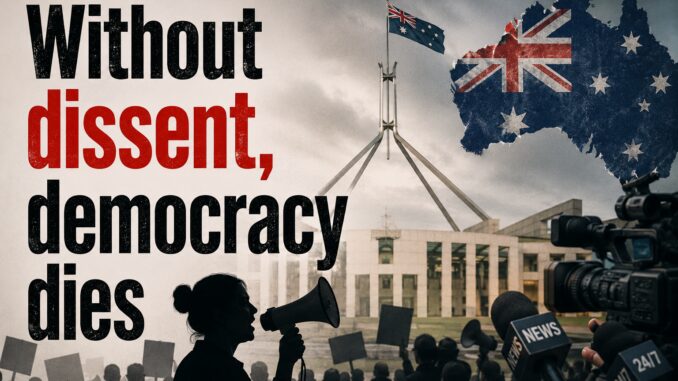
Dissent is the lifeblood of democracy. Not comfortable dissent, not licensed dissent, not dissent that has been reviewed by a QC and cleared by the risk-management committee: actual dissent, the kind that names names, follows money, holds power to account even when power would very much prefer to be left alone, even when the preference of power is backed by counter-terrorism legislation, defamation solicitors, intelligence agencies and the quiet withdrawal of every oxygen molecule that kept the truth teller breathing. A democracy that loses the institutional and economic capacity for that kind of dissent is not a democracy that has matured. It is a democracy in the early stages of something that has a name, and the name is not maturity.
The question, the only question that now matters, is whether enough people read the note before it becomes an epitaph. Whether enough people are furious enough, and organised enough, and willing enough to be visible: genuinely, inconveniently, undeniably visible. To tear it up.
Keep Independent Journalism Alive – Support The AIMN
Dear Reader,
Since 2013, The Australian Independent Media Network has been a fearless voice for truth, giving public interest journalists a platform to hold power to account. From expert analysis on national and global events to uncovering issues that matter to you, we’re here because of your support.
Running an independent site isn’t cheap, and rising costs mean we need you now more than ever. Your donation – big or small – keeps our servers humming, our writers digging, and our stories free for all.
Join our community of truth-seekers. Please consider donating now via:
PayPal or credit card – just click on the Donate button below
Direct bank transfer: BSB: 062500; A/c no: 10495969

We’ve also set up a GoFundMe as a dedicated reserve fund to help secure the future of our site.
Your support will go directly toward covering essential costs like web hosting renewals and helping us bring new features to life. Every contribution, no matter the size, helps us keep improving and growing.

Thank you for standing with us – we truly couldn’t do this without you.
With gratitude, The AIMN Team

Democracy is the resolution of dissent.