In the post colonial world, departing imperialists have handed over the power of government to indigenous leaders. A soft form of regime change.
Taking a waltz through Africa we see how well that has worked.
Zimbabwe took on a form of democracy but somehow managed to ensure that Robert Mugabe retained power, first when the country gained independence after a fifteen year struggle against the Smith white colonial government, as Prime Minister from 1980 till 1987 and then President for thirty years, enforcing his rule with racial violence aimed at European farmers and driving division on ethnic and political grounds while trashing the economy. The only real beneficiaries of that regime were Mugabe and his cohort.
So many of former colonies have followed that path, a struggle for independence, the formation of a national government and corrupt means to gain power and repress oppositions. The list is long and many of the conflicts ongoing. And the motivations appear to be similar, if not the same.
Power is sought through various groupings opposed to the colonial power, tribal and ethnic loyalties are laid aside in the struggle for independence but when that is gained, the arm wrestle for control begins, support is sought, often from foreign powers which have an interest in what ever resources the new nation state can offer, political alliances are formed, especially during the cold war period, Russian and American influence was played one against the other, arms were freely offered and development projects held as bribe motivators.
Today, China is a major player in seeking control over resources.
And then there are the religiously motivated wars, again in post colonial settings, where power vacuums are filled by Muslim warriors, as in the Sudan and Somalia, through Central African Republic, Mali, and other Sub-Saharan states.
Regime change has left power vacuums and civil strife as those power vacuums are filled by despotic leaders or religious hard line regimes.
Much the same has been seen in Asia, with Pakistan see-sawing from democratically elected governments to military overthrows, in Burma/Myanmar, much the same. Vietnam, Cambodia, even Indonesia have seen the struggles for independence fought as international interference has led to wars or internal repressions.
Should we even think about Afghanistan in this post colonial world?
That brings us close to the Middle East where international interference has stymied true independence, rather support for despotic leaders has ensured the commercial interests of the west are protected, the flow of oil and gas protected and ruling parties enriched beyond comprehension.
The Saudi royal family are pretty rich.
The most recent regime change has been the escape from Syria of the despot Bashar al-Assad to be replaced by the ISIS warrior and reputed terrorist turned good guy for now, Ahmed al-Sharaa. Although saying that Syria will be a peaceful nation in his government, rebuilding after its destruction during the civil war, there has been some bloodletting, some revenge taking. al-Sharaa’s role in Iraq from 2003, his ties to al-Qaeda and involvement with ISIS seem at odds with the his seeking legitimacy as a moderate leader, renouncing his past to focus on protecting Syria’s minorities. The jury is still out on that, but there is some hope that Syria will be a more peaceful place. If he succeeds, it will be in part due to there being a degree of organised resistance to the al-Assad regime and al-Sharaa’s political activism and organisation abilities. We live in hope.
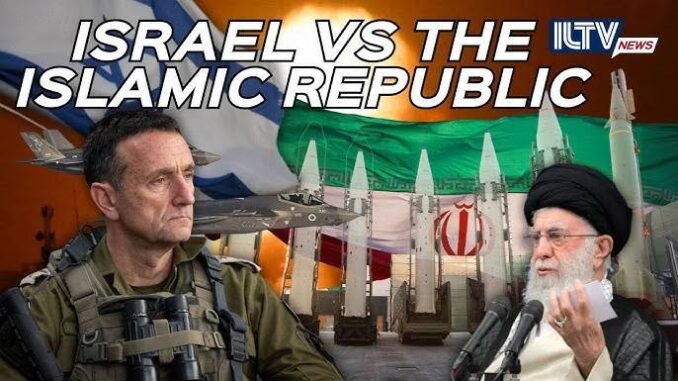
The question of regime change in Iran is something that Netanyahu has referenced but the foundations for a new government do not appear to be yet in place. Any opposition which exists, and it seem that there are a number of opposition voices, there is no evidence of there being and organised group ready to assume the role of interim government should the current government collapse, and in the vacuum that would exist, understanding the power of the Islamic religion in that country and in the region, the greater likelihood would be that another form of religious despotism would replace the ayatollahs.
Afghanistan is very close by and the influence of the Taliban cannot be discounted.
For Israel, that would be a major victory.
Throughout its history, Israel has worked on Arab disunity as being a major part of its defence.
In the recording of the destruction of Palestine and the oppression of the Palestinian people, Rashid Khalidi opens the first chapter of his book ‘The Hundred Years’ War On Palestine’ with a quote from Arthur James Balfour; “There are plenty of cases of war being begun before it is declared.” (Page 17)
Going back to Israel’s founding document, the Balfour Declaration and commentary around that document, there was a non-naming of the Palestinian people, a reference to there being people who lived there but they were quite insignificant in determining whether the Mandated territory of Palestine should be colonised, renamed Israel. There was to be no negotiating with the people who lived there, since they were not an organised nation, just a disparate bunch of Arabs. And so it sort of proved to be, the Palestinians watched on as parcels of lands were sold to new, incoming migrants, Jews from Europe who established Kibbutzes and introduced new farming practices.
The lack of recognition of Palestinians continued with the formation of the United Nations Resolution 181 which divided Great Britain’s former Palestinian mandate into Jewish and Arab states. Note that the term ARAB STATES is used, there is no mention of a Palestinian state. Palestine and Palestinians have been eradicated from the discussion, they are a non-entity. More than half the population was ejected in the Nakba of 1948, villages erased and replaced by parklands and forests, as so clearly described in Ilan Pappe’s ‘The Ethnic Cleansing of Palestine’ (2006), a book which came from Pappe’s PhD theses where he opened the archives of the foundation of Israel and read document after document of the erasure of Palestine. It was all there in the public record.
And so we move onto the growing population of Israelis, the influx of refugees from war torn Europe, survivors of the Nazi Holocaust found refuge in the promised return to their biblical homeland, as the now the lands cleared by the Nakba were opened up for the new settlers.
As for any hope of Arab unity forming to protect Palestinian interests were discouraged. A minority report in the UN Special Commission on Palestine stated that ‘Partition both in principle and in substance can only be regarded as an anti-Arab solution’. (Ibid Page 55) That being understood, efforts at dividing Arab attempts of unity were actively engaged. The Suez Canal conflict of 1956 is one such an effort, where Egypt was more concerned at retaining its own power, and controlling the major transport link from the Indian Ocean to the Mediterranean than to work with other Arab nations to paper over some of the issues which divided them then, as they do now. Commercial interests in the hands of Arab Royalty become personal.
The first real challenge to Israeli legitimacy came in 1967, a war which lasted (officially) a mere six days. Israel was seen as militarily weak. Israel had allowed that belief, in fact encouraged that belief to be understood among its Arab neighbours. Israel’s right to self defence has been its ‘battle cry’ in all its confrontations, but in the 1967 war, it proved that it was far more capable than its neighbours, including Egypt, then considered the major military power in the region. In the days leading up to the war, Israeli war planes attacked the unsuspecting airforce bases of Egypt, Syria and TransJordan, giving it air superiority, and able to strike any land based attacks, bombing tanks and other armoured vehicles as they attempted to cross the open desert terrains. Victory was swift and absolute.
In addressing that war, Khalidi opens the third chapter with a quote: “I was trying to see how an event is made and unmade, as ultimately it only exists via what one says about it, since it is properly speaking fabricated by those who spread its renown.” (Ibid Page 96) And in the chapter the myth of Israel’s vulnerability is expounded on. “This fiction has served to justify blanket support of Israeli policies, no matter how extreme, and despite the repeated rebuttal even by authoritative Israeli voices.” (Ibib Page 97)
It was and remains pure fiction that Israel is vulnerable, surrounded by superior Arab powers. Lyndon Johnson at the time expressed that he was confident that Israel would ‘Whip the hell out of’ any threatening Arab nation, or even alliance of nations. It is pure fiction today too, where the need for preemptive strikes, such as that carried out against Iran in recent days is justified through the expression of a threat from a potentially powerful enemy.
The fiction of Israeli vulnerability has ensured ongoing support from most Western nations, the supply of military hardware, political support in the UN and other international agencies, and when all else fails, the veto power that the US enjoys in the UN Security Council ensures that whatever international efforts are aimed at Israel they will be defeated in the UN.
Israel is in a powerful position. The fictional story of vulnerability, its constant appeal to the guilt of the west in allowing the holocaust, and its victim status ensures that support will be provided. Antisemitism is the biggest weapon it has in ensuring that Israel will survive, a constant reminder that antisemitism led to the holocaust, the genocide conducted in an attempt to rid Europe of Jews. Lay that at the feet of anyone who speaks out against Israeli atrocities.
Each time Israel goes to war, and there have been six wars it has initiated against neighbouring nations and in planned attacks on marginalised Palestinians, both in Gaza and on the West Bank, it has sown discord between the various opposition parties, whether it be with the attempts at Arab and Palestinian unity through the likes of the PLO, PLF and other so called ‘terrorist’ organisations, and between the neighbouring countries, with the infiltration of the various nations and groups by probably the best ‘spy’ organisation on the planet, Mossad.
So what chances are there that any form of regime change in the Middle East, whether the establishment of the al-Sharaa government in Syria which has to settle the disparate religious and political forces to establish stability, or, should the Ayatollah regime of Iran fall, that an organised stable government can be formed either of which would threaten Israel. Iraq is still a political shambles, and it is more than likely that both Syria and Iran would suffer that fate. The lack of a viable, coherent, strong government makes those countries vulnerable to Israeli power. Regime change is what Israel wants because it continues to destabilise the region, enhancing Israeli power.
It is part of the Israeli doctrine of fighting wars.
Quoting Khalidi, and reflecting on the tactics currently being used in Gaza, The West Bank and East Jerusalem:
“The doctrine holds that attacking pre-emptively or in a retaliatory fashion with overwhelming force, and by striking directly at civilian populations considered supportive of insurgents, the enemy can be decisively defeated, permanently intimidated, and forced to accept the terms of the coloniser.” (Ibid Page 262).
In Gaza, the term ‘Mowing the lawn’ has been used to keep up the pressure, to keep the population in a constant state of intimidation.
It would be fair to say that the lawn has now been ripped up.
Regime change, in the light of the tactics Israel has and continues to deploy would be in their interests. Within days of the over throw of the al-Assad regime, Syrian airforce bases were attacked: Demonstrating Israeli military power to the incoming government, a reminder to ‘behave’.
Regime change in Iran would destabilise the nation, allowing intimidatory tactics to keep them in check.
Nothing changes.
But it does beg the question of who the real terrorists are.
Also by Bert Hetebry:
Dear reader, we need your support
Independent sites such as The AIMN provide a platform for public interest journalists. From its humble beginning in January 2013, The AIMN has grown into one of the most trusted and popular independent media organisations.
One of the reasons we have succeeded has been due to the support we receive from our readers through their financial contributions.
With increasing costs to maintain The AIMN, we need this continued support.
Your donation – large or small – to help with the running costs of this site will be greatly appreciated.
You can donate through PayPal or credit card via the button below, or donate via bank transfer: BSB: 062500; A/c no: 10495969


No question about who is the ‘Mother of all terrorist states”-Uncle Sam, and it’s bastard son-Israel.
Shhhh Harry, not so loud. They may hear you.
“Today, China is a major player in seeking control over resources.”
Bert, you’ve done it again.
What’s with this fear of China?
How is trade “control over resources”?
If you have a point to make, then make it.
Genuine criticism is great, but not petty remarks.
Check out Alan Kohler at the ABC site now.
While Trump fights, China makes friends.
China’s leaders still work on the old-fashioned idea that economic policy is for improving the prosperity of citizens and strengthening the country, not for conducting ideological culture wars, and that diplomacy is about winning friends and influencing people.
I think Kohler is right, but that does not make it so. He could be wrong.
Let’s hear it.
https://www.abc.net.au/news/2025-06-23/trump-us-iran-war-economy-china/105446938
Knocking the Chinese has been a favourite western preoccupation for several hundred years; whether it was British chagrin in the 1800s at China’s pushback against the British East India Company’s determination to continue making a fortune through addicting countless Chinese to opium, which in turn eventually led to British & European forces acting militarily against inferior Chinese resistance, or the forcing of China to cede concessions to British & European countries… allowing them to set up territorial holdings – Hong Kong, Qingdao, Shanghai, Ningbo, Fuzhou, and Xiamen – along with the payment of reparations for losses due to the cessation of the opium trade, or the outrageous destruction & looting of the Old Summer Palace by British troops… truly an act of barbarity, never forgotten, never forgiven, the ruins extant as a constant reminder of the untrustworthiness of foreigners… all of these acts, and countless others, all served to indicate to the Chinese that they were deemed to be inferior, pagans, heathens, speakers of an unintelligible language, yellow-skinned… all these acts of overt & covert racism and implied superiority by people who were, objectively, inferior in many many ways. It’s always thus, this ‘holier than thou’ hypocrisy.
That ‘Century of Humiliation’ at the hands of the foreign devils was the turning point in respect of the birth and development of modern China. The overriding ethos is ‘never again.’ Despite the constancy of western propaganda, China is not a military threat in the sense that America is; it has no designs on extraterritorial acquisition; the argument over their South China Sea island claims is moot, their claim to Taiwan is historically legitimate and particularly so given the colonisation of that island by the defeated Kuomintang in the late 1940s, and the ongoing paranoia exhibited by commentators and so-called analysts wrt the phenomena that is the awakened dragon and its significance is to a large degree born of ignorance and a refusal to become fully acquainted with the history of that profoundly significant nation & its peoples.
OK Bert, fairly well observed. Albeit I concur with SD’s comment. And am most pleased about the accuracy of Canguro’s narration.
Whilst we’re at it, we may as well not leave out the fact of Britain, Europe & America repeatedly over many years interfering with, bribing and coercing the echelons of Iran, with the main objective of getting their grubby mitts on Iran’s resources, and also cleaving their way into the lands of Gog Magog. It is they (Europe Britain & America) that brought about the most recent installation of the Ayatollahs.
Indeed, just who are the insurgent terrorists?
Steve, take a look at the Chinese influence in Africa. They are right up their in exploiting the resources, but not taking over the lands in the tradition colonial way, they are funding developments, and will call in the debt. But they are somewhat more benign than the colonials of the past. The cost of development comes as loans. That is evident in the loans given at our back door, the Solomons, Papua New Guinea and other Pacific nations. Much the same has occurred in parts of Africa. That is the measure of control China has over its need for resources. Perhaps a new kind of colonial control, until we can find another term, but definitely more benign that the authoritarian arrogance of the imperial colonists of the past 200-300 years past.
China’s Imperial desires do not extend much past Taiwan, but their military might is purely defensive, and history has shown that repeatedly, going back to the time of the Silk Road.
Bert, thanks for the response, but can you provide evidence of exploitation.
Calling in a debt is not in itself exploitation, and there’s plenty of evidence of loan terms being re-adjusted.
Also evidence of debts being written off.
My reports on this are several years old now, so perhaps things have changed.
But links would be helpful, because I want to stay up to date on this.
Thanks.
Ah yes, “the supply of military hardware”, time to check out the superfund?
‘The companies listed here (below) have provided Israel with weapons and other military equipment used in its attacks on Gaza, the West Bank, Lebanon, and Syria since October 2023’:
https://afsc.org/gaza-genocide-companies
Bert appears to be having trouble finding evidence for Chinese exploitation of Africa’s resources, so I did a bit of digging myself.
A London School of Economics article sees problems for Africa other than Chinese influence.
https://blogs.lse.ac.uk/africaatlse/2024/10/28/foreign-countries-are-lining-up-to-exploit-africas-critical-minerals/
Foreign countries are lining up to exploit Africa’s critical minerals. On the sidelines of the UN General Assembly in September 2024, a significant meeting took place. Under the Minerals Security Partnership (MSP) a group of 14 countries and the European Union (EU), joined forces to finance the Kabanga Nickel Project in Tanzania, one of the world’s largest untapped nickel deposits.
The MSP members include the USA, Australia, Canada, Finland, France, Germany, India, Italy, Japan, the Republic of Korea, Norway, Sweden, the UK and the EU. There is no African country in the grouping, which is alarming.
The EU holds considerable regulatory power, shaping the global economic rules that countries, including those in Africa, must follow. Through policies like the Green Industrial Plan, the Carbon Border Adjustment Mechanism (CBAM), and the Critical Minerals Act, the EU exerts influence on how African nations can participate in global trade, especially in green industries. While these policies aim to promote sustainability, they inadvertently create significant barriers for African countries pursuing green industrialization and integration into the global economy.
The CBAM imposes tariffs on imports into the EU based on their carbon emissions. This disproportionately affects African exporters who may struggle to meet the EU’s stringent environmental standards due to a lack of resources or infrastructure. South Africa, where coal remains a major energy source, is a key example. The CBAM penalises such countries, making it harder for them to access the EU market, thus stifling their economic potential. Instead of providing support to help African countries transition to cleaner energy, the EU’s policies risk reinforcing unequal trade dynamics, where African nations and other developing countries face barriers to developing their own green economies.
The Critical Minerals Act prioritizes securing raw materials from African countries and does little to foster value addition or industrial development within these nations.
This regulatory framework locks African countries into a cycle where they supply essential resources for Europe’s green transition but are denied the opportunity to build local industries around those same resources. The result is a modern form of “green neo-colonialism,” where Africa’s role in the global green economy is reduced to resource extraction, benefiting wealthier nations while limiting Africa’s own development prospects.
A strong reason for China’s success in renewable energy is its effective long-standing relationship with African countries like Guinea and DRC where they have secured long term critical mineral supplies for minerals such as Bauxite and cobalt which are predominantly in those nations. In exchange, China has invested heavily in Africa’s infrastructure development with near term plans to support Africa’s mineral value addition and industrialisation plans.
Africa could leverage its relationship with China to benefit more from it, but even so, the Africa-China relationship has been one of the most advantageous for most African nations since 2000.
From the journal Mining Technology.
https://www.mining-technology.com/features/arrests-and-attacks-tracking-chinas-illegal-mining-in-african-countries/?cf-view
The journal seems to contradict the allegation of undue influence enjoyed by China with this — “The Democratic Republic of Congo has banned six Chinese businesses operating in South Kivu for illegally extracting gold and other minerals. Before this, according to the India Times, 33 Chinese nationals were detained in Ghana in 2019 for engaging in illegal gold mining activities.”
Even the United States Institute of Peace gets in on the act. (Now there’s a name to inspire confidence!)
https://www.usip.org/publications/2023/06/challenging-chinas-grip-critical-minerals-can-be-boon-africas-future
Here we see an article comprised almost entirely of motherhood statements based on the beneficence of US foreign policy, but even carefully worded propaganda cannot hide the purpose behind the article — US fear of economic competition. As in “ Forecasts estimate that in the coming decades, the world will need many times more cobalt, copper, lithium and manganese, among other minerals, than what is currently being produced. This poses a strategic challenge for the United States, as China dominates global critical mineral supply chains…”
And this “ The United States and its partners can work with African countries to help ensure that the dividends of these resources go first and foremost to Africans. But it will first have to overcome the immense in-roads China has already made on the continent.”
Dividends first and foremost to Africans? I’m pretty sure that’s not how capitalism works.
The article raised one allegation of substance —“China’s dominance in the sector hasn’t been beneficial to Africans. Its contract concessions are typically opaque and heavily tilted toward Beijing. Indeed, just the other week, DRC President Felix Tshisekedi traveled to Beijing, seeking to renegotiate a lopsided $6 billion infrastructure-for-minerals deal with Chinese leader Xi Jinping. In place since 2008, the deal has sent billions in minerals to Beijing, but little infrastructure for the DRC has materialized in return.”
Pretty bad, huh? Except for this. From Jan 2024, Voice of America — “Democratic Republic of Congo President Felix Tshisekedi has promised to use $7 billion from a renegotiated Chinese mining deal to build roads and infrastructure …”
In compiling this I stuck to recent sources to ensure relevance as much as possible. I found no recent articles that contained credible criticism of China.
I should add to my most recent comment that China’s business practices are not without blemish.
Individual Chinese businesses are engaged in a cutthroat game.
When it comes to foreign investment, they are certainly assisted by the Chinese government, but that is par for the course. All governments do that.
Chinese companies also compete against other Chinese companies for foreign contracts.
This process is not managed by China, as some might assume.
And so, as business is business, a company is just a company, after all.