When a philosophy becomes a religion, or using a definition for philosophy as being ‘a theory or attitude that acts as a guiding principle for behaviour’ becomes a dogma, a power structure which over rides the moral principles of human existence, we have a problem.
The George Orwell novel, 1984 was written shortly after World War II. A fictional account possibly based on the horrors of the Nazi regimes. The use of ‘philosophy’ as doctrine, a quasi religious manifestation of political power, the manipulative control of a population fostering hate, division and the inherent dangers of ever pervasive spying to ensure that disparate voices are silenced, the evil eye of Big Brother a ubiquitous reminder that no secret thought were beyond the watchful party apparatus.
The image visible to the main character, Winston, whether on the screen in his apartment or on the wall of Party Headquarters, visible through his window:
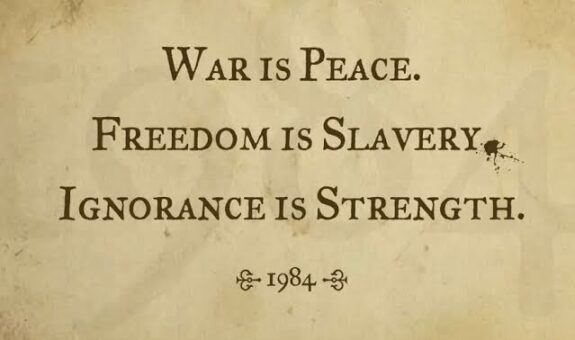
“… the face of Big Brother faded away again, and instead the three slogans of the Party stood out in bold capitals:
WAR IS PEACE
FREEDOM IS SLAVERY
IGNORANCE IS STRENGTH”
1984 is a work of fiction, an imaginary view of what may be in the not too distant future, leaning on lessons from the then recent past.
The Gulag Archipelago however is not a work of fiction, it is the collected writings of Aleksandr Solzhenitsyn, writings scribbled secretly while detained in the notorious prison system developed by the communist regime of the USSR to quell dissent, to enforce compliance to the doctrines of the ruling party… Or should that be the supreme leader, Party Chairman, Joseph Stalin.
The writings are a retelling of the stories told by fellow inmates during his time in detention.
From the foreword to the recently republished book, a key passage is quoted:
“So let the reader who expects this book to be a political expose slam its covers shut right now.” The passage proceeds to specify that moral matters are fundamental, because ‘the line dividing good and evil cuts through the heart of every human being’… far from limiting himself to politics, he (Solzhenitsyn) attends primarily to ‘timeless essence of humanity’ to those ‘fixed universal concepts called good and justice’.”
In 1984, the fear of arrest is evident from the first pages, the fear of writing down or saying thoughts which oppose the Party line. But the fear is in a work of fiction.
In The Gulag Archipelago, there is the reality of arrest:
“You are under arrest.”
If you are arrested, can anything else remain unsheltered by this cataclysm?
But the darkened mind is incapable of embracing these displacements in our universe, and both the most sophisticated and the veriest simpleton among us, drawing on all life’s experience, can gasp out only: “Me? What for?” (From the opening page of Chapter One.)
When politics becomes doctrine, when political philosophy becomes dogma, when ideology becomes the rule of law, freedoms are repressed.
In many respects we are most fortunate to live in one of the most democratic nations in the world. But we need to remember that Hitler’s rise to power was in the newly minted democratic Germany. The restive nature of politics during the Weimar Republic days saw conflicts between the various political parties, the clash of the ‘isms’, the experiment with ideologies and how to transition from the German Empire ruled by the House of Hohenzollern with Kaiser (King) Wilhelm II to a democracy was a painful journey as Germany dealt with the repercussions of defeat in WWI and the repressive conditions imposed by the Treaty of Versailles which very much restricted the rebuilding of the German economy and limited its military capacities. Germany was effectively told to pay for the damage caused by the war they had started.
Out of the ashes defeat and the disfunction of the Weimar Republic rose Hitler and his National Socialist party, which got enough votes in the election of 1932 to form a minority government and forced changes which ultimately made Hitler the ‘Fuhrer’, leader or guide, but effectively Dictator. Both Head of Government (Prime Minister) and Head of State (President).
That rise to power enabled political ideology to become dogma, the rule of law, the ability to govern through compliance or fear.
Joseph Stalin did not so much have a democratic system to manipulate as much as a political party to control. The rise to power of the communist regime came through the overthrow of the Czarist regime and a civil war to transform the philosophic foundations of The Communist Manifesto into political reality. But the equality sought in the philosophy of Marx was overlaid by a power structure, the democratic ideal restricted to the party faithful and the suppression of freedoms which conflicted with the variability of free speech.
His rise to power was through the strong man of politics, so strong that to stand up to him was lethal. As a military leader during the civil war he was ruthless, and when he attained the Chairmanship of the Communist Party he ruled both the party and the state in a draconian fashion. He is attributed to having been responsible for the deaths of over 20 million people and the development of the prison system called the Gulag.
In both cases, the governments had a form of democracy, but limited in who could participate, in both cases what started as a multi-party form, become a one party rule with a demagog as leader, a man who would not countenance opposition, wither within the party or from outside, controlling the press, controlling the information the public was privy to and imprisoning or killing opposing voices.. or even potentially opposing voices.
War is Peace
In both books, the idea of war is the struggle against opposition within the country. The idea of being at war with dissent and even potential dissenters.
Stalin imprisoned those who returned from Europe after WWII, fearing they may have experienced a somewhat better, more benign form of government, or that the economies being rebuilt after WWII were performing better than in the USSR.
Hitler’s war was a war of ethnic cleansing, but it was more than that. It was a crusade against all forms of ‘difference’, it was a commitment to falling in line behind the party. Targets for discrimination were as disparate as sexual deviance, mental illness, willingness to take up arms, the Jehovah’s Witnesses were on the ‘kill’ list, as well as ethnicities and racially defined people. Apart from those killed in WWII, the targeting of those not fitting the racial purity code of Nazi-ism saw over 11 million killed. Too often we are reminded that 6 million were Jews, but stated in such a way that we may believe that only Jews were targeted.
Freedom is Slavery
To be ‘free’ in USSR or Hitler’s Germany was to tread a fine line of subservience to Party rule. Deviation from that line made one a target in the WAR IS PEACE scenario. And when arrested, the question, “Me? What for?” The unspoken answer may well be “Just because.”
Both authors enumerate the many forms of punishment, the many reasons for the ‘just because’ and the many creative means of torture. One is an imagining, the other is a remembering.
Repeatedly ignored is the imprisonment of Palestinians in the West Bank or before 7 October 2023, in Gaza, ‘just because’, or brining it closer to home the imprisonment of First Nations people here in Australia, also seemingly ‘just because’.
Ignorance is Strength
Misinformation, lies or just a vacuum of information was the hallmark exposed in both books. The party, whether Big Brother’s fictional or the Communist Party of the USSR controlled information, lulling the population into a slumber of ignorance so they could be easily manipulated.
The spy network included children telling tales to teachers or other authority figures, or just saying the wrong thing over a drink, a coffee, a chat with a friend.
When philosophy becomes dogma, thinking is outlawed. This applies in religions, especially when religions become the government as we see in various Islamic regimes, or a run through the history of Europe, the religious wars of the Reformation period, but it also applies where too much power is in the hands of a political power elite.
Or when the flow of information and disinformation is such a fog that it is hard to discern what is real and what is not, what is true and what is fiction, ignorance becomes a comfortable place, just let the shit roll by. Disengagement is good, and so political participation is restricted, turned off.
In the political and geo-political climate of today, it is relevant to look at what lessons we may have learned, or what lessons are passing us by as we allow totalitarians to govern, to allow the the rights we have, the rights we rightfully demand, to be stripped away. The peace we desire to be rendered so fragile that we live in fear.
At a time such as we have now, where we have seen in Britain, considered a bastion of democracy by some , we have witnessed the misinformation campaign which was BREXIT, we see racism and Islamophobia rife. We see a continual fight against immigrants, racism rears its head constantly from a nation which was the greater Empire, with colonial holdings on every continent (except Antarctica), where it dominated over ‘inferior’ races.
In that leader of democracy, the USA, we see political participation fuelled by messages of hate and division, we see a ‘free press’, meaning the ever growing media, both mainstream and ‘social media’ demanding that freedom of speech means saying what ever one wants to say, no matter how wrong, how scurrilous, how defamatory, how hateful.
And the ostensibly democratic system to a congress and presidency being bought by the movers and shakers of industry.
And the rise to power of a most divisive president in the history of the American Republic who has managed to wage war against the very people he has sworn to defend, the least of the citizens who depend on government services such as food stamps, Medicare and Medicaid. A president who has unleashed the military on his war against immigration, sweeping up legal citizens along with those who are not documented as citizens but who are a much needed workforce, filling the most basic of tasks.
Both books, 1984 and The Gulag Archipelago were written to remind us of the dangers which are present in any political environment, that the rights we have, the rights which have been hard fought for are able to be removed. The right to question governments, the right to fight for the humane treatment of dissenters, the right to be who we are, what ever colour, creed, ethnicity, sexual orientation, what ever difference we choose to have, so long as that same right is extended to all others, is what underwrites humanitarianism.
The fight for freedom has been a long one.
After WWII the United Nations Organisation was formed as a watch dog over the world, trying to create a peaceful world. It has succeeded to some degree. I read recently that there have been about 26 days since the end of WWII that no wars were being fought.
I don’t know how accurate that is, but it is a scary thought.
That means that for 26 days in the last 80 years all people have been able to live in peace.
In establishing the bi-cameral structure of the UN, the winners of WWII, five nations, America, Britain, China, France and USSR (now Russia) were given the power of veto in the ‘upper house’ of the UN, the Security Council. That I suggest has been one of the worst decisions ever made in trying to establish an organisation built to ensuring a peaceful world, when time and again that power of veto has been used to enable genocidal conflicts to continue. In the case of Israel, that the conflict in Gaza, while condemned by so many, continues because debate is useless, since the USA will veto any sanctions proposed. The USSR and now Russia have protected its allies during the cold way period and into today.
John Lennon and Yoko Ono wrote these words in 1969:
Two, one two three four
Everybody’s talking ‘bout
Dragism, Madism, Ragism, Tagism Bagism, Shagism,
This-ism, that is-m, is-m, is-m, is-m
All we are saying is give peace a chance
All we are saying is give peace a chance
Let me tell you now
Everybody’s talking ‘bout
Revolution, evolution, masturbation, flagellation, regulation, integrations,
Meditations, United Nations, congratulations
All we are saying is give peace a chance…
Also by Bert Hetebry:
Dear reader, we need your support
Independent sites such as The AIMN provide a platform for public interest journalists. From its humble beginning in January 2013, The AIMN has grown into one of the most trusted and popular independent media organisations.
One of the reasons we have succeeded has been due to the support we receive from our readers through their financial contributions.
With increasing costs to maintain The AIMN, we need this continued support.
Your donation – large or small – to help with the running costs of this site will be greatly appreciated.
You can donate through PayPal or credit card via the button below, or donate via bank transfer: BSB: 062500; A/c no: 10495969


Thought crime! That’s what Iran is guilty of ? Yes? They were thinking about nuclear weapons weren’t they?
Or were they just thinking about not being attacked by Netanyahu?
Bert, I don’t know that it’s a great idea to present Solzhenitsyn as a credible historian. A great writer, perhaps not so great on the history.
There’s a fair chance that his Gulag Archipelago has a propaganda element to it.
From a critic — “In The Gulag Archipelago Solzhenitsyn systematically attempts to demonstrate with facts and figures that institutionalized terror began at the time of the October Revolution…In dozens of pages he lays out a detailed description of the red terror. But not a word about the white terror that came first and that led to the Bolsheviks’ response! Not a word about the generosity of the revolutionists in October, November, and December, 1917, when they freed most, if not all, of their prisoners; like General Kaledin, for example, who quickly responded by unleashing a wave of terror and assassinations against the proletariat in power! Not a word about the thousands of communists, commissars, and soldiers traitorously murdered throughout a country put to the torch and drowned in blood with the aim of reestablishing the rule of the landlords and capitalists. Not a word about the intervention of foreign armies, about the invasion of Soviet territory on seven different fronts! Solzhenitsyn the “moralist” and “nationalist” is singularly reduced in stature by presenting such a one-sided analysis.”
Now all that could be merely a case of he said this, no he said that, and we’ll probably never know the full story. (The reference to the dozens of pages about the red terror should be easy to check though.)
But I do know that we were fed lies about the prison camps. It turns out that while conditions were harsh, they were better than in many Western countries.
A 1957 CIA document titled “Forced Labor Camps in the USSR: Transfer of Prisoners between Camps” reveals the following information about the Soviet Gulag in pages two to six:
Until 1952, the prisoners were given a guaranteed amount food, plus extra food for over-fulfillment of quotas. From 1952 onward, the Gulag system operated upon “economic accountability” such that the more the prisoners worked, the more they were paid. For over-fulfilling the norms by 105%, one day of sentence was counted as two, thus reducing the time spent in the Gulag by one day. Furthermore, because of the socialist reconstruction post-war, the Soviet government had more funds and so they increased prisoners’ food supplies. Until 1954, the prisoners worked 10 hours per day, whereas the free workers worked 8 hours per day. From 1954 onward, both prisoners and free workers worked 8 hours per day. A CIA study of a sample camp showed that 95% of the prisoners were mainstream criminals.
We all need to keep in mind that almost all information of a political nature, an economic nature or a moral nature pertaining to perceived enemies or rivals of the West, is false.
Always a tendency towards reevaluation of the dominant paradigm; in this instance, Solzhenitsyn’s veracity. As a prisoner under the Stalinist program of internment of those who opposed his regime, his exposition via his published works spoke to his experiences in what he termed The Gulag Archipelago. Is it appropriate or necessary to critically reevaluate his account of his experiences?
It was good to see that Antoinette Lattouf won her court case. While many native born ozzies sat on their apathetic collective arses, this plucky woman fought a hard battle for truth. And this extends to our system, since the alternative to the win was a Goebbelsian msm system and the final defeat of a resposble press and media-
Whither Democracy?
An interesting read, it gives one reason to think.
“Is it appropriate or necessary to critically reevaluate his account of his experiences?”
I think yes, definitely.
The critic I quoted accepted the account of the Gulags. He did not accept the account of the Revolution and its aftermath, and gave what appears to be good reasons for that.
If the criticism is correct then it casts a shadow over the whole work. It calls into question Solzhenitsyn’s veracity, as you put it.
From wiki — Natalya Reshetovskaya described her ex-husband’s book as “folklore”, telling a newspaper in 1974 that she felt the book was “not in fact the life of the country and not even the life of the camps but the folklore of the camps.” In her 1974 memoir, Reshetovskaya wrote that Solzhenitsyn did not consider the novel to be “historical research, or scientific research”, (that was actually stated by Sol in a preface to one edition) and stated that the significance of the novel had been “overestimated and wrongly appraised.”
UCLA historian J. Arch Getty wrote of Solzhenitsyn’s methodology that “such documentation is methodologically unacceptable in other fields of history” and that “the work is of limited value to the serious student of the 1930s…”
There’s evidence that Solzhenitsyn was simply unhappy about the Revolution. In a 1980 issue of Foreign Affairs, a group of American scholars criticised Solzhenitsyn for his rosy image of pre-revolutionary Russia — a vision that elided, or falsified, many historical facts. Where he had argued that the Tsars tolerated dissident intellectuals and religious minorities (including Jews), historians observed that this was a fantasy. The Russian empire under the Tsars organised massive surveillance programmes, and routinely imprisoned and executed suspects without trial. Gulag is a Soviet term, but Siberia was used as a penal colony long before the Soviet era, and the brutal and dehumanising conditions imposed there under the Tsars led Dostoevsky to describe his four years in a Siberian prison camp as like being in ‘a world all of its own . . . a house of the living dead’.
There’s no denying that Gulag Archipelago was used as propaganda by the West. And as with much Western propaganda, it concealed unflattering details of our inhumanity at the time. Who can forget the French penal colony Devil’s Island, that operated for 100 years, from 1852 to 1952, and officially closed in 1953? It was notorious both for the staff’s harsh treatment of detainees and high mortality, with a death rate of 75 percent at its worst.
Pointing out the inhumanity of others in order to “give peace a chance” as Bert put it, is highly questionable.
How about we sort out our own inhumanity first?
In the Lattouf judgement Federal Court Justice Darryl Rangiah found that the ABC terminated her employment in 2023 to “appease … pro-Israel lobbyists” because “she held political opinions opposing the Israeli military campaign in Gaza”.
We need to value the independence of our judiciary as the foundation of our fragile democracy. “When philosophy becomes dogma, thinking is outlawed.”
Steve, thank you for your response.
Is The Gulag Archipelago a history book?
No, it is the reflections of one man who was imprisoned there. Yes, he was biased, but he does highlight that power can be abused, and often is abused.
We see that in Iran, we see that in the treatment of Palestinians in Israel.
It is interesting in some of the stories about Iran and from Iran at the moment talk about repression. Depending on who writes those stories, some may say that the morality police re doing ‘god’s’ work, just like the witch trials of New England were aimed at that.
Another book, a novel but highlighting the stupidity of having such a law is The Scarlet Letter. Not history, but a novel describing the hypocracy of such laws.
Interesting Steve, your closing comment was about sorting out our own inhumanity first.
That is a daily challenge. How do we behave toward others, how judgemental are we?
Yes, we need to do that Steve. I was reminded of that yesterday as I picked my car up from the mechanic who had serviced it. He had just released a vehicle to a young lady who did not have enough money to pay for the repairs she had done. She was allowed to take the car, having paid what she could. She needed the vehicle to go to work, and has agreed to pay the outstanding amount on the shake of hands agreement. Treated with empathy and respect. That is humanitarian behaviour.
We rep what we sow.
First, The Gulag Archipelago was not a novel; it was a large collection of writing, including – but not limited to – historical analysis, memoir and collected anecdotes.
Second, as a child of the Revolution, Solzhenitsyn was raised to accept the society it produced, without question. He was a good little soviet soldier until his own experiences lead him to examine both the political history and the reality of life in the USSR.
Third, no-one gets absolutely everything right, or covers every single aspect of a question accurately and objectively.
Fourth, the wrongs of an earlier regime do not justify or ameliorate the wrongs of its successor.
Whatever flaws there may be in that book, it is still an important account of a deeply troubling time and place in human history.
Thanks Bert, but all I’m saying is that it’s a slippery slope to attempt to improve our record on moral issues (personal or national) by referring to abuses in foreign countries.
In many cases we just do not know the full story of what occurs overseas, so why take the risk of slandering others unnecessarily?
Many of us see our system of liberal democracy as the pinnacle of social development, but to continue your prison theme, of the twenty worst prisons in the world according to the International Security Journal, all are in democracies of various descriptions.
Seven are in western liberal democracies.
Four are in the US.
Guantanamo Bay was No. 2.
https://internationalsecurityjournal.com/worst-prisons-in-the-world/
Closer to home, there was an article from Human Rights Watch in 2018 titled Interview: The Horror of Australia’s Prisons.
Why make use of failure elsewhere when we’re tripping over it here at home?
The unpleasant truth is that we are all conditioned by our news media to denigrate outsiders. We all fall for it. You fell for it in your 9.11am comment about Iran.
“Some of the stories talk about”??
“Some may say that”??
We do it without a second thought.
Actually, with no thought at all.
We are conditioned to react without thought.
Cleaning up that particular failing might be the best thing we can do to “give peace a chance”.
Thanks for the reference to The Scarlet Letter.
Works of fiction can be useful in this regard, but the difference to the Gulag Archipelago is that although both writers were knowledgeable about their subjects, Hawthorne’s motivation was admirable, Solzhenitsyn’s less so.
Using Gulag in this way also assists denigration of outsiders, even if that is not intended.
Apropos Solzhenitsyn’s The Gulag Archipelago and the tetchy issue of accuracy in depiction of that period, perhaps Varlam Shalamov’s Kolyma Tales offers something more acceptable.
“…perhaps Varlam Shalamov’s Kolyma Tales offers something more acceptable.”
Quite so Canga, but the existence of the camps and their brutality is not really an issue.
Surely the question that should be considered from the discussion this generated, is why Solzhenitsyn became a household name in the West while Dostoevsky and Shalamov are just two more Russian writers.
One possibility stands out like a beacon.
Gulag Archipelago, with its criticism of the revolution, had propaganda value for the West.
I remember reading Gulag Archipeligo (or most of it- a long book) a long time ago and the instances of callousness Solzhenytsin descibed were ghastly.
The downfalls, at different times, of party bigwigs, Secret police bosses and so forth seemed to give hime great comfort, especially when Gulag consequences were applied- very straight foward they were, from the the time Dzerzhinsky onward.
As to the West using Our hero against the
Soviet, chimes in with other stuff about Orwell, who also used a general critique of breakdown also used for propagnda purposes and McCarthyism.
In many cases we just do not know the full story of what occurs overseas, so why take the risk of slandering others unnecessarily?
Define unnecessarily.
Written histories (whether as novels or purported reportage) that focus on the perpetrators and their ‘structures’ and ‘doings’ of ‘wrongs’, so often from the perspective of a victim (casualty or martyr), may be prone to bias and as such, invariably contestable.
Perhaps more insight on the idiosyncrasies of a culture’s humanity can be gained from allegory – long a tradition which all can participate in and more readily (in abstract) allow us to plumb the depths of our own nature, such as in the stories for children.
Accordingly, the article and comments remind me of Bulgakov’s The Master and Margarita, a tour de force.