By Denis Hay
Description
Comprehensive guide to public housing, community, and social housing, featuring 2024 statistics and policy updates leveraging Australia’s dollar sovereignty.
🎧 Prefer to listen to this article? Press play
Introduction: From Stability to Crisis
There was a time when public housing in Australia was a source of stability, dignity, and opportunity for hundreds of thousands of working families. After World War II, governments built homes on a massive scale, creating thriving communities and ensuring people could live securely without being crushed by rent or mortgage debt.
Today, that vision has faded. Public housing stock has declined sharply, replaced in part by community housing providers and a housing market dominated by private investors. Waiting lists have grown, and housing has shifted from being a human right to a commodity.
The change is not due to a lack of money. Australia’s monetary sovereignty means the government can directly fund large-scale construction if it chooses. The question is whether there is the political will to do so.
The Problem: Why Australians Feel Stuck
The Golden Era of Public Housing
From the 1940s through the 1970s, Australia experienced its golden era of public housing. The Commonwealth–State Housing Agreements (CSHAs) provided a framework for funding and building homes directly through public works departments.
These homes were not just for the unemployed or disadvantaged. They were built for working-class families, giving them a secure, affordable place to live while they worked and raised children.
- Scale: Hundreds of thousands of homes built across all states and territories.
- Quality: Solid construction, often brick, designed to last decades.
- Affordability: Rents set at reasonable levels, usually a fixed percentage of income.
Public housing back then played a vital role in economic stability, ensuring that workers were not priced out of their communities.
The Decline Under Neoliberalism
From the 1980s onwards, neoliberal policy shifts began dismantling this system. Governments sold off public housing stock, stopped building at scale, and began funnelling public money into subsidies for the private rental market.
Key features of the decline:
- Stock sell-offs: Large housing estates sold to private developers.
- Targeting: Public housing redefined as “housing of last resort” for those with the highest needs.
- Funding changes: Reduced direct investment in new builds.
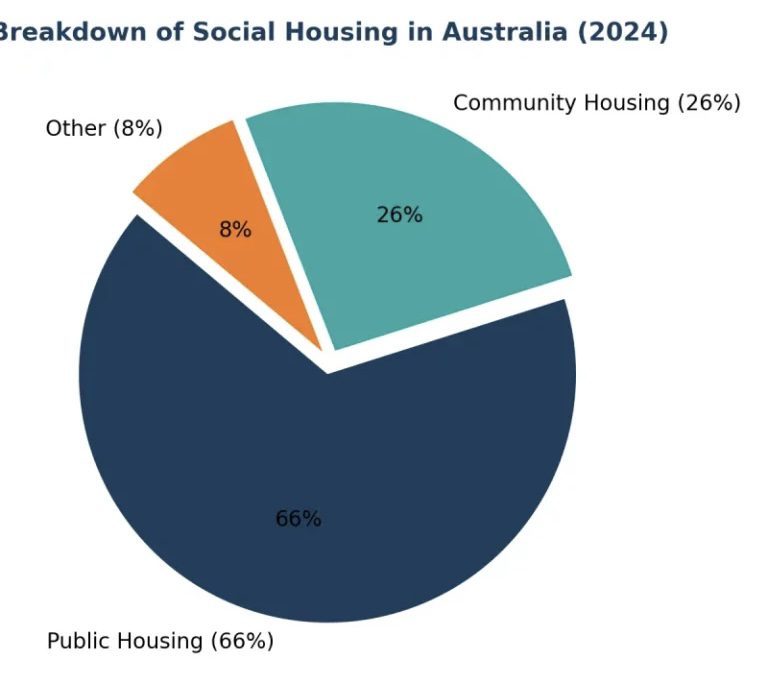
By June 2024, only 66% of social housing stock was public housing. The rest was community housing or other forms of non-market housing.
The Impact: What Australians Are Experiencing
Rising Social Housing Demand
The term social housing covers both public housing and community housing, all provided at below-market rent to eligible tenants.
As of June 2024:
- Total stock: 452,000 dwellings.
- Public housing: 298,000 dwellings (66%).
- Community housing: 119,000 dwellings (26%).
- Other categories: Aboriginal housing and state-owned, privately managed properties (8%).
What this means in practical terms
Imagine 100 social housing homes:
- 66 would be owned and managed by the government (public housing).
- 26 would be run by non-profit or community organisations (community housing).
- 8 would be other types, such as Aboriginal-owned housing or government-owned homes run by private managers.
In the past, almost all 100 homes would have been public housing. Today, public housing makes up only about two-thirds of the total, with community housing taking a growing share. This shift means fewer homes are directly built and owned by the government, and more tenants deal with non-profits instead.
Demand far outstrips supply. Waiting lists are often measured in years, not months. Some people remain in insecure private rentals for years while they wait for a social housing placement.
Growing Role of Community Housing
Non-profits or housing associations manage community housing. These organisations may own the properties or manage them on behalf of the government.
Growth has been rapid:
- In 2006: ~30,100 community housing dwellings.
- In 2024: 119,000 dwellings – almost a fourfold increase.
Community housing providers (CHOs) reinvest rental income into housing maintenance and expansion, but they operate under different rules than government-run public housing. Tenancies may be less secure, and rents can be slightly higher.
While CHOs play an essential role, they cannot fully replace the stability and scale of government-built housing.
The Solution: What Must Be Done
Monetary Sovereignty and Public Housing
Australia is a currency sovereign nation. It issues its own currency, which means it cannot “run out of money” to pay for projects in Australian dollars. The real limits are resource availability, skilled labour, and construction capacity – not the federal budget balance.
Using monetary sovereignty, the government could:
- Directly fund large-scale housing projects.
- Employ workers through public works programs.
- Guarantee ongoing maintenance and upgrades.
This is how public housing was funded during its golden era, and it remains possible today.
Policy Actions for a Fair Housing Future
A modern housing strategy should:
- Build at least 25,000 public homes annually to meet growing demand.
- Retain public ownership to ensure long-term affordability.
- Use community housing partnerships only when they increase net supply, not replace public stock.
- Integrate housing policy with healthcare, education, and transport planning.
- Adopt best practices from countries like Austria’s Vienna model, where more than 60% of residents live in affordable public or co-operative housing.
Case Studies: Lessons from the Ground
- Positive Example: The Carlton redevelopment in Melbourne combined public and community housing with improved public spaces and services.
- Cautionary Tale: The Millers Point sell-off in Sydney displaced long-standing residents and removed hundreds of public housing units from the system, showing the harm of prioritising asset sales over community stability.
International Comparisons
Many countries continue to invest heavily in government-built public housing or large-scale co-operative housing systems. These examples show that secure, affordable homes for all are not just possible – they are policy choices.
Why this matters for Australia
If these nations can sustain high levels of publicly funded housing, Australia can too. The difference lies in political will, not financial capacity. With our monetary sovereignty, we can invest in building large-scale public housing without relying on private developers or waiting for market conditions to improve.
Frequently Asked Questions
Q: What’s the difference between public housing, community housing, and social housing?
Public housing is owned and managed by the government. Non-profits manage community housing. Social housing is the umbrella term for both.
Q: Why did public housing decline in Australia?
Neoliberal policies from the 1980s onward prioritised market delivery and asset sales over direct public provision.
Q: Can Australia afford to build more public housing?
Yes. As a currency sovereign nation, Australia can fund housing directly without needing to raise taxes first.
Final Thoughts: Reclaiming the Right to a Home
Public housing in Australia has moved from being a pillar of opportunity to a lifeline for the desperate. This shift is a political choice, not an economic necessity.
By using our monetary sovereignty, we can once again guarantee that every Australian has access to a safe, secure, and affordable home.
What’s Your Experience?
How has the decline of public housing in Australia affected you or your community? Share your thoughts below.
Call to Action
We’d Love to Hear from You!
Inspired by this article?
See what others are saying on our Reader Testimonials page.
Please share your thoughts via our Reader Feedback form. Your voice helps shape future content.
Scroll down and leave a comment below to join the discussion.
If this article resonated with you, explore more on political reform and Australia’s monetary sovereignty at Social Justice Australia.
Spread the word:
Please share this article with friends, family, or your social networks to keep the conversation going and help build a fairer, more just Australia.
Email this to 3 friends who care about social justice and a fair go for all citizens.
Keep Independent Journalism Alive. Support Voices That Challenge the Status Quo
We’re 100% reader-supported, no ads, no corporate strings, just honest, truth-driven journalism.
If our work informs or inspires you, please chip in.
Donate Now, one-time or monthly. Even $5 helps us keep publishing.
Together, we’re making change possible.
Already donated? Share the love by leaving us a quick review on Google to help others find us.
Engaging Question
What’s the first public investment you’d fund with Australia’s dollar sovereignty: housing, health, education, or green energy?
References
Australian Institute of Health and Wellbeing: Housing Assistance in Australia: Social Housing Dwellings
Community Housing Industry Association: Community Housing Industry Profile 2025
Australian Bureau of Statistics: Census Data: Housing Tenure and Landlord Type
This article was originally published on Social Justice Australia
Dear reader, we need your support
Independent sites such as The AIMN provide a platform for public interest journalists. From its humble beginning in January 2013, The AIMN has grown into one of the most trusted and popular independent media organisations.
One of the reasons we have succeeded has been due to the support we receive from our readers through their financial contributions.
With increasing costs to maintain The AIMN, we need this continued support.
Your donation – large or small – to help with the running costs of this site will be greatly appreciated.
You can donate through PayPal or credit card via the button below, or donate via bank transfer: BSB: 062500; A/c no: 10495969


Having been fortunate to get a family home from the NSW Housing Commission in 1994, where I still live, I have seen some of the changes mentioned in the article. One that I believe feeds the spiralling cost of rents everywhere, is that the market rent of similar homes in the whole town is now used as the benchmark for the rent. Considering that many of these public or social housing homes are not up to normal standard, this can mean that a high rent is being charged for a basic residence. My house, for example, has four bedrooms, and a 699 square metre block, so quite desirable on size. But there is no garage, no built-in cupboards, quite basic kitchen fittings, shower over bath, no light fittings, no curtains. Funnily enough, it is in a rather depressed neighbourhood, and has a low reputation as a locality. Meanwhile, rents rise in the area because, if you can get the existing average rent for a basic house, then a better house can demand higher rent.
Rebated rent is very helpful, but the total earnings of every person in the household are considered for the figure receiving the rebate. Should the tenant lose their job, the rent will be dropped. However, on the other hand, when your child reaches 16 years of age, their income will be counted. When that child gets a part time job the rent on the household goes up. When there is a pension increase, the household income goes up. This puts extraordinary pressure on poor families as any improvement in incomes leads to a rent increase.
There was a time in the past, when tenants could apply to buy their home. The cost was paid off through a calculation that included some rent and a contribution towards the purchase. However, this was ended by the same Liberal Government that decreed public housing rents should be based on the market. Again a calculation representing the local average value of houses being sold in the town was imposed, not a figure that recognised the basic nature of the houses. A tenant now needs to secure a bank loan and get a mortgage, just like anyone else – equality I suppose. One of the effects of this decision has been to remove the incentive to care for homes and localities as having a future for the people living there. “Houso” areas are becoming more depressed.
Another thing that happens to public housing families is that, if the main tenant dies or can no longer live in the house, the family members may be evicted rather than being allowed to stay with a rebated rent that reflects the changed household income. I saw this happen a few years ago when the mother of a lass doing her HSC died suddenly, and the girl, although old enough to manage at home at least in the short term, was sent away to live with relatives,while her younger half-brother was given into the care of a different family. I myself pay quite a high rent because I have a disabled adult son living with me. He does not understand that his income counts against the rent I pay, and so I pay a higher rent that covers him being there. If I die, or need aged care, I don’t know what will be done about my son.
LyndaLyndal, I’m sorry you’re carrying this. What you describe feels like the system prioritising price over people. Since the 1980s, governments shifted from building homes with simple, stable rents to a market-benchmark plus income-rebate model. That neoliberal approach means even basic houses can be priced off the “average,” lifting rents locally and adding stress when a teenager gets casual hours or pensions rise. Succession uncertainty makes it heavier still.
Here Here are practical steps that are usually available:
Ask for a rent reassessment and condition review (list missing features, neighbourhood disadvantage).
Request a hardship review and a gentler taper, noting your caring role and your son’s disability needs.
Seek a written succession/continued-occupancy plan now, so your son’s housing is secure if your situation changes.
Get help from a tenants’ service or community legal centre to draft the requests and come to meetings.
None of this is inevitable. As a currency-issuing nation, Australia can choose fairer rent rules and build public homes again.
Thankyou for your helpful advice, Denis
Interesting but pertinent talk between Lyndal and Denis Hay..
aap on MWM have published an article on how well Labor’s housing build programs are going entitled “Nation’s big home build already off target”.
The figure Labor bandied about was that it would build 1.2 million homes by 2029. Does that include builds that would have gone ahead even if Labor did nothing?
The figures and graphs on the ABS website would seem to indicate so. Whether you look at builds completed, or builds commenced the figures show things are far worse than they were in 2018.
Labor’s housing policy is a conn. Labor is pissing down our backs and telling us its raining. This while over 3 million Australians live in poverty.
https://michaelwest.com.au/nations-big-home-build-already-off-target/
https://www.abs.gov.au/statistics/industry/building-and-construction/building-activity-australia/latest-release
public service rules:
My bridge partner, a 10 pound pom, children left home in late 70s. with rent grandfathered at $32 per week in a two bedroom two level townhouse. At nearly 90 stairs are hard but to shift means paying full rent.
An African immigrant couple get gov single bedroom flat, child born get upgrade to the next door two bedroom townhouse get a separation man keeps the house and wife gets another two bedroom townhouse. Two others have single women paying grandfathered rent. That is 4 out of an eight townhouse complex.