By Maria Millers
Alas, this exciting news from 2023…
“It’s truly exciting news that Australia is about to appoint its first poet laureate in 200 years. At last the Albanese government is giving poetry proper recognition as an art form that speaks to and for a country’s people, not something that exists only in schoolrooms, fusty old books or funky bars.” (Jane Sullivan).
… has been put on the backburner. And anyway, probably for most Australians it would be far down on their list of priorities. What they would ask is what has poetry got to do with cost of living pressures, housing unavailability, climate anxiety, technological disruption and many other concerns of modern living?
And yet in past times of disruption, uncertainty and hardship whether caused by war, political upheaval, economic hardship or national tragedy, poetry has often flourished.
Today there is confusion about what kind of country Australians believe themselves to be, and what kind of country are they actually becoming? There is however little leadership in fostering a debate around this topic.
Modern life increasingly rewards speed, distraction, and simplified narratives. Poetry asks readers to slow down, notice details and tolerate complexity.
And poetry often succeeds where reports, speeches, policy papers, and news articles struggle. It distils political, social, and moral issues into images, stories, rhythms, and emotions that people can carry with them long after the details are forgotten.
Poets from oppressed or disadvantaged communities often articulate experiences that dominant institutions overlook. It’s this ability to transform public issues into human experience that’s one reason why poetry has remained politically and socially influential from the time of Homer to contemporary poets writing about climate change, migration, war, and inequality.
Poetry, of course, does not solve inequality directly, but it can challenge assumptions, build empathy, and expand public understanding of whose stories matter and can express those feelings that many people may share but find hard to express.
A Poet Laureate can bring a different kind of leadership: a cultural and moral one, other than a political one.
US Youth Poet Laureate, Amanda Gorman’s poem The Hill We Climb, delivered at the presidential inauguration in 2021, emphasized democratic renewal and collective responsibility during a time of intense political division
We will rebuild, reconcile, and recover.
And every known nook of our nation and every corner called our country, our people diverse and beautiful, will emerge battered and beautiful.
When day comes, we step out of the shade aflame and unafraid.
The new dawn blooms as we free it.
For there is always light, if only we’re brave enough to see it.
If only we’re brave enough to be it
Poets can also be critical and highlight injustices, inequality, moral failings and invite people to reflect.
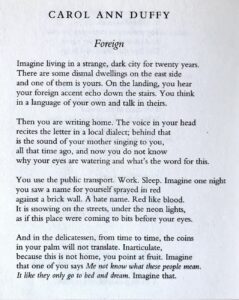
UK Poet Laureate 2009-2019 Carol Ann Duffy wrote poems responding to contemporary events, helping readers reflect on social and political changes, promoting unity while acknowledging difference
Imagine living in a strange, dark city for twenty years.
There are some dismal dwellings on the east side
and one of them is yours. On the landing, you hear
your foreign accent echo down the stairs. You think
in a language of your own and talk in theirs.
Then you are writing home. The voice in your head
Recites the letter in a local dialect; behind that
Is the sound of your mother singing to you,
All that time ago, and now you do not know
Why your eyes are watering and what’s the word for this.Excerpt from (Foreign)
Many laureates seek common ground while acknowledging diverse experiences. Rather than issuing directives, they invite reflection and dialogue.
Current UK Poet Laureate Simon Armitage promoted poetry projects that encouraged participation and reflection during the COVID-19 pandemic era. He believed that a laureate must be prepared to go into schools, prisons, communities, hospices, theatres, festivals and nightclubs and address social change:
Give
Of all the public places, dear
to make a scene, I’ve chosen here.
Of all the doorways in the world
to choose to sleep, I’ve chosen yours.
I’m on the street, under the stars.
For coppers I can dance or sing.
For silver-swallow swords, eat fire.
For gold-escape from locks and chains.
It’s not as if I’m holding out
for frankincense or myrrh, just change.
You give me tea. That’s big of you.
I’m on my knees. I beg of you.
This is a remarkably simple poem, spoken by a homeless person sleeping in a doorway and asking for some compassion from a stranger.
The longest serving Poet Laureate was Lord Alfred Tennyson (1850-1892) best remembered for The Charge of the Light Brigade, written shortly after reports reached Britain of the disastrous cavalry charge at the Battle of Balaclava during the Crimean War.
The charge resulted from confused orders and led hundreds of British cavalrymen into devastating Russian fire. It was recited publicly, memorized by schoolchildren, and helped sustain morale during a difficult war. The poem simultaneously recognizes bravery but also military incompetence:
Most recall the lines
Theirs not to reason why,
Theirs but to do and die.
By the twentieth century, poets such as Wilfred Owen felt freer to challenge patriotic narratives directly.
Poems such as Dulce et Decorum Est changed public perceptions of war. Owen did not debate military strategy; he showed readers the suffering of a single soldier during W1.
If you could hear, at every jolt, the blood
Come gargling from the froth-corrupted lungs,
Obscene as cancer, bitter as the cud
Of vile, incurable sores on innocent tongues,-
My friend, you would not tell with such high zest
To children ardent for some desperate glory,
The old Lie: Dulce et decorum est
Pro patria mori.
Writing today, Mohammed Mousa in They ask me who I am describes Gaza as the ‘largest open-air prison’ but this does not prevent him from holding on to hope:
nothing I want more than a homeland,
unrestricted birthplace,
no fences of tyranny,
no walls of oppression,
no checkpoints to undress my fears,
with clouds heavy enough to carry my soul.
Australian Indigenous poets have often used poetry as both art and advocacy, transforming social and political issues into powerful personal testimony. Their work frequently addresses dispossession, racism, cultural survival, identity, incarceration, environmental stewardship, and reconciliation.
Australian Indigenous poets such as Oodgeroo Noonuccal had transformed political arguments about Aboriginal rights into direct, personal, memorable language. Even today, her voice continues to inspire new generations to honour their roots and stand tall in the face of adversity: poets like Ali Cobby Eckermann, Ellen Van Neeren, Tony Birch, Emily Araluen follow in her footsteps.
We are as strangers here now, but the white tribe are the strangers.
We belong here, we are of the old ways.
We are the corroboree and the bora ground,
We are the old ceremonies, the laws of the elders.
We are the wonder tales of Dream Time, the tribal legends told.Excerpt from We are Going.
Today poetry has a new way of reaching people. Poetry no longer lives only on the page, but on stages, screens, headphones, social media feeds, and public spaces.
Many scholars argue that poetry today may actually be reaching more people through spoken word, rap, podcasts, and digital media than through traditional printed poetry collections alone.
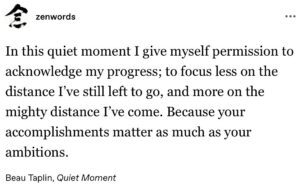
Beau Taplin represents a newer generation of poets, one that does not fit the traditional profile of a poet.
He came to fame through social media, posting his own song lyrics in poetry form, and has grown a following of more than 800,000 fans on social media.
But despite his status as one of Australia’s most widely-followed poets, the Melbourne-based author had mixed feelings about the poet laureate announcement.
“When I first heard about it – and this is very pessimistic – but I just felt like it would likely be a meaningless title because they would go in a direction where it’s not really about everyday people,” he said.
Some say that reading or writing poetry can be a small act of resistance against a culture that often reduces and labels people only as consumers, voters, or social media profiles.
Of course a poem cannot feed the hungry, house the homeless, stop a war or redesign a tax system. Even though poetry does not produce change automatically it can shape perceptions, values and imagination.
In an age increasingly influenced by algorithms and artificial intelligence, poetry may become more valuable precisely because it emphasizes qualities that are deeply human: attention, ambiguity, emotional depth, lived experience, and the search for meaning.
Trauma, grief, humiliation, and moral injury can be difficult to describe directly. Poetry can reveal what these conditions feel like from the inside.
In periods of social stability, poetry may seem peripheral. In periods of crisis, people often return to it because social breakdown is not merely a technical problem, it is also an emotional, moral, and imaginative problem.
A historian may need 500 pages to explain a war, a poet may crystallize the emotional reality in a few lines.
For example, from W. H. Auden’s poem September 1, 1939: We must love one another or die.
People may forget an argument, but they often remember an image, a metaphor, or a line of verse for decades.
Also by Maria
Keep Independent Journalism Alive – Support The AIMN
Dear Reader,
Since 2013, The Australian Independent Media Network has been a fearless voice for truth, giving public interest journalists a platform to hold power to account. From expert analysis on national and global events to uncovering issues that matter to you, we’re here because of your support.
Running an independent site isn’t cheap, and rising costs mean we need you now more than ever. Your donation – big or small – keeps our servers humming, our writers digging, and our stories free for all.
Join our community of truth-seekers. Please consider donating now via:
PayPal or credit card – just click on the Donate button below
Direct bank transfer: BSB: 062500; A/c no: 10495969

We’ve also set up a GoFundMe as a dedicated reserve fund to help secure the future of our site.
Your support will go directly toward covering essential costs like web hosting renewals and helping us bring new features to life. Every contribution, no matter the size, helps us keep improving and growing.

Thank you for standing with us – we truly couldn’t do this without you.
With gratitude, The AIMN Team
Uhm ….. the late Les Murray (1938-2019) was possibly the last Australian poet to even be considered for an Australian Poet Laureate nomination.
https://en.wikipedia.org/wiki/Les_Murray_(poet)#:~:text=Leslie%20Allan%20Murray%20(17%20October,collections%20of%20his%20prose%20writings.