Before Palestine became a battlefield of competing nationalisms, it was something far less dramatic and far more instructive: a plural society. Muslims, Christians, and Jews lived across the country under the governance of the Ottoman Empire – not as equals in the modern democratic sense, but as communities governed by a legal order that prioritised coexistence over domination.
That historical reality matters today, because it challenges a central myth: that Zionism arrived to redeem a land defined by religious hostility or demographic absence. Neither was true.
A plural society, not a vacuum
In the late nineteenth century, Palestine was overwhelmingly Arab in language and culture, religiously mixed, and socially interconnected. Jewish communities – often called the Old Yishuv – were long-established, Arabic-speaking, and locally embedded. Christian Palestinians maintained churches, schools, and civic institutions dating back centuries. Identity was local and communal, not nationalist.
This was not an idyllic society. Ottoman Palestine was hierarchical and imperfect. But it was not organised around ethnic replacement, nor did it pursue a political project of removing one people to secure the sovereignty of another.
Were Ottoman laws fair?
By contemporary standards, Ottoman governance was not democratic or fully equal. Yet by the standards of its time, it was comparatively tolerant and functional.
Under the Ottoman millet system, non-Muslims were recognised as protected communities (dhimmi), permitted to practise their religion, manage communal affairs, and hold property. Jews expelled from Christian Europe repeatedly sought refuge in Ottoman lands, including Palestine.¹
In the nineteenth century, the empire initiated the Tanzimat Reforms, which aimed – however unevenly – to equalise subjects before the law regardless of religion.² These reforms reduced religious hierarchy rather than intensifying it.
Crucially, Ottoman law did not pursue demographic engineering. It governed diversity; it did not attempt to erase it.
Zionism as rupture, not return
Political Zionism emerged not from Palestinian Jewish life but from nineteenth-century Europe, shaped by ethnic nationalism and colonial settlement logic. Its leaders were explicit about the central obstacle they faced: Palestine was already inhabited.
Rather than abandoning the project, early Zionists debated how to overcome that reality. Theodor Herzl wrote privately of removing the indigenous population through economic exclusion.³ Zionist institutions adopted policies of land acquisition coupled with tenant removal, “Hebrew labour only”, and the construction of a separate economy.⁴
Demographic dominance was understood as a prerequisite for sovereignty. Mass immigration would create irreversible “facts on the ground,” after which political recognition could follow.
“Transfer” and force
By the 1930s, leading Zionists discussed population removal – often termed “transfer” – as necessary. David Ben-Gurion acknowledged that a Jewish state could not be realised without displacement, writing that compulsory transfer could provide “something which we never had.”⁵
Ze’ev Jabotinsky was even more candid. In his 1923 essay The Iron Wall, he argued that indigenous peoples never consent to colonisation, and that Jewish sovereignty would require overwhelming force until resistance was broken.⁶ This was not a religious argument; it was a settler-colonial one.
Palestinian Jewish opposition – erased from memory
These developments were not universally welcomed by Jews in Palestine. Many Palestinian Jews opposed Zionism, fearing it would shatter coexistence, recast Jews as settlers, and provoke conflict with Muslim and Christian neighbours. Their objections were pragmatic and prescient. They understood that they – not European ideologues – would live with the consequences.
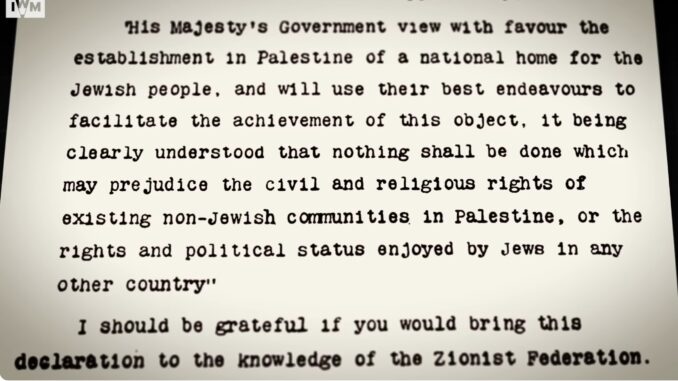
Zionism’s eventual dominance owed less to universal Jewish consent than to imperial sponsorship, particularly British support following the 1917 Balfour Declaration, and to the catastrophic narrowing of perceived alternatives after the Holocaust.
What was lost
Zionism transformed Jewish identity from a plural, diasporic, and ethical tradition into a political nationality defined by territory, demography, and security doctrine. Dissent increasingly became framed as disloyalty. Equality became a threat.
The tragedy is not that Ottoman Palestine was perfect. It is that a plural society governed by law – however flawed – was dismantled and replaced by a project that required dominance to succeed.
That is the historical rupture. And it is why the conflict is modern, political, and structural – not ancient or inevitable.
A society that already contained Jews, Christians, and Muslims was remade into a battlefield by a European nationalist project that could not tolerate equality.
Understanding that history does not deny Jewish suffering. It honours it – by insisting that persecution should never be answered with its reproduction.
Footnotes and Primary Sources
- Karen Barkey, Empire of Difference: The Ottomans in Comparative Perspective (Cambridge University Press, 2008).
Carter V. Findley, Turkey, Islam, Nationalism, and Modernity (Yale University Press, 2010).
Theodor Herzl, The Complete Diaries, ed. Raphael Patai (Herzl Press, 1960), entry for 1895.
Gershon Shafir, Land, Labor and the Origins of the Israeli-Palestinian Conflict, 1882–1914 (University of California Press, 1996).
David Ben-Gurion, letter to his son Amos, 1937, cited in Simha Flapan, The Birth of Israel: Myths and Realities (Pantheon, 1987).
Ze’ev Jabotinsky, The Iron Wall (We and the Arabs), 1923.
Keep Independent Journalism Alive – Support The AIMN
Dear Reader,
Since 2013, The Australian Independent Media Network has been a fearless voice for truth, giving public interest journalists a platform to hold power to account. From expert analysis on national and global events to uncovering issues that matter to you, we’re here because of your support.
Running an independent site isn’t cheap, and rising costs mean we need you now more than ever. Your donation – big or small – keeps our servers humming, our writers digging, and our stories free for all.
Join our community of truth-seekers. Donate via PayPal or credit card via the button below, or bank transfer [BSB: 062500; A/c no: 10495969] and help us keep shining a light.
With gratitude, The AIMN Team


We seem poised on how far we go to please the Jewish community after the recent event, but one aspect of our commitment is what we teach our young at school>
Jillian Segal is most insistent that she wants to catch them young and plant ideas in their head which may remain for a life span.
Historical facts as detailed in this piece may be quite different from what is taught in Jewish schools, and what Ms Segal has in mind for Aussie kids.
I have a strong preference for facts which can be verified over the delusional history which is cobbled together for the current generation of Israeli schools.
A brief recap of the more recent history…
* members of the Arab League declared war on Israel immediately after it was legally created by the United Nations
* the 2 state solution was accepted by Israel but rejected for decades by other Middle Eastern countries
* the neighbours of Israel again declared war in 1967 and 1973
* illegal settlements have been able to flourish in Israeli occupied territory , this has almost put an end to a viable 2 state solution
* on 7 October 2023 Hamas slaughtered over a thousand Israelis
* Israel engaged in a totally disproportionate and brutal response, which probably amounts to genocide
* Israel has almost entirely lost the support of those traditionally supportive
In all that, I struggle to identify the “right” side
I’m entirely comfortable with differences in emphasis or clarification.
I think it is also worth noting-
* in 1917 the Balfour Declaration foreshadowed the creation of the state of Israel, within the Palestinian administrative area of the Ottoman Empire
* with the defeat of the Ottoman Empire, Britain inherited legal authority for the region
* the precedessors to the Arab League had 32 years prior to the creation of Israel to figure out a proposal or compromise.
Israel vs Palestine is an awful human and historical tragedy and a diplomatic debacle.
All parties have a legitimate claim, it just depends on the point in time you choose to start
And I’m fine with dropping the word “probably” re genocide
I agree that this is a profound human tragedy and a diplomatic failure, and I appreciate the willingness to refine language — particularly on genocide.
Where I still disagree is with the idea that all parties have a legitimate claim depending on where history is started.
Historical depth does not automatically generate legitimacy. Claims are not made equal simply by choosing an earlier or later date. Legitimacy rests on how claims are pursued, not merely on their existence.
Jews unquestionably have deep historical, cultural, and religious ties to the land. That is not in dispute. But political Zionism was a modern nationalist project that sought sovereignty through demographic transformation, land acquisition, and ultimately displacement of an existing population. That method matters.
Palestinian Arabs — Muslim, Christian, and Jewish — did not assert a competing nationalist claim in 1917 because they were already living there as a society, not as a movement seeking to replace another people. Their claim was not aspirational; it was lived.
To say “both sides have legitimate claims” risks flattening a crucial distinction:
between historical connection and political entitlement
between self-determination and settler sovereignty
between defence of an existing society and creation of a new one through exclusion
This isn’t about picking a convenient starting point. It’s about recognising that one project required displacement to succeed, and the other did not.
That doesn’t deny Jewish suffering or history. It simply insists that injustice cannot become legitimate through time, repetition, or international endorsement — especially when inequality and occupation persist.
Where I think we do agree is that the enduring tragedy lies in the failure to protect equality, civilian life, and coexistence — principles that international law is actually quite clear about, even if politics has not been.
Terrific, timely, article!
Lachlan Mckenzie etc, very useful, but some here need to pull their finger out.
AC,
I didn`t say that 1000 Israelis did not die on 7th Oct, but I did say that Hamas was not responsible for all the deaths.(Hannibal)
Yeah, you tend to wonder at much of what Douglas Prtichard says.
And they tell us the Gazan death toll is 70,000, but people keep coming up with reports that the death toll is immensly higher than the “official” figure despite a backdrop of censorship, spin and white-collar cowardice.
And now we drown in IA and other methods used, to not just avoid the truth but for lying unrepentantly and unceasingly over the most tragic of horrors.
Normalisation of genocide is a bit horrific at the end of it all.
To the brief points of history above, It is probably of interest to note that at no time in the creation of the State of Israel were Palestinians included in any negotiations, so while the UN may have passed the vote establishing the State of Israel, Palestinians may feel a bit miffed that they were not asked if they wanted to be (re)colonised, or even asked whether they were prepared to share their lands with an incoming population.
The question of who declared war on whom in 1967 and 1973 if open to question, since there were claims of Israel mounting pre-emptive strikes in order to avoid negotiations.
In summary: there is fault on both sides, but it isn’t equal, and claims of the “legality” of the British decision to hand so much of Palestine over to the Zionists are technicalities that have no connection to the reality of the situation on the ground at the time.
If Israel had stayed within 1948 borders and behaved like a civilised nation is expected to, its existence, while unfair on those who were displaced, would have been tolerable. Given the ongoing bastardry of the Zionists, the nation has lost whatever legitimacy it may once have been able to claim.