How Trump Walked Into the Trap Mearsheimer Spent Twenty Years Mapping
John Mearsheimer sees war with Iran as a strategic folly, arguing it is unwinnable, will not destroy Iran’s nuclear knowledge, and could, instead, boost Iran’s interest in acquiring nuclear weapons.
No stranger to irony, or paradox, Dr Mearsheimer does not mince words. The West Point graduate and former Air Force Captain, now a distinguished scholar at Cornell, has spent two decades documenting exactly how an American Eagle could get sucked into the vortex of wars that serve its bovver-boy, or Middle-East proxy, Israel, and its bellicose aspirations at enormous cost.
When Mearsheimer speaks about a US military adventure in Iran, he is not waffling. He is quoting from the autopsy he wrote in advance. And Mearsheimer’s verdict on Operation Epic Fury, is that Trump has dug himself into a deep hole; an opinion all the more damning for its formal, almost courteous understatement:
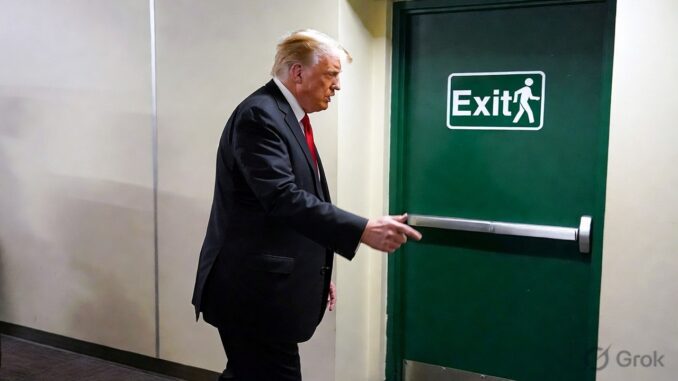
“I think President Trump has put himself in a situation where he really doesn’t have a good exit strategy.”
The Trap Was Telegraphed
Trump’s catastrophe may be complex and irretrievable, but it was not inevitable. It was predicted, in detail, by experts whose job it was to predict it, and who were systematically ignored, discredited or sacked for saying so. Trump ignored the experts. This is how he can always snatch defeat from the jaws of victory.
The pretext for the attack doesn’t bear scrutiny. Before the first double-tap Tomahawk missile crushed and burned alive 168 schoolchildren on 28 February, Oman’s Foreign Minister Badr Al-Busaidi was announcing what could have been a diplomatic coup: Iran had agreed to never stockpile enriched uranium, had accepted full IAEA verification, and was prepared to irreversibly downgrade its enriched uranium to the lowest level possible.
Peace, he said, was “within reach.” Further talks were due to resume on 2 March.
Iran now says that the US President never intended to avoid war and that the talks were a ruse to get more time to set up a military attack. It’s true. It’s also true that Trump and Netanyahu are driven by the need to stay out of court. Both are hell-bent in quest of a more enduring diversion-and both would have always pulled the trigger anyway. Even without Saudi encouragement.
Was Israel the little urger? The merciless slaughter of innocents had the paw-prints of the Israeli lobby all over it. The homicidal maniac Netanyahu, as munitions expert Dr Ted Postol and others who have met the Israeli PM, refer to him, must have blood.
The tail wagged the dog. Again. Unless, of course, Israel and the US turn out to be a single entity, after all, or a grotesque and genocidal Umbilical Brothers? Or is world war three being kindled by a familiar team; a debauched imperial power, a wen of deadly depravity, decadence, awash with armaments corporations, merchants of death and their Middle-Eastern monster-baby, or pet colony.
Senator Marco Rubio and House Speaker Mike Johnson have both let the cat out of the bag: American domestic political pressure from pro-Israel donor networks tipped dithering Donald into the most ignoble attack of any war, while Mossad and CIA agents broke the rules of war by murdering key members of Iran’s leadership elite.
The most damning testimony, however, comes from inside the administration itself. Joe Kent, a senior counterterrorism official, resigned. “We started this war,” Kent said, “due to pressure from Israel and its powerful American lobby.”
Kent is not a fringe antiwar activist in a Brooklyn courtyard. That is a man with a security clearance, who had sat in the meetings. His words should be carved into the neoclassical facades of every Washington, and Canberra, think-tank.
Mearsheimer has been saying it for twenty years. They call him an antisemite and keep going. Now they’re in over their heads.
What the Catastrophe Looks Like on Day Twenty
Twenty days in, and the war has metastasised across a dozen countries. As experts said it could. The Strait of Hormuz, through which roughly a fifth of the world’s traded oil ordinarily flows, is closed. And that’s before you factor in the effect of disruption to global trade in fertilisers.
Or you begin to price in Panadol as you realise that, alas, many medicines, including paracetamol, use ingredients derived from petrochemicals in their manufacturing process.
More than 2,300 people are dead across the region. Iran’s Red Crescent counted 742 civilian dead in the first week alone; the confirmed toll now exceeds 1,400, with over 18,500 injured and climbing.
But on Day 20, Israel struck Iran’s South Pars gas field. It’s the biggest in the world. Or was. Iran replied within hours, launching missiles at oil and gas facilities across Qatar, Saudi Arabia and the UAE. Ras Laffan Industrial City, the world’s largest liquefied natural gas facility, was torched. One analyst describes what followed as hitting the plumbing of the global energy system.
But it’s far more complex yet much less sophisticated than that.
Let us remember the dead. And how wars inflict pain and suffering on survivors. Amnesty International confirms what Iranian state media reported, and the Pentagon declined to comment on: a US strike on an elementary school in the city of Minab killed at least 170 people, more than 160 of them schoolgirls.
Many missile strikes in the war’s opening phase are seen by UN human rights experts as potential war crimes under the Rome Statute. At least a million Lebanese people have been displaced.
The Golestan Palace in Tehran, a UNESCO World Heritage Site, its famous mirrored throne room catching the blast of nearby strikes, was damaged in the crossfire. The Assembly of Experts was bombed as its members gathered to elect a new supreme leader. Iran’s state broadcaster was reduced to rubble.
Meanwhile, Donald Trump, on his Truth Social, calls Iran “militarily ineffective and weak.”
Stay In or Get Out? The Mearsheimer Dead End
This is the architecture of the trap. Mearsheimer lays it out with the precision of a man who wrote the autopsy before the patient was even sick.
Stay in? The costs compound daily. The USS Gerald R. Ford, deployed for 268 days as of this week, has limped into Crete for repairs. A fire in the ship’s laundry if we believe the official reports. It’s also having trouble deep in its bowels; the vacuum sewerage system is playing up again.
There is something exquisitely apt about the USS Gerald R. Ford becoming the image of the war itself. The most expensive floating monument to American power, after 268 days of over-extension, is diverted to Crete by a laundry fire and recurring trouble with its own plumbing.
That feels less like an accident than a parable. The empire arrives trumpeting mastery, only to find its systems fouling from within. Even its waste pipes are in revolt. The costs compound daily, maintenance is deferred, appearances are managed, and the great machine of war reveals itself as what it has long been: bloated, brittle and forever one blockage away from humiliation.
If the Ford remains at sea another month it will break the record for the longest American carrier deployment since Vietnam. The European allies have declined, with magnificent consistency, to be useful. Germany has said explicitly it has no intention of joining the war. The EU’s foreign policy chief has noted, in the pussy-footing diplomatese of someone trying not to be rude while being totally unhelpful, that European nations have “no appetite” to send troops.
Trump is demanding NATO allies help secure the Strait of Hormuz. NATO is, to put it charitably, otherwise engaged.
Retreat? Mearsheimer is equally clear-eyed. Declare victory and withdraw, and it will be “perceived as a humiliating defeat for the US.” And that assumes Iran cooperates. “They have many cards to play,” he notes. “They can inflict significant losses. Therefore, even if we retreat, it’s unclear whether this will solve the problem.”
Trump promised a generation of winning. He has delivered a generation’s worth of losing, compressed into twenty days. And let’s not forget his Latin American fiasco. El Presidente, who endeared himself to millions south of the border with his talk of “shithole” countries, has rather a lot of Venezuelans on the warpath after his regime change curdled almost on contact into a neocolonial farce, with Maduro gone, sovereignty shredded and the gringos already with their fingers in the till.
Iran Is Not Fighting This Alone
Cuba could be next on Hegseth’s hit-list? Trump does need to keep the distractions going. Meanwhile disinformation is being pumped as vigorously as the Ford plumbing. And with similar effect.
Fox News cheerleaders and the Netanyahu communications office have been carefully not telling the American public: Iran is not the isolated, backward, sanction-crippled military of the pre-war briefings.
It is fighting with Russian eyes and Chinese precision. Together, those two contributions have changed the strategic calculus in ways that neither Washington nor Tel Aviv appear to have seriously gamed.
Russia’s contribution is best understood as years of reciprocal military partnership, built on mutual sanctions desperation and quietly substantial. Iran supplied Russia with an estimated 7,000 Shahed-136 kamikaze drones and several hundred ballistic missiles for use against Ukrainian infrastructure.
Russia supplied Iran with Su-35 fighter jets, Mi-28 attack helicopters; the first six arrived in January 2026, months before the war, and the Rezonans over-the-horizon radar, specifically designed to track stealth targets. Three senior American officials told the Washington Post that Russia has also been feeding Iran sensitive intelligence about US warships and aircraft operating across the Middle East.
Putin denies all of this personally, in a call with Trump. Trump says. The denial changes nothing operationally.
The Carnegie Endowment’s Nikita Smagin notes that most Russian systems are better suited to suppressing protests than intercepting B-2 stealth bombers at altitude. The real value of the Russian partnership has always been intelligence, satellites, and what it enabled China to do next.
China’s contribution is where the story becomes strategically consequential, and strategically irreversible.
The single most significant development is Iran’s transition from American GPS to China’s BeiDou-3 satellite navigation system.
Former French foreign intelligence director Alain Juillet, a man who spent his career tracking precisely these transfers, tells France’s Tocsin podcast that this explains the most startling military fact of the conflict: Iranian missiles are dramatically more accurate than they were eight months ago, during the twelve-day campaign of last June.
The United States can jam or degrade GPS signals in a conflict theatre. It cannot jam BeiDou. That option simply does not exist. And BeiDou includes a short-message service that allows Iranian command nodes to communicate even when local networks are destroyed. Tehran now has guidance infrastructure resistant to the full suite of Western electronic warfare doctrine.
No one in the pre-war briefings thought to mention it loudly enough.
China went further. The Shanghai firm MizarVision has been publicly posting satellite imagery of US military deployments throughout the conflict; F-22s, command and control aircraft, carrier strike groups, annotated in Mandarin, with AI identification of aircraft types, distributed on social media.
A number of assets that appeared in MizarVision’s feeds were subsequently targeted by Iranian strikes. Whether this constitutes deliberate intelligence transfer or merely commercial satellite imagery made available to anyone with an internet connection, the operational effect is identical: Iran has been targeting mobile US assets with an accuracy that has visibly shocked Western military planners.
China also supplied Iran with the YLC-8B anti-stealth radar; a UHF-band system specifically designed to negate the coatings that make American fifth-generation aircraft invisible to conventional detection. Against a YLC-8B, the B-21 Raider and the F-35C are considerably less invisible. This war is, among other things, the first large-scale operational test of Chinese anti-stealth technology against American aircraft. Beijing is watching carefully. It is taking notes for Taiwan.
Then there are the speedboats. Iran’s IRGC Navy has been deploying fast-attack craft in the Strait of Hormuz with a doctrine, formation and tactical profile that will be instantly familiar to anyone who has followed Chinese naval operations in the South China Sea. Swarming small, fast vessels to harass, obstruct and threaten larger assets in confined waters; presenting defenders with the impossible calculus of a two-billion-dollar destroyer menaced by craft costing tens of thousands, is a Chinese tactical signature. It did not arrive in the Persian Gulf by coincidence. The Maritime Security Belt 2026 exercises, conducted jointly by Russia, China and Iran in the Strait of Hormuz just ten days before the war began, rehearsed exactly these techniques. China brought the doctrine. Iran is applying it.
Russia’s Other Gift: The Oil Trade
Russia’s contribution to Iran’s war-fighting capacity extends beyond hardware. It is financial. Since 2022, the two countries have built a parallel oil trading architecture specifically designed to evade Western sanctions; shadow fleets, AIS transponders switched off, port-to-port transfers conducted in the dark. Iran entered this conflict with oil revenues that sanctions were supposed to have strangled. In the weeks beforehand, it tripled its export rate and drew down storage; deliberate financial pre-positioning for a war the leadership believed was coming.
Moscow’s interest in the conflict is not passive. Every barrel disrupted in the Gulf is a barrel European and Asian buyers must find elsewhere. Russian oil, already trading at discounts on the shadow market, becomes relatively more attractive every day Hormuz stays closed. Putin is not watching this war. He is banking it.
The Netanyahu Factor: Closing Every Window
Mearsheimer’s analysis cuts deepest on the question of diplomacy.
On Day 19, Israeli strikes killed two of Iran’s most consequential figures: security chief Ali Larijani and Basij commander Gholamreza Soleimani. Larijani’s death was not a military decapitation strike in the conventional sense. It was the targeted elimination of Iran’s most experienced nuclear negotiator; a pragmatic, sophisticated operator whom analysts had consistently identified as one of the few figures capable of opening a negotiated exit.
Israel killed the man who could have brokered the ceasefire Netanyahu claims to want.
Netanyahu told Sean Hannity that Operation Epic Fury “will usher in an era of peace that we haven’t even dreamed of” and create conditions for Iranians to form “their own democratically elected government.” He said something substantially similar about Iraq in 2003. About Libya in 2011. The script is laminated. The outcomes are identical. The lesson is never drawn.
He is currently in a bunker, hinting with characteristic coyness that perhaps the Iranian regime survives after all. Of course it does. The Islamic Republic has outlasted everything the West has thrown at it: the Iran-Iraq war, decades of sanctions, assassination campaigns, Stuxnet, and the twelve-day bombing campaign of last June.
What authoritarian governments do not typically survive is delegitimisation, the slow erosion of popular consent. Foreign explosions perform the opposite function. They rally populations to regimes they were beginning to turn against. American military planners know this. They appear to have chosen not to say it.
The Intelligence Scandal Underneath It All
One more thread demands to be pulled. Tulsi Gabbard, Director of National Intelligence, has been accused of altering her Senate testimony on Iran; specifically, of omitting intelligence details that contradicted Trump’s claim that Tehran posed an imminent threat. The IAEA had found no evidence Iran was moving toward a nuclear weapon. Oman had just brokered what its foreign minister described as a breakthrough agreement.
The WMD playbook. Twenty years on. Different country, different actors, identical catastrophic third act.
The difference is that this time the intelligence community’s most senior official allegedly carried the water personally, rather than leaving it to a Colin Powell with a vial and a podium at the Security Council. Progress of a kind.
What Australia Needs to Ask
An Iranian projectile struck near Australia’s military headquarters in the UAE this week. Anthony Albanese confirmed it. Then said nothing else useful.
Pine Gap is almost certainly providing targeting intelligence that has enabled strikes now characterised by UN human rights experts as potential war crimes. Under laws amended by the Howard government in 2001 and never restored, the Prime Minister can take Australia to war on Cabinet agreement alone, no parliamentary debate, no public mandate, no vote. Nobody in the national media is asking whether that authority has been invoked. Nobody is asking whether it should be.
The question Mearsheimer asks about Washington; what’s the exit, and who owns the consequences, deserves to be asked in Canberra. With the same urgency. And considerably more honesty than we are currently getting.
No Good Exit
John Mearsheimer spent twenty years building the theoretical framework that explains exactly how the United States ends up in a war like this. Stay in, and the costs compound while the losses accumulate. Retreat, and the humiliation is cosmic and the outcome no less uncertain. Iran holds cards it hasn’t played.
Trump got his war with Iran, on the urging of a foreign government, on the basis of intelligence his own Director of National Intelligence allegedly falsified, over a diplomatic resolution that was days from signature.
History won’t be interested in who did the urging. He owns this. Every schoolgirl in Minab. Every barrel at Ras Laffan. Every day the Hormuz stays closed.
It has, as Mearsheimer warned, no good exit.
Keep Independent Journalism Alive – Support The AIMN
Dear Reader,
Since 2013, The Australian Independent Media Network has been a fearless voice for truth, giving public interest journalists a platform to hold power to account. From expert analysis on national and global events to uncovering issues that matter to you, we’re here because of your support.
Running an independent site isn’t cheap, and rising costs mean we need you now more than ever. Your donation – big or small – keeps our servers humming, our writers digging, and our stories free for all.
Join our community of truth-seekers. Please consider donating now via:
PayPal or credit card – just click on the Donate button below
Direct bank transfer: BSB: 062500; A/c no: 10495969

We’ve also set up a GoFundMe as a dedicated reserve fund to help secure the future of our site.
Your support will go directly toward covering essential costs like web hosting renewals and helping us bring new features to life. Every contribution, no matter the size, helps us keep improving and growing.

Thank you for standing with us – we truly couldn’t do this without you.
With gratitude, The AIMN Team

An excellent article describing what the MSM is NOT reporting.
TACO Trumpery has the innate ability to turn everything he touches to manure ….. and a BIG PROFIT for Trumpery related entities, which is the main objective.
The tail wagged the dog. Again. Unless, of course, Israel and the US turn out to be a single entity, after all, or a grotesque and genocidal Umbilical Brothers?
There’s not much point in trying to work out who did what.
The US and Israel are so close on this that they are a single entity.
And awful though this is, it’s just another chapter in the US foreign policy playbook.
Continuity of Agenda.
The consistent intent, the Agenda, is global domination.
The only thing that changes is the tactical approach.
The tactics vary according to the strength of the victim at any given time.
Keep that in mind wherever a conflict is discussed.
The agenda is consistent — only the tactics change.
It had been reported that Iran had offered to permit safe passage of vessels transporting fuel oils and LNG through the Hormuz Strait other than countries engaged in hostilities against Iran (i.e. principally US and Israel).
Within forty eight hours Israel bombed and severely disabled the Iranian facilities linked to South Pars, the largest natural gas field in the world. It has now been conceded by Israel that they did this without notifying the US, effectively cutting off for Trump an off-ramp for this war.
The question has to be posed : do the Israeli authorities actually want to see the hostilities cease?
“Pine Gap is almost certainly providing targeting intelligence that has enabled strikes now characterised by UN human rights experts as potential war crimes.” That makes us complicit. That makes us a legitimate target.
Badmouthing, easy to start, hard to finish….
https://johnmenadue.com/post/2026/03/five-steps-to-prevent-the-iran-war-from-becoming-a-global-catastrophe/?
Sadly, by dent of history, Oz is up to its gills in the US-Zionista imperium. From Doc Evatt’s UN foray for the Zionists into Palestine without consulting Palestinians, Arthur Caldwell tweeking all the immigrant Jews for donations. For decades of turning a blind-eye to Zionist drug smuggling and charitable donations crimes. For Pine Gap, and free access by USA to Oz defense facilities. Letting Palantir into Oz, incl via Defense Dept contracts. And recently, not least AUKUS.
Oz govts are truly mad, and getting more secretive and paranoid by the day.
Seems the chooks are coming home to roost.