
When all groups work together there are better results for locals
By Callen Sorensen Karklis
Redland City Council Era (Increasing division since 2012)
Since the late 2000s, Redland City has become increasingly populated and urbanised. Alongside this growth, local politics has become more partisan, reflecting broader national and international debates. Issues such as climate change, immigration, overpopulation, housing pressures, and the rising cost of living have all contributed to a more divided political landscape. This growing tribalism has, at times, led to a breakdown in communication between different groups within the community.
These tensions intensified toward the end of the Hobson administration. While Hobson introduced strong climate policies, improved customer service, and economic stimulus during the Global Financial Crisis, this period also coincided with wider political upheaval. Hobson lost the 2012 local government election, during a time that also saw the decline of the Bligh Labor government in Queensland and the rise of Campbell Newman at the state level, alongside Karen Williams becoming mayor.

The situation further evolved during the Williams era. Her administration oversaw significant deregulation of environmental controls and increased urban development, which proved controversial. The long-running dispute over the Toondah Harbour development (2014–2024) became a defining issue of her time in office, often overshadowing other achievements. Concerns about the direction of the city were raised by councillors Wendy Boglary and Lance Hewlett, who at different times gained support as Deputy Mayors between 2016 and 2020.
Williams was re-elected in 2020 during the height of the COVID-19 pandemic, but her tenure ultimately ended in scandal following a drink-driving incident in Cleveland after three terms in office.
In the 2024 local government elections, independent candidate Jos Mitchell was elected mayor with 67% of the vote. However, her allies failed to secure a majority on council. As a result, many councillors aligned with the LNP who had been elected during the Williams era retained their positions, creating ongoing tension within council.
Since taking office, Mitchell has initiated an independent review into council operations and prioritised greater transparency. Her administration has also focused on improving relationships with the Quandamooka First Nations community, promoting inclusivity across the city, and strengthening environmental policies – particularly in the context of planning for the 2032 Olympics, including proposals such as the white-water facility in Birkdale.
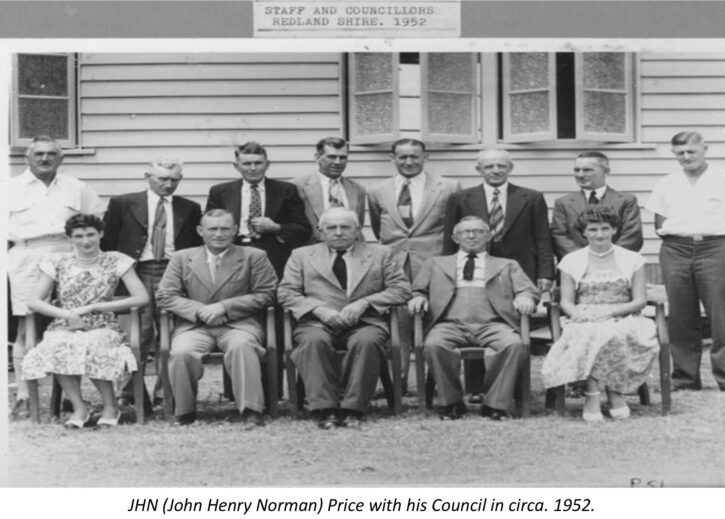
Price/Ellis Era (1949-1961) (Country and Labor Coalition)
From the mid-1880s through to the 1960s, the Redlands was largely an agrarian, community-oriented region with a small rural population. Politically, the area tended to alternate between Country and Labor representation, benefiting from state-level policies introduced under Edward Granville Theodore, widely known as “Red Ted” Theodore.
Originally, the Redlands consisted of two separate rural councils located southeast of Brisbane and was often referred to as the “Salad Bowl of Queensland” due to its strong agricultural output. Cleveland Shire covered suburbs such as Cleveland, Thornlands, Ormiston, Thornside, Birkdale, and Wellington Point. Tingalpa Shire included areas such as Capalaba, Tingalpa, Victoria Point, Redland Bay, and parts of what later became Logan.
Despite local resistance, the two councils were eventually amalgamated during the Great Depression. In 1936, Ernest Ellis, a former Cairns Shire clerk, was appointed by the state government to Cleveland Shire and played a central role in overseeing the merger, which led to the formation of Redland Shire Council in the years leading into the Second World War.
Ellis worked alongside a former ANZAC veteran who contributed significantly to the region’s early development. Together, they oversaw the establishment of key local infrastructure, including the region’s first secondary school at Cleveland District State High School, the relocation of the Redland Showgrounds (initially planned for the site of what later became Leslie Harrison Dam), and the development of early jetties, marinas, and the foundations of the Capalaba CBD.
Their most enduring legacy, however, was the establishment of essential community services, including the QTAB Ambulance Committee and local facilities, as well as the Rural Bush Fire Brigade—institutions that would serve the growing region for decades to come.
Lessons in Partisan Eras (1961-1994) (Country vs Labor)
Following Price’s retirement, a period of significant political change began. After Ernest Ellis attempted to reform outdated by-laws dating back to 1906, tensions emerged within council. In 1961–62, newly elected Country Party mayor Dick Wood moved to remove Ellis from his position, replacing him with Donald Simpson. While Simpson proved to be a capable clerk, this shift marked the beginning of nearly three decades of Country Party dominance in local government.
Over the next 29 years, local politics became increasingly partisan, reflecting broader state trends during the eras of Frank Nicklin and Joh Bjelke-Petersen. This period was characterised by electoral gerrymandering, rising concerns about police corruption, and significant urban development pressures. Notable controversies included the development of Raby Bay in Cleveland and the original Toondah Harbour proposal, which was ultimately defeated in 1989 following strong community opposition led by the STIR group (Stop Toondah Impact Committee), a precursor to Redlands 2030.
Despite these tensions, there were also important infrastructure achievements. Wood – who also served as the state Country Party MP for Logan from 1966 to 1969 – and his successor, Merv Gengrich (1982–1991), continued earlier efforts to develop Leslie Harrison Dam and protect the Cleveland rail line corridor, building on the work of Price and Ellis.
A shift in political direction came in 1991, when former federal MP Len Keogh won the mayoralty. His administration focused on improving transparency, strengthening customer service, introducing habitat protections, and delivering cost-of-living relief for pensioners. Keogh also oversaw further development of Capalaba, including the establishment of a library and upgrades to the local shopping precinct.
However, this reform agenda faced a voter backlash. In 1994, Keogh was defeated by long-serving and more conservative councillor Eddie Santagiuliana of Division 3 (Thornlands), marking another shift in the political landscape of the Redlands.
Santagiuliana/Bucknall Era (1997–2000) – Labor and LNP Cooperation
Unlike many of his conservative predecessors, Eddie Santagiuliana adapted to the post-Fitzgerald Inquiry political environment by working collaboratively across party lines. During a period when Labor dominated both state and federal politics locally, Santagiuliana formed a productive working relationship with ALP representatives.
This cooperation was strengthened in part by his shared Sicilian heritage with former Bowman MP and Hawke–Keating government minister Con Sciacca. To his credit, Santagiuliana continued many of the policy directions established under Len Keogh, while also fostering a more cooperative approach within council.
A key partnership emerged with Labor councillor Ray Bucknall of Capalaba, who served as Deputy Mayor from 1997 to 2000. Together, they advocated for expanded bus services between Brisbane and Capalaba as the area developed into a more centralised urban hub. They also pushed for limits on overdevelopment, improved essential infrastructure – including sewerage services for Dunwich on North Stradbroke Island – and took steps toward recognising Native Title in 1997 through engagement with the Quandamooka community.
Newman/Hinchcliffe Era (2004–2008) – Cross-Party Governance in Brisbane
A comparable example of cross-party cooperation can be seen in Brisbane during the mid-2000s. After 13 years of Labor control under Jim Soorley and Tim Quinn (1991–2004), political power shifted, yet collaboration across party lines remained possible.
During this period, Campbell Newman, as Lord Mayor, worked alongside Deputy Mayor David Hinchliffe, despite their differing political affiliations. Together, they delivered major infrastructure and policy initiatives, including the TransApex plan to address traffic congestion through a network of bridges and tunnels, the construction of the Eleanor Schonell Bridge, and the urban renewal of Fortitude Valley.
Their administration also introduced forward-looking policies such as 100% renewable energy for council operations, a city-wide bike hire scheme, and the “Homeless Connect” program – demonstrating that effective governance could transcend political divisions.
An Opportunity Ahead of the 2032 Olympics
Regardless of political differences, Redland City now faces a similar opportunity. Over the next two years, there is strong potential for councillors to work collaboratively in addressing the region’s future needs.
As demonstrated during the Santagiuliana/Bucknall era, cooperation can deliver practical outcomes. One clear example is the potential expansion of public transport – particularly improved bus connections between Brisbane and Capalaba. A proposed extension of the Brisbane Metro to Capalaba could play a significant role in preparing the region for the 2032 Summer Olympics, especially if the planned white-water facility proceeds.
Support for such infrastructure spans political lines, with Bowman MP Henry Pike backing the Metro extension, alongside former Labor MP Don Brown. Beyond the Olympics, such investment would deliver long-term benefits for the Redlands.
If the current Mayor and Deputy Mayor can set aside political differences and work together – particularly in advocating to the Queensland government – they have an opportunity to shape both their legacy and the city’s future. Achieving tangible outcomes in transport and infrastructure would represent a political win for all sides, while still allowing space for continued progress on transparency and governance reforms.
Please sign our petition to Extend Brisbane Metro to Capalaba.

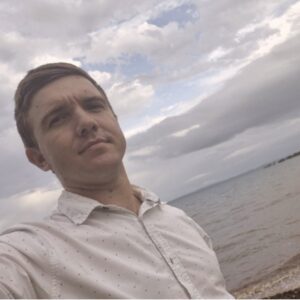
Callen is a Quandamooka man of the Nunukul, Goenpul (Snake), and Ngugi (Dolphin) peoples from Minjerribah (North Stradbroke Island). He is also of mixed heritage, with Celtic, Scandinavian, German, Polish, Latvian, Spanish, Fijian, and Filipino ancestry.
Over the past 15 years, Callen has worked as a unionist, political activist, staffer, and campaign organiser across local, state, and national levels. He was previously involved with the Queensland ALP before later aligning with the Greens.
In 2020, Callen ran as an independent candidate for Redland City Council (Division 2), campaigning on the protection of Toondah Harbour and its Ramsar-listed wetlands, as well as advocating for economic restructuring in the Cleveland CBD. In 2024, he stood as the Greens candidate for the Queensland state seat of Oodgeroo, contesting against LNP candidate Amanda Stoker.
Professionally, Callen has experience across retail, business operations, market research, and media advertising. Since 2022, he has been a co-host of Workers Power on 4ZZZ radio.
He is actively involved in community life, volunteering with several local groups, and is a member of the Queensland Fabians. Callen identifies as a Queensland socialist.
Keep Independent Journalism Alive – Support The AIMN
Dear Reader,
Since 2013, The Australian Independent Media Network has been a fearless voice for truth, giving public interest journalists a platform to hold power to account. From expert analysis on national and global events to uncovering issues that matter to you, we’re here because of your support.
Running an independent site isn’t cheap, and rising costs mean we need you now more than ever. Your donation – big or small – keeps our servers humming, our writers digging, and our stories free for all.
Join our community of truth-seekers. Please consider donating now via:
PayPal or credit card – just click on the Donate button below
Direct bank transfer: BSB: 062500; A/c no: 10495969

We’ve also set up a GoFundMe as a dedicated reserve fund to help secure the future of our site.
Your support will go directly toward covering essential costs like web hosting renewals and helping us bring new features to life. Every contribution, no matter the size, helps us keep improving and growing.

Thank you for standing with us – we truly couldn’t do this without you.
With gratitude, The AIMN Team
Thankyou for your work protecting Toondah, Callen.
Much appreciated by me and my fellow birders and nature lovers.
You don’t want fake light rail, you need real light rail. Besides those horribly named Metro buses (they are not Metros as they don’t run on rails) are horrible vehicles to be in.
Gday 2353NM
I’m also part of a group pushing for the Cleveland Train line duplication. The eastern busway extension to Capalaba is an old proposal but now most sides of politics support this.