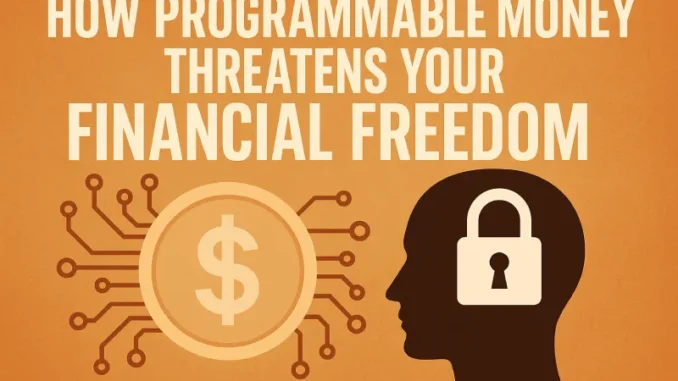
By Denis Hay
Part 3
Continued from Part 2
Description
Programmable money in Australia could limit your financial freedom and privacy. Learn how CBDCs could change how you access and use your money.
🎧 Prefer to listen to this article? Press play
A Quiet Revolution in Currency Is Underway
Money is no longer just a medium of exchange – it’s becoming a tool of control. The Reserve Bank of Australia (RBA) is trialling programmable money, specifically Central Bank Digital Currencies (CBDCs), as part of a global trend. While marketed as innovation, this shift could fundamentally reshape how Australians save, spend, and access their finances.
Unlike traditional digital payments, programmable money can be embedded with conditions: where, when, and how it can be used. These features aren’t hypothetical – real-world Australian CBDC pilot programs have tested programmable functions such as geo‑restricted spending and timed expiry of digital money (source: RBA and DFCRC project report, August 2023).
This is not just a technology experiment. It’s a political one – with real consequences.
Why Programmable Money Should Concern Every Australian
Problem – Control Hidden Behind Convenience
CBDCs are often promoted as secure, efficient, and low-cost. But the silent feature embedded in programmable money is controlled by central banks, governments, or authorised third parties. This undermines the very notion of financial autonomy.
Examples from China’s e-CNY trials show authorities restricting funds for certain types of purchases and requiring real-name tracking (source: Taiwan’s Opportunities in Emerging Industry Supply Chains, Carnegie Endowment For International Peace). If Australia follows suit, digital dollars could be coded to prevent you from spending on travel, protests, or non-compliant services.
Why It Hurts – Eroding Privacy and Autonomy
- Loss of privacy: Every transaction is traceable, enabling surveillance far beyond current banking norms.
- Government overreach: Emergency laws could instantly freeze, limit, or redirect your funds.
- Expiration dates: Use-it-or-lose-it stimulus undermines your ability to save.
- Geo-fencing: Money restricted to certain suburbs or retailers can socially engineer behaviour.
Once programmable money is adopted, reversing course may be impossible. Australians could unknowingly surrender freedom for convenience.
The RBA’s Role in Laying the Groundwork
Australia’s central bank is actively involved in CBDC experimentation. In June 2023, the RBA concluded a pilot with the Digital Finance Cooperative Research Centre, testing programmable features in areas such as welfare delivery and restricted payments (source: Australian CBDC Pilot for Digital Finance Innovation, RBA).
While the RBA says there are no immediate plans for rollout, its language remains open-ended: “We will continue to explore.” That ambiguity masks a trajectory toward deeper monetary control, particularly under the guise of combating financial crime or mitigating economic shocks.
The Global Push – and the Dystopian Pattern
Australia is not acting in isolation. Countries like China, Nigeria, and India are already piloting or deploying CBDCs with programmable limits. In Nigeria, for example, citizens saw their access to cash restricted after resisting the eNaira rollout (source: From $10 Million Transactions to Zero: What Lessons Can Be Learned from eNaira’s Failure, Social Voices).
These are not hypotheticals. Programmable money is already being used to reshape behaviour and suppress dissent in authoritarian contexts. The technology may be global, but the consequences will be local.
Counterpoints and the Need for Balance
The Pro-CBDC View
Proponents argue that CBDCs can enhance inclusion, reduce transaction costs, and improve payment speed. They highlight potential benefits in reducing fraud and making government benefits more targeted and effective.
Why That Doesn’t Hold Up
- Inclusion requires trust, not surveillance.
- Fraud prevention doesn’t require programmable spending controls.
- Targeted welfare can be achieved without removing financial autonomy.
The truth is that CBDCs are not needed for digital payments – we already have PayID, debit cards, and instant transfers. The added layer of programmability serves political, not public, interests.
Australia’s Dollar Sovereignty – A Better Path Forward
Australia issues its own currency. It does not need to rely on surveillance-based tools to manage the economy. Public money, spent wisely, can stimulate demand, create jobs, and ensure equity, without controlling how citizens use it.
We can harness our dollar sovereignty to build a better payment system – one that enhances privacy, autonomy, and participation.
The Real Solution – Public Money, Public Control
- Reject programmable constraints.
- Demand legislation that enshrines financial privacy and cash rights.
- Support public banks and community finance models.
- Explore open-source, non-programmable digital payments under democratic oversight.
Australians should not be passive recipients of monetary policy; they should be active participants in shaping it.
Why This Matters
Programmable money threatens to convert your freedom into a permissioned system. It risks turning Australia’s payment infrastructure into a surveillance tool, undermining our democracy and eroding civil liberties. The stakes are too high for silence.
What Do You Think?
How would you feel if your spending was tracked, limited, or reversed by policy?
Could programmable money be used to suppress protests or dissent?
Q&A Section
Q1: What is programmable money?
Digital currency with rules embedded in the code
Can control how, when, and where money is spent
Q2: How is it different from current digital banking?
Traditional banking allows unrestricted use of funds.
Programmable money can enforce expiry, geo-fencing, and spending restrictions.
Q3: Is Australia implementing programmable money?
Not yet fully, but the RBA is actively trialling CBDC features that allow programmability.
No formal commitment, but groundwork is being laid
Q4: Can programmable money help with financial inclusion?
Not necessarily – privacy risks may erode trust.
Other inclusive tools exist without the surveillance.
Next in this series:
👉 Part 4: Why Australia Must Protect Cash in the Age of Programmable Money
Cash is freedom. Here’s why we must protect it as digital control systems grow.
💬 We’d Love to Hear from You!
Inspired by this article?
✅ See what others are saying on our Reader Testimonials page.
✅ Share your thoughts via our Reader Feedback form – your voice helps shape future content.
✅ Scroll down and leave a comment below to join the discussion.
If this article resonated with you, explore more on political reform and Australia’s monetary sovereignty at Social Justice Australia.
📢 Spread the word:
Share this article with friends, family, or your social networks to keep the conversation going and help build a fairer, more just Australia.
⭐ Keep Independent Journalism Alive. Support Voices That Challenge the Status Quo
We’re 100% reader-supported – no ads, no corporate strings – just honest, truth-driven journalism.
💸 Donate Now – one-time or monthly
Even $5 helps us keep publishing.
🙌 Already donated? Share the love – leave us a review on Google to help others find us.
This article was originally published on Social Justice Australia
Link to Part 4:
Dear reader, we need your support
Independent sites such as The AIMN provide a platform for public interest journalists. From its humble beginning in January 2013, The AIMN has grown into one of the most trusted and popular independent media organisations.
One of the reasons we have succeeded has been due to the support we receive from our readers through their financial contributions.
With increasing costs to maintain The AIMN, we need this continued support.
Your donation – large or small – to help with the running costs of this site will be greatly appreciated.
You can donate through PayPal or credit card via the button below, or donate via bank transfer: BSB: 062500; A/c no: 10495969



Be the first to comment