By Denis Hay
Description
Discover why Australia’s Economic Sovereignty is under threat as BRICS nations reshape global trade.
🎧 Prefer to listen to this article? Press play
Introduction
Australia’s Economic Sovereignty is facing unprecedented threats. Imagine waking up to news headlines stating that Australia’s currency, the AUD, is no longer widely accepted in international markets. Suddenly, imported goods become scarce, prices skyrocket, and economic panic ensues.
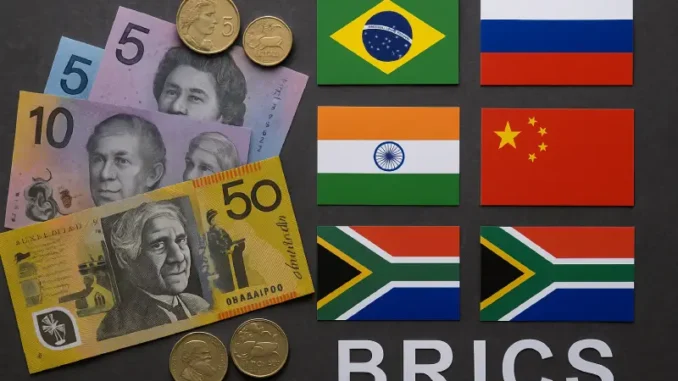
This hypothetical scenario might seem extreme, but as the BRICS nations (Brazil, Russia, India, China, South Africa) challenge the dominance of the U.S.-led financial system, Australia’s economic sovereignty hangs in the balance.
As global financial power shifts, safeguarding Australia’s Economic Sovereignty will determine how resilient we remain in uncertain times.
Understanding the Current System
Australia’s Economic Sovereignty
Australia benefits greatly from its monetary sovereignty, meaning it issues and controls its currency, the AUD. According to Modern Monetary Theory (MMT), this allows the government to fund public spending without dependence on taxes or external borrowing.
However, this advantage heavily relies on the global acceptance of the AUD, largely maintained through alignment with U.S.-centric financial systems.
Modern Monetary Theory, when paired with a strong democratic and anti-imperialist agenda, offers a transformative framework. It enables Australia to invest in public goods, support full employment, and fund public infrastructure while prioritising labour rights, decolonisation, and public ownership.
These principles ensure that economic policy supports people and communities rather than private profits or foreign corporate interests. This is a foundational pillar of Australia’s Economic Sovereignty.
In public discussion, MMT is often misunderstood or conflated with other concepts like Quantitative Easing (QE). QE involves central banks purchasing assets to stimulate financial markets, often benefiting private banks.
In contrast, MMT emphasises using public money directly for public purpose – like health, housing, and infrastructure. This distinction matters. The U.S. used QE to rescue financial institutions; an MMT approach would have used sovereign capacity to meet real social needs (Kelton, 2020).
There’s also widespread confusion around central bank “independence.” Institutions like the RBA and Treasury are legislative creations and ultimately accountable to Parliament. MMT makes clear that spending by currency-issuing governments comes first – with bond issuance and interest rate tools used post-spending to manage inflation and liquidity, not to “fund” operations (Mosler, 2019).
Furthermore, Australia’s continued reliance on resource exports and a weak manufacturing base has created a structural imbalance. A persistently low AUD may benefit exporters in the short term, but it reflects a deeper vulnerability: the country’s overdependence on raw material exports limits domestic industry development and weakens its true economic sovereignty (Denniss, 2025).
Role of the U.S. in Australia’s Economy
The global economy currently revolves around the U.S. dollar (USD). Australia’s economic health is closely linked to USD dominance, including reliance on the SWIFT banking system, USD pricing of oil, and broad acceptance of AUD due to its connection to USD-based trading systems.
This dependency creates vulnerabilities that directly impact Australia’s Economic Sovereignty.
BRICS and the Shifting Economic Order
What is BRICS?
BRICS, originally an economic bloc comprising Brazil, Russia, India, China, and South Africa, is expanding its influence by advocating for resource-for-resource trading models and reducing reliance on USD.
How BRICS Challenges the U.S.-Led Order
By promoting direct trade in local currencies or commodities, BRICS nations challenge the established global economic order that favours USD. This shift could significantly impact countries like Australia, traditionally aligned with the U.S.
Potential Impacts on Australia
By 4Trade and Currency Challenges
If global acceptance of USD and AUD declines, Australia would need to rely more heavily on exporting tangible goods such as minerals, agriculture, and technology.
Rejection of AUD could severely disrupt trade, with serious consequences for Australia’s Economic Sovereignty.
Case Study: Lithium Exports and Currency Barriers
Melbourne-based lithium startup BrightVolt experienced firsthand the challenges of currency shifts. A promising export deal with India’s Tata Motors stalled when export finance insurance excluded deals settled in rupees, highlighting Australia’s vulnerability to shifting currency dynamics and potential job losses.
Australia’s BRICS Strategy: Opportunities and Risks
Diversification of Trade Relationships
Australia must urgently diversify its trade relationships beyond traditional Western allies. This strategic shift could unlock opportunities in sectors where Australia holds competitive advantages, like critical minerals and renewable energy.
Government’s Preparedness and Response
Currently, the Australian government demonstrates limited proactive measures to address the emerging BRICS-induced economic realities, creating vulnerability and risking economic sovereignty.
Solutions and Recommendations
Strengthening Australia’s Economic Resilience
Australia needs immediate steps to mitigate its dependency on U.S.-centric financial systems, including establishing trade agreements independent of USD.
A long-term strategy to enhance Australia’s Economic Sovereignty should prioritise diversified trade, robust public investment, and industrial self-reliance.
Strategic Investment in Key Sectors
Investing in sectors like renewable energy, critical minerals, and agriculture can position Australia as a strong independent economic entity, less vulnerable to global financial shifts.
Embracing Economic Partnerships with BRICS Nations
Proactively engaging with BRICS nations can offer substantial economic benefits. Australia must carefully balance these relationships, managing risks and opportunities effectively.
Doing so will be crucial for maintaining and strengthening Australia’s Economic Sovereignty in a multipolar world.
Reader Question
How do you think Australia should navigate its economic future – and protect Australia’s Economic Sovereignty – as the global order shifts away from U.S. dominance toward BRICS-led trade?
Conclusion
As BRICS nations reshape global economic dynamics, Australia’s proactive strategies to maintain Australia’s economic sovereignty become crucial. Protecting Australia’s economic future requires immediate action and strategic foresight.
Call to Action
💬 We’d Love to Hear from You!
Inspired by this article?
✅ See what others are saying on our Reader Testimonials page.
✅ Share your thoughts via our Reader Feedback form – your voice helps shape future content.
✅ Scroll down and leave a comment below to join the discussion.
If this article resonated with you, explore more on political reform and Australia’s monetary sovereignty at Social Justice Australia.
📢 Spread the word:
Share this article with friends, family, or your social networks to keep the conversation going and help build a fairer, more just Australia.
⭐ Support Independent Voices That Challenge the Status Quo
Social Justice Australia doesn’t rely on corporate advertisers or donors. We exist because of passionate readers like you.
If you believe in independent media that:
- 🧠 Educates and informs through truth-based analysis
- 🔍 Exposes injustice and failed policies
- 📣 Advocates for real, people-first reform
… then please consider supporting our work.
💸 Click here to donate – one-time or monthly, your contribution keeps our platform alive, ad-free, and uncompromising.
🙏 Thank you for being part of this movement.
Together, we are changing the conversation – and the future.
🌟 Bonus: Help others discover our work – leave us a quick Google review. It only takes a moment and means the world.
This article was originally published on Social Justice Australia
Dear reader, we need your support
Independent sites such as The AIMN provide a platform for public interest journalists. From its humble beginning in January 2013, The AIMN has grown into one of the most trusted and popular independent media organisations.
One of the reasons we have succeeded has been due to the support we receive from our readers through their financial contributions.
With increasing costs to maintain The AIMN, we need this continued support.
Your donation – large or small – to help with the running costs of this site will be greatly appreciated.
You can donate through PayPal or credit card via the button below, or donate via bank transfer: BSB: 062500; A/c no: 10495969

To quote you: “..Imagine waking up to news headlines stating that Australia’s currency, the AUD, is no longer widely accepted in international markets….”
Well, on first thoughts this pricked my curiosity however later you answered the question for me, thus:
“.. Australia’s economic health is closely linked to USD dominance, including reliance on the SWIFT banking system, USD pricing of oil, and broad acceptance of AUD due to its connection to USD-based trading systems….”
In other words Australia is not in control of its monetary sovereignty – in fact Australia is tied to the dictats of American commerce and trade and foreign relations policies. In almost all scenarios Australia can only trade internationally if we buy USD to use as the transactional currency. BRICS has long ago objected to the hegemonic activities espoused by the White House and is now preparing to provide an alternative mechanism for trade that promotes transactions based on independent national currencies. Recently a news report (sorry I don’t have the link) described a digital transaction between China and (? Saudi Arabia or maybe Iran) that was conducted with Yuan and the other national currency. If the SWIFT system was employed it would take 7 days to completion – with digital Yuan it took less than 7 minutes! Of course Australia is a minnow compared to the economies of China, India, Brazil, Russia etc; however I believe my grandchildren will ultimately be better off as minnows in a multi-polar community than continuing as slaves to a uni-polar hegemony.
Retaining an American military alliance comes at great cost against our nation. Currently, America and its American based corporations plot to defy paying their due Australia generated income due taxes which must no longer become at an enormous cost to our annual GDP.
For example: some 84% of our Australian Gold Mines, and still increasing, are operating under some form of international corporate control and proprietorship.
In spite of America’s corporate avoidance of paying taxes on their Australian generated income, this same goes for both their PRRT and MRRT as both are also obligated payments to our ATO.
Our Federal government should undertake the introduction of a substantial costing mineral resource “Australian Mining License” for all externally owned and or operational mining entities.
Let it be known that our current government should legislate for all external countries operating in the resource extraction sector in our sovereign nation, to purchase a mining license, no matter the cost of doing so. e.g. $200 million dollars per annum. They will pay if Tony Albanese and his flock of self-serving ministers don’t cower under the bully boys in the USA.
(Whilst also in their legislative mind-set there is urgent need to strengthen the insufficient Federal legislation, re the unregulated-taxation-dodging oil, gas, and mineral resource extracting sectors.)
Too often our inadequate non-testicular Federal Regulatory Authoritative Agencies are avoiding their legislated control objectives, set in place to extract, pursue, and or derive higher revenue streams from said external countries, e.g. the USA, currently gaining/plundering their wealth to the detriment of our nation’s rich mantle of gas and mineral resources.
At all costs, our nation must not cower before the exaggerated might of the USA. As I speak, it takes some 4 years to manufacture one new Nuclear-powered Submarine.
The AUKUS Agreements 1 and 2 are a gigantic scam over our nation.
I note that the Russian President, Vladimir Putin, cares no longer to the threats of Donald Trump in the USA. Any nation carrying a 40 Trillion dollar debt burden is nothing more than a donkey administration.