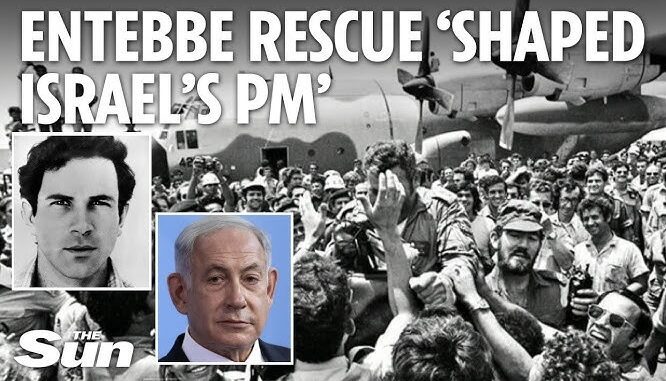
It was the height of the 1970s, a decade defined by political turbulence and the rise of international terrorism. On June 27, 1976, the world’s attention was hijacked along with Air France Flight 139. The aircraft, an Airbus A300 carrying 248 passengers and a crew of 12, had departed Tel Aviv, stopped over in Athens, and was en route to Paris when four terrorists – two from the Popular Front for the Liberation of Palestine (PFLP) and two Germans from the Revolutionary Cells – seized the cockpit.
The hijackers forced the plane to fly to Benghazi, Libya, for refueling before ultimately diverting it to its final, shocking destination: Entebbe, Uganda. There, the situation took an even darker turn. The terrorists were joined by additional reinforcements and received explicit support from Uganda’s erratic dictator, Idi Amin, who had been informed of the plot in advance. The hostages were moved to the transit hall of a disused old terminal, a building that would become their prison.
The hijackers’ demands were clear: the release of 40 Palestinian militants held in Israel and 13 others imprisoned elsewhere, or they would begin executing hostages. In a chilling echo of the Holocaust, the captors separated the Israeli and Jewish passengers from the other hostages, moving them into a separate room. One survivor, showing a concentration camp number tattooed on his arm to the German hijacker Wilfried Böse, was met with the hollow protest, “I’m no Nazi!… I am an idealist.”
Over the following days, the terrorists released 148 non-Israeli hostages. But 106 people remained – including the heroic 12-member Air France crew, who refused to abandon their passengers, and the Israelis and Jews held in the separate room. With the new deadline set for July 4, the clock was ticking.
In Israel, the government was locked in a fierce debate. Prime Minister Yitzhak Rabin was initially inclined to negotiate, while Defense Minister Shimon Peres pushed for a military option. As the politicians deliberated, the Israel Defense Forces (IDF) began to plan the impossible. The operation was given the codename “Thunderbolt.”
The plan was audacious to the point of insanity. Four C-130 Hercules transport planes would fly 2,500 miles (4,000 kilometers) at low altitude to avoid radar, landing at a hostile airport in the dead of night. Intelligence was cobbled together from released hostages, the Israeli construction firm that had built the airport, and Mossad agents. To fool Ugandan soldiers on the ground, the commandos would arrive in a black Mercedes and Land Rovers designed to mimic the entourage of Idi Amin.
Command of the assault force fell to the elite Sayeret Matkal unit, led by a 30-year-old colonel named Yonatan “Yoni” Netanyahu. He was described by his men as “cool-headed and brave.” At 11:00 PM on July 3, 1976, the Israeli cabinet gave its final approval. The planes were already in the air.
The first C-130 touched down at Entebbe at 23:01 on July 3. The ramp dropped, and the black Mercedes rolled out, speeding toward the old terminal. The ruse worked for precious seconds, allowing the commandos to close in on the building. Bursting inside, they shouted in Hebrew and English, “Stay down! We are Israeli soldiers!” The firefight was swift and brutal. In moments, all seven hijackers were killed.
In the midst of the chaos, however, tragedy struck. As the team provided cover for the retreating hostages, Yonatan Netanyahu was hit by a bullet fired by an Ugandan sniper from the control tower. While his soldiers secured the rescue of 102 hostages, their commander was mortally wounded.
Within 90 minutes of landing, the Israeli planes were airborne again. As they departed, commandos destroyed 11 Soviet-built MiG fighter jets on the tarmac to prevent any Ugandan pursuit. They flew not to Tel Aviv, but to Nairobi, Kenya, where the rescued passengers were transferred to a waiting Boeing 747. It was only then that the surviving soldiers could count their dead. They had lost one of their own.
The Entebbe raid, retroactively codenamed “Operation Yonatan” in his honor, became the stuff of legend. It was a triumph of intelligence, courage, and precision that proved the distance of terror was no longer a safe haven. But for one family, the victory was forever tinged with grief.
What is the Gaza connection?
The lone Israeli casualty of the raid was the mission’s leader, Yonatan Netanyahu. And as the world celebrated the rescue, a young man named Benjamin Netanyahu – Yoni’s younger brother – began a path that would see him follow his fallen sibling into the highest echelons of Israeli power, eventually becoming the country’s longest-serving prime minister. On that night in 1976, Israel saved its people. Yet the shadow of what it lost remained on the runway at Entebbe.
From Entebbe to Gaza, the story is still being written.
Keep Independent Journalism Alive – Support The AIMN
Dear Reader,
Since 2013, The Australian Independent Media Network has been a fearless voice for truth, giving public interest journalists a platform to hold power to account. From expert analysis on national and global events to uncovering issues that matter to you, we’re here because of your support.
Running an independent site isn’t cheap, and rising costs mean we need you now more than ever. Your donation – big or small – keeps our servers humming, our writers digging, and our stories free for all.
Join our community of truth-seekers. Please consider donating now via:
PayPal or credit card – just click on the Donate button below
Direct bank transfer: BSB: 062500; A/c no: 10495969

We’ve also set up a GoFundMe as a dedicated reserve fund to help secure the future of our site.
Your support will go directly toward covering essential costs like web hosting renewals and helping us bring new features to life. Every contribution, no matter the size, helps us keep improving and growing.

Thank you for standing with us – we truly couldn’t do this without you.
With gratitude, The AIMN Team

Be the first to comment