
By Denis Hay
Description
Federal pressure to privatise through funding deals forces states to comply. Learn how this reshaped Australia’s public assets.
🎧 Prefer to listen to this article? Press play
Introduction: Canberra’s Hidden Hand in State Selloffs
When New South Wales sold its electricity network under federal pressure in 2015, residents were told it would “unlock billions for infrastructure.” What followed were soaring power bills and declining accountability. The sale wasn’t just a state decision; it was part of a national pattern driven by federal pressure to privatise.
Between 1995 and 2019, Canberra offered states more than $6 billion in incentive payments to sell public assets and introduce competition into essential services (The Australian Institute). While pitched as “reform,” these deals forced states into decisions that served private investors, not the public.
This article examines the Commonwealth’s use of funding levers, including tied grants, the National Competition Policy, and the Asset Recycling Initiative, to reshape state economies and promote privatisation, often at the expense of community interests.
The Problem: How the Federation Was Weaponised
1. Tied Grants and Coercive Federalism
Australia’s Constitution gives the federal government power to grant financial help to states, “on such terms and conditions as it thinks fit” (s 96). While intended for cooperation, this clause has become a tool for control. Through tied grants, Canberra dictates how states must spend the funds to receive them (University of Melbourne Law School, 2021).
Quick Fact:
Between 1995 and 2005, National Competition Policy payments exceeded $5.7 billion, conditional on introducing competition into water, energy, transport, and local government services (NCC, 2005).
The National Competition Policy (NCP), introduced under Prime Minister Paul Keating in 1995 and expanded by John Howard, linked funding to the adoption of pro-market reforms. The logic was simple: deregulate, privatise, and you’ll get paid.
This “competitive federalism” blurred the line between cooperation and coercion, forcing states to pursue economic liberalisation to avoid losing Commonwealth funds, a clear example of federal pressure to privatise.
2. State Budgets Held Hostage
As GST distributions tightened and states faced structural deficits, Canberra’s influence deepened. States like Queensland and Victoria became increasingly dependent on Commonwealth transfers. By withholding or attaching conditions to funding, the federal government made it impossible for states to resist its policy agenda.
In effect, Canberra turned fiscal dependency into leverage. When states hesitated to sell assets, federal ministers hinted that funding might dry up, a veiled threat that left premiers with little room to manoeuvre (Senate Inquiry, 2019).
The Impact: Privatisation and Public Loss
3. The Asset Recycling Initiative (2014–2019)
In 2014, the Abbott Government introduced the Asset Recycling Initiative (ARI), a program offering states a 15 per cent bonus for selling public assets and reinvesting proceeds into new infrastructure (Treasury, 2014).
Under the ARI, NSW received over $2 billion in federal bonus payments after leasing its electricity network, dubbed “poles and wires.” Victoria earned similar rewards from leasing the Port of Melbourne for 50 years, while Queensland considered partial privatisations of its rail and power assets under pressure to join the scheme.
Quick Fact:
The ARI expired in 2019 but resulted in over $6 billion in Commonwealth incentives and over $23 billion in state asset sales (Senate Inquiry, 2019).
These deals may have balanced short-term budgets, but they permanently removed profitable public assets from community ownership. Citizens now pay tolls, fees, and higher energy prices to private monopolies, the very entities that once belonged to them.
4. Higher Costs and Reduced Accountability
Privatisation’s outcomes have been predictable:
- Electricity prices in NSW and SA rose faster than inflation after selloffs (ACCC, 2018).
- Toll roads in Sydney and Melbourne became multi-billion-dollar monopolies for corporations like Transurban.
- Port and rail leases prioritised shareholder returns over public service.
Quick Fact:
After South Australia’s electricity privatisation, prices surged by 30% in three years, prompting national energy policy reviews (Grattan Institute, 2016).
Every deal promised “efficiency,” but what Australia received was reduced transparency and lost control. Parliamentary committees and the Senate Inquiry into Privatisation (2019) concluded that many sales did not serve the public interest, yet the same mechanisms of federal pressure to privatise remain embedded in Commonwealth funding policy.
The Solution: Reclaiming Public Control
5. Use Australia’s Dollar Sovereignty to Fund Direct Investment
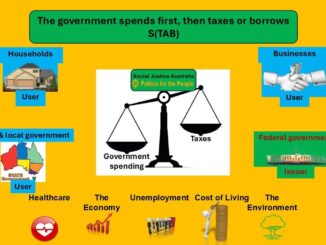
Australia is a sovereign currency issuer; the federal government cannot run out of Australian dollars. It creates money whenever it spends (RBA, 2018). This reality dismantles the central justification for privatisation: that the government must sell assets to raise funds.
Instead of coercing states to sell income-producing assets, Canberra can use its monetary capacity to:
- Directly fund infrastructure and public services.
- Support state budgets through unconditional grants.
- End reliance on private finance or foreign investors.
Quick Fact:
The federal government can always afford to fund state projects in its own currency; what limits it is politics, not affordability.
As Modern Monetary Theory (MMT) economists note, public money can be used to meet public purpose, without debt crises or austerity (Mitchell, 2020). Australia could fund a Job Guarantee, renewable energy grids, and public housing directly, empowering states to deliver for citizens instead of corporate shareholders.
6. Policy Proposals for Fair Federalism
To restore balance and rebuild public ownership, reforms should include:
- Removing privatisation clauses from Commonwealth grants.
- Restoring state enterprises where possible, particularly in energy and transport.
- Creating a National Public Investment Fund to finance infrastructure through the RBA.
- Transparency requirements for any future asset transfers.
- Auditing past privatisations to measure real public cost.
Australia’s future depends on governments rediscovering the power of public money for the public good. The same creativity used to design privatisation incentives can design a future of shared prosperity.
Frequently Asked Questions
Q1: What was the National Competition Policy, and how did it encourage privatisation?
The National Competition Policy (1995–2005) offered financial rewards to states for deregulating markets, corporatising public services, and selling assets, embedding market competition into essential sectors (NCC, 2005).
Q2: How did the Asset Recycling Initiative pressure states?
The ARI paid states a 15% bonus for selling public assets and reinvesting proceeds, effectively bribing them to privatise for short-term revenue (Treasury, 2014).
Q3: Could states refuse federal incentives?
Technically, yes, but the structure of Commonwealth funding made refusal financially risky. Declining tied grants could create budget gaps, making resistance politically difficult (Senate Inquiry, 2019).
Q4: How does dollar sovereignty offer an alternative?
Because the federal government issues its own currency, it doesn’t need to raise money through taxes or sales to fund programs. It can be spent directly to build assets for public benefit (RBA, 2022; Mitchell, 2020).
Final Thoughts: Reclaiming Australia’s Future
The story of privatisation in Australia isn’t one of state mismanagement, but of federal pressure to privatise. Canberra’s funding carrots and sticks reshaped public ownership into private empires. Each sale traded long-term security for short-term fiscal convenience.
But this trend is reversible. With Australia’s dollar sovereignty, the federal government can fund the infrastructure, housing, and energy systems we need, without selling what we already own.
Public wealth can be rebuilt, and democracy restored, when we reject the false claim that governments “can’t afford” to invest in the people.
What’s Your Experience?
Have you seen the impact of federal privatisation pressure in your state? Which public asset sale affected your community the most?
Call to Action
We’d Love to Hear from You
If you found this article insightful, explore more about political reform and Australia’s monetary sovereignty on the Social Justice Australia website.
Please share your thoughts through our Reader Feedback form, check out what others are saying on our Testimonials page, or scroll down and leave a comment below. Your voice helps shape future content.
Spread the Word
Change starts with conversations. Share this article with friends, family, or your social networks so more Australians can see what’s possible. Every share helps build momentum for a fairer society.
Keep Independent Journalism Alive
We’re 100% reader-supported, no ads, no corporate strings, just honest, truth-driven journalism. If our work has informed or inspired you, we invite you to consider contributing. Even $5, or whatever you can spare, helps us keep publishing and reaching more Australians.
Donate Now – one-time or monthly.
Already donated? Share the love by leaving us a quick review on Google to help others find us.
Engaging Question
If federal pressure to privatise ended tomorrow, which public service should Australia rebuild first – energy, housing, or transport?
References
Treasury: Review of the NPA on Asset Recycling (2014)
Federal Financial Relations: National Partnership: Asset Recycling (2015)
National Competition Council: Competition Principles Agreement and NCC Assessments (2005)
Parliament of Australia: Senate Inquiry: Privatisation of Public Assets (2019)
Melbourne Law School: Making Sense of s 96 Tied Grants (2021)
Reserve Bank of Australia: Understanding Money Creation and Fiscal Capacity (2019)
Grattan Institute: Powering Through: Electricity Prices and Reform (2017)
Bill Mitchell, Economist: Modern Monetary Theory
This article was originally published on Social Justice Australia
Keep Independent Journalism Alive – Support The AIMN
Dear Reader,
Since 2013, The Australian Independent Media Network has been a fearless voice for truth, giving public interest journalists a platform to hold power to account. From expert analysis on national and global events to uncovering issues that matter to you, we’re here because of your support.
Running an independent site isn’t cheap, and rising costs mean we need you now more than ever. Your donation – big or small – keeps our servers humming, our writers digging, and our stories free for all.
Join our community of truth-seekers. Donate via PayPal or credit card via the button below, or bank transfer [BSB: 062500; A/c no: 10495969] and help us keep shining a light.
With gratitude, The AIMN Team


Be the first to comment