By Denis Hay
Description
Critical mass in politics shows how small groups trigger sudden change. Learn how dollar sovereignty could reshape Australia’s future.
🎧 Prefer to listen to this article? Press play
Introduction: Why Change Feels Impossible Until It’s Inevitable
Changes in politics often feel painfully slow, especially in Australia, where outdated economic myths and entrenched interests prevail. Yet history shows that once an idea reaches critical mass in politics, transformation can happen almost overnight.
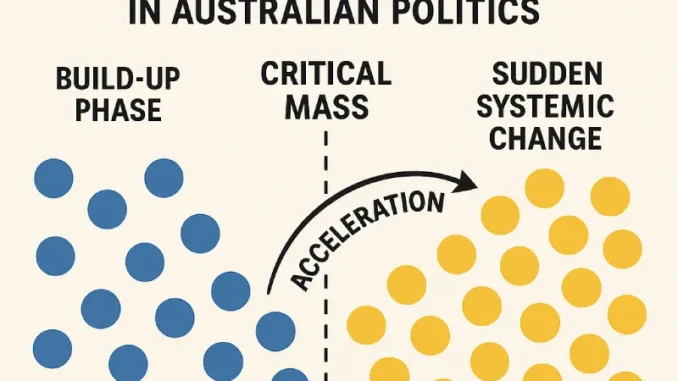
Critical mass, a concept borrowed from physics, refers to the point at which enough momentum accumulates to make a change self-sustaining. In society, this means that when around 15-25% of people adopt a new belief or demand, it spreads rapidly until it becomes mainstream.
For Australia, the most powerful candidate for such a tipping point is the recognition of dollar sovereignty, which means our government cannot run out of its own currency. Once enough citizens understand this, the excuses of austerity and “budget discipline” collapse, opening the door to massive public investment in housing, health, education, and climate action.
The Problem: Why Australia Feels Trapped in the Old System
1. Neoliberal Narratives Dominate
For forty years, Australians have been told that the government must “live within its means,” as if it were a household. This has justified:
- Austerity measures and cuts to essential services.
- Privatisation of assets such as Telstra, Qantas, and electricity networks.
- Reluctance to build large-scale public housing or expand Medicare.
Mainstream media and both major parties reinforce this myth, suppressing alternative views. As explored in Why Australia Will Never Run Out of Money, this framing is misleading, yet it keeps citizens passive.
2. Public Apathy and Resistance to Change
Because of this narrative, many Australians believe “nothing can change.” Low trust in politics is widespread, only 25% of Australians believe the system works in their best interests (ABC source). Citizens fear that public spending will lead to “mountains of debt,” even though nations with far higher debt ratios, such as Japan, function without crisis.
This apathy helps the status quo, allowing governments to avoid bold reforms.
The Impact: What Australians Experience Under the Current Model
3. Rising Inequality and Insecurity
The result of the delay is hardship for ordinary people:
- Housing: In 2024, the median house price reached $934,000 (CoreLogic). Home ownership for under-35s is at a historic low.
- Work: Nearly 1 in 3 Australian workers is in part-time or insecure employment (Australian Bureau of Statistics).
- Retirement: The aged pension is among the lowest in the OECD, leaving seniors struggling to afford basics.
This aligns with what we outlined in ‘Why It Feels So Hard to Get Ahead in Australia Today‘. Citizens are pressured, while corporations thrive.
4. Who Benefits from the Status Quo
The current system protects elites:
- Corporations enjoy tax loopholes and generous subsidies.
- Media monopolies, especially Murdoch outlets, frame economic debates to their advantage.
- Lobbyists influence policy, ensuring public money serves private profit.
Without a sudden change, these interests will continue to block reforms.
The Theory of Critical Mass: How Change Suddenly Accelerates
5. Small Beginnings, Big Shifts
Critical mass in politics works like this:
- A small group begins pushing a new idea.
- Adoption feels slow and marginal.
- At around 15-25% adoption, a tipping point is reached.
- Suddenly, the idea spreads rapidly, becoming mainstream.
Historical parallels in Australia:
- Medicare: Once resisted, now untouchable.
- Marriage equality: Years of opposition collapsed into broad support within a short window.
- Renewable energy: Wind and solar were niche in the 1990s, but once adoption passed critical mass, investment accelerated.
These examples illustrate how entrenched norms can shift rapidly once public sentiment surpasses the threshold.
6. Dollar Sovereignty as the Next Critical Mass Issue
Dollar sovereignty is primed for critical mass. The key points are simple:
- Australia issues its own currency.
- It can never “run out of dollars.”
- The real limits are inflation and resource capacity, not money.
Once enough citizens grasp this, they will no longer accept excuses like “we can’t afford public housing” or “healthcare is too expensive.” Politicians will have no choice but to respond.
The Solution: What Critical Mass Could Unlock in Australia
7. Policies That Could Tip the Balance
If critical mass is reached on dollar sovereignty, reforms could accelerate overnight:
- Public housing boom to end homelessness.
- Universal free education, from early learning to university.
- A federal Job Guarantee, ensuring meaningful work for all.
- Green energy transition at the speed climate science demands.
These are not utopian dreams but practical outcomes of sovereign spending.
8. Building Momentum
To accelerate this shift, Australians must:
- Support independent media challenging economic myths.
- Join grassroots campaigns spreading the truth about public money.
- Back independent MPs and Teal candidates, who often push harder on reform.
- Engage in local activism, discussions, and community education.
As seen with the Teal independents, when citizens rally around an idea, political narratives change.
Frequently Asked Questions
What is critical mass in politics?
It’s the tipping point where enough people support an idea that it becomes unstoppable.
Has Australia ever seen critical mass in action?
Yes, Medicare and marriage equality are prime examples of once-contested reforms that became mainstream.
How does dollar sovereignty trigger a sudden change?
Once people realise government spending is not constrained like a household budget, they demand investments that serve the public good.
Final Thoughts: From Impossible to Inevitable
Critical mass in politics explains why change often feels impossible until it becomes inevitable. Australia is stuck in an outdated economic story, but once enough people recognise our dollar sovereignty, sudden change will follow.
Housing, healthcare, education, and climate action can all shift from “unaffordable” to “urgent priorities.” The only barrier is whether we, as citizens, are willing to push the conversation to critical mass.
What’s Your Experience?
Do you think Australia is approaching a critical mass moment in housing, healthcare, or dollar sovereignty?
Call to Action
We’d Love to Hear from You
Please share your thoughts through our Reader Feedback form, check out what others are saying on our Testimonials page, or scroll down and leave a comment below. Your voice helps shape future content.
Spread the Word
Change starts with conversations. Share this article with friends, family, or your social networks so more Australians can see what’s possible. Every share helps build momentum for a fairer society.
Keep Independent Journalism Alive
We’re 100% reader-supported, no ads, no corporate strings, just honest, truth-driven journalism. If our work has informed or inspired you, we invite you to consider contributing. Even $5, or whatever you can spare, helps us keep publishing and reaching more Australians.
Donate Now – one-time or monthly.
Already donated? Share the love by leaving us a quick review on Google to help others find us.
Engaging Question
Have you ever seen a time when public opinion shifted suddenly and changed everything? What sparked it?
Resources
SIPRI: Military Expenditure Database.
World Bank: China Infrastructure & Development Overview.
This article was originally published on Social Justice Australia
Keep Independent Journalism Alive – Support The AIMN
Dear Reader,
Since 2013, The Australian Independent Media Network has been a fearless voice for truth, giving public interest journalists a platform to hold power to account. From expert analysis on national and global events to uncovering issues that matter to you, we’re here because of your support.
Running an independent site isn’t cheap, and rising costs mean we need you now more than ever. Your donation – big or small – keeps our servers humming, our writers digging, and our stories free for all.
Join our community of truth-seekers. Donate via PayPal or credit card via the button below, or bank transfer [BSB: 062500; A/c no: 10495969] and help us keep shining a light.
With gratitude,
The AIMN Team




National Debt is a control tool, used by governments to reduce or curb social improvements. It is worth noting National Debt doesn’t stop $billions paid for nuclear submarines or support of American shipyards!! The simple fact is, Australian dollars spent in Australia keeps the wheels of industry/commerce turning.
That’s a great point, Jonangel. You’ve summed it up perfectly. The idea of “national debt” is often used to justify cutting social programs, yet there’s never hesitation when it comes to massive defence spending. As you said, when the government spends Australian dollars within Australia, it strengthens our economy, supports jobs, and builds communities. It’s time for more people to understand that public spending is not the enemy, but rather the engine of social progress.
Everything is outdated in Australia, from the bathroom fiitings and ovens we can buy, to old political sentiment, to our unwillingness to stand on our own two feet or our fear of standing up to our billionaire
class!