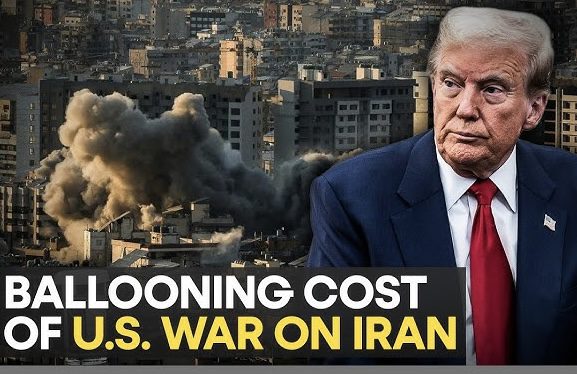
The big drain on military resources has begun. A war apparently already won (and not), against an adversary supposedly without means to fight back, its air force and navy destroyed, its missile capabilities blunted, is now drawing the clumsy colossus of American power into the Middle East with embarrassing effect. The Middle East, where US President Donald Trump promised the “forever wars” would end, promises an end to his beginning.
The ledger of losses keeps rising with giddying pace. The US casualty list, for now, remains manageably low, but the military purse is being raided with manic relish. Operation Epic Fury cost US taxpayers $11.3 billion in munitions over the first six days, an estimate that excludes operating and maintenance costs of the engaged military force or the damage inflicted by Iran. The Washington-based Center for Strategic and International Studies (CSIS) claims that the first 100 hours of the war cost $3.7 billion, approximating to $891.4 million each day.
Strain is also being placed on inventories. The US prides itself on deluxe, high brand killing and extermination of targets, using chic weaponry and dull doctrine. Expensive homicidal measures do have to be eventually accounted for. According to reporting from Bloomberg, “as the conflict extends toward a third week, the US war effort is showing unexpected signs of strain against an adversary whose military budget is smaller than the GDP of Vermont – but which has an arsenal of missiles and drones unlike anything the US has ever faced.”
Critical munitions are being depleted. With the campaign barely 100 hours old, 168 Tomahawk cruise missiles had been fired. (Each unit costs a mighty $3.6 million.) This is a staggering figure when compared to the rate of procurement: the previous five years had seen the production of 322 Tomahawks. According to a source quoted in the Financial Times, “The navy will be feeling this expenditure for several years.”
While the Pentagon gloats at reducing Iranian strikes by 80% or more, Tehran has gotten more economical with its targeting, successfully striking military and energy infrastructure across the Middle East with telling effect. Ballistic missiles have hit the US Navy’s Fifth Fleet headquarters in Bahrain, destroying two AN/GSC-52B SATCOM terminals. A costly AN/FPS-132 early warning radar in Qatar – a facility estimated to cost some $1.1 billion – was successfully struck by a ballistic missile.
The AN/TPY-2 radar facilities used by the lauded yet hideously expensive Terminal High Altitude Area Defense (THAAD) system have also been struck in Saudi Arabia’s Prince Sultan Air Base, Al Ruwais in the UAE, Al Dhafra Air Base in proximity to Abu Dhabi and Jordan’s Muwaffaq Salti Air Base. A sense of how important that facility is to the operation of the battery is provided by N.R. Jenzen, a munitions specialist of Armament Research: “The AN/TPY-2 radar is essentially the heart of the THAAD battery, enabling the launch of interceptor missiles and contributing to a networked air defence picture.” Knocking out the radar blinds the system.
The outstanding feature of many of the strikes is their relative cheapness to the interceptor missiles used to destroy them. “The round’s we’re firing – Patriot rounds, THAAD rounds … these weapon systems, each around is millions of dollars,” laments Arizona Democratic Senator Mark Kelly. “The math on this doesn’t work.” Shahed-136 one-way drones, each one costing $35,000, have played a starring role in upsetting “the math.” CENTCOM commander Adm. Brad Cooper has also noted that the majority of wounded US personnel – some 140 troops – have been injured in “one-way strikes.”
This has compelled the Pentagon to pay greater attention to its own Low-Cost Uncrewed Combat Attack System (LUCAS), which is now seeing service in some instances against Iranian attacks. But the department is also set to seek more cash, expecting to ask $50 billion in additional funding from Congress. Given the sheer unpopularity of the war, some lawmakers have reservations. “You’ve got to be able to provide us with more information as […] justification,” insists Alaska Republican Senator Lisa Murkowski, member of the Senate Appropriations Committee. “Don’t just take it for granted that the Congress’s role is basically to write the cheque.”
US military power is now being drawn from other theatres of interest to feed the Moloch of war. In a recent cabinet meeting, South Korean President Lee Jae Myung confirmed that Washington might relocate air defence material to the Middle East. Multiple launchers of the THAAD system have been or are in the process of being moved to Osan Air Base in Pyeongtaek, roughly 70km south of Seoul, with the interceptor missiles destined for the Middle East.
This shifting of pieces has not been without consequence. The THAAD batteries had been sent to South Korea in 2017 to assure it against threats from its nuclear-armed neighbour to the north. Depriving them of projectiles has gotten tongues wagging about increasing vulnerability. Besides, the ostensible security provided by US power for its allies and partners has been shown to be something of a dud, as Iran’s attacks on the Gulf states has so convincingly demonstrated.
Concern from Taiwan about such moves was registered in an interview by Chen Kuan-ting, a legislator and member of the country’s Foreign Affairs and Defence Committee. As US military assets and resources could not “be deployed in two places at the same time”, it was a case of priorities. And those priorities, it was implied, should lie in Asia. “Deploying the main military assets in Asia and confronting the US’s primary competitor here is more in line with US interests.” That may well be what he hopes for, but it is clear that Washington is battling through the another malady Trump had once campaigned against: the debilitating entanglement of a foreign war with ill-defined objectives involving a resourceful, obstinate foe.
Keep Independent Journalism Alive – Support The AIMN
Dear Reader,
Since 2013, The Australian Independent Media Network has been a fearless voice for truth, giving public interest journalists a platform to hold power to account. From expert analysis on national and global events to uncovering issues that matter to you, we’re here because of your support.
Running an independent site isn’t cheap, and rising costs mean we need you now more than ever. Your donation – big or small – keeps our servers humming, our writers digging, and our stories free for all.
Join our community of truth-seekers. Please consider donating now via:
PayPal or credit card – just click on the Donate button below
Direct bank transfer: BSB: 062500; A/c no: 10495969

We’ve also set up a GoFundMe as a dedicated reserve fund to help secure the future of our site.
Your support will go directly toward covering essential costs like web hosting renewals and helping us bring new features to life. Every contribution, no matter the size, helps us keep improving and growing.

Thank you for standing with us – we truly couldn’t do this without you.
With gratitude, The AIMN Team

Possibly, but this Anglo ‘analysis’ misses or averts how Trump, Netanyahu and Trump are allies/frenemies who have all kicked off wars of aggression to protect their own corruption, legal and other existential threats?
Further, there is a common person, weakness and mentee of Murdoch, Witkopf’s partner with Putin & Trump, Jared Kushner, another geopolitical, real estate and financial strategic genius…..joined at the hip with Netanyahu.
While Saudi & Gulf States are well p*ssed off with Trump, they invested $2 billion into Kushner’s fund for ‘access’, an in return they get nada; maybe Saudi should divest from Kushner’s fund?
On the above, other indie media are not informing anyone by using dodgy US non expert ‘analysis’, using Iran and Gaza to wedge the centre/ALP, but ignoring Ukraine, Sudan, Myanmar etc., the right and related fossil fuel think tanks?
Ignorance abounds when the ageing faux anti-imperialist left, including around Wikileaks, share talking points vs centre, Democrats, UK Labour etc. with Fox News and Nigel Farage, wtf?
Another outstanding analysis by Andrew Smith, typified by its scintillating and coruscating depth of discernment as to the issues at play. Well done, Andrew, and keep up the good work. It’s not often I make these comments, but your contributions to the general/comprehensive understanding of global affairs makes you one of the key contributors to The AIMN’s community of commentators. Don’t stop. We’d be lost without you.
Nice one Kanga.
I love the way Mr Smith provides so many links to credible sources so that readers can check his many assertions.
“Ignorance abounds” he tells us from on high…
Never a truer word spoken.