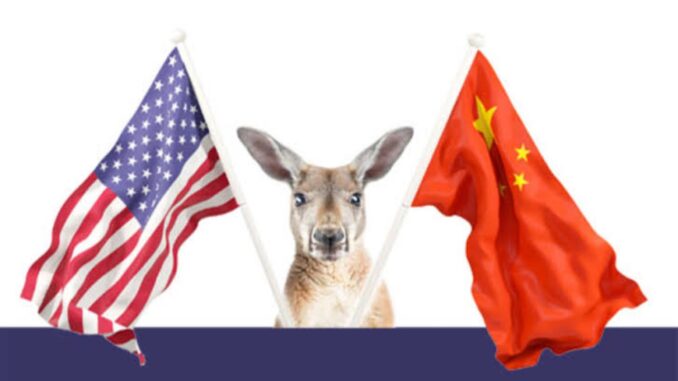
As the Trump administration ramps up its confrontational stance toward China over Taiwan, it has turned its gaze to Australia, pressing Canberra to clarify its role in a potential U.S.-China conflict. This demand, however, lands on uneasy ground. Since Donald Trump’s return to the White House in January 2025, Australian public sentiment has soured, with many expressing dismay over his administration’s treatment of our nation. The imposition of broad tariffs, which threaten Australia’s economy, and the perceived strong-arming of allies have fueled a growing skepticism about aligning too closely with Washington’s agenda. This tension places Australia in a precarious position, balancing its historic alliance with the U.S. against domestic discontent and its vital economic ties with China.
Trump’s policies have hit Australia hard. Despite a 20-year trade agreement ensuring 90% of Australian exports to the U.S. are tariff-free, Trump’s campaign promise of a 10% universal tariff looms large, endangering industries like mining, agriculture, and education that rely on open markets. Posts on X reflect Australian frustration, with users slamming Trump for “free-loading” via U.S. military bases and urging withdrawal from alliances like Five Eyes. The 2025 Lowy Institute Poll captures this mood, revealing only 36% of Australians trust the U.S. to act responsibly – a 20-point drop from last year. Former Foreign Minister Gareth Evans has warned that Trump’s approach erodes global trust, a sentiment echoed by X users who see Australia as a potential “patsy” in U.S. plans. This distrust complicates Canberra’s response to Washington’s call for military alignment, especially as the Pentagon reviews the AUKUS agreement, raising fears that promised submarine transfers may be at risk unless Australia boosts defense spending to 3.5% of GDP.
Yet, Australia’s strategic and economic realities pull in conflicting directions. The Albanese government has deepened military ties through AUKUS, hosting a significant U.S. military presence to counter China’s assertiveness in the Indo-Pacific. However, China remains Australia’s largest trading partner, and stabilised relations since 2022 have lifted punitive trade restrictions on goods like wine and lobster. Choosing sides in a U.S.-China conflict could devastate Australia’s export-dependent economy, a concern amplified by public opinion favoring pragmatic engagement with China over military escalation. The Lowy Poll shows 81% of Australians disapprove of Trump’s tariff tactics, and 60% support stronger deterrence against China without committing to U.S.-led wars.
As Trump pushes for Australia to pick a side, Canberra faces a delicate dance: maintaining its alliance with the U.S. while safeguarding economic stability and public support. Refusing to be drawn into a conflict not of its making, Australia may leverage its role in regional forums like the Quad and the Pacific Islands Forum to advocate for de-escalation and rules-based trade, preserving its autonomy in an increasingly volatile world.
Also by Michael Taylor:
Dear reader, we need your support
Independent sites such as The AIMN provide a platform for public interest journalists. From its humble beginning in January 2013, The AIMN has grown into one of the most trusted and popular independent media organisations.
One of the reasons we have succeeded has been due to the support we receive from our readers through their financial contributions.
With increasing costs to maintain The AIMN, we need this continued support.
Your donation – large or small – to help with the running costs of this site will be greatly appreciated.
You can donate through PayPal or credit card via the button below, or donate via bank transfer: BSB: 062500; A/c no: 10495969


Trump wants unwavering loyalty or we’ll be penalised. We’ve seen what he’s capable of, supplying arms to bomb a coralled, unarmed, populace, and bombing Iran. Not a shred of human decency in him. Most of us know that if we even think of stepping out of line, he could turn on us in the blink of an eye. Australia walked into AUKUS with its eyes closed and now we’re in an unfathomable mess. The earlier we back out of it, the better, though we’ll pay for it in more ways than one. But likely at a lower cost than $400 billion, which 26 million people cannot afford.
This latest demand from Chump regarding Taiwan is so wildly inappropriate, it is a question no country should ever ask publicly and one that no country should ever reply to publicly.
Most Australians I believe do not give two hoots about AUKUS and wish it was just cancelled.
I have always been a Labor supporter (and for good reason) but, fair dinkum, they do some very strange things. After being elected they created the NACC and then staffed it with Lieberal stooges. They nominated a woman to be the Jewish Envoy………who is attempting to dictate how universities and other institutions conduct their business and……………..whose extreme right wing husband is the biggest donor to Advance. They signed up for and agreed to pass legislation for AUKUS, a secretive deal done by Scomo with zero consultation with anyone, without any knowledge of the details, costing Australian hundreds of millions to screw over the French, and leaving us with the biggest hit to the Australian taxpayer in history…………and still with zero guarantee that we will even get the subs we paid for. And just to top off that deal we have to pay extra billions to keep the US sub industry afloat and agreed to be their nuclear waste dump.
Like, come on Labor, you can do better.