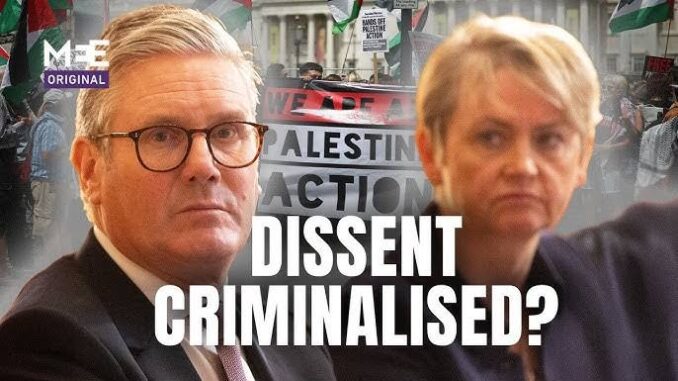
Protest in Britain has become dangerous of late. Shaky lawmakers minding their elected positions, displaying decorative ignorance, have been criminalising protests against the war in Gaza, branding certain groups “terrorist” in inclination. While the laws dealing with criminal damage to property and such are already more than adequate, the government of Sir Keir Starmer thought it wise to enlarge them. There are people dying in large numbers in Gaza, and those protesting that situation have become a nuisance.
The keen obsession of this government – and a majority of the cerebrally softened legislators in the House of Commons – is that a group called Palestine Action is somehow worthy of being bracketed as a terrorist group under the Terrorist Act 2000. On June 20, members of the outfit broke into a Royal Airforce base at Brize Norton, Oxfordshire and spray painted two military aircraft alleged to be aiding US and Israel in refuelling tasks. This seemingly minor display of indignation by the organisation was enough to warrant its proscription by Home Secretary Yvette Cooper three days later under section 3 of the Terrorism Act.
United Nations experts linked to the UN Human Rights Office of the High Commissioner, among them Francesca Albanese, Ben Saul and Irene Khan, issued a press release on July 1 calling the labelling of a protest movement as “terrorist” an unjustified measure. “According to international standards, acts of protest that damage property, but are not intended to kill or injure people, should not be treated as terrorism.” Despite there being no binding definition of terrorism in international law, the experts were of the view that it would be limited to such acts as would cause death, serious personal injury, or involve the taking of hostages “in order to intimidate a population or compel a government or an international organisation to do or to abstain from doing any act.”
Were a national law to criminalise property damage in democracies, it would have to exclude acts of advocacy, protest, dissent or industrial action not causing death or serious injury, an approach approved by the UN Security Council’s Counter-Terrorism Executive Directorate. In the case of banning Palestine Action, individuals would be needlessly “prosecuted for peacefully exercising their rights to freedom of expression and opinion, assembly, association and participation in political life.”
A leaked report by the Joint Terrorism Analysis Centre (JTAC), obtained by human rights activist and former diplomat Craig Murray, further showed the decision to proscribe Palestine Action under the Terrorism Act as one marked by mendacity and panic on the part of the Starmer government. While JTAC is not sympathetic to Palestine Action, it did note that “The majority of the group’s activity would not be classified as terrorism under Section 1 of the Terrorism Act 2000.” While it assesses the group as having “promoted terrorism”, the primary focus of the direct action, according to the sanitised version of the report, is on inflicting property damage. Serious damage to property could bring the group within the legislation, but even then, as the UN experts have noted, that would not meet necessary international standards to warrant the label of terrorism.
According to Murray, had Palestine Action, as claimed or implied by the government, deliberately attacked individuals, received foreign funding from Iran or any hostile power, attacked Jewish-owned businesses based on racism, or planned a “future unspecified appalling terrorist acts”, then JTAC’s report would have made mention of it. “Palestine Action,” insists Murray, “is what it says it is: a non-violent direct action group which targets the Israeli weapons industry and its support and supply line.”
The High Court has granted Palestine Action co-founder Huda Ammori judicial review regarding the proscription of the organisation on two grounds: that it arguably amounts to a disproportionate interference with Article 10 and 11 rights of the claimants, which guarantee free speech and peaceful assembly under the European Convention on Human Rights; and that the proscription was made in breach or natural justice and/or contrary to article 6 the ECHR, which entitles all to a fair and public hearing within a reasonable time by an independent and impartial tribunal established by law. The Home Secretary, it was noted, had failed to even consult PA in making the decision.
The decision by the Starmer government was astonishing and, as with all bad laws, the foundry of astonishingly stupid results. It has made the police imbecilic enforcers; it has turned prosecutions into a dismal circus. Protesters otherwise regarded as very English and very middle class have found themselves facing arrests and charges. Over the course of one weekend this month, section 13 of the Terrorism Act 2000 was used to arrest over 500 people, most of them carrying a placard supporting PA. That provision criminalises the wearing of clothing items or the wearing, carrying or displaying of any article, and the publishing of an image of an item of clothing or any other article “in such way or in such circumstances as to arouse reasonable suspicion that he is a member or supporter of a proscribed organisation.” Sentences range from six-month imprisonment to a fine.
One particularly absurd arrest was that of retired head teacher John Farley, who was carrying a placard making reference to Palestine Action. Farley was eventually released on bail pending charges, which were never pressed. The incident last month did not even involve the proscribed organisation but was connected with another organised protest group.
The protest held in Leeds began as a solemn, silent march. Two police caught sight of Farley holding the placard. They proceeded to drag Harley away, and, typical of those types of recruits, refused to listen to any explanation: that the cartoon on the placard was a replica from the satirical magazine Private Eye, commenting on the banning of Palestine Action. The Private Eye piece, brutal, grim, and apposite, sought to explain what “Palestine Action”entailed: “Unacceptable Palestine Action” involved “spraying military planes with paint”;“Acceptable Palestine Action” entailed “shooting Palestinians queuing for food.”
Private Eye’s editor, Ian Hislop, roundly condemned the arrest as “mind-boggling” and “ludicrous”. The cartoon had been “a very neat and funny little encapsulation about what is and isn’t acceptable, and it’s a joke about – I mean, it’s quite a black joke – but about the hypocrisies of government approach to any sort of action in Gaza.”
A spokesman for West Yorkshire Police expressed some contrition for Farley’s consternation, and went on to express a view in tortured middle management speak. “As this is a new proscribed organisation, West Yorkshire Police is considering any individual or organisational learning from this incident.” That ship would seem to have sailed into the waters of sheer lunacy, leaving the judges to decide in November whether the proscription order for Palestine Action struck a proportionate balance. Till then, this egregious application of the law will continue to make pro-Palestinian protests in Britain a perilous affair.
Dear reader, we need your support
Independent sites such as The AIMN provide a platform for public interest journalists. From its humble beginning in January 2013, The AIMN has grown into one of the most trusted and popular independent media organisations.
One of the reasons we have succeeded has been due to the support we receive from our readers through their financial contributions.
With increasing costs to maintain The AIMN, we need this continued support.
Your donation – large or small – to help with the running costs of this site will be greatly appreciated.
You can donate through PayPal or credit card via the button below, or donate via bank transfer: BSB: 062500; A/c no: 10495969


Our febrile politicians in this country have been tending to lean in the direction of slamming nuts with a sledgehammer when it comes to legitimate protests.Same goes for the secrecy around freedom of information.Can’t have the punters becoming dangerously informed.
It’s a disturbing trend.
Care to elaborate on the nature of the nuts, Harry?
My legs tense and cross as a memory of a thoroughbred colt being emasculated by the vet returns, the sound of crushed tissue, men wincing in empathetic concern.
I wasn’t thinking of the family jewels Canguro,but there are certainly some public figures I can visualise having the scalpel applied to the orchestra stalls without any wincing at all.
An old student of British history, I’ve never seen things worse, nor could have imagined such decline in behaviour, attitudes, achievements. The opposition is frightfully bad and this government is loose, low, limited. Grate Britain, indeed, sir, and the people (who?) can get Wellington booted. Let the shrivelling commence, what? (perhaps the next decent, competent U K leader is yet to be born, somewhere.)
Starmer & his mob of chardonnay sippers are pathetic drama peddlers & control freaks of the highest order – grouped with ‘Reform’ and the ‘Tories’. Thank goodness a new Jeremy Corbyn led party is belting all the others with 500 per minute seeking membership. It’s already got a membership far outstripping Labour.
Die Sturmer seemws to live with fingers pushed on a permanent anxiety button.