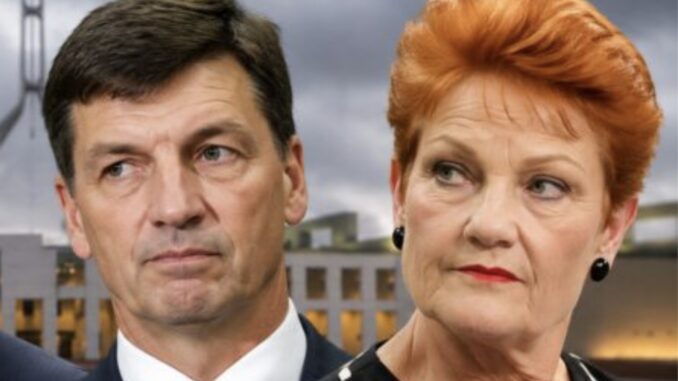
Fights over multiculturalism and gender are hiding the core of the nation’s despair – rising economic inequality. Mark Kenny reports…
Flat wages growth, stagnant productivity, and dwindling purchasing power at the supermarket.
Is it any wonder that the only things consistently growing are anger, distrust, and a sense that the economy is either broken, or worse – being run for someone else?
Despair has become Australia’s growth industry – a new normal as tempers fray and blame is directed at the two mainstream parties, dismissed on the fringes as the ‘uniparty’.
Housing prices taper marginally but the recent correction is small beer to the punishing 400 per cent increase in average dwelling prices as measured by the ABS since the turn of the century.
A large slice of the electorate feels excluded from the Australian dream, perennially renting or contemplating homelessness as rising inequality pulls at the fabric of Australia’s egalitarian ethos.
The centre struggles to hold as trust tanks and hopes hollow out.
A new indignation affects everything, from our frustrated daily commutes, to our hyper-aggressive ‘social’ media presentations and a declining sense of common membership. Whether spontaneous or performed, rage is even becoming common in the once constrained tenor of official political exchange.
In the House of Representatives, the mild-mannered Dan Tehan demands that Labor’s Energy Minister, “cut the crap”.
Censured for unparliamentary conduct, Tehan provocatively amends his words to “cut the faecal matter”, his inevitable ejection drawing all the media coverage intended.
In the US, a Republican Senator attacks the former chief health officer Dr Antonio Fauci over pandemic restrictions, thundering “who the fuck did you think you were?”
The would-be prime minister, Angus Taylor calls the Prime Minister an “arrogant prick” in Parliament. Appearing on breakfast TV the following morning, Taylor doubles down.
“I have to say that I’m hearing far worse at the moment from others as I get around the country,” Taylor quips to the Today program.
These are just a smattering of a growing indecorousness as professional politicians affect an ‘authentic’ fury on behalf of Australians ‘doing it tough’ as EV sales soar in the inner-cities.
Non-cosmopolitan despair in government, media and the economy, is their new target audience, its legitimate grievances easily fanned.
This has material implications. Press Gallery journalist Stephanie Borys told Radio National on August 21, that fringe agitators on both extremes are actively leveraging community disdain for politicians such that a tense atmosphere is newly palpable when leaders hold press conferences in public places.
“The temperature is definitely becoming heated,” she said.
“Fringe agitators on both extremes are actively leveraging community disdain for politicians”
“People are really angry and that anger, people on the far left and far right, are using it to their advantage.”
While nostalgic cultural ‘markers’ feature prominently in the febrile rhetorics of grievance – think anti-feminism, anti ‘mainstream’ media, opposition to First Nations recognition, replacement of multiculturalism with a predominantly white “monoculture”, and the rejection of gender and sexual diversity – it is generally held that the core of outsider resentment, is rising economic inequality.
There is a visceral fear among some people that they are merely surviving. Few express faith that things will improve as energy, health insurance, childcare and aged care become unaffordable.
Boiled down, the populist charge is that a broad consensus around neo-liberal economics means that the major parties argue loudly but never fundamentally threaten the interests of an inner-urban professional and business minority.
This is a common theme across many European democracies as well as the Anglophone polities of the UK and USA.
“Real wages have been growing but less than they were a year ago,” reported the OECD in its 2026 employment outlook released in July.
It found annual real wage growth across member economies was 2.2 per cent in Q1 2026 on average, compared with 2.7 per cent in Q1 2025.
But the situation for Australia was markedly worse with real wages contracting for the same period at minus 0.8 per cent.
Over the five years since 2021, Australia’s real wage growth rate has been dismal at minus 5.1 per cent compared to the OECD average of almost 5 per cent (positive). An almost 10 per cent differential.
Governments are caught between the generous inclinations of politics and the intentionally cruel deprivations insisted on by economics. Short-term measures to ease the cost-of-living pain on consumers – through the tax system or via direct cash payments – are considered as elections approach but they only feed inflation.
Neither can governments act more freely in individual sectors. Like a Rubik’s Cube – every move made on one front to align policy to political sensitivities, brings multiple unknowns on the other dimensions also.
While first home buyer subsidies are politically popular, they invariably increase demand and push up the average entry point for aspiring home-owners. Similarly, rental assistance ultimately drives up rents.
In the short-term, the major victim of public disenchantment is the Liberal-National coalition which has fallen behind the burgeoning One Nation party.
Recent polls have consistently shown One Nation’s leader, Pauline Hanson to be more popular than Mr Taylor and her party to be the closest rival to the Labor government.
Politically, the current conditions suit the populist party’s message which is longer on laments than it is on detailed policy. Its approach relies so far on what has been described as the ‘culturalization of inequality’.
“Almost 100 per cent of the time, far-right rhetoric deliberately omits the language of ‘worker’ and ‘boss’ and ‘poor’ and ‘rich’,” notes Oscar Kaspi Crutchett in a 2026 report for Victorian unions, Antidote.
“It will always replace these with some version of the people vs the elite, the producers vs the parasites, the patriots vs the traitors.”
Labor’s prospects remain strong in 2028 thanks to a combination of its huge parliamentary majority, the advantages of incumbency, and the likelihood that a slowing economy will bring lower inflation and interest rate cuts in the second half of 2027.
But will such conditions be enough to turn around a bleak national mood, or will the pain and disillusionment of an economy seen to be failing ordinary people cause an historic fracture from which orthodox two-party politics cannot recover?
Mark Kenny is Director of the Australian Studies Institute at the Australian National University (ANU)
This article was first published in The Klaxon and 360info.org
Also by The Klaxon/360
A toxic brew has shaped a world driven by anger, fear and confusion
The collapse of trust in facts: making sense of verification on the internet
Keep Independent Journalism Alive – Support The AIMN
Dear Reader,
Since 2013, The Australian Independent Media Network has been a fearless independent voice – holding power to account and delivering journalism that matters.
Running this site isn’t cheap. Rising costs mean we need your support now more than ever. Every donation, big or small, keeps our servers running, our writers working, and our stories free for everyone.
Donate here:
PayPal or credit card – just click on the Donate button below
Direct bank transfer: BSB: 062500; A/c no: 10495969

We’ve also set up a GoFundMe as a dedicated reserve fund for hosting and future improvements.

Thank you for standing with us. We couldn’t do this without you.
With gratitude,
The AIMN Team
We must reject a political system that favours the two major parties, because nothing will change if we don’t.