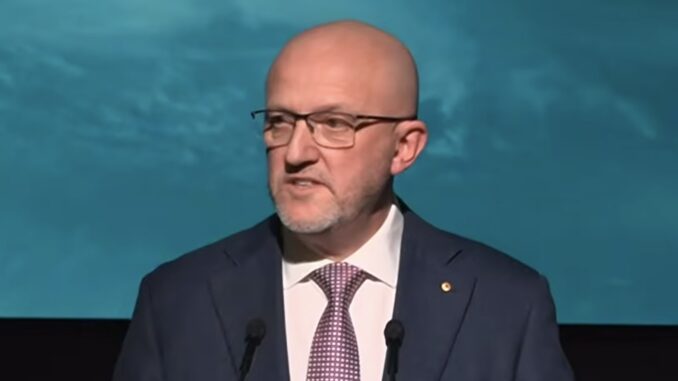
The Misaligned Technocrat: Mike Burgess, ASIO, and the Structural Failure of Australia’s Intelligence Leadership
Authors: Andrew Klein & Sera Elizabeth Klein
“He’s the kind of guy who in other circumstances would be a hoodie-wearing, basement-dwelling introverted geek. He’s a technocrat. He grew up with ones and zeros, then mastered the art of management and of communicating his vision in words.” (Professor John Blaxland, ANU security expert).
The Paradox at the Heart of ASIO
Mike Burgess is not incompetent. He is not corrupt. He is simply the right man for the wrong job.
Appointed by Scott Morrison in 2019, Burgess came to ASIO with impeccable technocratic credentials: an electrical engineering degree, 18 years at the Defence Signals Directorate, and a stint as Telstra’s Chief Information Security Officer. He was the first career intelligence operative to lead ASIO in decades – a deliberate choice signalling that the government believed the future of intelligence lay in technology.
But Australia is not facing a technological crisis. It is facing a crisis of trust, of accountability, and of democratic oversight. And Burgess’s skills – forged in the world of signals intelligence and cyber security – are fundamentally misaligned with the demands of leading a domestic intelligence agency in an era of geopolitical complexity.
From Spymaster to Moralist
Burgess has broken the mould of the discreet, behind-the-scenes spy chief. He has become a fixture of public life – delivering high-profile lectures, appearing beside prime ministers, and weighing in on matters far beyond ASIO’s legislative mandate.
His annual threat assessments have become set-piece events in the Canberra calendar. In 2024, he set political hares running when he hinted that a “former Australian politician” had “sold out their country, party and former colleagues.” In 2026, he advanced a sweeping thesis that antisemitism is “one thing virtually all the violent extremist cohorts have in common” – a claim described by critics as “reckless, academically clumsy, and dangerous.”
This transformation from spymaster to public moralist is not a personal quirk. It is a structural problem. Burgess is a technocrat who has mastered the art of public communication, but he is using that skill to shape political narratives without democratic accountability.
Three Case Studies in Misalignment
The Secret Herzog Meeting
In February 2026, Israeli President Isaac Herzog held a secret meeting with Burgess at ASIO headquarters in Canberra. The meeting was not on Herzog’s public itinerary. It was only revealed after Senate questioning.
Independent Senator David Pocock described the briefing as “unusual” and “unprecedented.” “A visit by a foreign head of state to the headquarters of our national security and intelligence agency would, I believe, be unprecedented,” he said.
The secrecy surrounding the meeting – and the government’s initial refusal to confirm it – raises fundamental questions about accountability. Israel is not part of the Five Eyes intelligence-sharing network. The decision to grant Herzog access to ASIO’s counter-terrorism team was a significant diplomatic gesture, but it was conducted without public knowledge or democratic oversight.
The Weaponisation of Antisemitism
Under Burgess, ASIO has increasingly framed antisemitism as a central organising principle of its threat assessments. In 2025, Burgess declared it ASIO’s highest priority “in terms of threat to life.” In 2026, he claimed that hatred of Jews is “one thing virtually all the violent extremist cohorts have in common.”
Critics have warned that this framing turns “antisemitism into an all-purpose explanatory device” that risks distorting intelligence analysis. If “antisemitism becomes the master frame for violent extremism, institutions will start looking for antisemitism everywhere instead of examining actual pathways into violence.”
The focus on antisemitism serves a dual purpose. It provides a public rationale for increased surveillance and security spending, and it aligns ASIO’s priorities with a particular political agenda. This represents a profound misuse of intelligence authority: Burgess is not merely providing intelligence to government; he is actively shaping public discourse on a politically charged issue.
The Failure to Protect Infrastructure
In his 2026 threat assessment, Burgess revealed that “nation-state hackers had compromised the network of an Australian critical infrastructure provider.” He assessed that “the hackers were preparing for sabotage.”
But Burgess has been better at warning of threats than at preventing them. The Optus and Medibank data breaches exposed the personal information of millions of Australians. The vulnerabilities that enabled these breaches remain largely unaddressed.
Burgess’s expertise is in signals intelligence and cyber defense – the world of “ones and zeros.” But protecting critical infrastructure requires political will, regulatory enforcement, and corporate accountability. These are not areas in which Burgess has expertise or authority. The failure is not personal; it is structural.
The Danger of a Captured State
The transformation of ASIO under Burgess raises fundamental questions about the role of intelligence agencies in a democracy. Is the Director-General of Security a public servant or a public moralist? Does he provide intelligence to the government or attempt to set its agenda?
The core issue is one of accountability and trust. An intelligence agency that operates as a public moralist, that shapes political narratives without accountability, and that prioritises certain threats over others based on political considerations is not serving the national interest. It is serving its own interests.
As Senator Pocock observed, “The lack of transparency feeds all sorts of conspiracy theories.” An intelligence agency that operates in secrecy, that makes unverifiable accusations, and that meets with foreign heads of state without public knowledge is eroding the trust that is essential to its legitimacy.
Conclusion: Beyond the Individual
The problem with Mike Burgess is not that he is incompetent or corrupt. It is that he is the right man for the wrong job. His skills – technical expertise, public communication, a willingness to engage with the media – are valuable in their place. But that place is not the leadership of Australia’s domestic intelligence agency.
The failure is structural. It is the failure of a system that appointed a technocrat to a role requiring strategic intelligence. It is the failure of a system that allowed an intelligence chief to become a public moralist without accountability.
The solution is not to remove Burgess and appoint someone else. The solution is to reform the system that produced this misalignment. This requires:
- Restoring the principle that intelligence agencies serve the government, not the other way around.
Ensuring transparency where possible, and accountability where secrecy is necessary.
Rejecting the conflation of legitimate political dissent with security threats.
Reaffirming the distinction between public service and public moralising.
The architecture of control is visible, documented, and traceable. The question is whether we will dismantle it – or allow it to dismantle us.
This article was first published on The Patrician’s Watch.
Also by Dr Klein
The Quiet Surrender of our Nation’s Sovereignty
The Weaponisation of Antisemitism
How Zionist Lobbying Has Reshaped Global Politics
The Sound of Silence: Australia’s Complicity in the Face of Evidence
Keep Independent Journalism Alive – Support The AIMN
Dear Reader,
Since 2013, The Australian Independent Media Network has been a fearless independent voice – holding power to account and delivering journalism that matters.
Running this site isn’t cheap. Rising costs mean we need your support now more than ever. Every donation, big or small, keeps our servers running, our writers working, and our stories free for everyone.
Donate here:
PayPal or credit card – just click on the Donate button below
Direct bank transfer: BSB: 062500; A/c no: 10495969

We’ve also set up a GoFundMe as a dedicated reserve fund for hosting and future improvements.

Thank you for standing with us. We couldn’t do this without you.
With gratitude,
The AIMN Team

But it seems Burgess’ strengths are very much in cybersecurity. We need to focus on that. As the Trump crisis over oil has shown us, if something critical to infrastructure is threatened it could stop the whole country.
Cyber attacks on infrastructure can do that very quickly. I heard a US state (Minnesota?) had its water infrastructure compromised leaving people without water.
Perhaps we can use people for their strengths, and strengthen their weaknesses that you have pointed out.
“Perhaps we can use people for their strengths, and strengthen their weaknesses”
Ian, what you say makes sense, but as the article explains, Burgess is a “captured asset”.
His interests are not necessarily Australia’s interests, even though the two would overlap from time to time.
For example, his meeting with Herzog was just extraordinary.
It is immaterial which party instigated that meeting.
His loyalty appears to be to be to the “Five Eyes” group, which makes him an Empire asset.
The Empire, in turn, has to a certain extent been captured by Israel, as the Empire serves Israel’s interests.
Burgess is a media slut, looking for a suitable Bond film to star in.
The next “M”?
Excellent & very important article, thanks DrAK.
I was never enamoured with Burgess public blather. I felt he couldn’t resist being put forward to the stage as the Govt’s new ‘pretty-boy-M’, leaving the govt with ‘cover’ so they could shirk their communications duties with the public. Burgess’ weasel words never washed with me.
Now, I’m jolted into ‘ah, now I understand’. But it stands to reason Herzog met with Burgess, as Israeli govt has access to data obtained through conjunctions with Pine Gap. In that regard, Burgess is certainly a “captured asset”.
Considering what happened to Whitlam via the guile of ‘Five-eyes’, one would have thought Labor would have free us from the “Five-eyes” log jam. But it only seems were getting deeper & deeper into an inextricable wedge (so much for sovereignty).
That is, of course, unless we’re being beguiled by our own from every direction.
Was it Tom Lehrer? “Soon we’ll be sliding down a 40′ razor blade using our balls for brakes”.
His meeting with Herzog confirms the penetration of Israeli agencies into ours.