On January 1st, the World Nuclear News was upbeat about the industry’s prospects, with an edited transcript of World Nuclear Association Director General Sama Bilbao y León’s World Nuclear News podcast interview.
“What do you think are the main priorities for the year ahead?”
“I think that for everybody in the global nuclear industry, it is essential that we move from ambition to action, to see real projects deployed, many of them. We also need to see many final investment decisions, and see more countries moving forward with nuclear projects.”
COMMENT: Well, the nuclear industry has certainly been big on ambition. But in 2025, not so much on action. It has been bogged down with financial wrangling over the costs of new projects, such as the UK’s Hinkley Point C, and Sizewell C projects, and of the plethora of small nuclear reactor wannabes.
“Finance continues to be an important piece of the puzzle, and in more and more projects we see private investors understanding how they can contribute. We are seeing this in Poland, we saw this in the UK, and I think that we are going to see this in many other jurisdictions. We will continue to work on the supply chain. This year we will have our second World Nuclear Supply Chain Conference. We are really pleased that it is going to be held in Manila in the Philippines… Also, we are looking closely at India’s plans.”
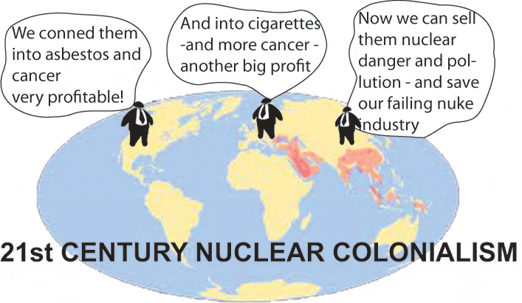
“The ASEAN region is moving forward with nuclear projects very, very quickly and most of the countries are growing their economies incredibly quickly, which of course translates into enormous energy demand. And many of them – Vietnam, Indonesia, Malaysia, Philippines, Singapore – they are really looking at nuclear as a key piece of the puzzle.”
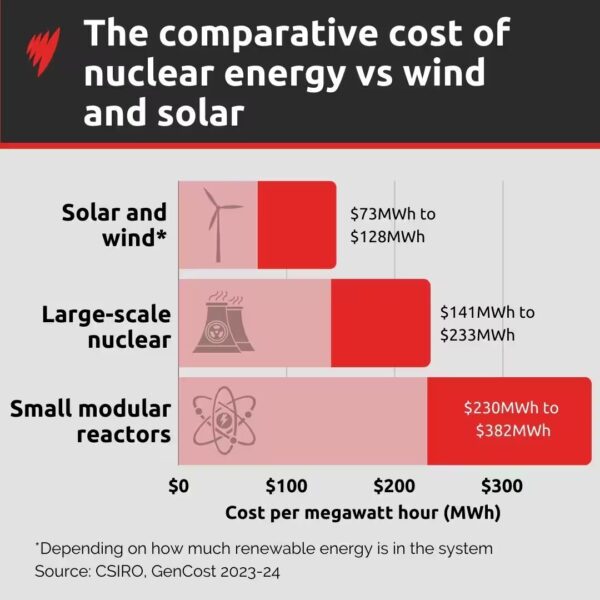
COMMENT: There’s a fair bit of confusion in the Western world about who’s to pay for the setting up of a few very big nuclear reactors, of thousands of “small’ and “mini” reactors, of the security costs, and the huge decommissioning and waste disposal costs. Even government-run nuclear in Russia finds this a financial burden, while China, still pursuing some new nuclear, is investing massively in solar and wind. No wonder the World Nuclear Association is keen to sell to the “third world.”
“We are seeing the realignment of some of the laws in India, the Atomic Energy Act and also the liability laws, that are going to hopefully incentivise international cooperation, international participation in the Indian market.”
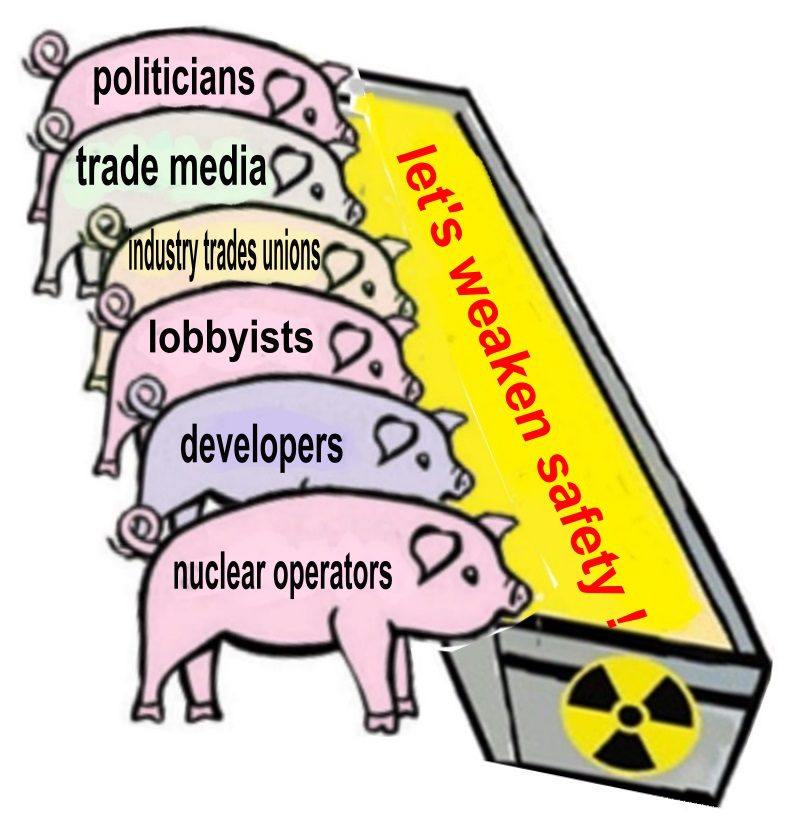
COMMENT: India’s new law undercuts the operator’s cost of nuclear incidents while allowing foreign suppliers to walk away with no liability. This is in line with moves in the USA to weaken safety regulations.
“One of the big issues for the public is nuclear waste.”
“That is true, but I think that in 2026 we are going to see the entering into operation of the geological repository in Onkalo, Finland. I think this will be a key opportunity to show the world that the questions about what to do with nuclear waste and used nuclear fuel are not a technology problem. It is actually most often a problem of policy, politics, and political will. So I think it is great that Finland is being proactive. I think that Sweden is a minute behind, and then France is also very close by. So I think it will be a key year for that part of the fuel cycle also.”
COMMENT: Not that simple. Further delay in Finnish repository licence review. A multi-million dollar dispute rages over Olkiluoto 3 – only lawyers will win. Sweden is building the world’s second nuclear waste storage site amid safety concerns. Sweden’s nuclear waste plan is a 100,000 year gamble. France’s plan to bury accumulated highly radioactive waste at Bure, 250 kilometres east of Paris, remains at an impasse.
“April will see the 40th anniversary of the Chernobyl accident.”
COMMENT: Doncha love the way these nuclear hypocrites turn every bad thing into a plus?
Chernobyl’s so good as a lesson. Never mind the fact that the damaged protection dome is spewing radiation out, and they can’t get rid of the toxic melded waste inside.
“It is always good to look back and make sure that we have really learned all the lessons and taken the opportunities for improvement from previous events. 2026 will also be the 15th anniversary of Fukushima. I think that the industry has been very good at reflecting on these events and extracting all the lessons to be learned.”
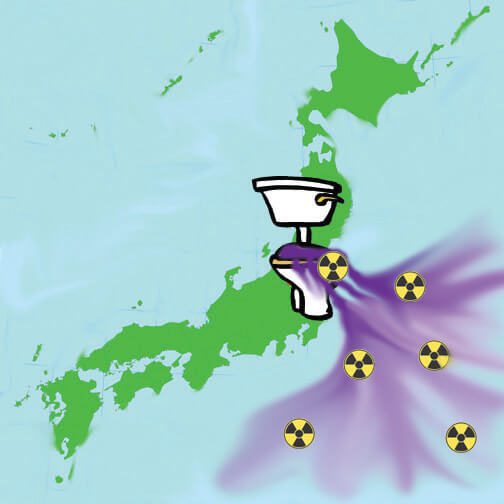
COMMENT: Fukushima’s intractable and ever mounting problem of nuclear wastes.
“I think that the safety culture at a global level continues to be better than ever… they need to be put in context with the impacts of things like using fossil fuels on human health, on the environment and obviously on climate change. We really need to look at the entire life-cycle of all energy sources and to recognise that there is not one energy source that is a silver bullet for anything. I think that perhaps Fukushima’s anniversary and Chernobyl’s anniversary will be an opportunity for us as a society to become more pragmatic and realistic about the risks and opportunities of all these technologies.”
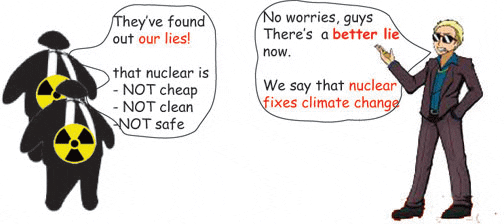
COMMENT: Note that here the WNA seems to imply that nuclear power helps action on climate change, (but later on, boasts its partnership with with fossil fuel industries).
“What do you think are the key planned events for the year?
“We hit the ground running at Davos at the World Economic Forum this year, from 19 January – this is perhaps the second time that nuclear energy is really going to be visible there, so we are excited about that opportunity. Immediately after Davos there is India Energy Week in Goa, which is the second-largest energy conference in the world.”
“In March, we will be at CERAWeek in Texas, a very important event where we are bringing together nuclear energy with many of these large energy users, in particular the oil and gas industry, that are really aligning themselves to best understand how nuclear can contribute to their decarbonisation and energising efforts.”
“So interesting times ahead…
“Definitely. This is the time. We’ve been discussing how the stars are aligning for nuclear energy and I think that we are there. The stars are definitely aligned. This is the moment where we, the global nuclear industry, really need to be proactive and active and make the most of this opportunity. We really need to work together with our governments. We need to work together definitely with the nuclear regulators, with the finance community, with large energy users, and we cannot leave behind civil society. We have seen major improvements in public acceptance and interest in nuclear, but we need to continue to be proactive to engage with civil society, to make sure that no question is left unanswered.”
COMMENT: A lot of questions not even asked. The mind boggles. Not a mention of the now terrifying possibilities of cheap little drones targeting nuclear reactors, and nuclear waste pools. Not a mention of the fearful progress being made on smaller nuclear “tactical weapons”. Not a mention of the new Highly Enriched nuclear fuels for new generation nuclear reactors – that bring big risks of nuclear weapons proliferation. And of course, in the current energy economics – really no need for new nuclear reactors. (except to provide technical staff, academic “cover” and hidden funding for the nuclear weapons industry).
Keep Independent Journalism Alive – Support The AIMN
Dear Reader,
Since 2013, The Australian Independent Media Network has been a fearless voice for truth, giving public interest journalists a platform to hold power to account. From expert analysis on national and global events to uncovering issues that matter to you, we’re here because of your support.
Running an independent site isn’t cheap, and rising costs mean we need you now more than ever. Your donation – big or small – keeps our servers humming, our writers digging, and our stories free for all.
Join our community of truth-seekers. Donate via PayPal or credit card via the button below, or bank transfer [BSB: 062500; A/c no: 10495969] and help us keep shining a light.
With gratitude, The AIMN Team


This atomic leak is going to cause a reaction, and there will be fallout.
We should be thankful that the nuclear lobby give a damn about the environment, but it’s really just some reject marketter from the fossil-fuel lobbyists who got a glow-in-the-dark pen from Santa.
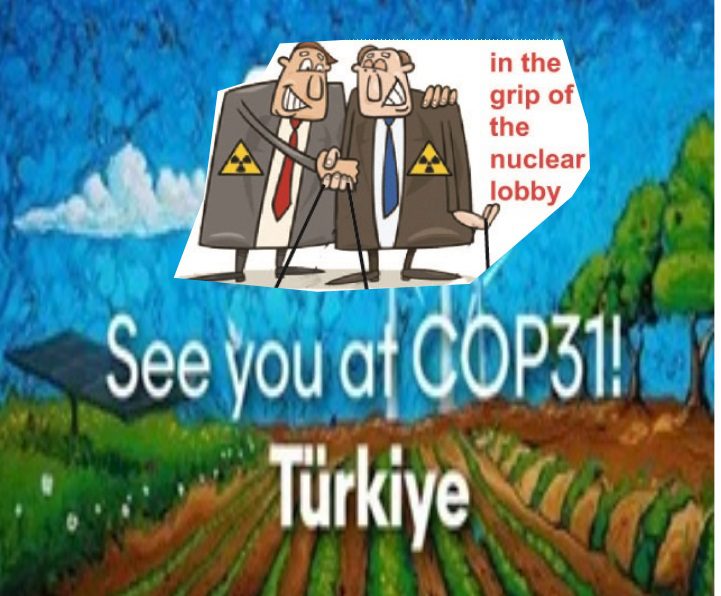
(The battle for world supremacy, between oil and nukes at COP31 will be a giggle)