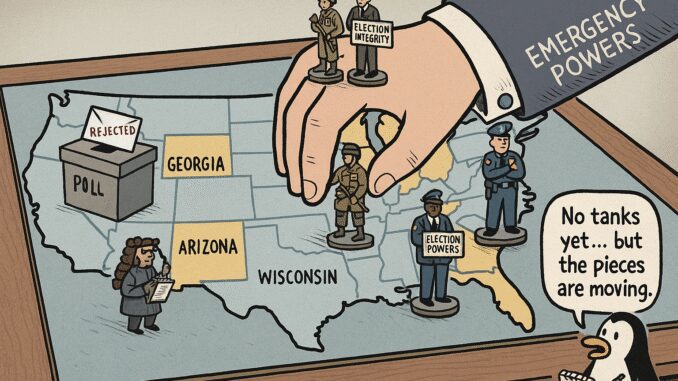
What’s happening in Washington right now is more than a one-off power grab – it’s a test run. Trump’s unprecedented move to seize temporary control of D.C.’s police and deploy the National Guard under a manufactured “crime emergency” isn’t martial law. But it’s a live demonstration of how to centralise authority, sideline local control, and normalise extraordinary powers without triggering the constitutional tripwires that would force a fight.
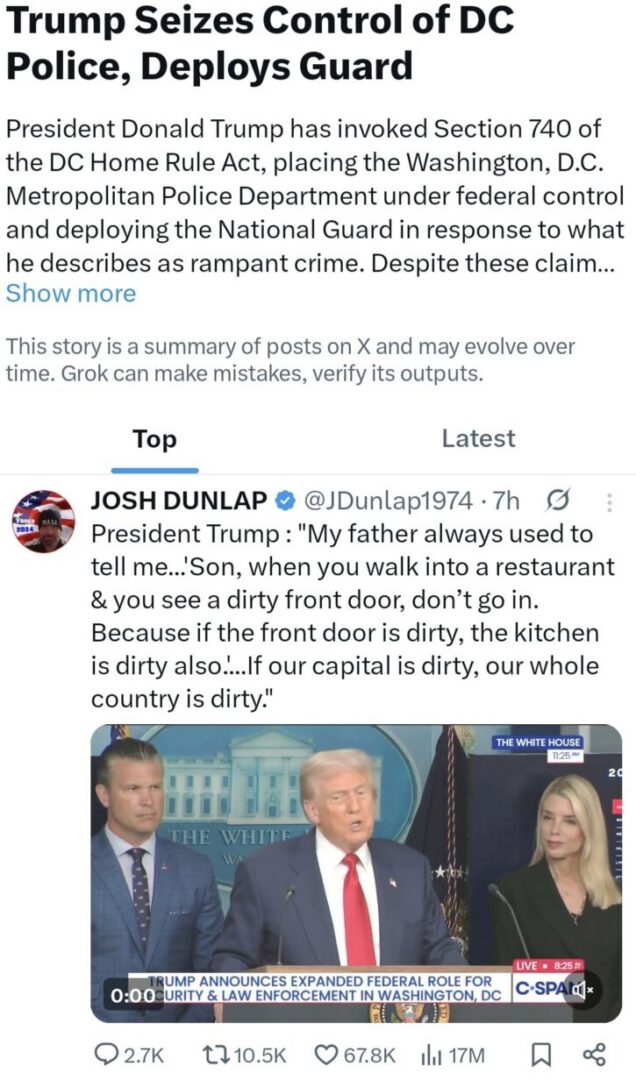
My prediction? This won’t stay confined to the capital. By November, we’re likely to see a repeat of this playbook – episodic “emergencies,” selective voter suppression, targeted disruptions, and loyalists in key decision-making seats – deployed across battleground states. It’s a way to shift results without ever cancelling an election, and the mechanisms are already in motion.
1) Are core institutions being bypassed or weakened?
Now: Trump just asserted temporary federal control over D.C.’s police under §740 of the Home Rule Act and deployed ~800 National Guard for 30 days. Courts remain open, but this is an unprecedented centralisation step.
Likely outcome: Expect extensions/attempts to normalise “public safety emergencies” in D.C., with copy-cat pressure on blue jurisdictions via DOJ/ DHS tasking rather than formal martial law. Confidence: medium-high.
2) Is the law being “weaponised” (autocratic legalism)?
Now: Schedule F (or its renamed variant) has been reinstated, letting the White House reclassify thousands of civil-service roles and purge non-loyalists faster.
Likely outcome: A wider loyalty filter across DOJ, DHS, intel, and key regulators; slower, subtler chilling of internal resistance and watchdog functions before the midterms. Confidence: high.
3) Are loyalists being installed in chokepoints?
Now: Federal control over MPD is placed under the AG; reporting indicates interim leadership swaps aligned with the takeover narrative. Schedule F enables broader replacement across agencies.
Likely outcome: More acting appointments and bypassed Senate confirmations in security/justice portfolios; pressure on state election administrators through DOJ rhetoric/litigation threats. Confidence: medium-high.
4) Are dissenters (media/civil society) being chilled?
Now: Escalating “crime/emergency” framing plus Guard presence in the capital raises the intimidation cost of protest while staying technically within law. Advocacy groups warn the PCA/Insurrection Act loopholes could be exploited.
Likely outcome: Heavier federal policing posture around selected demonstrations, aggressive prosecutions, and targeted misinformation labeling to deter turnout—without a formal ban. Confidence: medium.
5) Are elections being structurally tilted (without cancelling them)?
Now: No legal path for Trump to cancel or delay federal elections; guardrails still stand. But the practical risks are selective suppression and selective counting, not cancellation.
Likely outcome (midterms):
Suppression: targeted “integrity” actions (roll-purges, ID/ballot technicalities), plus precinct closures framed as security.
Disruption: localised emergency declarations to shorten hours or close sites in opposition-leaning areas, especially if unrest can be cited.
Counting/certification games: amplified rejection of mail/absentee ballots on technical grounds; pressure on county and state boards. Courts will block some of it, but time pressure will let parts stick. Confidence: medium.
6) Are “perpetual crises” being used to justify exceptional steps?
Now: The D.C. move rides on a “crime emergency” despite falling violent crime data cited in coverage; Trumpworld policies are tracking closely with the Project 2025 blueprint even as he distances himself rhetorically.
Likely outcome: More rolling emergencies (crime, border, campus unrest) to centralise authority episodically and keep opponents reactive. Confidence: high.
7) What do independent trackers say?
Now: Threat-to-Democracy Index has flagged sustained risk, with occasional upward ticks tied to militarisation/foreign strikes; it situates the U.S. “near the tipping point,” not past it.
Likely outcome: Indicators stay elevated through the midterm cycle, spiking around flashpoints (protests, border actions, international crises). Confidence: medium.
Net forecast (midterms horizon)
No formal martial law. It’s legally fraught and unnecessary for the strategy. Confidence: high.
De facto hardening of the playing field: episodic federal takeovers/emergency postures (like D.C.) become precedent; selective suppression/disruption in key locales; admin-friendly appointees in decision bottlenecks. Confidence: medium-high.
Outcome effect: Not a guaranteed one-party lock, but a few percentage points shaved off opposition turnout/ballot acceptance in pivotal House/Senate races could decide control. Expect a blizzard of litigation; some remedies land after results are “socially settled.” Confidence: medium.
Big states shaping the environment:
Texas
- Why it matters: Long history of polling-place closures post-Shelby; legislature keen on tighter rules.
- Likely play: Fewer urban polling sites; fear of criminal penalties for helping voters.
- Forecast: Turnout drag in Dem-leaning metros; statewide results less affected, but several House seats at risk.
Florida
- Why it matters: Repeated restrictions on mail voting and ballot handling since 2020.
- Likely play: Technical rejections, limited drop boxes, high-profile “integrity” policing.
- Forecast: Process looks smooth, but quiet attrition of ballots; few successful challenges after the count.
Ohio
- Why it matters: Tighter ID rules and methods in recent cycles.
- Likely play: More absentee rejections; trimmed early-voting windows.
- Forecast: Small, rules-driven shifts that can flip close House districts.
Federal overlay to watch (D.C. move as precedent)
- What happened: Trump seized temporary control of D.C.’s police under Home Rule Act §740 and deployed ~800 National Guard for 30 days (extendable by Congress). Courts remain open – not martial law – but it normalises executive policing of a civilian jurisdiction.
- Why it matters to states: Even without martial law, similar “public safety emergency” narratives can justify heavier security postures around protests or election activities, raising the cost of civic participation in targeted locales.
- My read: Expect the D.C. template to be messaged nationally, pressuring blue-led cities and shaping public acceptance of episodic crackdowns.
Structural levers (national)
- Schedule F revival: Reclassifies swathes of civil service, easing loyalist placement in policy chokepoints (DOJ/DHS). That increases capacity for selective enforcement around “election integrity.”
- Project 2025 playbook: Proposals to criminalise assistance to voters/officials and expand federal scrutiny under an old civil-rights statute – i.e., autocratic legalism rather than overt cancellation.
- State law churn: 2024 was the second-heaviest year for restrictive voting laws in a decade; 2025 hasn’t slowed. That’s the fuel for county-level obstruction and post-hoc rejection games.
Overall forecast (plain language)
- No formal nationwide martial law. It’s unnecessary to tilt outcomes. Instead: episodic emergencies + legal choke points.
- Where results shift: PA/GA/AZ/WI/NC – through small, legal-looking attrition (mail rejections, precinct bottlenecks, board disputes). Margins move by 0.5–2.0 pts – enough to flip House control and a few Senate races.
- What stops it: Fast litigation, robust curing/ballot-tracking, surplus poll-worker capacity in urban counties, and pre-Election-Day voter help (IDs, deadlines). Brennan Center/Voting Rights Lab guidance suggests these countermeasures are where the ROI is highest.
Conclusion:
The warning lights are flashing, but the road ahead isn’t set in stone. This is not a plan to end elections outright – it’s a plan to make them winnable on one side’s terms. The midterms could be decided not by a dramatic suspension of democracy, but by a thousand small cuts: precinct closures, mail ballot rejections, board disputes, and a steady stream of “emergencies” timed to shape turnout and counting.
Stopping it will take rapid legal action, airtight ballot tracking, an over-supply of trained poll workers, and relentless voter preparation in the high-risk states identified above. The decisive battles will be fought precinct by precinct, and the clock is already running.
Dear reader, we need your support
Independent sites such as The AIMN provide a platform for public interest journalists. From its humble beginning in January 2013, The AIMN has grown into one of the most trusted and popular independent media organisations.
One of the reasons we have succeeded has been due to the support we receive from our readers through their financial contributions.
With increasing costs to maintain The AIMN, we need this continued support.
Your donation – large or small – to help with the running costs of this site will be greatly appreciated.
You can donate through PayPal or credit card via the button below, or donate via bank transfer: BSB: 062500; A/c no: 10495969


This is the MAGA version of mid-1930s Germany. So long, civilisation, it’s been good (sometimes) to know you.
It’s not (QUITE) martial law. But there’s not a yawning gap between the two.
Just my view:
Trump is not the issue.
Unlike Hitler, trump is not the brains behind the march to fascism in the US. He may be the front man but he does not have the intellect to be the driving force, he is just the tool that those who are now running the US are using to gain their prizes. But like Hitler and the Nazi regime the result will be much the same. Whether it results in a world war will depend on how the rest of the world reacts and whether the US decides to expand its territory. It would seem at the moment that the aim is to grab all the monetary goodies for themselves and the idea of branching out to grab more territory, other than Canada, is not the main objective.
Who are they? I don’t know enough to say, but I would suggest that whoever it is will not stop until they have gained everything that they want and whether they ruin the country or any other country is not even a consideration.
I could be wrong, trump could be an evil genius, but I doubt it, and anyone who thinks that by getting rid of trump, whether he is moved on, spirals down into full blown dementia or dies, will make no difference, the push is on and nothing will stop it, other than the American people themselves and currently they seems to be cowed to the point of inertia.