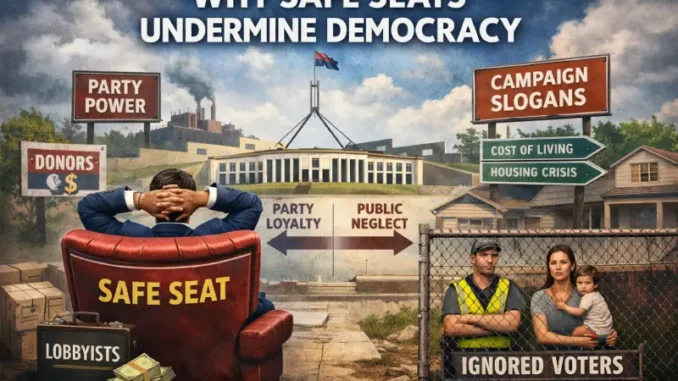
By Denis Hay
Description
Why safe seats undermine democracy in Australia, weaken accountability, distort policy incentives, and how realistic reform can restore representation.
Introduction
Safe seats are often treated as a normal feature of Australian politics, but their impact on democratic accountability is rarely confronted directly. When one political party can rely on winning an electorate regardless of performance, the relationship between voters and their representatives weakens.
This article explains why safe seats undermine democracy, how they distort political incentives, who receives help from the arrangement, and how Australia can realistically restore competitive representation using systems already in place.
The pattern is clear and explains why safe seats undermine democracy by shifting power away from voters and toward party structures.
The focus here is not on blaming voters, but on understanding how power operates within the system.
The Problem: Why Safe Seats Undermine Democracy and Weaken Accountability
What Is a Safe Seat
A safe seat is an electorate where a political party consistently wins by a large margin. In these seats, the election outcome is predetermined. According to Australian Electoral Commission data, a majority of House of Representatives seats fall into this category.
Once a seat becomes safe, electoral accountability shifts away from voters and toward internal party processes.
How Incentives Change Political Behaviour
In marginal electorates, MPs must respond to local concerns to keep their position. In safe seats, the primary threat is not voters but party leadership and factional control.
This incentive structure is central to understanding why safe seats undermine democracy, because accountability is redirected away from citizens and toward internal party power.
This changes behaviour in predictable ways:
- Party loyalty is prioritised over community advocacy.
- Challenging leadership carries career risk.
- Policy positions align with donors and internal power blocs.
- Voter dissatisfaction has limited electoral consequences.
This is not a moral failure on the part of individual MPs. It is a structural outcome of incentive design.
Who Holds Power in Safe Seats
Party Control and Preselection
In safe seats, the most decisive contest is preselection, not the general election. Party factions, branch numbers, and internal negotiations decide candidates long before voters have a meaningful choice.
The Australian Parliamentary Library has repeatedly documented the strength of party discipline and preselection control in shaping parliamentary behaviour. MPs who challenge leadership can lose advancement opportunities or be removed entirely.
Who Benefits from the Status Quo
Safe seats advantage:
- Major parties, which can give resources strategically.
- Donors and lobbyists, who gain policy predictability.
- Career politicians, insulated from electoral pressure.
Ordinary citizens receive little benefit when accountability is reduced.
The Impact: What Voters Experience
Political Disengagement
When voters believe their vote will not change the outcome, engagement declines. Turnout stays compulsory, but participation becomes hollow.
The Australian Election Study consistently finds lower political efficacy in safe seats, meaning voters feel less heard and less represented.
Policy Inertia
Safe seats reduce urgency around difficult issues, such as:
- Housing affordability.
- Job security.
- Access to health and transport services.
- Cost of living pressures.
When electoral consequences are minimal, responsiveness declines.
Lived Experience: How This Feels in Everyday Life
The lived experience of voters explains in practical terms why safe seats undermine democracy in everyday life.
For a renter in a safe seat, it feels like contacting an MP who responds politely but never follows through. Rents rise, conditions worsen, and local advocacy achieves little.
For a pensioner, it feels like being acknowledged during campaigns but ignored afterwards. Services stay stretched and promises fail to materialise.
The frustration is practical rather than ideological. Life feels harder because political responsiveness is missing.
What This Makes Possible If Reform Occurs
Recognising why safe seats undermine democracy also shows how restoring competition can materially improve daily life for ordinary Australians.
Reducing the dominance of safe seats would not create an instant transformation, but it would restore accountability.
If MPs knew their seat could realistically change hands, it would enable:
- Stronger advocacy for housing security.
- Greater attention to local service delivery.
- More independent voting on community issues.
- Increased trust in democratic institutions.
- Stronger representation for regional and outer suburban communities.
Competition realigns incentives toward voters.
Existing Electoral Mechanisms Make Reform Achievable
Australia does not need to invent a new democratic system. The tools already exist.
Preferential Voting Enables Real Competition
Australia’s preferential voting system allows voters to rank candidates in order of preference. This means voters can support independents or minor parties without wasting their vote. If a preferred candidate is eliminated, the vote continues to count through preferences.
This system already enables community-backed challengers to defeat entrenched parties, even in seats considered safe.
Redistribution Processes Are Well Established
Electoral boundaries are regularly reviewed by the Australian Electoral Commission through an independent redistribution process. These reviews are based on population changes and prevent extreme unequal representation.
This system already protects fairness and can support competitive electorates without political interference.
Public Funding Rules Can Be Strengthened
Political parties and candidates already receive public money during elections. These funding rules could be strengthened by linking funding more closely to genuine voter engagement rather than party size alone.
Such changes would improve fairness for independents and challengers without increasing overall public expenditure.
Parliamentary Independence Protections Already Exist
MPs are not legally required to vote with their party. Parliamentary privilege protects free speech, and standing orders allow for conscience votes.
While party discipline is strong, the legal framework already supports independence. Cultural and procedural reform could strengthen this capacity.
International Example: Ireland
Ireland uses a preferential voting system and has highly competitive electorates. MPs stay responsive to local concerns because no seat is guaranteed.
Despite strong competition, Ireland maintains a stable government and an effective public administration. This shows that competitive democracy improves responsiveness without destabilising governance.
Solutions That Follow Logically from the Problem
Realistic reforms include:
- Greater transparency in party preselection processes
- Fairer access to public funding for challengers
- Stronger media access rules during elections
- Community endorsement models for candidates
- Parliamentary reforms that protect independent voting
These solutions use existing institutions and public capacity. They are politically challenging but administratively realistic.
Frequently Asked Questions
Are safe seats inherently undemocratic?
No. They become harmful when they remove accountability and responsiveness.
Can this be fixed without constitutional change?
Yes. Most reforms are legislative or procedural.
Do independents really make a difference?
Yes. They increase competition and shift incentives even when they do not win.
Why do safe seats undermine democracy in Australia?
Safe seats undermine democracy because they reduce electoral accountability, weaken voter influence, and concentrate power within party structures rather than communities.
Final Thoughts
Understanding why safe seats undermine democracy allows citizens to focus reform efforts on incentives and structures rather than blaming voters or individuals. This is a structural problem that requires structural solutions.
Change is possible because incentives can be changed. Electoral pressure works when it is informed, organised, and persistent.
Democracy functions best when representatives know they must earn support every time.
Call to Action
We want to hear from you
- Please share your thoughts through our Reader Feedback
- Visit our Testimonials page to see how others are engaging.
- Leave a comment below; every voice helps shape future content.
Explore more
Find more writing on political reform and Australia’s dollar sovereignty at Social Justice Australia.
Share this article
Articles like this only create change when they are shared. If it stays with one reader, the message stops.
Support independent journalism
Running this site costs around $2000 a year, and reader donations have helped cover $807 so far. Every contribution helps keep this work online, accessible, and independent.
Donate now, one time or monthly.
Already donated? A quick Google review helps others discover the site.
Engaging Question
Does your electorate feel genuinely competitive, or does it feel taken for granted?
This article was originally published on Social Justice Australia
Keep Independent Journalism Alive – Support The AIMN
Dear Reader,
Since 2013, The Australian Independent Media Network has been a fearless voice for truth, giving public interest journalists a platform to hold power to account. From expert analysis on national and global events to uncovering issues that matter to you, we’re here because of your support.
Running an independent site isn’t cheap, and rising costs mean we need you now more than ever. Your donation – big or small – keeps our servers humming, our writers digging, and our stories free for all.
Join our community of truth-seekers. Donate via PayPal or credit card via the button below, or bank transfer [BSB: 062500; A/c no: 10495969] and help us keep shining a light.
With gratitude, The AIMN Team

Case in point….Western suburbs of Melbourne have been treated very, very poorly over the past 30 years
https://www.theage.com.au/national/victoria/reimagining-the-west-and-the-idea-of-melbourne-20251021-p5n45t.html
https://www.theage.com.au/national/victoria/infrastructure-victoria-objects-to-government-delay-on-key-rail-upgrade-for-the-west-20251107-p5n8lj.html
https://www.theage.com.au/national/victoria/this-is-the-population-boom-we-re-not-talking-about-but-should-be-20251023-p5n4u0.html
https://www.theage.com.au/national/victoria/western-suburbs-rail-boost-pushed-back-to-2030s-and-beyond-20251022-p5n4h0.html
https://www.theage.com.au/politics/victoria/a-metropolis-of-multiple-cities-the-radical-plan-to-fix-the-west-s-brain-drain-20251022-p5n4gz.html
https://www.theage.com.au/national/victoria/reimagining-the-west-and-the-idea-of-melbourne-20251021-p5n45t.html
You get the picture and the local Government is full of Labour debris, the overarching body The State Government, the other Federal Government, none who have done anything for the booming area, and the majority of that decay was under Brendan O’Connor’s supposed representation as the federal member of the West.
The only thing delivered for the West was the Sunshine Hospital and the Rail upgrades and ‘new’ station which does not even have public toilets, which from memory used to be a health regulation.
The sooner the State election are held in Victoria, the better as the West will no longer be a ‘safe’ seat anywhere.
Denis, I don’t really believe in “safe seats”, in many cases when a long standing member retires of die, their “safe seat” is lost to the opposition. This seems to indicate it’s about the membeer, not the party?
But I take on what you have suggested and give it more thought.
So true Dennis. All my attempts to engage my local representatives for Corangamite and Corio on matters relating (respectively) to the Covid mandates and the AUKUS project were treated with callous disregard. Responses were form emails espousing bland narratives devoid of either rational or critical content. The Labor Party media advisors controlled by external lobby groups are running this country, not the elected representatives.
OK, the Australian Electoral System overseen by an independent Australian Electoral Commission (AEC) is the best in the world, bar none!!
The one flaw is likely the unlimited tenure of incumbent politicians.
The NOtional$ have made a life style out of this missing feature, providing jobs for untalented sons of party ”donors”, thus removing the cost onto the government while maintaining their ”reds under the beds” mantra and fear of ”those nasty union types who expect us to keep to agreed working conditions and correct provision of the workplace”.
Consider the incumbency of some notable past incumbents, like John Anderson, then Member for Gwydir during the 2004 terrible drought, who believed that the loss of 34 businesses in Moree NSW was preferred to the trickle down effect of buckets of drought support for the grazing and cropping industries in the electorate. His successor, another off-spring of an establishment family, made little difference to the economy and social life in the electorate during his recently ended about 16 year incumbency.
Naturally the antics of the NOtional$ MP for New England, Beetrooter Joyce, are politely described as adultery, alcoholism, bigotry, corruption, deceit, fornication, sexual harassment and misogyny. Are these the standards practiced in Tamworth where the ladies have been encouraged to believe that only their husbands/male partners have the right/obligation to vote?
Now Beetrooter has moved from NOtional$ to the autocratic Only Nutters where the only ”party structure” is Porelein with her alleged $20,000 donation and requirement for all candidates to purchase all political materials from her related company.
The above examples are cancelled in 4/8 NSW electorates west of the Range where local INDEPENDENT MPs are providing exemplary representation of the voters rather than the foreign owned corporations ”political donors”.
By introducing a grandfather clause limiting election to a political incumbency to three terms, either continuous or split, can this stasis be overcome. Doubtless there will be loud howls of protest from the major parties and especially the unelected political hacks in party offices. But this is one way to have voters in electorates effectively represented rather than the foreign owned multinational & national corporations ”political donors”.
NEC, I like this. “Only Nutters”, do you mind if I use it?
“By introducing a grandfather clause limiting election to a political incumbency to three terms, either continuous or split, can this stasis be overcome. ”
Since most politicians now are career politicians the chances of getting a referendum up to limit terms is probably no better than Buckley’s.
They know nothing else, they often come from political families where it is expected that they will follow in the footsteps of their father or grandfather They come out of university and into some serving pollies office as an errand boy, mostly boys but occasionally a girl will slip through, then work their way up in the organisation until they have enough credo to put their name forward as a candidate in some not quite marginal seat where they don’t win it but they do quite well, and from there it is being parachuted into a safe seat that one of old career boys has retired from that sets them on the gravy train, not for their constituents but for the party. This applies to both major parties but more so the liberals and nationals.
And Denis is quite correct in his view that safe seats do not serve the electorate but the careers of those who inhabit the seat.
Heather, you have described exactly how safe seats operate in practice.
The western suburbs are a textbook example of what happens when rapid population growth is treated as electorally secure rather than politically urgent. Decades of reports, plans, and media coverage have identified the same gaps in transport, health, education, and jobs, yet delivery keeps getting delayed or watered down.
What stands out is not the lack of ideas, but the lack of consequence. When representation is guaranteed, pressure dissipates. Responsibility gets passed between local, state, and federal levels, and no one feels compelled to act decisively.
The Sunshine Hospital and limited rail works show that progress is possible, but the scale has never matched the growth or need. Basic details, like public amenities at major stations, reflect how low expectations have become.
Your final point is important. Once areas like the West stop being treated as safe, incentives change. History shows that competition, not loyalty, is what finally forces governments to respond.
@ Patricia: You are welcome ….. NOtional$ supporters dislike being reminded that ”only a Nutter” would employ a stockman, shop assistant or labourer for $200,000+ per year salary plus perks, to sit in the shade drinking themselves drunk as a skunk, then claiming credit for any job progress that has occurred ….. during a continuous 13 years.
Yet these same doyens of respectability will elect Beetrooter Joyce with the common knowledge picadilloes of adultery, alcoholism, corruption, deceit, fornication, sexual harassment and misogyny ”because we must stop the reds from getting under our beds”.
Or is it that this male behaviour is acceptable in a regional community where many residents get their exercise jumping the blanket while ”the little woman” remains closeted bare foot & pregnant in the kitchen.
Thanks Jon, that is a fair point and it is true that some so-called safe seats do change hands when a long-standing member retires or dies.
That actually helps illustrate the argument. In many cases the seat was not competitive because the party was responsive, but because the individual member built personal loyalty over time. Once that buffer disappears, the underlying lack of engagement or delivery becomes visible.
The key issue is incentives while the seat is considered safe. As long as party control is assumed, pressure on both the party and the sitting member is reduced. When competition returns, behaviour often changes quickly.
It is not that parties always hold seats forever, but that safe seat status weakens accountability until something disrupts it. That disruption can be retirement, demographic change, or voters deciding they want real competition again.
Appreciate you engaging with it thoughtfully.
Mediocrates
What you describe is a very common experience, especially in electorates that are treated as politically secure.
Form responses and scripted talking points are a sign that engagement has been filtered through party processes rather than handled by the representative themselves. Once issues are deemed sensitive or outside the approved narrative, genuine dialogue tends to stop.
That does not require bad intent from individual MPs to occur. It flows from how modern parties manage risk, messaging, and internal discipline, particularly in safe or semi-safe seats where electoral consequences are limited.
The deeper issue is that when representatives are insulated from pressure, controversial or complex concerns are managed rather than debated. That weakens democratic confidence and reinforces the feeling that participation makes little difference.
Your experience fits closely with the structural problem the article is examining.
New England Cocky
You make an important distinction. Australia’s electoral administration, particularly the independence of the AEC, is rightly regarded as strong and fair. The mechanics of voting are not the core problem.
Where your comment aligns closely with the article is on incumbency and incentives. Long tenure can weaken accountability when there is little realistic chance of electoral loss. Over time, that can blur the line between representing an electorate and occupying a position.
Term limits are one possible way of addressing that, and they are worth serious discussion. They would not fix everything, but they would change incentives by ensuring renewal and reducing the sense of entitlement that can develop in very safe seats.
Your point about independent MPs is also significant. In several regional electorates, independents have shown that strong local representation is possible when MPs are answerable directly to voters rather than party structures.
The broader issue is not party labels, but how systems reward behaviour. Any reform that restores pressure from voters back onto representatives deserves careful consideration.
Patricia
You are putting your finger on something structural rather than personal.
The issue is not that people enter politics young or come from political families, it is that the career pathway has become inward-looking. When most experience comes from party offices rather than workplaces, communities, or public service delivery, incentives naturally tilt toward serving the organisation first.
Safe seats amplify that problem. They turn representation into succession planning, where loyalty, timing, and internal credibility matter more than performance for constituents. That is why voters often feel invisible once the seat is secured.
You are also right about the difficulty of reform. Any change that threatens career security will face resistance. That does not make the case weaker, it explains why pressure needs to come from outside party structures.
The article’s core point is exactly what you have said here. Safe seats protect careers, not communities. Restoring competition is one of the few ways to rebalance that relationship.
Denis,
I agree that the political career path is inward looking, career politics is like a sheltered workshop, it coddles them, directs their thinking and moulds them in the way of the party, no matter whether they come from a political family or not, it is the way of party politics.
The worst thing about party politics is that they have infiltrated local councils. Once upon a time local councils were run by local people, and they mostly still are in the bush, but in the cities they are like state politics and very much run by the parties.
I wonder if the rise of the independents might dilute the career politician, not necessarily the liberal or national party and to, I think, a lesser degree the Labor Party, but as a larger cross bench. When supported by a party the member is always going to toe the party line and as we see time and again, the party line is not always in the best interests of the people.
When we look at the independents that have been elected, not those who have scurried over to the cross benches leaving their party behind, but the true independents, they have been mostly women, and mostly professional women who have spend a good deal of their lives in the real work world.
As a labor voter if there was a viable independent in my electorate at the next election I would give them my first preference vote. Unfortunately politics is a rough and tumble business to be in and very few experienced, qualified, community minded, sane people would be willing to give up their day job for a politicians position.
In my electorate of Bonner, the LNP(Qld) incumbent was beaten by a labor woman, which gives me hope that the people in this electorate have been taking some notice, but I think that both parties are much of a muchness, although Ross Vasta was completely useless, the new labor incumbent, Kara Cook, has not been very present in the electorate in the ten months since the election but then I don’t get out much, preferring my own company, so she might have been around.
Think it’s a moot point when policy & issues are imported from the US, while the public, politicians and media are not informed by the RW MSM and armies of right wing influencers, but react and reflex.
@ Denis Hay @ Patricia: This discussion has overlooked the old political mantra & reality; ”Swinging seats get government infrastructure funding”.
The current ”political power” lies with the unelected political hacks who control pre-selection and Ministerial appointments from their air-conditioned city offices, rather than the voters sweating in the summer heat of the paddocks.
This is most obvious in the NSW LIARBRAL$ where unelected ”faction leaders” dictate policy to suit both individual and corporate ”political donors”. The NSW Labor branch is a little more discrete in their manipulations.
Back in the 80s in the New England electorate, the NOtional$ ”star” reprobate was saved by the voting of one ultra-conservative Inverell booth, showing once again that too many regional voters prefer a 19th century future and so keep their noses entrenched in their backsides.
Even back then, politicians were excused adultery, alcoholism and misogyny to ”keep the reds from under our beds” for the conservative mythology. A sad precedent for the present New England incumbent …..
@ Denis Hay: Thank you for your considered response to my comments. I hope many readers re-post to their many contacts so that the Australian electorate can take suitable action in all future elections.