By Denis Hay
Description
Real democracy in Australia is under pressure. Discover why voting alone is not enough and how citizens can regain real political power.
Introduction
Real democracy in Australia is often assumed to exist, yet many citizens feel increasingly disconnected from real political power. Why does this gap exist? If voting truly gave people control, policies would reflect the needs of everyday Australians. Instead, rising living costs, housing stress, and insecure work continue despite widespread concern.
This article explains why real democracy in Australia feels out of reach, what structural factors are driving this disconnect, and how change is achievable using Australia’s existing public capacity. It focuses on systems, not individuals, and shows how political pathways, economic influence, and institutional design shape outcomes.
This is not about whether Australia holds elections, but whether citizens can genuinely influence the decisions that shape their lives.
Why Real Democracy Australia Is Limited
Voting Without Real Influence
Australians elect representatives, but decision-making occurs within party systems that limit direct public influence.
Narrow Political Choice
Two-party dominance reduces meaningful alternatives, particularly in economic policy.
The Cause – Structural Barriers
Career Politicians and Staffer Pathways
A growing number of politicians come from political staff roles. Around one in five MPs have staffer backgrounds, with even higher concentrations in major parties.
Working-class representation has declined significantly, meaning fewer decision-makers have direct experience of everyday economic pressures.
This creates a system in which political thinking is shaped within party environments rather than in broader society.
Expanding Political Staffing Networks
Political staffing has grown significantly, reinforcing a closed loop where political experience leads to political careers.
Corporate Influence and Lobbying
Policy priorities are influenced by powerful interests, often connected to insider networks.
Media Concentration
Media ownership shapes public debate and political narratives.
Party Discipline
MPs often follow party positions, limiting independent representation.
The Impact – What Australians Experience
Cost of Living Pressures
Policies often prioritise economic structures over household stability.
Unequal Opportunity
Access to education, housing, and secure work varies widely.
This raises a key question about real democracy in Australia and who holds power.
Who Benefits
- Large corporations
- Political insiders
- Wealth holders
The Missed Opportunity – Public Money Capacity
Australia has monetary sovereignty. The federal government can use public money to support full employment, housing, and essential services. The limitation is political choice.
The Solution – Reclaiming Democratic Power
Structural Reforms That Are Achievable Now
- Limits on political donations
- Independent allocation of political staff
- Broader candidate selection pathways
- Citizen assemblies
- Proportional representation
- Public interest media funding
- Job Guarantee using public money
What This Makes Possible
A more representative parliament, better policy outcomes, stable employment, affordable housing, and renewed trust in democracy.
Lived Experience
A worker could rely on a stable income, a renter could secure housing, and a pensioner could access services without delay. Life would feel predictable, not uncertain.
Proof of Feasibility
Australia already runs large-scale public systems like Medicare. Reform builds on existing institutions and proven approaches.
Where Australia Stands
Australia has strong institutions but a narrowing political pathway. The issue is not capability, but policy design and decision-making structures.
Frequently Asked Questions
Is Australia still a democracy?
Yes, but with limited influence over policy outcomes.
Why do politicians seem disconnected?
Similar career pathways reduce exposure to everyday experiences.
Can this change?
Yes, through structural reform and public pressure.
Conclusion
Voting is essential, but it does not guarantee real democracy. When political pathways narrow and decision-making is concentrated among insiders, public influence declines.
If real democracy in Australia is to function properly, citizens must influence both elections and policy outcomes. Australia has the tools and public money capacity to build a more representative system.
Call to Action
If this article helped you better understand how Australia really works, do not leave it here. Please share it with others who are asking the same questions.
Your voice matters. Your experience matters. And your participation matters.
➡ Share this article with family, friends, and your community
➡ Leave a comment below and join the discussion
➡ Visit the Reader Feedback page and share your view
➡ Share a testimonial if our content has helped you think differently
➡ Connect with us on TikTok, LinkedIn and X
Discuss this article in our Facebook group, where Australians share perspectives and ask questions in a calm, respectful space.
A more informed Australia begins with people willing to discuss the issues that shape our future. You can help lead that change.
Support independent journalism
Operating this site costs approximately $2,000 per year, and reader donations have covered $807 so far. Every contribution helps keep this work online, accessible, and independent.
If you find value in these articles, please consider supporting the site. Even a few dollars help keep this work going.
Donate now, one time or monthly.
Already donated? A quick Google review helps others discover the site.
References
- It’s Not Just You. Our Politicians Are Actually Getting Worse: https://yotu.be/QmXOmdm_oN8?si=1EVp88I4Tge8mF_U
- Citizens Assemblies: https://www.newdemocracy.com.au/independent-citizens-assemblies/
- Why a Job Guarantee in Australia: https://socialjusticeaustralia.com.au/job-guarantee-in-australia/
This article was originally published on Social Justice Australia
Keep Independent Journalism Alive – Support The AIMN
Dear Reader,
Since 2013, The Australian Independent Media Network has been a fearless voice for truth, giving public interest journalists a platform to hold power to account. From expert analysis on national and global events to uncovering issues that matter to you, we’re here because of your support.
Running an independent site isn’t cheap, and rising costs mean we need you now more than ever. Your donation – big or small – keeps our servers humming, our writers digging, and our stories free for all.
Join our community of truth-seekers. Please consider donating now via:
PayPal or credit card – just click on the Donate button below
Direct bank transfer: BSB: 062500; A/c no: 10495969

We’ve also set up a GoFundMe as a dedicated reserve fund to help secure the future of our site.
Your support will go directly toward covering essential costs like web hosting renewals and helping us bring new features to life. Every contribution, no matter the size, helps us keep improving and growing.

Thank you for standing with us – we truly couldn’t do this without you.
With gratitude, The AIMN Team
whats the saying….. if voting actually changed anything, they would make it illegal….
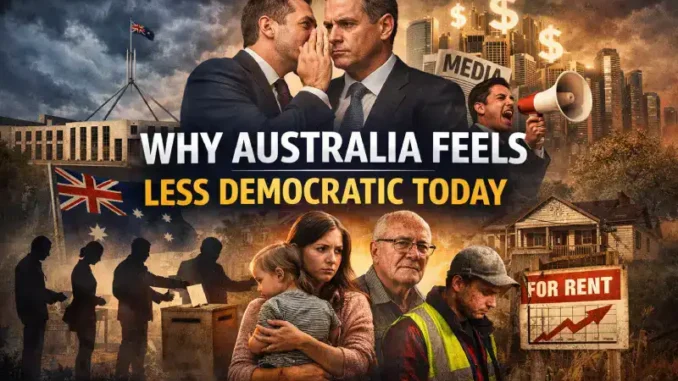
Citizens won’t regain real political power by using A.I. images!
Perhaps folk are too depressed, having read it.
Albo’s choice NOT to raise royalties on fuel exports despite the oil (gas) shock…that shows the analysis is correct.
Max, it’s better than paying $600 for a photo.
A substantial segment of the population is just too lazy, or alienated, or concerned with day to day survival, to give much deep consideration to how politics works, how elections work, or what policies are offered by which party. They arrive on election day uncertain even of their electorate and ready to vote for a familiar name. This happens at every level of government, including Councils
Max, the image is just there to draw attention. The real issue is whether citizens can influence policy, not how the article is illustrated. What are your thoughts on that?
Thomas, there’s some truth in that feeling. Voting does change who governs, but it doesn’t always change the system itself. That’s really what the article is getting at. What changes do you think would give people more real influence?
Paul, perhaps folk are too depressed, having read it.
Albo’s choice NOT to raise royalties on fuel exports despite the oil (gas) shock…that shows the analysis is correct.
Lyndal:
A substantial segment of the population is just too lazy, alienated, or preoccupied with day-to-day survival to give much deeper consideration to how politics and elections work, or to what policies are offered by which party. They arrive on election day, uncertain even of their electorate and ready to vote for a familiar name. This happens at every level of government, including Councils
Roswell: You are correct. I don’t have the money to pay for commercial images.
Over a million($3m cash) first preferences went to independents.
The election of loonies and idiots, in Australia, is ‘real’ democracy.
Who, in their right mind, would want them to form government??
Denis, Has there ever been at time when “… too lazy, alienated, or preoccupied with day-to-day survival…” was not true???
ps
Is there such a thing as society?
Wam: You raise a few important points. A large vote for independents doesn’t necessarily mean people want instability; it often reflects frustration with the major parties and a desire for representation that feels closer to everyday experience.
On your question about disengagement, you’re right, people have always had competing pressures. The difference now is that economic stress, job insecurity, and rising costs can make meaningful participation harder, which affects how democracy functions in practice.
As for society, it clearly exists in how we organise services, laws, and communities. The real question is whether those systems are working for most people or primarily for a smaller group.
The article is not arguing against democracy, but asking whether people have enough influence over outcomes after elections.
What do you think would improve that: stronger parties, better independents, or changes to how decisions are made?
As I’ve previously said-
• there is significant disaffection with the major political parties
• the reaction in voting for independents is simply a result of the disaffection, it is not the result of thoughtful analysis
• there are a multitude of minor parties, who have published policies, leadership and a membership structure. You know what they stand for
• there will be a minor party that will reflect the general political orientation of most people. Choose one, join it and participate in it
• independents generally make it up as they go. They are an indulgence, parliament can function with about a handful of them. 20 or 30, without leadership, or a coherent policy plaform would be a debacle
Maybe this has more to do with what’s going on, and if you have read Margo Kingston’s ‘Not Happy John’ I suspect that Albo is up to the same tricks as indicated here….
https://www.themonthly.com.au/april-2026/nation-reviewed/hidden-agenda?
A Commentator:
You make a fair point about disaffection driving support for independents. I agree that frustration with the major parties is a big part of what we are seeing.
Where I see it slightly differently is that voting for independents is not always a lack of thoughtful analysis. For many people, it is considered a response to feeling that the existing party structures are not representing their interests or listening to their concerns.
You are right that minor parties offer clearer platforms and a way to participate more directly, and that is a valuable part of the system. At the same time, independents can reflect local priorities in ways that party structures sometimes struggle to.
The bigger issue the article raises is not whether people choose parties or independents, but why so many feel that neither option gives them real influence over policy outcomes after elections.
What do you think matters more for improving that, stronger party participation, or changes to how decisions are made once people are elected?
thanks, Denis.
I dodged involvement in politics but spent 20 years involved with local government and all of us whingers need such experience. But more involvement is needed at the branch level which will make for stronger parties.
Perhaps a number of small changes aimed at making each pollie responsible for doing a fair days work.
To prevent corruption and confirm the hard work done by pollies, their 24 hour diary, showing where, when and duration of appointments and meeting outcomes, should be made public, at the end of the month.