By Denis Hay
Description
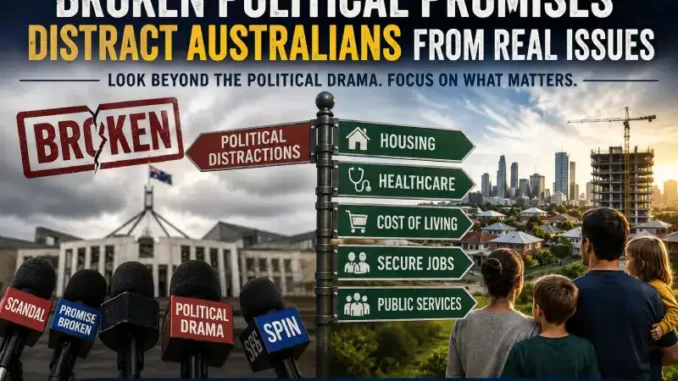
Broken political promises in Australia. Why media outrage distracts from housing, healthcare, and cost-of-living failures.
Introduction
The debate over broken political promises has become a constant feature of Australian politics. Every election cycle produces outrage over promises abandoned, watered down, or quietly forgotten after governments take office. While accountability matters, the endless media focus on political betrayal often distracts Australians from the deeper problems shaping everyday life.
Housing affordability continues to collapse. Public healthcare is under pressure. Energy, food, and insurance costs keep rising faster than wages. Secure jobs are becoming harder to find. Yet much of the political conversation revolves around headline controversies instead of the long-term structural issues affecting millions of Australians.
This growing cycle of outrage and distraction is damaging public trust and preventing serious national conversations about what Australians need from government.
If you value independent, fact-based analysis like this, consider supporting Social Justice Australia.
Even a small contribution helps keep this work available to everyone.
👉 Support the site here
The Problem – Why Australians Feel Stuck
- Political theatre has replaced serious reform
Modern politics increasingly rewards spectacle over substance. Media organisations compete for clicks, ratings, and emotional reactions. As a result, political reporting often focuses on conflict, scandals, and broken promises rather than deep policy analysis.
This creates what many Australians now recognise as political distractions. Citizens are encouraged to become emotionally invested in daily political drama while larger systemic problems continue unresolved.
Instead of sustained debate about housing shortages, declining bulk billing, privatisation, or insecure work, Australians are bombarded with “gotcha” politics and personality conflicts.
This is not accidental. Complex structural problems require a detailed explanation. Political theatre is easier to package into headlines and social media clips.
Many of these patterns are explored further on Social Justice Australia, particularly in articles examining media concentration and political accountability.
- The consequences reach far beyond politics
The impact of this constant political distraction is now deeply felt across Australian society.
Many Australians increasingly feel disconnected from politics because the issues dominating headlines often do not reflect the pressures they experience every day. A family struggling to pay rent, an elderly person waiting months for treatment, or a young worker trapped in insecure employment gains little from endless debate about political point scoring.
According to the Australian Bureau of Statistics, cost-of-living pressures are still one of the biggest concerns facing Australian households. Meanwhile, research from the Australian Electoral Study has consistently shown declining trust in political institutions.
Australians are not simply angry about broken promises. Many feel governments are not addressing the underlying causes of insecurity and inequality.
The Impact – What Australians Are Experiencing
- Everyday Australians are carrying the burden
For many Australians, life feels increasingly unstable despite years of rhetoric about economic growth.
Housing affordability has deteriorated dramatically. Younger Australians are delaying home ownership or abandoning it entirely. Rental stress is becoming normalised even among full-time workers.
Healthcare pressures are also growing. Bulk billing rates have declined, waiting lists are still long, and mental health services are stretched beyond capacity.
At the same time, insecure work continues to expand. Casualisation, labour hire arrangements, and gig economy jobs leave many workers uncertain about their future.
Articles from Social Justice Australia examining cost-of-living pressures and insecure employment explore how these issues are reshaping daily life across the country.
Meanwhile, political debate often stays trapped inside short-term controversies rather than addressing the causes of these growing pressures.
- Who benefits from the distraction?
Political distraction benefits those already holding economic and political power.
When public debate centres on political drama instead of structural reform, powerful interests face less scrutiny. Major corporations, lobbying groups, privatised industries, and concentrated media organisations benefit when deeper economic questions are avoided.
Questions such as:
- Why is housing increasingly unaffordable?
- Why are privatised essential services becoming more expensive?
- Why is public infrastructure under pressure?
- Why does public money flow so easily toward some sectors while social services struggle?
These are far more significant than daily political controversies, yet they often receive far less sustained attention.
Large sectors receiving public money, including defence contractors, fossil fuel subsidies, and privatised infrastructure operators, rarely face the same intense scrutiny as political “broken promises.”
This kind of analysis is rarely covered in mainstream media.
If you want more content like this, reader support makes it possible.
👉 A small donation helps keep this work going
The Solution – What Must Be Done
- Australia’s monetary sovereignty changes the conversation
One reason many critical issues stay unresolved is that Australians are repeatedly told the federal government “Cannot afford” major reforms.
However, Australia operates with monetary sovereignty. The federal government issues its own currency and cannot run out of Australian dollars in the same way households or businesses can.
This does not mean governments can spend without limits. Real limits include available labour, infrastructure, skills, and productive capacity. But it does mean that many national problems are political choices, not financial impossibilities.
Modern Monetary Theory, often referred to as MMT, helps explain this reality. Policies such as a Job Guarantee show how governments could use public money to support full employment and economic stability rather than relying on unemployment to control inflation.
Understanding monetary sovereignty fundamentally changes how Australians view housing, healthcare, education, and infrastructure investment.
- Practical reforms Australians could demand
Australians do not need endless political theatre. They need practical reforms focused on public well-being.
Reforms include:
- Large-scale public housing construction.
- Expanded Medicare and bulk billing support.
- Greater investment in TAFE and public education.
- Media ownership reform to improve diversity.
- Stronger political donation transparency laws.
- Public infrastructure investment.
- A federal Job Guarantee program.
- Reduced reliance on privatisation.
- Greater support for independent journalism.
- Long-term climate and renewable energy investment.
Research from The Australia Institute and ACOSS Australia regularly highlights many of these policy areas as critical to improving social and economic outcomes.
None of these reforms are impossible for a country with Australia’s resources and monetary sovereignty. The main obstacle is political will.
This article is part of a broader effort to inform and empower Australians.
Right now, the site is only partially funded.
👉 If just a small number of readers contribute, this work continues.
Final Thoughts
The discussion around broken political promises in Australia matters because honesty and accountability are important in any democracy. But Australians should also ask a deeper question: what happens when political outrage becomes a distraction from the structural problems shaping everyday life?
Housing stress, insecure work, rising costs, healthcare pressure, and growing inequality cannot be solved through political theatre or media outrage cycles.
Australia has the resources, skills, and monetary sovereignty to build a more secure and fair society.
The challenge is whether citizens can push public debate away from endless distractions and back toward long-term national priorities.
If Australians continue focusing only on political drama, the deeper problems affecting daily life may remain unresolved for another generation.
Support Independent Journalism That Puts Australians First
This site runs on about $2,000 per year and is currently partially funded.
So far, readers have contributed $807.
👉 If just 1 in 20 readers donated $5, the site would be fully funded.
Your contribution helps:
- Keep content free and accessible.
- Provide independent analysis.
- Hold power to account.
➡ Donate $5, $10, or whatever you can
➡ One-time or monthly options available
If this article helped you see things differently, this is your chance to support more work like it.
Every contribution matters.
Join the Conversation
If this article resonated with you:
- Share it with others.
- Leave a comment below.
- Submit feedback through the Reader Feedback section.
- Visit the Testimonials page.
- Join the discussion on Social Justice Australia Facebook Group
Frequently Asked Questions
Why do broken political promises receive so much media attention?
They are simple, emotional, and easy to turn into headlines. Complex structural problems require more detailed explanation and often receive less coverage.
Are broken political promises still important?
Yes. Accountability matters. However, Australians should also focus on whether governments are addressing deeper long-term issues affecting society.
What are the biggest issues facing Australians today?
Housing affordability, cost-of-living pressures, insecure work, healthcare access, and declining trust in institutions remain major concerns.
How do broken political promises in Australia connect to monetary sovereignty?
Many Australians are told governments cannot afford major reforms. Monetary sovereignty shows the federal government has far greater financial capacity than commonly presented.
What Is Your Experience?
Do you think the media’s focus on broken political promises distracts Australians from the deeper issues affecting everyday life?
This article was originally published on Social Justice Australia
Keep Independent Journalism Alive – Support The AIMN
Dear Reader,
Since 2013, The Australian Independent Media Network has been a fearless voice for truth, giving public interest journalists a platform to hold power to account. From expert analysis on national and global events to uncovering issues that matter to you, we’re here because of your support.
Running an independent site isn’t cheap, and rising costs mean we need you now more than ever. Your donation – big or small – keeps our servers humming, our writers digging, and our stories free for all.
Join our community of truth-seekers. Please consider donating now via:
PayPal or credit card – just click on the Donate button below
Direct bank transfer: BSB: 062500; A/c no: 10495969

We’ve also set up a GoFundMe as a dedicated reserve fund to help secure the future of our site.
Your support will go directly toward covering essential costs like web hosting renewals and helping us bring new features to life. Every contribution, no matter the size, helps us keep improving and growing.

Thank you for standing with us – we truly couldn’t do this without you.
With gratitude, The AIMN Team
We should not, perhaps, ever use terms like “promise”. or even “law”, for these human constructs, concepts, brainfarts are “good ideas” that never actually existed. You and I could have been exterminated under law contrived and controlled by such as Hitler, Stalin, Pol Pot, Idi Amin, so many ruthless dictatorial arseholes, that any sanctity or eternal durability is gone, and never was… Sargon gave “law”, Moses, various Greek and other lawgivers did so, and for what?? As for a political promise, how amusing.., just ask old classmate Jack Howard as necessity, ambition, donor requirements impelled him to, well, backtrack. Correcting a wrong as times change, facts change, career needs change, leads to promises going blackholey. When the situation changes, change one’s mind, as did John Adams, (?) (certainly J M Keynes) What do you do? Apparently, a Newspoll indicates that ignorance, greed, resentment, dullness live on…
The coalition would have us believe that millennials (trying to get ahead) will be hardest hit by the Negative Gearing and CGT changes on housing.
The way they spin it is that millennials, 30-45 age group are saving hard and in the meantime they rent an apartment in the city and borrow to buy a house in the country which they intend negatively gearing (i.e. it’s not a new home which would be OK and would allow NG and CGT discounts but an existing home which wouldn’t)
So clearly, according to Newscorp, SKY and Tim Wilson, they will be adversely impacted.
Oh dear, what a pity!
Political parties need to frame their campaign promises as “aims” or “intentions that will be brought to fruition when when circumstances allow” rather than as immutable pledges. They also need to clarify their philosophic bases to show that their aims etc are related to a coherent vision.
Phil. History certainly shows that laws and political promises are human constructs and can be manipulated, abandoned, or rewritten by those in power. Governments often change direction because of pressure from donors, media, economic interests, or changing political realities.
I think the deeper issue is not simply whether politicians break promises, because that has probably always happened. The real concern is whether the political system itself is serving the public interest or mainly protecting powerful interests while ordinary Australians struggle with housing, healthcare, insecure work, and rising living costs.
That was really the core point of the article. Endless outrage about broken promises can sometimes distract us from asking the bigger questions about why so many long-term problems remain unresolved despite decades of economic growth and enormous national wealth.
A healthy democracy probably needs both accountability and a much deeper discussion about who politics is really working for.
Terry. The political and media focus often seems centred on protecting the interests of people already positioned to buy investment properties, while far less attention is given to the growing number of Australians who cannot afford to enter the housing market at all.
The idea that every younger Australian should aspire to become a negatively geared property investor also says a lot about how distorted the housing debate has become. Housing has increasingly been treated as a speculative asset first and a basic human need second.
Of course, some people genuinely use investment properties as part of their financial planning. But the bigger question is whether public policy should mainly support speculative gains on existing homes while millions struggle with affordability and rising rents.
That broader structural issue rarely receives the same level of media attention as the political scare campaigns around negative gearing changes.
I think there is a lot of truth in what you are saying, Lyndal. Governments operate in a changing environment, and unexpected economic events, international pressures, or crises can alter priorities very quickly. Presenting every policy announcement as an absolute guarantee can create unrealistic expectations and contribute to public cynicism later.
At the same time, I think citizens still expect honesty about priorities and intent. If governments clearly explained their broader philosophy and long-term goals, voters could better judge whether policy changes were genuine responses to changing circumstances or simply political backtracking.
Perhaps one of the deeper problems today is that politics has become so focused on short-term campaigning and media management that many parties no longer communicate a coherent long-term vision for the country at all.
First problem as I see it is that no politician has philosophical aims, period, they also lack genuine integrity as it’s all political theatre to maintain the status quo.
The political system as it is does not serve the people, it serves the system.