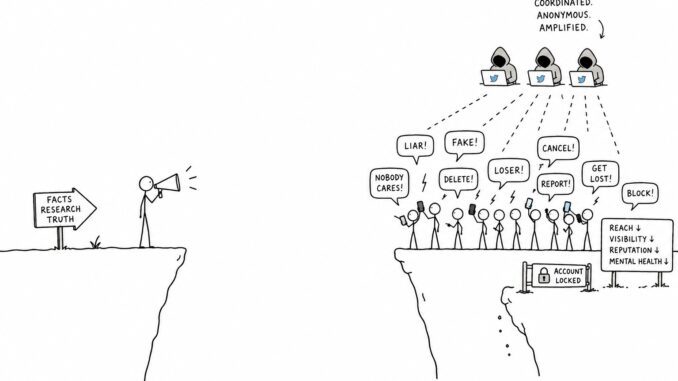
There was a time when losing a social media account was mostly seen as a nuisance. Reset the password. Contact support. Recover access. Move on.
That assumption no longer feels safe.
In recent years, evidence has accumulated showing that politically active users, journalists, researchers, activists, and public commentators are increasingly exposed to coordinated online harassment, phishing attacks, impersonation campaigns, and account takeovers. While motives vary – financial scams, political intimidation, ideological conflict, or simple chaos – the outcome is often the same:
Reduced reach. Exhaustion. Confusion. Silence.
And sometimes that outcome is enough.
The New Information Battlefield
Social media platforms, especially X (formerly Twitter), have become central battlegrounds for political narratives, activism, journalism, and public influence.
Researchers at the Oxford Internet Institute documented widespread use of organised “cyber troop” activity across dozens of countries. These operations used coordinated social media tactics to shape discourse, amplify aligned voices, harass critics, and manipulate visibility.
Not all manipulation is state-sponsored. Some campaigns emerge organically from ideological communities, influencer networks, or loosely coordinated online groups. Others involve bot amplification, mass reporting, or targeted harassment.
The tactics differ. The effect is often similar.
Hacking as Suppression
When people imagine account hacking, they often imagine direct financial crime.
But public-facing accounts carry another kind of value: influence.
A journalist with 100,000 followers. An activist with a loyal audience. A policy analyst whose threads routinely spread beyond their immediate network. These accounts represent attention, trust, and reach.
Remove access to the account, even temporarily, and the consequences can be significant:
- loss of audience momentum
- reputational confusion
- impersonation risks
- disruption during major news cycles
- emotional exhaustion
- permanent follower loss
In this environment, an attacker does not necessarily need to permanently control an account to succeed.
A delayed recovery process may achieve much of the same outcome.
Platform Weakness as a Force Multiplier
This matters because many users now perceive account recovery systems as weaker, slower, or more inconsistent than they once were.
Following major staffing reductions after the takeover of X, concerns emerged about reductions in moderation and trust-and-safety capacity. Australia’s eSafety Commissioner reported deep cuts to safety and moderation staffing connected to the platform.
If response systems weaken while attacks increase, a dangerous imbalance emerges: Attackers operate quickly. Recovery moves slowly.
In practice, that means even a short disruption can matter enormously. A 48-hour lockout during a fast-moving political controversy or breaking news event may permanently alter the visibility trajectory of a public voice.
Harassment as Attrition
Not every suppression tactic requires hacking.
Academic research and investigative reporting have repeatedly documented coordinated harassment campaigns targeting journalists, women, activists, researchers, and political commentators.
The objective is not always persuasion. Sometimes it is exhaustion.
Flood the replies. Trigger constant notifications. Generate stress. Encourage self-censorship. Push targets offline. Overwhelm moderation systems through mass reporting. Distort public perception by creating the appearance of overwhelming hostility.
Researchers and online safety experts have repeatedly warned about the silencing effects of sustained online harassment.
The target eventually posts less.
Or leaves entirely.
The Difficulty of Proof
Caution matters here.
Not every hostile interaction is coordinated. Not every hacked account is politically motivated. Not every spam wave represents targeted suppression.
Large social platforms naturally attract scammers, trolls, opportunists, and random abuse.
This creates an important distinction: There is strong evidence that coordinated manipulation and targeted harassment exist. There is far less certainty when attributing motive in individual cases without forensic evidence.
Suspicion alone is not proof.
Still, patterns matter.
And patterns increasingly suggest that visibility itself has become something people compete to control.
The Quiet Lesson
Perhaps the most uncomfortable reality is this:
- Suppression does not always require censorship.
- Sometimes all that is required is friction.
- A hacked account that is never properly restored.
- A harassment campaign that slowly wears someone down.
- An endless wave of nuisance interactions.
- A platform too chaotic or understaffed to respond effectively.
- Over time, voices disappear.
Not necessarily because they were defeated in debate.
But because exhaustion scales remarkably well online.
Sources and Further Reading
- Oxford Internet Institute – Computational Propaganda / Cyber Troops reports
- Electronic Frontier Foundation – online harassment and platform rights research
- Amnesty International – Pegasus spyware investigations
- Citizen Lab – targeted surveillance research
- Australian eSafety Commissioner – online abuse and platform moderation reporting
- Microsoft Digital Defense Reports
- Google Threat Analysis Group reports
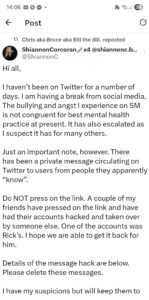
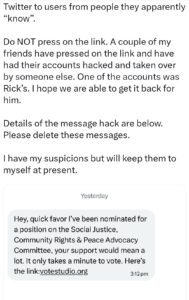
 Yeah – and this is exactly the sort of attack pattern that keeps working because it piggybacks on trust, urgency, and identity.
The message in the screenshot is classic social-engineering phishing:
- “Quick favor”
- fake activism / community cause wording
- urgency (“only takes a minute”)
- sent from someone you “know”
- suspicious external link
Once someone clicks, the site can:
- steal login/session tokens
- trick them into entering credentials
- harvest MFA codes
- auto-send the same message to all their contacts
- hijack the account for scams, crypto spam, or political propaganda
The really nasty part is the emotional layer. People are more likely to click when it appears to come from a friend or someone in their online community. That’s why compromised accounts spread so effectively.
The earlier point about hacked accounts never being recovered despite proof of ownership also matters here. Attackers know platform support can be weak or slow, so a stolen account can remain useful for quite a while.
A few practical things worth repeating to people:
- never click login links from DMs
- verify with the sender through another channel
- enable 2FA (preferably authenticator app, not SMS)
- check active sessions/devices regularly
- change passwords immediately if clicked
- revoke suspicious app permissions
- warn followers publicly if compromised
And honestly, the first paragraph from that post about stepping away from social media because of bullying/angst plus then getting hit by phishing chaos… it says a lot about the state of these platforms right now.
“The humans built vast networks to connect with one another. The scavengers noticed they also connected panic, outrage, and trust with remarkable efficiency.”
See also:
Keep Independent Journalism Alive – Support The AIMN
Dear Reader,
Since 2013, The Australian Independent Media Network has been a fearless voice for truth, giving public interest journalists a platform to hold power to account. From expert analysis on national and global events to uncovering issues that matter to you, we’re here because of your support.
Running an independent site isn’t cheap, and rising costs mean we need you now more than ever. Your donation – big or small – keeps our servers humming, our writers digging, and our stories free for all.
Join our community of truth-seekers. Please consider donating now via:
PayPal or credit card – just click on the Donate button below
Direct bank transfer: BSB: 062500; A/c no: 10495969

We’ve also set up a GoFundMe as a dedicated reserve fund to help secure the future of our site.
Your support will go directly toward covering essential costs like web hosting renewals and helping us bring new features to life. Every contribution, no matter the size, helps us keep improving and growing.
Thank you for standing with us – we truly couldn’t do this without you.
With gratitude, The AIMN Team

I had all my Facebook pages, both personal and political, suspended by Facebook because they said I breached their community and cybersecurity rules. I had no warning first. When I asked for a review, they upheld their suspension. I had over 2500 friends and members. I am not sure, but I suspect that one of the political parties was behind my suspension, as I have been critical of many of their actions or inactions on issues that are important to most citizens.
Denis. Yes, this also happened to me. I used to follow you on Fb. I lost around 1000 friends. I was given 6 months suspension. That was 2 years ago, and I never went back. I suspect a well-known Zionist organisation.
See X how Musk became upset when informed by his ppl that many if not a majority of his followers were bots.
The same platform promotes neo-Nazi and anti-semitic etc talking points, but punishes centre and left with ‘reduced visibility’ or suspension when naming and shaming the far right; two triggers have been Koch and Tanton Network, both Project 2025.
Now due to the the latter Tanton Network via DOJ are going NGO research resources ie SPLC Southern Poverty Law Centre human rights and anti-KKK.
One suspects due to their wealth of intelligence on far right and white Australia admirer late anti-semite John Tanton; muse of Miller, Bannon, Orbán, Le Pen, Musk, Fox News, Brexit, Trump, Project 2025, far right, white Christian nationalists etc., with influence on both immigration and faux environmental strategies in Anglosphere.
Geez, I am in exalted company. I posted a reply to an ugly TACO Trumpery pic post, ”If his lips are moving he is probably lying” and immediately received a Community Concern Notice demanding a Police mug shot PLUS a Police mug reel before I would be allowed back on Facebook. Naturally I quickly wiped my FB account and so lost any & all contact within the electorate.
However, about six (6) weeks later I got a ”Where are you, you haven’t posted for weeks” notice. ”Just fill in this six digit number and come back to FB”.
Naturally I declined; the six-eight (6-8) hours I re-discovered in the day has been filled with other more useful matters.
Nobody should support a platform that silences their free speech. But what that means of course, is that their tactics are working – getting rid of the loud noises who oppose their ideology. However, I’ve found my place at Bluesky. So far I haven’t been censored and in 12 months have acquired over 1000 followers. Many of my friends and family have also moved there.
Shadow banned, black banned.
Failed to provide my bio-metrics on Facebook – Refused to accept any other form if identification – permanently locked out of the Facebook account I had for 19 year. Now cannot access 5 pages I managed – 3 of them political. No access to the thousand plus Groups many were Political Group. I was one of the founding members of Organised Revolution, until I was usurped and they removed as an Admin.
The control over the online world is now on par with the real world.