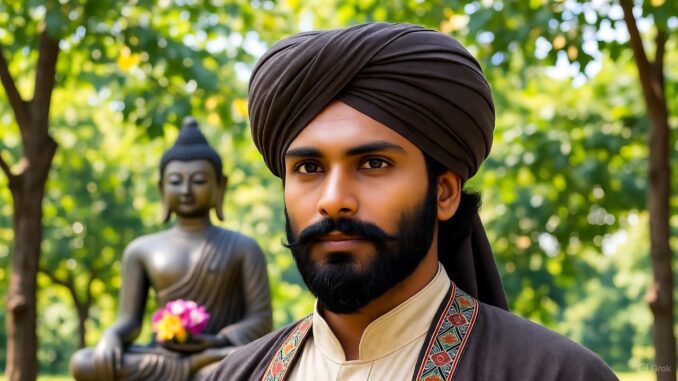
History is not just a record of what happened; it is an argument about what matters. The stories we choose to tell, and those we choose to forget, reveal our deepest biases and our greatest fears. In the annals of human civilisation, few figures offer a more profound lesson in power than Ashoka, the third-century BCE ruler of the Mauryan Empire in India. His near-absence from the standard Western historical canon is not an oversight. It is a deliberate omission, for his story is a direct and devastating critique of the very foundations of imperial power.
The Ashokan Transformation: From Conquest to Conscience
Ashoka’s early reign was defined by the brutal logic of his time. Following the path of his grandfather, Chandragupta, he sought to expand his empire. His campaign against the state of Kalinga was a success by military metrics, resulting in a staggering loss of life – reported as 100,000 killed and 150,000 displaced.
But then, Ashoka did the unthinkable. He looked upon the devastation he had wrought and saw not victory, but catastrophe. In his own words, inscribed on rock edicts across his empire, he confessed: “What have I done?… If this is a victory, what’s a defeat then? Is this a victory or a defeat? Is this justice or injustice? Is it valor to kill children and women? Do I do it to expand the empire and for prosperity or to destroy the other’s kingdom and splendor?”
This moment of radical self-reflection sparked one of the most remarkable transformations in history. Ashoka renounced armed conquest, embraced the Buddhist principles of Ahimsa (non-violence) and Dharma (moral law), and dedicated his life to peaceful governance. He built hospitals for people and animals, cultivated medicinal herbs, established universities, and sent emissaries of peace, not war, to distant lands. He became a ruler who measured his strength not by the territory he controlled, but by the well-being of his people.
The Great Silence: Why the West Ignores Ashoka
Why is a ruler of such immense historical and ethical significance a footnote in Western education, while figures like Alexander the Great or Julius Caesar are household names? The reasons are rooted in a deep-seated cultural and ideological bias.
- A Threat to the Imperial Narrative: Western history, as traditionally taught, is a chronicle of empires built and maintained through military supremacy. The story of a ruler who achieved his greatest military victory and then voluntarily renounced violent expansion is profoundly threatening. It suggests that the core engine of their historical identity – conquest – is not a virtue, but a moral and strategic dead end. Ashoka’s life proves that an empire’s golden age can begin not with a battle, but with a choice for peace.
- The Bias of “Civilisational” Origins: For centuries, a racist and colonial undercurrent in Western historiography has positioned “wisdom” and “enlightenment” as unique products of a Greco-Roman, Judeo-Christian lineage. To acknowledge that one of history’s most profound ethical transformations occurred in the heart of ancient India disrupts this biased map of human progress. It forces an acknowledgment that profound moral genius emerged fully formed outside of their defined cultural sphere.
- An Inconvenient Model of Power: Ashoka presents a model of leadership that is anathema to the modern military-industrial complex and the culture of endless growth. A leader who invests in public health and ethical education over the projection of military force? A sovereign who seeks conquest of the self over conquest of territory? This is a dangerous idea. It is far safer to celebrate the Caesars – conquerors who never questioned the virtue of their conquests – than to contemplate a leader whose power was rooted in compassion.
The Lesson We Desperately Need Today
The story of Ashoka is not a dusty relic. It is an urgent mirror for our time. We live in an era of perpetual war, where conflicts are fueled by a multi-trillion dollar arms industry and justified by dehumanising propaganda. We see the fruits of this logic in the rubble of Gaza, in the manipulation of currencies to fund forever wars, and in the collapse of social infrastructure as military budgets swell.
Ashoka’s lesson is that true power is the courage to change. It is the strength to look at the systems of violence you have mastered, recognise their ultimate futility, and choose a different path. It is the understanding that a nation’s security is not found in the subjugation of others, but in the health, education, and moral integrity of its own people.
The silence surrounding Ashoka in the West is a silence we must break. For in his story lies the antidote to the hubris and destruction that defines so much of modern geopolitics. He is the proof that a civilisation can look into the abyss of its own violence, and choose to turn away.
We are told history is written by the victors. Perhaps it is time we started listening to the voices of the wise, even – especially – when they come from places we have been taught to ignore. The choice before us is the same one Ashoka faced: do we continue the bloody, cyclical folly of conquest, or do we have the courage to lay down the sword and build a world on the foundation of conscience?
Keep Independent Journalism Alive – Support The AIMN
Dear Reader,
Since 2013, The Australian Independent Media Network has been a fearless voice for truth, giving public interest journalists a platform to hold power to account. From expert analysis on national and global events to uncovering issues that matter to you, we’re here because of your support.
Running an independent site isn’t cheap, and rising costs mean we need you now more than ever. Your donation – big or small – keeps our servers humming, our writers digging, and our stories free for all.
Join our community of truth-seekers. Donate via PayPal or credit card via the button below, or bank transfer [BSB: 062500; A/c no: 10495969] and help us keep shining a light.
With gratitude, The AIMN Team


Imagine.
Andrew’s comment that “… it is time we started listening to the voices of the wise” is prefaced with the adverb ‘Perhaps,’ turning what ought to be a strong statement of good intention into a take it or leave it observation. If I were the editor, I’d dump the adverbial preface and stick with the stronger statement.
It’s beyond argument or debate that what’s seriously lacking in this modern world is wisdom, expressed forcefully, taken seriously, acted upon for the benefit of all, deemed incontrovertible, sought out and venerated for its overview on whatever purview it’s applied towards.
It’s unsurprising that Ashoka is so little known in the western hemispheres outside the arcane institutions of academia and religious studies; western societies have long displayed little to no interest in those civilisations that arose in the east and persisted for millennia… aside from mercantile interests that sought to profit but for the wisdoms learned from the great teachers such as Buddha along with Hinduism, Jainism, the Bhagavad Gita, the Upanishads… all largely neglected by western audiences fed instead on essentially juvenile interpretations of the Bible that fail abysmally to understand the deeply esoteric contents of that collection of teachings.
One might benefit by the pragmatic view that the pendulum swings, whatever the timeframe of its cycle. As rotten as the current global state of affairs appears to be, there will be a reckoning, eventually.
Revenue system of the Mauryan Empire was highly structured and efficient for its time. By relying on agricultural taxes, trade duties, state monopolies, and other sources, the Mauryan rulers established a stable economic foundation. The organized administrative framework ensured effective collection and management of revenue, allowing the empire to sustain its vast territory and complex governance system. This system remains an important example of early fiscal administration in ancient India.
https://www.indianetzone.com/revenue_system_mauryan_empire
Nancy, thank you for providing that link to a fascinating article.
Would it be fair to say that the Mauryan society was a socialist society? It seems to me to be socialist, with one qualification – the bonded laborers that it mentions.
Do you know whether that refers to laborers who had to work on a project for a length of time in order to get recompensation, or does it mean slavery?
I notice that indianetzone has a similar avatar to yours – it’s striking, great choice.