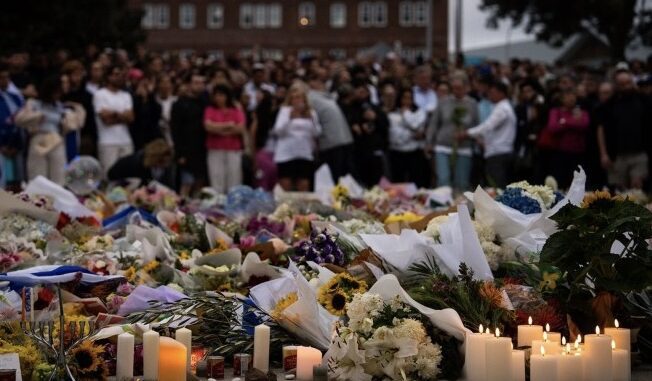
Bondi has forced Australia into one of those moral moments that arrives without asking permission. A public gathering to mark Hanukkah at Bondi Beach became the scene of mass killing, authorities and major reporting have described it as a terrorist incident and a targeted attack on Jewish people, with the surviving alleged perpetrator now facing extensive charges including murder and terrorism offences. In the immediate aftermath, grief has names, families, empty chairs, and a community now asked, again, to carry fear in public.
The moral claim I want to press, without hedging, is this – after Bondi, more than ever, we must be able to separate legitimate criticism of Israel’s government policies and actions from antisemitism. Legitimate criticism of Israel is not antisemitism. Yet criticism can cross the line into antisemitism when it imports anti-Jewish stereotypes, conspiracy tropes, or holds Jews as Jews, anywhere, collectively responsible for what the Israeli state does. The distinction is conceptually clear, and the duty to maintain is owed to Jewish people, to the victims and families of Bondi, and to the moral health of the wider society that has just been reminded, bloodily, what happens when hatred finds licence.
This is an argument about moral clarity, but it is also an argument about protection. When distinctions collapse, people get hurt. Not metaphorically – literally. Antisemitic violence is one of the most predictable historical consequences of turning “the Jews” into a political symbol. Bondi is an Australian instance of that old machinery. But it is equally important to see the other direction of harm – when a society treats criticism of Israel’s policies as inherently antisemitic, it does not thereby protect Jewish people. It often does the opposite, and it also sabotages our capacity to meet the ethical demands of the present, including our duty to speak clearly about human rights abuses wherever they occur, Gaza included.
The starting point is almost insultingly simple, and yet moral life repeatedly fails to honour it – persons are not states. Jewish Australians are not the Israeli government. They do not sit in its cabinet, vote in its elections by virtue of being Jewish, command its military, or authorise its policies. Even Jewish citizens of Israel do not, as individuals, collapse into the state, democracies are not moral monoliths. A person is a bearer of dignity and rights; a state is an institutional agent with coercive power and public responsibilities. Criticism aimed at a state is a form of democratic and moral accountability, hostility aimed at an identity group is racism. Confusing these is the moral logic of scapegoating.
The Jerusalem Declaration on Antisemitism defines antisemitism as “discrimination, prejudice, hostility or violence against Jews as Jews (or Jewish institutions as Jewish).” The IHRA Working Definition likewise stresses that antisemitism is expressed in speech and action directed toward Jews and Jewish institutions, and, crucially for our purposes, it contains a sentence that should be quoted more often than it is: “Criticism of Israel similar to that levelled against any other country cannot be regarded as antisemitic.”
The Nexus Document, written precisely to address the Israel/antisemitism nexus, states the general rule in unambiguous terms: “criticism of Zionism and Israel, opposition to Israel’s policies, or nonviolent political action directed at the State of Israel and/or its policies should not, as such, be deemed antisemitic,” while also warning that using accusations of antisemitism as a tool to suppress criticism of Israel is “dangerous on many levels.”
There is a kind of intellectual laziness, sometimes sincere, sometimes strategic, that refuses these distinctions. One form of laziness says; “Israel is Jewish; therefore, criticism of Israel is criticism of Jews.” Another says; “Antisemitism accusations are always bad faith, therefore ignore them.” Both are morally unserious. Both help create the conditions in which Jewish people are less safe and public reasoning becomes less trustworthy. In the wake of Bondi, unseriousness is itself an ethical failure.
Let me tighten the logic. If antisemitism is hostility toward Jews as Jews, then criticism of a state policy is not antisemitism unless it either targets Jews as Jews or uses the conceptual materials of antisemitism to make its case. This is how categories work. A critique of a military campaign, a legislative act, an administrative regime, a diplomatic posture, a budget allocation, or a doctrine of deterrence is not, by its nature, a judgement about an ethnic or religious group. It becomes antisemitic when it smuggles in one of the classic moral corruptions – collective blame, essentialisation, conspiracy fantasy, or proxy punishment. That is why the key diagnostic is not; “Does the speaker dislike what Israel is doing?” but “Who is being held responsible, by what reasoning, using what imagery, and with what foreseeable consequences?”
Collective blame is the most obvious crossing. If the moral indictment is effectively “the Jews,” then it is antisemitic even if the speaker insists they are “only talking about Israel.” The insistence cannot save the structure of the act. Ethics judges not only declared intentions but also the meaning and function of speech in context. When Jews anywhere are treated as responsible for the actions of a government, the ancient move has been made – identity has been converted into guilt. That move is a vandalism of moral responsibility itself. Responsibility tracks agency. The moment we detach blame from agency and attach it to identity, we are not doing politics, we are doing racial metaphysics.
Stereotypes and conspiracy tropes are the second crossing. Much of modern antisemitism is not expressed as overt hatred but as a repertoire of insinuations – Jews as uniquely manipulative, uniquely powerful, uniquely disloyal, uniquely controlling of media, finance, governments, universities, “globalism,” “the narrative.” This is the resurrection of a mythic explanation of history in which Jews become the hidden author of what goes wrong. The IHRA definition explicitly notes that antisemitism frequently charges Jews with conspiring to harm humanity and uses sinister stereotypes. Once that repertoire enters discourse about Israel, the boundary has been crossed. It is perfectly coherent to argue that a government has violated human rights, it is antisemitic to argue, explicitly or by code, that “the Jews” orchestrate world events, or that Jewish citizens are inherently suspect, or that Jewish institutions are legitimate targets of intimidation because of what a foreign state does.
Proxy punishment is the third crossing – using Israel as a permission slip to target Jews and Jewish institutions. If a synagogue is defaced “because Gaza,” if Jewish students are harassed “because Israel,” if a Jewish neighbour is told they must publicly denounce Israel to be treated as acceptable, the moral structure is antisemitic even if the slogans are political. The JDA explicitly treats it as antisemitic to hold Jews collectively responsible for Israel’s conduct, or to treat Jews, simply because they are Jewish, as agents of Israel, and it explicitly rejects forcing Jews to publicly condemn Israel or Zionism as a condition of participating in public life. In a society newly wounded by Bondi, it should be obvious why this matters – we have just witnessed the catastrophic endpoint of treating Jewish identity as a legitimate handle for violence.
At this point the argument might sound like a familiar plea for “civility,” which would be a profound misreading. The issue is not tone. The issue is whether we preserve the ethical possibility of democratic judgement. A democracy is a culture of moral attribution. It trains citizens in what counts as a reason, what counts as evidence, who counts as accountable, and who counts as untouchable. When we conflate criticism of Israel with antisemitism, we damage that culture in ways that are ethically intolerable, especially after Bondi.
Here is the additional moral dimension that must now be said explicitly. Conflating legitimate criticism of Israel with antisemitism harms Jewish people, and it does so in a distinctive and doubly perverse way. It appears to defend Jews by policing speech, but it often leaves Jews more vulnerable. When “antisemitism” is stretched to cover ordinary political critique, the concept loses its diagnostic power. People begin to treat the charge as merely strategic, a conversational trump card rather than a moral alarm. The predictable consequence is that when antisemitism is real, when it appears as harassment, exclusion, intimidation, violence, fewer people listen, fewer institutions act decisively, and fewer bystanders understand what they are seeing. The protection that Jewish communities need becomes harder to secure precisely because the moral language meant to name the threat has been diluted.
After Bondi, that dilution is a form of disrespect to the dead and the living. When an antisemitic massacre is used as a rhetorical asset to shut down good-faith moral criticism of a foreign government, the victims are instrumentalised. Their suffering becomes a tool of someone else’s political agenda. That is a violation of a basic Kantian constraint – persons must never be treated merely as means. The victims and families are owed remembrance that honours them as persons, not as props, solidarity that protects the community in concrete ways, not as a pretext for silencing debate. In this sense, conflation does not honour Jewish people, it burdens them with yet another injustice, the injustice of having their trauma converted into a gag.
The disrespect extends beyond the Jewish community. A society that cannot distinguish racism from policy critique is a society that cannot be trusted to deliberate about anything ethically serious. It becomes a society of shortcuts. And shortcuts are how prejudice spreads. “Israel” becomes a cipher for “Jews” in some mouths, “antisemitism” becomes a cipher for “don’t criticise power” in others. Either way, the public sphere degrades. We inherit a politics in which moral categories are weapons rather than instruments of truth.
It is also essential to see that conflation harms the cause of human rights itself, including the rights of Palestinians. There are times when events in Gaza are the subject of urgent moral and legal debate, where allegations of violations of humanitarian norms and the scale of civilian suffering demand scrutiny. A person cannot, in good conscience, accept a rule that says – “Because antisemitism exists, discussion of Gaza must be muted.” That is a capitulation to moral incoherence. The correct ethical posture is to insist on both – Jewish safety and equal belonging here, rigorous, evidence-based moral critique of any state’s conduct, including Israel’s, where human rights are plausibly at stake.
Indeed, if you take human rights seriously, you must be willing to criticise human rights abuses wherever they occur, regardless of who commits them, and regardless of which constituency is discomforted by the criticism. This the moral core of universalism. Universalism does not mean “all situations are identical.” It means that the dignity of persons is not contingent on their nationality, ethnicity, or usefulness to a narrative. It means that civilian life matters even when it is politically inconvenient. It means that if we have moral language for the protection of innocents, we do not ration that language by tribe.
This is precisely why the separation I am arguing for is ethically necessary rather than merely tactically prudent. If we cannot criticise Israel’s policies without being accused of antisemitism as such, then a whole category of moral speech becomes illegitimate by fiat. And when moral speech is illegitimate, what grows in its place is not peace but resentment, radicalisation, and moral illiteracy. The Nexus Document’s warning about weaponising antisemitism accusations is a statement about how democracies corrode – by turning the moral vocabulary into an instrument of faction.
Notice also the deeper insult to Jewish people embedded in conflation. If every criticism of Israel is treated as antisemitism, then Jewish identity is implicitly tethered to the state’s actions in a way that Jews did not choose and cannot control. Jewish people are, in effect, told; “Your safety depends on defending a government you may not support,your public acceptability depends on the world’s judgement of a state that is not you.” That is a form of coerced representation. It recreates the very dynamic antisemitism has always demanded – Jews must answer for collective abstractions.
The moral alternative is demanding but coherent. It requires us to say, at once, that antisemitism is real and lethal, that Jewish people must not be made targets or proxies, and that states, including Israel, remain accountable to moral and legal norms. The IHRA definition itself, often invoked in public battles, explicitly contains the principle that criticism comparable to that directed at any other country is not antisemitic. The JDA explicitly affirms “evidence-based criticism of Israel as a state” as not, on its face, antisemitic. The act of separation is the attempt to preserve what these frameworks are trying to preserve – the capacity to identify hatred without criminalising political judgement.
I am insisting on this because Bondi heightens the ethical cost of getting it wrong. When a Jewish community has just been attacked, there is a natural impulse, sometimes generous, sometimes anxious, to tighten the circle of what can be said, to make the world less sharp by making speech less free. But a society cannot purchase Jewish safety by abandoning moral clarity. Jewish safety is secured by opposing antisemitism directly – by naming it, prosecuting it, disrupting its networks, refusing its jokes, contesting its tropes, guarding Jewish institutions, standing with Jews as Jews. It is not secured by declaring that a government’s policies are beyond robust moral critique. That posture not only fails to protect Jews, it can, perversely, inflame antisemitic sentiment by teaching people that “the Jews” are shielded from accountability, exactly the kind of myth antisemitism thrives upon. The ethics of protection is the ethics of accuracy and courage.
Accuracy matters here in a particularly strict sense. We must be attentive to the difference between condemning policies and demeaning persons, between contesting a political ideology and essentialising an identity, between protesting state violence and performing collective blame. It is not enough to announce, “I’m not antisemitic”, moral life is not made safe by self-certification. We owe the public sphere reasons. We owe it language that does not launder racial hatred. We owe it the refusal to trade in conspiracies. We owe it the capacity to speak about Gaza, about civilians, about suffering, about proportionality, about rights, without letting that discourse mutate into a permission structure for harassing Jews in Sydney, Melbourne, or anywhere else.
One of the most corrosive habits in contemporary political argument is the habit of shortcutting moral evaluation by identity. The shortcut says; “If you criticise Israel you must hate Jews,” or, conversely, “If you name antisemitism you must be defending Israeli policy.” Both are forms of moral mind-reading dressed up as analysis. Both are ways of avoiding the labour of actual judgement. They replace argument with sorting. But ethical discourse is reasoning. Reasoning requires that we distinguish objects of evaluation. “Israel’s policy X is unjust” is a different proposition from “Jews are unjust.” The first can be supported or refuted with evidence and normative argument. The second is racism and should be treated as such. The refusal to acknowledge this is moral laziness with deadly historical consequences.
We should also be candid about why this issue is so combustible – the Israeli-Palestinian conflict sits at the intersection of trauma, identity, nationalism, religion, colonial histories, security fears, and competing narratives of victimhood. This makes it uniquely prone to moral distortion. Trauma seeks total explanations, identity seeks loyalty tests,nationalism seeks sanctification. Each of these pressures can tempt people into collapsing distinctions. Some will collapse Jews into Israel to justify antisemitism. Others will collapse Israel into Jews to justify shielding the state from critique. Others will collapse Palestinians into terrorism to justify indifference to civilian suffering. We must refuse all of these collapses, not because neutrality is a virtue, but because the integrity of moral judgement is.
If one wants a watertight ethical position, it is this: we can and must condemn antisemitism as antisemitism, with particular urgency after Bondi, we can and must criticise policies and actions of the Israeli government when those policies and actions plausibly involve human rights abuses, just as we criticise any state, and we must do so in a way that does not traffic in collective blame or anti-Jewish tropes. None of these commitments contradict the others. The contradiction exists only if we accept a false premise, that Jewish people are morally represented by the Israeli state or that moral critique of state violence is inherently racist. The first premise is antisemitic in structure; the second premise is anti-democratic in effect.
Bondi adds one more layer of obligation – the obligation not to turn a massacre into a moral bargaining chip. In the weeks after an atrocity, there is a special kind of ethical obscenity in opportunistic rhetoric. If Bondi is invoked to silence discussion of Gaza, then the victims are being used to enforce a particular geopolitical posture. If Bondi is invoked to justify hostility toward Muslims or migrants, the victims are being used to launder another prejudice. If Bondi is invoked to justify hostility toward Jews elsewhere (“they had it coming”), the victims are being used to sanction further violence. Every one of these moves is a failure to mourn properly, because proper mourning is a recognition of the dead as beings whose dignity forbids instrumentalisation.
The deepest tribute we can pay the victims and the families is not only to grieve but to insist that the public sphere become less hospitable to the moral machinery that made such violence imaginable. That machinery is the machinery of proxy blame, of essentialisation, of mythic conspiracy, of dehumanising category collapse. The correct response is therefore not to impoverish our moral language, but to purify it – to make it capable of condemning antisemitism without confusing it with political critique, and capable of condemning human rights abuses without letting that condemnation mutate into hatred of Jews.
This is what moral seriousness looks like after Bondi. It does not ask Jews to become spokespeople for a state in order toearn safety. It does not ask Palestinians to accept silence about their suffering in order to prove that they are not bigots. It does not ask the rest of society to choose between protecting Jews and criticising a government. It asks us to do the harder thing – to maintain distinctions when emotion begs us to abandon them, to speak with precision when slogans are easier, to refuse the satisfactions of scapegoating, to keep faith with universal dignity in a moment when tribal reasoning seems tempting.
There is a final ethical point, and it is perhaps the most uncomfortable for a society that likes to imagine itself tolerant by default. Antisemitism is not only a pathology of extremists but also a set of cultural reflexes that can be activated by social permission. When discourse collapses Jews into Israel, Jewish people become targetable. When discourse collapses criticism into antisemitism, it incubates cynicism that later makes antisemitism harder to confront. The line we are drawing is therefore drawn because lives depend on it. Bondi has reminded us, in the most brutal way, that this is not theory.
I am not asking for gentleness. I am asking for ethical competence. Criticise Israel’s government policies where you believe they violate human rights or the demands of justice,do it with evidence, with moral argument, with a universalist backbone that does not ration compassion. But do not smuggle antisemitism into the critique, do not make Jews the defendant, do not turn Jewish institutions into targets, do not revive the conspiracy repertoire that has always ended in blood. Equally, do not use antisemitism as a veto to shield a state from scrutiny, do not turn a massacre into a gag, do not dishonour Bondi by treating the dead as instruments. The frameworks we already have, IHRA’s insistence that comparable criticism is not antisemitic, the JDA’s focus on Jews as Jews, Nexus’s warning against weaponisation, are not perfect, but they converge on exactly the discipline this moment demands.
Bondi has narrowed the moral excuses available to us. We cannot plead ignorance about where hatred leads. We cannot pretend that category errors are harmless. We cannot accept a public sphere in which Jews are made to fear public celebration, nor one in which moral critique of human rights abuses is treated as illicit by definition. If we want a society that can survive its own disagreements without turning minorities into targets, then we must do the unglamorous work of maintaining distinctions, patiently, insistently, even when it is socially costly. That work is not beside the point of mourning. It is part of mourning done rightly.
Keep Independent Journalism Alive – Support The AIMN
Dear Reader,
Since 2013, The Australian Independent Media Network has been a fearless voice for truth, giving public interest journalists a platform to hold power to account. From expert analysis on national and global events to uncovering issues that matter to you, we’re here because of your support.
Running an independent site isn’t cheap, and rising costs mean we need you now more than ever. Your donation – big or small – keeps our servers humming, our writers digging, and our stories free for all.
Join our community of truth-seekers. Donate via PayPal or credit card via the button below, or bank transfer [BSB: 062500; A/c no: 10495969] and help us keep shining a light.
With gratitude, The AIMN Team


Thank you. An excellent article.
I wish we could teach everyone to think like this. It is the only way we will survive without sinking into paranoid nationalism.
Well said Roger, and is instructive for any thinking person to comprehend and understand background issues and relevant details.
Ditto to what heather said.
An amazingly thorough and exacting discourse on a vitally important subject that must never be simplified.
Bravo Roger for your clearly stated explanation of a complex situation.
Brilliant and VERY important!
Amongst other benefits of civilized life in the west is International Law where it is agreed what is right, and what is wrong with consequences.
Some of us have followed recent judgements by both the ICC and ICJ.
Certain persons are subject to arrest, and the chance to have their day in court, and Australia subscribes to the court and its decisions and findings.
Some folk operate outside the law and we call them criminals because we have free speech in this country.
One of these criminals recently sat in Tel Aviv telling our PM that he was weak, while he would not have the guts to set foot on our land.
But we have a minority group here who do not feel obliged to follow international law, because they are simply above the law, and go their own way.
This is one country with one set of laws which we all observe, and you don`t dodge out because you wear a silly hat, and go to a private church to prove how exceptional you are.
I guess, Douglas Pritchard sums it up for me also.