By Maria Millers
As we lean into the heat of summer with the dread that it brings in places prone to fires and health risks to the vulnerable, it’s also that time of year when we recognise and celebrate the special people in our communities showing what it truly means to be Australian and a leader in a chosen field. All the nominees for Australian of the Year showed leadership in their particular field.
Astronaut and space engineer Katherine Benell-Pegg has been named Australian of the Year. Also honoured were: a pioneer in dementia treatment, Professor Henry Brodaty, an endurance runner raising money and awareness of homelessness and a First Nation construction leader. All have shown exceptional qualities of leadership in their respective areas of endeavour.
Indeed the question of leadership has recently been dominating politics not just locally but also internationally, reigniting the argument whether leadership is innate or learnt: nature versus nurture.
Visiting me for a few weeks has been a granddaughter with her two adorable fraternal twin girls, aged two and a half. Watching them at play, you could quickly see that at this stage one was definitely ‘in charge’. Interestingly, at birth she had been the smaller of the two.
This of course may change as they grow older but whether leadership is innate or learned is still debated
A lot of people argue that there’s a crisis in leadership today. Some of the concerns include political polarization, declining trust in institutions, and the rise of populism, which sometimes leads to more divisive or short-term focused leadership.
This has become a prominent political talking point following Bondi. I have already written about how unedifying it was to see the political point scoring and maneuvering at a time when so many were hurting and how it seemed there was no one picking up the mantle of leadership.
Which brings us back to the problem of how do we define leadership and how do we evaluate it? One definition would be that leadership is essentially the ability to guide, influence, or inspire others toward achieving a common goal. In this case it was the immediate response to ensure security and safety of the whole community and at the same time provide support to a traumatized group.
Overall, the definition and understanding of leadership have evolved over time and often depends on the cultural and historical context.
Ultimately, with the right combination of education, experience, and support, people can definitely grow into effective leaders. So it’s a mixed bag, but definitely a topic of ongoing discussion and concern.
Today more and more collaborative and visionary leadership is needed, which many feel is lacking. And in a liberal democracy a government is only as good as its opposition.
Philosophers have looked at leadership from many angles. Plato emphasized the idea of philosopher-kings, leaders who are wise and virtuous. Aristotle viewed leadership as a form of moral virtue and practical wisdom. More modern thinkers have examined leadership in terms of authority types, such as charismatic, traditional, and legal-rational authority.
Leadership in literature and poetry is often depicted in a rich and nuanced way. In many classic works, leaders are portrayed as heroic figures, often facing moral dilemmas or embodying virtues like courage, wisdom, and sacrifice. Epic tales like Homer’s Iliad and Odyssey explore leadership through characters like Achilles and Odysseus, who demonstrate both strengths and flaws. Poets like W.B. Yeats often reflected on power, complexities and failures of leadership in their works.
The best lack all conviction, while the worst
Are full of passionate intensity.
(William Butler Yeats – The Second Coming)
A warning poem: when good people hesitate, destructive leaders rush in.
Or Rudyard Kipling who frames leadership as calm under pressure showing integrity, and endurance. The leader here isn’t loud – just unshakeable:
If you can keep your head when all about you
Are losing theirs…”
But what if as Shakespeare wrote in Twelfth Night:
Some are born great, some achieve greatness, and some have greatness thrust upon them.
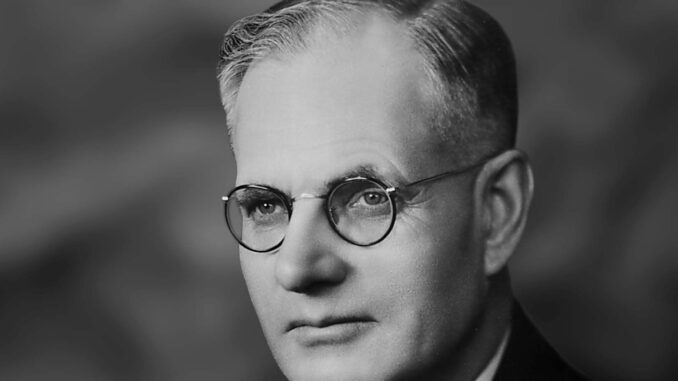
One such leader was our wartime Prime Minister, John Curtin who came to power after the collapse of the then United Australia Party.
A deeply ethical man and always honest with the people, he led Australia through the war with courage and integrity. A trusted leader who battled his own demon of heavy drinking and died exhausted before the end of the war.
Add to that Churchill, Roosevelt and Nelson Mandela all who were able to show outstanding leadership when called upon.
If we look at some contemporary leaders, we can see a mix of natural traits and developed skills. For example, leaders like Jacinda Ardern, the former Prime Minister of New Zealand, is often noted for her empathy, communication skills, and emotional intelligence – qualities that are both innate and honed over time. Her finest hour was the extraordinary leadership following the Christchurch massacre.
Hope and history rhyme.
(Seamus Heaney – From The Cure at Troy).
That said, today such a figure is yet to emerge. Because of the interconnected nature of today’s world it means that leadership often comes from multiple sources – international organizations, coalitions, and grassroots movements.
While a single world leader might seem like a solution, it’s often more about collective leadership and cooperation across nations and communities. Still, the idea of a unifying global leader is definitely a powerful and compelling vision.
Political leadership does have some distinct characteristics compared to other forms of leadership like business or community leadership.. They often have to balance competing interests, manage public opinion, and maintain accountability to constituents and stakeholders.
Today’s leaders face what has been called a values transition period and it seems that politics hasn’t caught up. Tensions exist about national identity, economic inequality, climate and cultural pluralism. Leadership usually emerges when someone is unafraid to articulate what they stand for, offer solutions and own the consequences. As Ralph Waldo Emerson put it: Do not follow where the path may lead. Go instead where there is no path and leave a trail.
Until that tension resolves, Australia is likely to keep producing leaders who feel underwhelming. Nor is this a uniquely Australian problem, but a global leadership malaise. But because of our strong institutions like courts and the electoral system, it is easier for leaders to coast along. Politics becomes transactional rather than representative and independents flourish.
Australia remains a stable parliamentary democracy with functioning institutions. What’s striking is not breakdown of the system, but widespread frustration that political leadership isn’t meeting public expectations.
Poets offer fascinating perspectives by exploring leadership through lenses of social justice, activism, and personal integrity.
In essence, poetry often brings a more personal and socially aware dimension to the concept of leadership, inviting readers to reflect on both the power and the responsibility of leaders in today’s world.
Drive my dead thoughts over the universe
Like wither’d leaves to quicken a new birth!
Though not contemporary, Shelley saw leadership as the ability to spread ideas that spark renewal. But in another poem he warns about arrogance, empire and how power collapses into dust.
Look on my Works, ye Mighty, and despair
(Percy Bysshe Shelley – Ozymandias).
Ultimately, if we want better leaders we should engage more in the political process or suffer the consequences and leave ourselves open to authoritarian leaders, as Bertolt Brecht warned in his savage satire, The Solution, blaming apathetic citizens for their own oppression:
Would it not be easier
For the government
To dissolve the people
And elect another?
Keep Independent Journalism Alive – Support The AIMN
Dear Reader,
Since 2013, The Australian Independent Media Network has been a fearless voice for truth, giving public interest journalists a platform to hold power to account. From expert analysis on national and global events to uncovering issues that matter to you, we’re here because of your support.
Running an independent site isn’t cheap, and rising costs mean we need you now more than ever. Your donation – big or small – keeps our servers humming, our writers digging, and our stories free for all.
Join our community of truth-seekers. Donate via PayPal or credit card via the button below, or bank transfer [BSB: 062500; A/c no: 10495969] and help us keep shining a light.
With gratitude, The AIMN Team

Maria; please allow me 2 comments:
First, “..Ultimately, with the right combination of education, experience, and support, people can definitely grow into effective leaders…” Professional leadership training may be designed to produce a leader who proclaims the vested interests of their trainer.
and secondly; Jacinda Ardern transformed from an empathetic (post Christchurch massacre) leader to a vicious (pro-Covidian) autocrat who imposed inhuman mandates and restrictions on our Kiwi neighbours without any sense of empathy or justice.
Maria, interesting post and IMHO is not an either-or issue, it’s a combination of both thru making mistakes and having the courage to know your limits and learning the difference with perspective.
Mediocrates:
Oh no, Ardern tried to keep people alive by limiting social interactions to slow spread of a deadly pathogen. How very dare she?!
Mediocrates, It is interesting to look at the Covid crisis with a few years hindsight, to consider the link between the actions taken by various governments and the fatality rates under each.
NZ achieved lower fatality rates than many other nations, so just maybe Adhern did the right thing…. just maybe.
Thank you Maria for your thoughtful article.
I suugest that the role of Prime Minister is probably the toughest job anyone could take on. No matter what decisions are made, the PM will cop flack.
It’s damned if you do and dsmned if you don’t.
It often says more about the critic than the PM when when complaints are laid, especially when the critic offers no alternate solution to the matter being criticised.
I’m trying to keep up with conservative political developments in Australia at the present time but I’m finding it very confusing.
The suggested challenge to Sussan Ley will now not come from Andrew Hastie next week as it seems he hasn’t got the numbers (he says ) and Angus Taylor won’t be challenging as he believes it would be a bad look to be contesting Liberal leadership during a week when interest rates are likely to rise and Angus believes that such a rise could be blamed on the coalition if they are engaged in an internal power struggles when, according to him the blame should be sheeted home to Labor even though the Reserve Bank operate independently of government.
So that just leaves the National Party who will have a leadership spill fronted by Colin Boyce who nobody has ever heard of and who doesn’t seem to be particularly interested in seizing the banner of leadership from David Littleproud.
So it would seem that Littleproud will be safe but, he has said that he cannot and will not work with Suss Ley [he actually stamped his little foot for emphasis] but he is anxious to rebuild the coalition [perhaps with Pauline Hanson].’
So I have no idea what is actually going on, even our Pauline seems a bit tepid about becoming an opposition leader as she is not known for turning up in parliament beyond three days a week and seems quite happy with being a casual senator in every sense of the term.
In the meantime I saw Barnaby Joyce on TV doing the rounds of the pubs and clubs of Tamworth and everybody buying him a beer and slapping him on the back and telling him what a good job he was doing, even though he doesn’t seem to be doing very much at all.
Can anybody illuminate me on the situation or is it just too boring?
Real leaders do stand tall, and thus, the few centimetres of vertical erection of Hastie and Taylor is wonderfully priapic, moreso than Ms. Ley. Giants of mediocrity and nonachievement, this pair is mentioned as replacements or bandaids.., but their record is a vacuum, a mirage, nil. We need B Joyce up there, because dogshit incomprehensible comedy is so Australian, Kath and Kim, Dad and Dave, Fat dumbo Kyle, etc. (Bowels go)