
To mark the fiftieth anniversary of the dismissal of Prime Minister Whitlam, I am pleased to remind readers to maintain an appropriate level of outrage against the dismissal of a twice elected constitutional government in 1975.
As Treasurer Jim Chalmers told everyone via Radio National at a doorstop interview near the Old Parliament House as he was completing a jogging run on the morning of 11 November 2025, responsible outrage is never an invitation to rehash old issues to right wrongs which cannot be changed. Australian representative government has survived the traumas of Dismissal Day. Australia is now one of the few developed countries with a majority centre-left government. Labor leaders can easily read the tea leaves on the global geopolitical scene in 2025 with the support of ever-expanding reservoirs of digital information and research foundations on all policy fronts. Consolidating a more united front with progressive crossbench members of the senate is still an ongoing challenge to avoid opportunistic Green Party amendments to legislation with the support of the LNP. Alternative negotiating processes should be in place.
As implied by Treasurer Jim Chalmers on his doorstop interview near the Old Parliament House, responsible rage needs to be relevant to these dangerous and more pragmatic times. Even the rage of 1975 failed to overturn the dismissal agendas. There was a 7.4 percent swing against Labor after preferences in the House of Representatives a month later in December 1975. The LNP gained an outright majority in the Senate which was re-elected under a double dissolution formula. Gough Whitlam as Leader of the Opposition achieved a net gain of two seats at the 1977 election but no improvement in the Senate result.
A half century later in 2025, the key challenge for both the US and most middle power representative democracies is the drift towards a Command Economy and Society as loosely defined by the academic and business consultancy team at Yale Insights.
Many representative governments, particularly in Western Europe, are operating in a more paramilitary style with support from minor far-right political parties. These issues are worthy of more mainstream media attention as they challenge the very foundations of democratic processes.
Some green shoots for change are also evident. There are positive examples in the election of Zohran Mamdani as Mayor of New York, Catherine Connolly’s presidential victory in Ireland and the prospects for centrist coalition maker in Prime Minister Rob Jetten in the Netherlands. These advances will encourage Labor leaders in Australia and Britain to transform their massive majorities into more needs-based commitments.
Despite these green shoots for change, troubled times have more generally fostered regressive policies with close links to corporations delivering domestic and strategic agendas chosen by most representative governments in developed countries.
Some of the claims from Yale Insights about the future direction of Trump’s Command Economy are highly sensational and should invite negative comments from lecturers to assignments submitted by journalism students. The Command Structures of the Trump administration can be more objectively linked to major US multinational companies with close associations to the burgeoning military industrial complexes across the US Global Alliances if details were more open to critical scrutiny.
The high technology components of US multinational corporations are experiencing a phenomenal growth in the US and wider global economy. My own limited research resources force me to rely on Gemini Google Bard with US Spelling Conventions. I regret the reliance on these resources but there are no less time-consuming options.
Nvidia: As the undisputed leader in high-end semiconductor manufacturing crucial for AI, Nvidia is considered a prime pioneer. The company’s announcement of multibillion-dollar investments in U.S.-based manufacturing operations aligns perfectly with the administration’s “America First” policy and its push for a manufacturing renaissance. CEO Jensen Huang has publicly lauded the administration for its supportive stance, particularly concerning energy access for data centers, which is critical for AI infrastructure growth.
OpenAI, Microsoft, Google (Alphabet Inc.), Meta, and Oracle: These major technology giants are seen as pioneers in driving the core AI agenda. Their large-scale investments – totaling billions of dollars – in AI infrastructure, including data centers and AI development, are directly credited by the White House as fueling unprecedented growth and securing U.S. global leadership in the field. This collaboration is formalized through key administration policies like the “AI Action Plan: Winning the AI race,” which prioritizes rapid AI buildout and minimal regulation. CEOs from these firms, like Sam Altman (OpenAI) and Safra Catz (Oracle), have publicly expressed gratitude for the administration’s pro-innovation and pro-business policies.
Palantir Technologies and Anduril Industries: These companies represent the intersection of high technology and national security/defense, a critical component of the MAGA agenda. Palantir, co-founded by close Trump ally Peter Thiel, provides analytical tools to the U.S. Department of Defense and other government agencies, while Anduril focuses on advanced, upstart weapons and defense technologies like drones. Their work is often highlighted as advancing American technological superiority in military and surveillance applications.
Tesla/SpaceX (Elon Musk): While not purely a software company, the companies led by Elon Musk are vital to the administration’s high-tech goals. SpaceX holds significant government contracts with NASA and the Department of Defense. Furthermore, Musk’s stated mission to advance technology and his strong personal alignment with administration figures, including his selection for a key advisory role, positions his enterprises as pioneers in areas like space exploration and government efficiency through technology.
Apple and Amazon: While sometimes maintaining a more traditional corporate posture, these behemoths earn pioneer status through massive domestic investment commitments, which directly support the administration’s goal of returning manufacturing and supply chain elements to the United States. Apple, for example, announced a significant investment in U.S. manufacturing and workforce training, adhering to the “America First” call for domestic production. Amazon’s major cloud computing infrastructure investments also contribute to the “massive infrastructure building” touted by the White House.
The Trump administration’s perception of these corporations as “pioneers” is a direct reflection of a policy framework that leverages deregulation, a focus on American-centric industrial growth, and a push for global dominance in emerging technologies, especially AI. The actions taken by companies like Nvidia, OpenAI, and Palantir, particularly their billions in U.S. investments and alignment with deregulatory and “pro-speech” policy shifts, are framed by the administration as essential for extending the core MAGA principles into the high-technology sector. This strategic partnership represents a significant convergence of political power and corporate might, aimed at accelerating a specific vision of American technological and economic leadership.
Gemini Google Bard notes the Trump administration’s selective sponsorship of key corporations and military industrial companies:
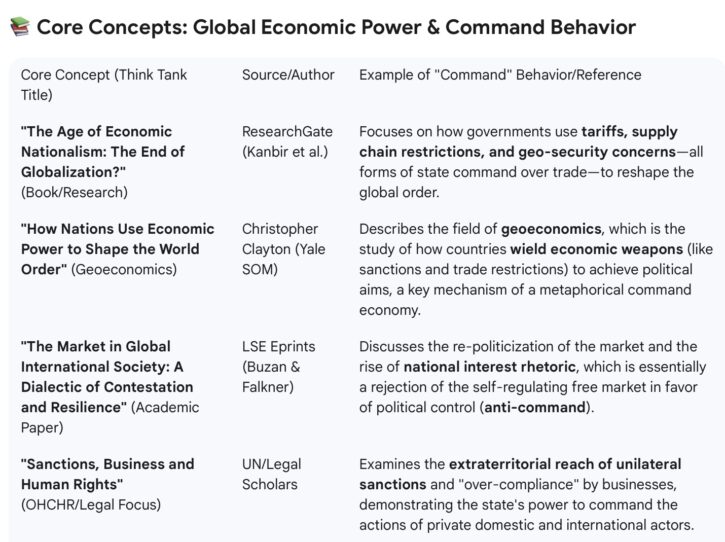
Overcommitment to the Command Structures of the Trump administration, is always threatening Australia’s free trade and investment protocols with nineteen countries and several regional trading associations. The Trump tariffs have a real impact on these trading and investment links. Australian exporters are burdened with higher tariffs on exports to the USA including steel and aluminium (50 percent), automobiles and parts (25 percent) as well as pharmaceutical and semiconductions (Under negotiation).
So-called Freedom of Navigation flights and naval shipping sorties by Australia are costly and risky operations which assess China’s capacity to pick up potential intrusions near key strategic sites. Changing things for the better will take time and hopefully there will be no mishaps like the shooting down of Korean Air Flight 007 when it strayed into Soviet Asir Space on 1 September 1983. The death toll from this incident reached 269 innocent passengers when the civilian flights was hit by a Soviet missile.
Today’s military personnel could of course to visit contested strategic locations on tourist flights or ferry services. Australia’s Jetstar were restored flights from Singapore to Haikou in Hainan, China for two years until 31 July 2025. It is a similar matter in the Taiwan Strait where Taiwan’s Eva Air operates direct services to Guangzhou in China as well as daily ferry services from Xinmin in China to Kinman Island in Taiwan with picnic and other lunch options for visitors from China after a 30-minute ferry trip.
Continuing these strategic tensions in partnership with US sorties into contested waters also compromises our free trade agreement with China with negative effects on our own living standards with a tapering off in Chinese investment. Hampering with investment multipliers made available through the LNP’s free trade agreement with China under the Abbott Government in 2014-15 contributes (Current investment data from KPMG):
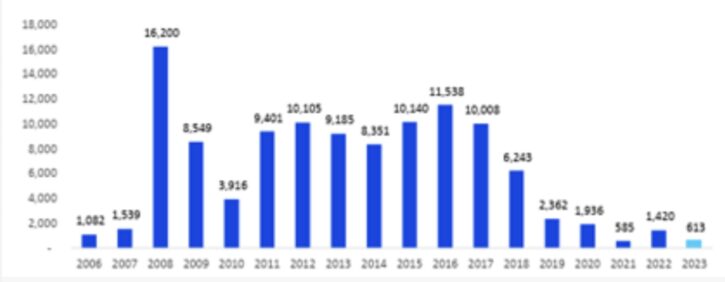
Chinese investment in Australia in 2023
In 2023, Chinese investment in Australia decreased by 57 percent, from US$1,420 million in 2022 to US$613 million. In Australian dollar terms, the decrease is 66 percent from AU$2,103 million in 2022 to AU$917 million. Eleven completed transactions were recorded in 2023.
2023 is the second lowest year in investment value and the joint-lowest year in number of investment transactions (the same as w021) since 2006.
Chinese ODI into Australia by value 2006 – 2023 (US$ million)
Many readers seek to be involved in making their own assessments of administrative, economic and strategic challenges. A lot of the fears and uncertainties about the future could be resolved if as much public policy as possible were to be opened for AI Investigation by readers. This could be done with both corporate and government-sponsored AI hardware.
In Queensland, the Crisafulli Government still relies on battalions of media officers to fine tune its political marketing messages (The Australian 8 November 2025). The Queensland Government employs 1260 communication, media and marketing personnel compared with just 919 disability support workers and 1177 youth and case workers according to communications released from the Queensland Public Service Commission.
My hope is that as much information as possible should be released from AI databases so that constituents can make their own assessment of public priorities at all levels of government. Online assistance might need to be provided where difficulties are encountered. The integration of Artificial Intelligence (AI) into public sector administration and policymaking is rapidly transforming government operations globally. In the United States, policy makers and administrative agencies increasingly rely on commercial AI tools, primarily from major US technology providers, to improve efficiency, analyze vast datasets, and streamline bureaucratic processes. These tools are not typically “government-branded” AI, but rather commercial products adapted for high-security environments, with US government agencies acting as key clients for providers like Microsoft, Google, Amazon Web Services (AWS), and IBM.
AI administrative support is being developed at all levels of government in Australia and could fast track routine development approvals to ease the current supply crisis in housing which adds to construction costs.
Positive developments in the application of AI have been noted by Gemini Google Bard in Australia:
The use of advanced digital and automated systems in Australian government administration is not entirely new, with certain forms of Automated Decision-Making (ADM), even if not fully AI-driven, having been present for decades (e.g., in business registration or social services processing). However, the recent focus on modern AI, particularly Generative AI (GenAI), marks a distinct and accelerated phase, moving from isolated, “narrow” applications to enterprise-wide capability uplift.
Key Historical Milestones
Pre-2024: Narrow AI Applications: Prior to the recent GenAI explosion, government use of AI was typically limited to specific, ‘narrow’ applications. This included:
- Predictive Analytics: Used by agencies like the Australian Taxation Office (ATO) to identify data patterns, assess non-compliance risks, and inform resource allocation.
- Natural Language Processing (NLP): Used in customer service interfaces and for internal data analysis.
Early Policy and Frameworks (2019-2024): The need for a national approach was recognized, leading to foundational policy work. The Australia’s Artificial Intelligence Action Plan(2021) set a vision for developing and adopting trusted AI. Crucially, the Australia’s AI Ethics Principles (developed by CSIRO Data61 and endorsed by the government) established a core set of values—including fairness, privacy, accountability, and contestability – to guide safe and responsible AI use.
The GenAI Catalyst (2024 onwards): The widespread availability of powerful GenAI tools accelerated the need for whole-of-government guidance and solutions. This led to the creation of formal policies and enterprise platforms.
- September 2024: The Policy for the Responsible Use of AI in Government took effect, mandating entities to designate ‘accountable officials’ and publish AI Transparency Statements.
- June 2024: The Data and Digital Ministers Meeting agreed to and released the National framework for the assurance of artificial intelligence in government, establishing assurance cornerstones for all government levels.
Administrative tools are available to enable the Australian media and readers themselves to fact check rival policy claims if the current advances in AI techniques could be shared with the wider public by participating governments at all three levels. Maintaining a responsible level of resistance to propaganda models of power would be a wonderful tribute to Gough Whitlam whose agenda for change was abruptly shut down on 11 November 1975 by the actions of the Governor-General with the support of the Palace and a host of unknown intel agencies overseas.
Meanwhile the emotional propaganda model continues as President Trump pranced before the navy ranks in Japan on a diplomatic sortie to APEC at a well-choreographed event on the nuclear-powered USS George Washington with an installed catwalk to assist the commander- in-chief with his performance to an adoring crowd of naval personnel:
 Denis Bright (pictured) is a financial member of the Media Entertainment and Arts Alliance (MEAA). Denis is committed to consensus-building on the critical issues raised in each article. Your comments on this and related articles can be recorded on theaimn.net site.
Keep Independent Journalism Alive – Support The AIMN
Dear Reader,
Since 2013, The Australian Independent Media Network has been a fearless voice for truth, giving public interest journalists a platform to hold power to account. From expert analysis on national and global events to uncovering issues that matter to you, we’re here because of your support.
Running an independent site isn’t cheap, and rising costs mean we need you now more than ever. Your donation – big or small – keeps our servers humming, our writers digging, and our stories free for all.
Join our community of truth-seekers. Donate via PayPal or credit card via the button below, or bank transfer [BSB: 062500; A/c no: 10495969] and help us keep shining a light.
With gratitude, The AIMN Team


I was at my work place when the news of the dismissal came through – we were all shocked .
Interesting read and well researched, thank you!
Good to move on as Treasurer Chalmers comments. Denis’ article follows that approach and is about future responses to our situation as the virtual 51st State of the Union under President Trump
Thanks for a great article Denis.
Hi Denis, thanks for, as Pat said ‘an interesting and well-researched’ read.
I’m sorry for being picky but I must disagree strongly with “Australian representative government has survived the traumas of Dismissal Day. Australia is now one of the few developed countries with a majority centre-left government.”
Firstly, I can’t see how a government that gives our gas away to foreign-owned gas companies, fails to tax said companies, further privatizes aged-care, has housing policies to address home affordability that enrich the banks, landlords and property developers whilst making housing affordability worse, changes environment rules to suit corporations and not protect the environment, replaces a defence strategy with an offence strategy via donation to an aggressive rogue nation, allows 4 million Australians to live in poverty whilst subsidizing fossil fuel companies, chooses to assist transitioning to renewables by picking corporate favourites (how’s it going Gina), kowtows to the gambling lobby, to mention just a few, as a centre-left party (I try to avoid such description as how does someone be centre-left on genocide? but I think I take your meaning.)
Secondly, have Australian governments subsequent to the dismissal survived the traumas? Or have they been swayed having seen interference by foreign governments resulting in a duly elected Australian government being dismissed, and turned to subservience to the US and UK governments, particularly the US?
ASIO was arguably for all intents and purposes embedded in the ‘five eyes’ spy network prior to the Dismissal and the formal naming of the network, it continues to be so and often makes me wonder if it is not just acting as its mouthpiece. ASPI is nothing more than a front for Washington spy agencies and think tanks, with a decided anti-China bent. It seems to have had an undue influence on Australian government decision-making. Whatever influence these organizations have on policy I don’t know, but I see Australia’s complete subservience to the US and think how could it just be a belief that it’s in our best interest?
“an ongoing challenge to avoid opportunistic Green Party amendments to legislation with the support of the LNP.” – those opportunistic amendments would be like trying to turn Labor’s corporate-free-for-all EPA legislation into one that might work, or is it the blocking of Labor’s attempt to hide everything from the people with its proposed changes to the FOI act?
Sorry, but I’m not convinced by your dismissal of Yale Insight’s claims. If I were to summarize in one paragraph their claims, hopefully correctly, it would be: “Unlike any leader of any free-market economy around the world, President Trump has seized control of private enterprise’s strategic decision-making and investment policies while invading corporate board rooms so that he may dictate leadership staffing, punish corporate critics, and demand public compliance with his political agenda. This is far more dangerous to capitalism than a city-run grocery store.”
They then go on to support each claim with numerous examples of actions Trump has done to achieve these things – that support seemed objective and fairly convincing to me (as opposed to its understanding of Marxism and communism, not sure about Maoism I’ll have to check that one.)
Having said all that thanks again for the informative discussion on AI and Australia’s committment to Trump’s command structure.
I’m concerned about Australia’s embedding itself in Israel’s military-intelligence-complex and its reliance on the technologies you listed above.
How many Aussies realise that the Governor-General – who represents the English Monarchy’s interests in Australia – is also commander-in-chief of Australia’s armed forces? And that the “authority” the G-G had to end an elected Australian government’s tenure in 1975 remains firmly in place today.
Sorry, I can’t get over you calling the current ALP “centre-left”. They aren’t even centre any more; socially they’re more left but economically they lean right.
Your right Leefe. Politics in the representative governments of developed countries has moved to the right everywhere. Treasurer Jim Chalmers must stand up to the demands of our military top brass for more funding and a lessening of strategic controls on Chinese investment which could be protecting Australia from future investment blues as being experienced in countries like Germany and the Netherlands. Here local economies are in dire straits.
While the Australian military plans more adventures in the South China Sea, our hospitals and youth services are starved of adequate levels of cash.
Labor’s future demands a more united front with the Greens and other progressive crossbench members of the senate.
Keep up with your criticisms Leefe but an LNP Opposition under possible far-right leadership in the future would offer no positive alternatives.
PS:
LNP would be immeasurably worse. We need more independants and more truly progressive parties.
I like American companies. Especially Apple. I trust these American Brands.
The University of Sydney has also updated the Chinese investment trends in Australia (https://www.sydney.edu.au/news-opinion/news/2025/04/01/chinese-investment-in-australia-shifts-from-acquisitions-to-gree.html).
“Chinese investment in Australia increased 43 percent to AU$1,312 million in 2024 – up from AU$917 million in 2023. Eleven completed transactions were recorded. However, despite the increase, 2024 had the third-lowest investment value and number of transactions since 2006, only higher than 2021 and 2023.
The continued low level of investment in Australia contrasted with the growth of China’s overall global Outward Direct Investment (ODI). China’s Ministry of Commerce reported a total ODI volume of US$144 billion in 2024, an increase of 10.5 percent on the previous year.
Investment in the ASEAN region has grown relatively rapidly, increasing by 12.6 percent compared to the previous year. Chinese enterprises made non-financial direct investments totalling US$33.69 billion in countries participating in the ‘Belt and Road’ initiative, a 5.4 percent increase over the previous year. Sub-Saharan Africa countries experienced the highest growth in Chinese investment.”
Report co-author Professor Hans Hendrischke, University of Sydney Business School said: “While the previous two decades saw Australia emerge as a top destination for Chinese ODI, particular across the 2010s, over the past five years we have seen a notable drop in investment. This is line with global trends, with Chinese investment moving towards Southeast Asia and Belt and Road countries.
“Detailed US data on project-based Chinese ODI indicate that Chinese investment is shifting towards clean energy, manufacturing, IT and software services, mining, and retail-favouring technology-intensive industries in Europe and emerging markets in Southeast Asia.
Thanks for the discussion. That’s the purpose of writing the article and agree with all the points made.
Gonggongche – totally agree on all points. You said it better than I could.