Narratives Under Siege: Part III
Words as Weapons – Redefining Antisemitism
Cold Open
In 2016, the International Holocaust Remembrance Alliance (IHRA) introduced a working definition of antisemitism. Within a few years, governments, universities, and public institutions across Europe, North America, and Australia began adopting it.
The definition itself was short and clear: “Antisemitism is a certain perception of Jews, which may be expressed as hatred toward Jews.” But what stirred debate were the examples attached – several of which explicitly referenced Israel. Critics warned that this blurred the line between hatred of Jews and criticism of a state’s policies. Supporters argued it was necessary to catch “coded” antisemitism that hid behind anti-Zionist rhetoric.
Suddenly, the battlefield wasn’t just on the ground in Gaza or the West Bank. It was in the dictionary.
Why Definitions Matter
Language is not neutral. The way we define antisemitism shapes what counts as hate speech, what gets punished, and what kind of criticism is socially or legally acceptable.
Traditional understanding: Antisemitism = hatred, prejudice, or discrimination against Jews as a people, or Judaism as a faith.
IHRA’s innovation: Adds examples, such as “claiming that the existence of the State of Israel is a racist endeavour” or “applying double standards to Israel not demanded of other democratic nations.”
The risk is obvious: when criticism of Israeli policies is framed as antisemitism, critics may be silenced, chilled, or punished – even when they target state actions, not Jewish people.
Alternative Definitions: Pushback from Scholars
Alarmed by how IHRA was being applied, Jewish and non-Jewish scholars proposed alternatives:
Jerusalem Declaration on Antisemitism (JDA, 2021): States clearly that “supporting the Palestinian demand for justice and the full grant of their political, national, civil and human rights, as encapsulated in international law, is not antisemitic.” It also clarifies that opposition to Zionism, or support for BDS (Boycott, Divestment, Sanctions), is not inherently antisemitic.
Nexus Document (US, 2020): Argues that while some anti-Israel expressions can be antisemitic, criticism of Israel’s policies – even sharp or harsh criticism – is not antisemitism by default.
These definitions sought to preserve a space where Jewish people are protected from hate while debate over Zionism remains legitimate.
Weaponisation in Practice
Universities: In the UK and US, IHRA adoption led to controversies where student groups, lecturers, or events critical of Israel were investigated or cancelled. Even Kenneth Stern – one of the original drafters of the precursor to IHRA – warned against turning it into a “speech code” that stifles debate.
Politics: In Germany, the Bundestag passed a resolution equating BDS with antisemitism, chilling cultural and academic initiatives. In the US, some state legislatures referenced IHRA in anti-BDS laws, linking definitions directly to enforceable policy.
Media: Journalists critical of Israeli military operations have sometimes faced accusations of antisemitism rooted in IHRA examples, muddying the distinction between anti-Jewish hate and political critique.
Why It Resonated
The IHRA definition spread quickly because it appealed to real concerns: antisemitism has been rising globally, from synagogue shootings in the US to far-right attacks in Europe. For many Jewish communities, adopting IHRA felt like an overdue shield.
But for Palestinians and their allies, it often felt like a sword: used to cut down legitimate advocacy, boycotts, or historical critiques of Zionism.
The Human Rights Compass
Human rights law already offers a compass:
Protect all people – Jews, Palestinians, Muslims, Christians, anyone – from hate, discrimination, and persecution.
Protect freedom of expression, especially political speech, unless it crosses into incitement or violence.
This means antisemitism must be fought relentlessly – while also protecting the right to call Israel’s occupation what leading rights groups.
Conclusion
The battle over definitions is not semantic nitpicking. It is about the boundaries of political freedom and human rights. When antisemitism is expanded to include criticism of Israel or Zionism itself, Palestinians lose their voice, academics lose their freedom, and human rights lose their universality.
The way forward is not to weaken the fight against antisemitism, but to keep it precise. Protect Jewish communities from hatred – and protect the space to debate, critique, and oppose state power.
In Part IV, we will see how this battle over words connects directly to the digital battleground – where social media platforms, algorithms, and access restrictions shape what the world sees about Israel/Palestine.
Further Reading
IHRA – Working Definition of Antisemitism
Jerusalem Declaration on Antisemitism
Nexus Document
The Guardian – IHRA Definition Risks Stifling Free Speech
Amnesty International – Israel’s Apartheid Against Palestinians
Narratives Under Siege: Part IV
The Digital Battleground – Platforms, Access, and Censorship
Cold Open
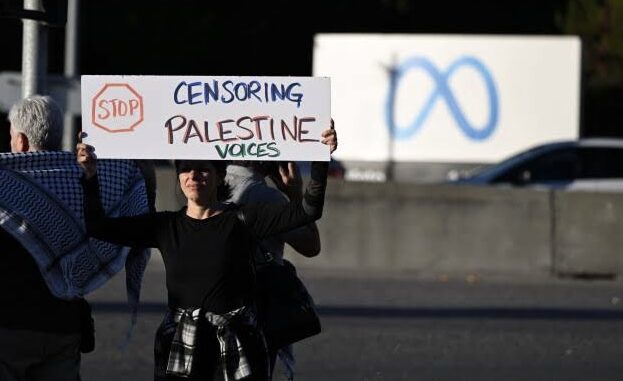
In May 2021, during the 11-day Gaza conflict, Instagram and Facebook began removing or down-ranking posts tagged with #SaveSheikhJarrah, a neighborhood in East Jerusalem where families faced eviction. Palestinian activists accused the platforms of censorship. Meta later admitted to “technical errors,” but Human Rights Watch found a consistent pattern: Palestinian content was disproportionately removed, while violent or inciting anti-Palestinian content often remained. For the first time, the frontline of narrative control wasn’t just parliaments or newspapers – it was the algorithm.
The New Gatekeepers
Where once Western editors shaped the story, now platforms like Meta, Twitter/X, and TikTok are the default arena. Billions get their news through social media feeds. That gives corporate rules and automated moderation systems enormous influence over what narratives survive.
Meta’s Oversight Board has repeatedly found bias in how Palestinian content is handled. A key ruling in 2023 overturned blanket takedowns of the slogan “From the river to the sea,” finding that context matters and the phrase cannot be automatically treated as hate speech.
Reports by digital rights groups show that hashtags linked to Palestinian advocacy are throttled, flagged, or suppressed far more often than comparable pro-Israel content.
The “content moderation” debate is not abstract. It determines whether the world sees images of bombed apartment blocks or whether those images vanish into algorithmic shadows.
Access Denied: Who Can Report?
At the same time, physical access became a form of censorship.
Since October 2023, foreign reporters have been largely barred from independently entering Gaza, except under tightly controlled Israeli military escorts.
Local Palestinian journalists bear the burden – and the risks. According to Reporters Without Borders (RSF), the Gaza war has been the deadliest for journalists in modern history.
With foreign press blocked and local press under fire, the global public relies heavily on short videos and livestreams from citizen journalists – material that platforms may throttle or remove.
When access to the ground is restricted and digital content is filtered, entire realities can disappear from the global record.
Algorithms as Political Actors
Unlike editors who can be held accountable, algorithms are opaque.
Posts with images of injured Palestinians are often flagged by automated systems as “graphic violence.” Yet images from other war zones do not face the same scale of takedowns, raising questions about consistency.
Activists have documented “shadow banning” – posts not deleted outright, but quietly buried so fewer people see them.
At the same time, pro-Israel digital campaigns like Act.IL (a government-linked app that organised supporters to mass-report content) have gamified influence, encouraging users to flag Palestinian posts until moderation systems remove them.
The result is a feedback loop: one side has more resources to mobilise reports, while the other is disproportionately silenced.
The OSINT Counterweight
Yet the same digital landscape also provides a counterweight: open-source intelligence (OSINT). Independent investigators use geolocation, satellite imagery, and metadata to verify citizen videos. Groups like Bellingcat and Forensic Architecture have used these tools to fact-check claims about strikes, deaths, and atrocities.
OSINT has eroded governments’ monopoly on “truth.” But it’s a race: platforms may remove the evidence before it can be preserved.
Human Rights Lens
The human rights implications are stark:
Freedom of expression: Palestinians face systemic barriers to speech online and offline.
Right to information: The global public is denied access to accurate reporting when journalists are killed or barred.
Accountability: Without verified evidence, war crimes become harder to prove.
The Universal Declaration of Human Rights guarantees both freedom of expression and access to information. When platforms or governments restrict those rights, the human rights framework itself is undermined.
Conclusion
The digital battleground has become as decisive as the diplomatic one. Algorithms, moderation rules, and access restrictions now determine what the world sees – and what it doesn’t.
Israel’s influence machine has adapted to this new terrain, but so have Palestinian activists, journalists, and OSINT investigators. The struggle is no longer just for territory or politics. It is for visibility itself.
In Part V, we will turn to the Shadow War – the covert influence operations, spyware scandals, and disinformation networks that push narrative control into the realm of intelligence and cyber warfare.
Further Reading
Human Rights Watch – Facebook Censors Discussion of Israel
Meta Oversight Board – “From the River to the Sea” Case
7amleh – Attacks on Palestinian Digital Rights 2022
CPJ – Israel Denies Foreign Media Access to Gaza
RSF – Gaza Deadliest Conflict for Journalists in Modern History
Haaretz – Israel’s Act.IL App
Bellingcat – How We Verified Gaza Building Collapse
Continued tomorrow…
Link to Part 1
Narratives Under Siege: Israel, Media Power, and the Struggle for Human Rights (Part 1)
Link to Part 3:
Narratives Under Siege: Israel, Media Power, and the Struggle for Human Rights (Part 3)
Dear reader, we need your support
Independent sites such as The AIMN provide a platform for public interest journalists. From its humble beginning in January 2013, The AIMN has grown into one of the most trusted and popular independent media organisations.
One of the reasons we have succeeded has been due to the support we receive from our readers through their financial contributions.
With increasing costs to maintain The AIMN, we need this continued support.
Your donation – large or small – to help with the running costs of this site will be greatly appreciated.
You can donate through PayPal or credit card via the button below, or donate via bank transfer: BSB: 062500; A/c no: 10495969


“In Australia, it is unlawful to discriminate on the basis of a number of protected attributes including age, disability, race, sex, intersex status, gender identity and sexual orientation in certain areas of public life, including education and employment. ..”
Quoted from the preamble to https://www.ag.gov.au/rights-and-protections/human-rights-and-anti-discrimination/australias-anti-discrimination-law
In addition to Australian Federal Law, Australian states have legislated similar laws relating to racial vilification. Thus it is obvious that Australia does not need further hectoring or legislation to protect Americans from anti-American epithets, Chinese from anti-Chinese epithets, Ugandans from anti-Ugandan epithets or any other nation or persons of political and/or religious belief, including Israelis who believe in any of the Abrahamic religions. ‘Nuff said.
I think we tie ourselves in knots when we try to redefine terms like semite and semitic.
The dictionary definition is usually along these lines : Semitic people are a broad grouping of ethnolinguistic communities primarily from the Middle East and the Horn of Africa who speak or once spoke Semitic languages, such as Akkadians, Arabs, Aramaeans, Canaanites, and Hebrews.
So, Palestinians may be more ethnically aligned with semites or semitic peoples than are Israelis.
I think Mediocrates makes the point quite adequately: we don’t need any further definitions beyond those already in our legislation.
I see they uncorked and decanted Caterpillar Eyebrows from his bottle of formaldahyde to spout his bullshit.
https://www.news.com.au/national/politics/former-prime-minister-john-howard-and-foreign-minister-alexander-downer-says-labors-decision-to-recognise-palestine-reckless-and-dangerous/news-story/cc224976649913495947cf6d5ca246ec