By Denis Hay
Description
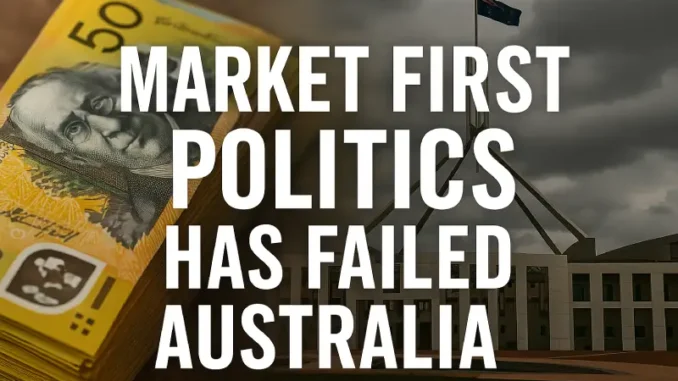
Market-first politics has harmed Australia for decades. Learn how a politics of care and dollar sovereignty can build a fairer future for all Australians.
A Personal View on Four Decades of Decline
For more than forty years, Australia has lived under what can best be described as market-first politics. I have watched this change unfold across my lifetime. In the years when public services were strong, governments invested in people, and community wellbeing was treated as a core responsibility.
Over time, a new political mindset took hold. It insisted that markets knew best, that governments should step aside, and that public services must run like commercial products.
Market-first politics slowly reshaped how Australians work, learn, live, and care for one another. It drove insecure jobs, weakened TAFE, strangled public housing, and turned essential services into profit centres.
Entire generations were pushed further away from stability, not because Australia lacked resources, but because governments chose to prioritise the market over the public good.
After four decades of decline, one truth is clear. This ideology has failed. It is time to choose something better.
What Market First Politics Really Means
Market-first politics is the practical application of neoliberalism. Neoliberalism is the theory that markets should dominate economic and social life. Market-first politics is how that theory is implemented through policy.
It assumes that the private sector delivers better outcomes than the public sector. It pushes governments to privatise, deregulate, cut spending, and rely on competition for essential services. Citizens are reframed as consumers. Public institutions are reframed as efficiency problems.
This operational form of neoliberalism has shaped every major Australian policy area. It influenced health, education, transport, energy, housing, welfare, and climate action. It created systems that prioritise profit over wellbeing and extraction over care.
Calling it market-first politics makes the ideology visible in everyday life. It shows that what we experience is not natural. It is deliberate.
Neoliberalism has dominated economics and politics for 45 years, despite being based on nothing more than myths, falsehoods, and fantasies that should have discredited the cult promoting it long ago.
How US Influence Helped Lock Australia into Market First Politics
Australia did not drift into this model on its own. We were guided, pressured, and encouraged by powerful allies, especially the United States.
Security alignment pushed economic alignment
As Australia strengthened its security ties with the United States, it also absorbed US economic thinking. Defence priorities shaped spending decisions. Billions flowed into US-aligned military projects rather than into public systems that support citizens.
US economic doctrines shaped Australian policy
US think tanks promoted deregulation, privatisation, and corporate freedom. These ideas were adopted as modern and inevitable. Australian governments embraced them without considering local consequences.
US narratives dominated the media
Australian media often mirrored US political discourse. Concepts like small government, trickle-down growth, and austerity took root through repetition rather than evidence.
US-led trade rules restricted Australia’s choices
Trade agreements reduced Australia’s capacity to regulate corporations, support local industries, or expand public ownership. These agreements protected market power rather than citizens.
The result was a narrow, constrained political imagination. Australia was taught to think small, even though we are a fully sovereign nation with the capacity to invest in ourselves.
Why Australia Must Demand a Politics of Care Now
A politics of care is not symbolic. It is practical, evidence-based, and achievable. Care-centred policy places human well-being at the heart of national decision-making.
Care-centred systems strengthen communities
Countries that invest in health, education, childcare, aged care, disability services, and mental health have lower inequality and stronger social outcomes. Care is infrastructure. It builds resilience and opportunity.
Dollar sovereignty in Australia enables public investment
Australia issues its own currency and cannot run out of dollars. This gives us the ability to fund the services that allow people to thrive. Our real limits are labour, skills, materials, and ecological sustainability, not money.
By understanding dollar sovereignty in Australia, it becomes clear that the idea we cannot afford strong public systems is simply untrue.
Global evidence supports care economies
The OECD and UN have shown that investment in care leads to long-term prosperity, greater workforce participation, and healthier societies. A politics of care is not idealistic. It is effective.
Now is the time to replace the failed model with one built on dignity and fairness.
The Social Damage of Market-First Politics
Work became precarious
Casual, gig, labour hire, and contract work replaced stable jobs. Workers were told this flexibility was empowering. In reality, it shifted risk from employers to workers.
TAFE was weakened
Cuts to TAFE, apprenticeships, and vocational training removed essential pathways for young people and regional communities. Education became a commodity instead of a public investment.
Housing shifted from shelter to speculation
Public housing construction collapsed. Investors were rewarded. Rents soared. Young Australians were locked out. Homelessness rose, while governments insisted the market would fix itself.
Generational unfairness intensified
Older Australians benefited from strong public systems and affordable homes. Younger generations face debt, insecure work, and declining access to services. This is not fate. It is policy.
The Environmental Toll of Market First Politics
Weak regulation rewarded pollution
Corporations faced minimal oversight. Land clearing increased. Environmental protections were weakened to attract investment.
Privatised utilities slowed climate action
Private energy companies focused on making money first, not on moving Australia to cleaner, cheaper renewable energy.
In practice:
They delayed upgrades: New transmission lines and renewable projects were pushed back because they cost money up front.
They protected their existing assets: Coal and gas plants still made profits, so companies kept them running longer instead of investing in cleaner options.
They avoided risks: Renewables require coordinated planning. Private companies did not want to take on projects unless they guaranteed high returns.
They passed costs to consumers: Instead of building for the long term, they focused on pricing strategies that maximised revenue.
They fought regulation: Strong climate policy would cut into profits, so companies lobbied against it.
In short: The market structure rewarded companies for doing as little as possible on climate, for as long as possible, while charging Australians more.
Water utilities drove up prices. Essential infrastructure investments were delayed because they did not maximise shareholder returns.
Extraction was prioritised over sustainability
Governments approved fossil fuel projects despite climate warnings. Environmental science was overshadowed by industry lobbying.
Our environment absorbed the cost of an ideology that placed short-term profit above long-term survival.
Why the System Persisted
Donations shaped decisions
Corporations and wealthy individuals funded major parties. Policies followed the money.
Lobbyists acted as shadow policymakers
Lobbyists drafted talking points, influenced legislation, and used personal networks to shape outcomes.
Revolving doors blurred public and private interests
Senior officials moved into corporate roles and vice versa. Regulators lost independence.
A concentrated media controlled the narrative
A small number of media owners shaped public understanding and defended market-first assumptions.
The system survived because it was useful to those who benefited from it.
A Practical Alternative Australia Can Start Today
A national public housing build
Using dollar sovereignty in Australia, governments can build high-quality public housing that stabilises rents and reduces homelessness.
A full TAFE rebuild
Restoring funding and pathways strengthens local economies and supports young people.
Public leadership in renewable energy
Large-scale public investment in renewables lowers costs and accelerates climate action.
Public and community-owned banking
Community banks and public banks keep profits in communities and ensure fair lending.
A strong care economy
Investment in health, aged care, disability services, childcare, and mental health strengthens every generation.
This is not an unrealistic dream. It is how a sovereign nation invests in itself.
What Life Would Look Like After Market First Politics
Australia would be fairer, more stable, and more confident.
- Housing would be affordable.
- Work would be secure.
- Public services would be strong.
- Communities would be supported.
- Climate action would accelerate.
A nation built on care would replace one built on extraction.
What Citizens Can Do Now
- Support Independents and community candidates.
- Engage with movements that champion care-centred policy.
- Challenge false claims about spending and affordability.
- Share the truth about Australia’s monetary sovereignty.
- Vote for policies that strengthen public systems.
Collective action created every major reform in our history. It can do so again.
Q1: What is market-first politics?
Market-first politics is the practical, everyday application of neoliberalism. It means governments step back, public services are treated like businesses, and markets are expected to solve problems. This approach prioritises profit over people and has shaped Australian policy for more than forty years.
Q2: How does dollar sovereignty help Australia?
Dollar sovereignty means Australia issues its own currency. Because of this, the government can fund public services, housing, health, and education without needing to “find the money” first. The real limits are workers, skills, materials, and environmental capacity, not dollars.
Q3: What is the politics of care?
The politics of care centres on human wellbeing, fairness, and community. Instead of putting markets first, it focuses on strong public systems, shared responsibility, and long-term social and environmental health. It is a practical and achievable alternative to market-first politics.
Call to Action
We’d Love to Hear from You
If you found this article insightful, explore more about political reform and Australia’s monetary sovereignty on the Social Justice Australia website.
Please share your thoughts through our Reader Feedback form, check out what others are saying on our Testimonials page, or scroll down and leave a comment below. Your voice helps shape future content.
Spread the Word
Change starts with conversations. Share this article with friends, family, or your social networks so more Australians can see what’s possible. Every share helps build momentum for a fairer society.
Keep Independent Journalism Alive
We’re 100% reader-supported, no ads, no corporate strings, just honest, truth-driven journalism. If our work has informed or inspired you, we invite you to consider contributing. Even $5, or whatever you can spare, helps us keep publishing and reaching more Australians.
Donate Now – one-time or monthly.
Already donated? Share the love by leaving us a quick review on Google to help others find us.
References
Bank of Japan: Monetary Policy Framework
SIPRI Military Expenditure Database: Military Expenditure Database
World Bank: China Development Overview
This article was originally published on Social Justice Australia
Keep Independent Journalism Alive – Support The AIMN
Dear Reader,
Since 2013, The Australian Independent Media Network has been a fearless voice for truth, giving public interest journalists a platform to hold power to account. From expert analysis on national and global events to uncovering issues that matter to you, we’re here because of your support.
Running an independent site isn’t cheap, and rising costs mean we need you now more than ever. Your donation – big or small – keeps our servers humming, our writers digging, and our stories free for all.
Join our community of truth-seekers. Donate via PayPal or credit card via the button below, or bank transfer [BSB: 062500; A/c no: 10495969] and help us keep shining a light.
With gratitude, The AIMN Team



Be the first to comment