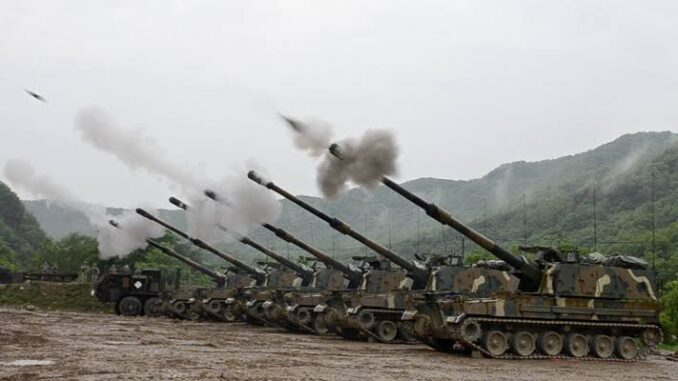
Militarism is catching on across the countries of advanced economies and beyond. The sly, disingenuous term of “defence” is used in this context, encouraging arms manufacturers, contractors and the entire apparatus of the military-industrial complex to fatten for the cause.
The European Union huffs and struts towards higher targets of expenditure that will cull projects for peaceful development in favour of a fatuous rearmament agenda. Member countries of the NATO alliance, lent on by the administration of President Donald Trump, are doing the same. The countries of the Middle East continue to add to the numbers, with warring Israel seeing a 65% increase in 2024 to US$46.5 billion, the sharpest annual increase since the Six-Day War in 1967.
In East Asia, military contractors are also preening themselves in Tokyo and Seoul, pressing the flesh and pursuing contracts. Japan’s military spending rose by a gulping 21% in 2024. The amount of US$55.3 billion is the largest since 1952. In Seoul, on the occasion of K-Defense Day on June 8, President Lee Jae-myung made it clear that he did not want South Korea’s own defence industry to miss out on all the fun. In a closed-door discussion held at the Grand Hyatt Seoul hotel organised by the Defense Acquisition Program Administration (DAPA), Lee solemnly promised to “do my best to push ahead, as long as we don’t end up being labelled arms dealers.”
This somewhat idiosyncratic caveat is bound to make little difference, given Lee’s ambitions to promote the value of South Korea’s killing inventory. DAPA, wanting to make the most of its first Defense Industry Day themed “Remembering the dedication and passion of Korea’s Defense Industry,” was in a bullish mood to promote Korean military prowess. Some well minted propaganda did the rounds, drawing inspiration on the exploits of Admiral Yi Sun-sin on July 8, 1592, when the turtle ship was committed to the Battle of Sacheon against the Japanese fleet. The turtle ship, in its “historical significance,” symbolised “Korea’s will to protect its territory and its independent technological prowess.”
Those in the defence industry had been worried that the new President might give them the cold shoulder on this grand occasion. He had previously attacked the installation of the US Terminal High Altitude Defense system on Korean soil, ostensibly to protect South Korea from North Korean missiles, as needlessly provocative.
The militarists need not have worried. All the relevant mandarins were in attendance, including the Minister of National Defense nominee Ahn Gyu-baek and Chairperson of the National Defense Committee, Seong Il-jong. The industry titans were also represented. Numerous awards of merit were also presented.
Lee had purportedly told his aides that K-Defense Day, put on the calendar of commemorations by his impeached predecessor Yoon Suk Yeol in 2023, would be a good opportunity to “highlight our support for defence.” According to Korea JoongAng Daily, Lee outlined his various achievements of late to the closed gathering, including attending the G7 summit held last month in Canada. “A big reason I went was to showcase the strength of our defence industry and to ask them to buy our submarines.”
In May, it was revealed that a trio of South Korean firms – Hyundai Heavy Industries, Hanwha Ocean and Hanwha Aerospace – had made a combined offer to the Canadian armed forces valued between US$14 to 17 billion in submarines, with US$720 million worth of armoured vehicles and artillery systems. It was a good time for the Koreans to strike, given the stated view by newly-elected Canadian Prime Minister Mike Carney that “the old relationship with the United States based on… tight security and military cooperation is over.”
Lee also explained his purpose for seeking an invitation to the latest NATO summit held in The Hague. Despite wanting to avoid accusations of being a grubby arms dealer, the ROK President was clearly placing the ambitions and wallets of arms dealers ahead of the common citizenry. He had become a pimp for arms: “The biggest reason I wanted to go was to advertise our defence industry and weapons.”
Participants at the forum pressed Lee to depart from the view that defence was a matter of procurement and competition between parties rather than a total industry beneficial to the state. The response was suitably patriotic – at least if you are a merchant of death: “Defence and arms exports are not just a competition between companies; they’re a competition between nations. We have to win as ‘One Team Korea.’”
In public remarks made at the start of the forum, Lee offered the sort of reasoning that launders the military-industrial complex of its stains, concealing its insatiable appetite to stimulate the cause for war. “I hope the defence industry not only strengthens our security but also becomes one of Korea’s future growth engines. The government will continue investing and providing strong support.”
In response to “the rapidly changing security environment,” the government would also “develop state-of-the-art weapon systems using artificial intelligence (AI) and unmanned robots and build a healthy business ecosystem that goes beyond the industrial structure centred on big corporations to allow small and medium enterprises and diverse talent to participate.” Militarism, following this seedy rationale, should not just be for the big corporations and arms manufacturers. In the business of killing, the little guys should also be given a chance.
Also by Dr Binoy:
Dear reader, we need your support
Independent sites such as The AIMN provide a platform for public interest journalists. From its humble beginning in January 2013, The AIMN has grown into one of the most trusted and popular independent media organisations.
One of the reasons we have succeeded has been due to the support we receive from our readers through their financial contributions.
With increasing costs to maintain The AIMN, we need this continued support.
Your donation – large or small – to help with the running costs of this site will be greatly appreciated.
You can donate through PayPal or credit card via the button below, or donate via bank transfer: BSB: 062500; A/c no: 10495969


Nearly all govts of the world have now become ‘pimps for the arms dealers’. Is it purely because a repetitive cycle of mindless hegemonic ambition is upon us because those same govts have mismanaged their economies and cultures, or suffered the interference of the olde nearly dead imperialists?
In a remarkable display of selective analysis, Dr Kampmark declines to identify the fact that (for decades) Russia has devoted a greater proportion of its economy to military expenditure than any NATO country.
Re. A commentator
Keep on track ……………. this is primarily about Asian expenditure [See the title].
No need to to “but what about Russia”
No
The article starts with discussion about the issue “across the world” and NATO/EU
In that context it is selective analysis to omit any reference to Russia.
I see that Trump has given Putin fifty days to stop bombing Ukraine before the US tighten sanctions.
Putin says he’s not sure if he can totally obliterate Ukraine in fifty days but he’ll give it his best shot.