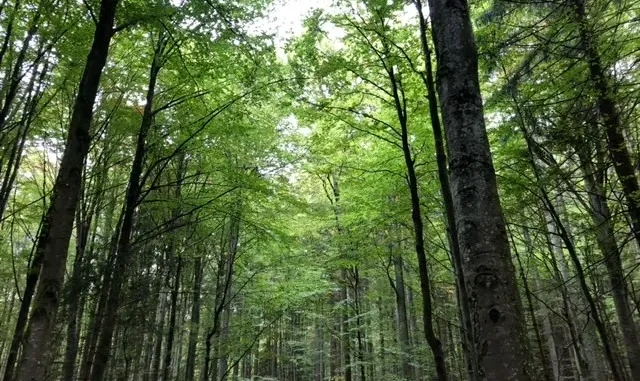
Have you ever walked through a forest and wondered at the feeling, the sense of freedom, quiet contemplativeness, perhaps barefoot, feeling the earth beneath your feet and your mind relaxes, listening to the sounds of nature.
The breeze rustling the leaves, the sounds of bird calls and a sense of peace.
Or sitting quietly near a stream as water ripples over rocks, slightly disturbing the reflections of the trees in water where the stream becomes a broad pool.
There are many times when we sense ‘things’, a kind of ‘super-natural’ something, just a feeling.
A doctor walked into his surgery to attend to a blind patient, being a bit pre-occupied he smiled and nodded at the patient who smiled and nodded back, a response which seemed to indicate that the blind patient saw and politely responded in kind.
When asked, the patient said:
“I am in total darkness, I can’t see you. But for some reason I was under the impression that you were smiling.” (The Ten Kinds of Human, Page 37)
We ‘feel’ stuff, it’s something innate within us, somehow we sense things.
Talking with a Christian friend, we discussed whether God was real or not, since neither she could prove the existence of her God, nor could I prove that there is no God. She is convinced there is a God and finds comfort in that knowledge, feels grounded in her faith and it spurs her on in her life journey. She does not preach at me, as has happened in the past when I have met with some Christians, especially in a church environment.
She is a friend and we value the friendship we share. She does not preach, nor does she judge.
The discussion moves on, to exploring different perceptions of gods, or the sense of sacredness. References to indigenous cultures and the concept of mother earth and the spiritual realm that embodies become conversational paths followed.
I must explain, I am a ‘lapsed Christian’, I have walked away from religious life and found freedom away from the judgementalism of organised religion, but was reminded recently when I met up with someone from my past why I walked away. We chatted for a while, he started on about creation and the power of his God, the God of Genesis 1, and left with a comment about the sins of the world. No explanation was offered on what that meant. He thought I would understand, and I did, but probably not in tune with his meaning.
That kind of got to me. ‘The sins of the world’. What does that even mean, surely if ‘sin’ is a problem, surely it is ‘my sin’, which I need to address for me to live a life which honours what I believe… Whatever I believe. And feelings play an important part of being true to oneself, true to what is believed.
I came across an interesting book, ‘We Who Wrestle With God’ by Jordan B. Peterson. I am kind of disappointed, yet somehow drawn to the book. It is very ‘sermony’, but, in discussing the mythology of Adam and Eve’s expulsion from the Garden of Eden, he draws an interesting metaphor, describing the garden and how the majesty of nature, of creation is designed into cathedrals:
“The garden theme permeates cathedral design, duplicating the primeval forest in stone with branching, tree-like arches and illuminating it through stained-glass windows, just as sunlight in a grove filters through leaves and branches.” (We Who Wrestle With God, Page 43)
And yes, I confess that entering a cathedral is special. There is an aura, a feeling of holiness perhaps, a sense of quiet, of peace. Is that the presence of God perhaps, or is it a feeling, not dissimilar to the feeling of peace and tranquility found sitting beside that rippling stream. A sense of spirituality perhaps?
In a sense, we experience feelings when we are confronted with ‘difference’, especially difference which either conforms to or otherwise stand in opposition to our beliefs.
When we consider how difference, especially differences of religion has caused and continues to cause so much distress, so much hatred and animosity, resulting in violence, whether it be the shooting up of places of worship, the burning of churches in Alabama during the fearful reign of the KKK, or the more recent shooting in a Synagogue in Minnesota, the killing spree in Mosques in Christchurch seven years ago or the murder of innocent Jews celebrating a holy day in their religious calendar in Bondi last December. Or diving deep into the history of Europe and the rise of colonialism, how ‘god’s people’ were ruthless in expressing their sense of entitlement. Contemptuous of the ‘pagan’ practices of indigenous peoples, their worship of ‘Mother Earth’.
Yet others will recognise those differences and be intrigued, be inquisitive, explore the difference and recognise it as a different expression of humanity, of a self definition based on cultural norms or even self definitions.
What drives those feelings, those emotions? Could it be an innate sort of spirituality?
The intrigue of Dexter Dias’s, ‘The Ten Kinds of Human’ is that he explores both sides of each coin, he explores the intrinsic good and evil we are all capable of, places them side by side, and explores the contradictions we have as humans, as homo sapiens. And that too points to something deep inside us, a kind of transcendental something, hard to name, but we all have it. The seeming contradiction of being totally blind, yet ‘sensing’ the silent greeting of a smile and nod of the head. He explores what it is, whether it is something we are born with, in some ways, a kind of spirit we have deep inside us. Further testing with the blind patient included fMRI scanning which produced some unexpected results, the patient, despite being blind was “using another neural pathway to ‘see’ emotion… What was observed was the result of the neural network constructed by evolution that allows humans to ‘see’ the joy and pain of other human beings when they can see nothing else… the patient had ‘Blindsight’”
Without the science of the fMRI, that could so easily be seen as spiritual.
The question of ‘spirituality’ is embedded in life, whether it is in religion or in a connection with nature. And that poses a conundrum which has beset the world from ages past and is most evident today in the hate speech which underlies the violence of terrorist attacks in the name of some god or other, some ethnicity or other., some bigotry or other.
It manifests on a subconscious level, a feeling. For some it may be the response to seeing a Muslim woman in a Burka or a hijab, or an orthodox Jew dressed in traditional Hasidic garb, long black suit, black hat and gartel, or it can be for some seeing a fan of an opposing team wearing the ‘wrong’ colours. A gay person wearing the rainbow of Pride. The emotional reaction is sensed.
I was having lunch a while back with a friend who is a Christian Zionist, and I mentioned a couple of then work mates, one is Lebanese and he plays the Oud in several ensembles, creating a beautiful mix of Classical and the mystical middle eastern sounds. Another isPalestinian, a Muslim.
My friends expression changed. His smile turned to a scowl. The mere mention that I have anything to do with such people was a problem for him. He felt hatred toward my friends whom he has never met, just because he was Lebanese, just because he is Muslim. He expressed anger that I should have such friends. He threatened to leave, but we had arranged for me to do him a favour, to give him a lift to another place.
The hatred he expressed came from deep inside him. A rage which was not contrived, it was almost a spiritual anger, a rage which defies logic, a rage so intense that should it be in an environment where there were Muslims present could become violent, and that is the same rage expressed though his on-line chatter, a rage which can lead to acts of terrorism. A rage which comes from others not seeing that the Zionists are right, they are the people reclaiming promised the land of Israel and those who stand in the way are wrong, and the destruction of them is, in their eyes, condoned by their God.
If there is a spirit within us, if we live in a spirit filled world, if we can find peace by retreating into a meditative place, a meditative space, the opposite can also occur, we can find anger, rage, hatred and bigotry when we feel only our own sense of right.
And we do tend to give off a sort of aura, an air about us which shows where we are, whether in a place of contentment or in a place of trouble. Some people give off a sense of positivity, a calmness, an approachability, while others appear shut off, a closed face, a drop-shouldered posture, an air of unapproachability. And others just look angry, threatening. It can be demonstrated through road rage, the combativeness within a domestic environment or in politics.
An article in today’s edition of The Guardian an article ‘Pauline Hanson’s racist rhetoric cast a shadow over my childhood. Here we are again’ by Zoya Patel speaks of the racism she encountered as a child of immigrants in the 1990’s, the rise of Pauline Hanson and her racism which became evident as a cohort of their community ‘didn’t like us for no reason other than our visible cultural difference’. The article continues highlighting the emotional, hot, anti-immigrant tropes, and questions whether there is some ‘golden standard of Australian culture’ (a line similar to that used by Andrew Hastie in his commentary of immigration). Zoya Patel looks back to our colonial heritage, that of dispossession and continued marginalisation of our First Nations people. It raises a relevant question about what Australian culture really is.
When we dive into the possible realms of a spirit world, when we listen to nature, the song lines of the outback, the morning walk on the beach to see the birds waking to breakfast from the offerings of the sea, the willy-wag-tails skipping about looking for little bugs to eat, to see that we are an intrinsic part of ‘Mother Earth’, where we recognise that every fibre of our being, the clothes we wear, the homes we live in, everything originated from the earth, and when we see raging ‘stuff’ find its way to land fill, or we see a dead bird in the bush decomposing, returning to the earth, when we recognise the funeral line, dust to dust, ashes to ashes, it humbles us to realise how incredibly small we are, how our time here is so short, that hatred really is a waste of time and energy.
Interestingly, while recognising our integral connection with the earth, there was a bit in the Bible, for those Israelites, tracking through the desert on their way to the promised land, where God provided manna from heaven. Food was provided, did that come from the earth or from outer-space somewhere. God fed His people from outside the earthly realm, His people were ‘special’.
When mythologies determine who we are, what ‘spirits’ do we allow to inhabit us?
When we take on the mantle of some distant deity which effectively removes us from the reality that we really are from the earth and will return to it, when we see our eternity in some New Jerusalem, or as a martyr are convinced that seven virgins await is in some heavenly realm, do we lose the humility which is our reality, that we are like specks of dust, that our passage through life is short and ultimately quite insignificant?
It is shameful that the most common of hatreds are from religions which deny the ‘animistic’ beliefs of indigenous peoples, the arrogance which was, and remains evident in the colonial mindset, where lands are taken, people stripped of their cultural heritages, including language, and mission stations developed to ‘Christianise’ them and yet keep them marginalised from the mainstream of colonial culture.
The question of a whether there is such a thing as a spirit world really has no concrete answer, except when we see how such a philosophy or faith manifests in communities that hold to such thinking. There is a respect for the earth, a worship of the spirit ‘Mother Earth’, there is generally a communal ownership and responsibility for occupied territory, and the ‘spirit’ of a deceased person is revered for a year. The earth is the source of life. In Aboriginal culture the name is not mentioned, allowing ‘the spirit to rest’.
In some western cultures, the widow’s garb is worn for a year, grief councillors advise grieving partners to not change, to not move out of their homes for a year, so the grieving process can go through its various stages of anger, of missing, of loving, of adjusting to life without.
When we consider the emotions expressed by the Jewish community after the Bondi terror attack, we can ‘feel’ for them, we can grieve with them. In that case the target of the attack was based on religious difference, but as we see repeatedly in mass killings in the US, or terrorist attacks, school shootings, when we hear of other random acts of violence with no apparent ethnic or religious motivation, the response is not politicised.
Hearing the Israeli President addressing a Jewish gathering the attack is seen in political terms, and is used to further the Zionist cause, the claim to the land of Israel, legitimising the genocide in Gaza and in the West Bank.
Is that the ‘spirit’ of exceptionalism, that of being chosen from beyond the reaches of ‘Mother Earth’? Does that make a Jewish life more valuable than the rest of humanity?
Or in the context of colonialism that indigenous lives are less than that of the coloniser?
That same question underlies all forms of hatred, bigotry, racism, exceptionalism.
Is a ‘spirit’ that guides our feelings?
Or could it be learned behaviour embedded through culture, through whatever belief we carry, that defines us as something somehow better, more worthy than those who we perceive as different?
Keep Independent Journalism Alive – Support The AIMN
Dear Reader,
Since 2013, The Australian Independent Media Network has been a fearless voice for truth, giving public interest journalists a platform to hold power to account. From expert analysis on national and global events to uncovering issues that matter to you, we’re here because of your support.
Running an independent site isn’t cheap, and rising costs mean we need you now more than ever. Your donation – big or small – keeps our servers humming, our writers digging, and our stories free for all.
Join our community of truth-seekers. Donate via PayPal or credit card via the button below, or bank transfer [BSB: 062500; A/c no: 10495969] and help us keep shining a light.
With gratitude, The AIMN Team


Thankyou Bert.
Like you I’m a “lapsed Christian” and was brought up in a Baptist family.
To understand that lapse after being baptised as a teenager, I need to tell more of my story.
When I was nearly 16, just finishing year 10 in Hobart, I fell ill and spent a lot of the next 2 years in hospital, and certainly not at school. While I was in my hospital bed, some – I suppose well meaning church members – came to visit and proceeded to tell me that my illness was punishment from God and that I must have done something very bad to be so ill.
Of course my parents were livid and my Dad apparently ripped them a new one at a Deacons meeting, but it was the beginning of the end of organised religion for me.
After my recovery I spent a lot of time in the Tasmanian wilderness, particularly at The Walls of Jerusalem where I really felt at peace and came to believe that if there is actually a God, that this was his place for me.
I have in my will that if possible I’d like my ashes spread there.
Judaism is an ancient theology that has been entangled by ZIONAZISM, the 19th century Viennese White Supremacist colonist settler response to centuries of persecution across all European countries.
Indeed, it may be claimed that ZIONAZISM prostitutes Judaism with the demand for violent occupation of target lands, at one time including SW Tasmania, and the necessary whingeing about everything that does not support their self-serving theft of lands.
re. the discussion whether God is real or not, a discussion which seems interminable and often binary with strongly held opinions for and against, I’m reminded of the words of the great mystic psychologist Carl Jung, who when asked if he believed in God replied, ‘I don’t believe, I know.’
The same could be said of any of the great teachers, such as Rumi, the Sufi mystic whose writings overflow with his adoration and love of God, or Hildegard von Bingen, the German Benedictine abbess of the early 12th century, or Meister Eckhart, or in more recent times, individuals such as George Gurdjieff and Eckhart Tolle. Many others, also, whose labour brought them to these exalted realms of existence.
Without for a moment pretending to comprehend what the experience in terms of consciousness and awakening was for these individuals, it’s safe to say that they lived a far more rich and profound experience than that of the great mass of humanity, we poor creatures who slog through our lives half blind, half deaf, half dumb.
The mind, such as it is, the mechanical chatbox, will never understand the reality of God, and will spend its time forever flipping between yes & no, truth or no truth, in favour of this, or against that. The way to the truth lies elsewhere, as the man known as Jesus constantly taught.
Canguro,
All that is evidence of nothing more than the certainty of righteousness that is the inevitable result of total blind faith.
“I know”, one man said. And so many others have said the same about so many different possibilities and nuances of those possibilities.
The fact is, we don’t really know. Not anything. We think we do but there is no guarantee of truth or accuracy.
Cogito cogito ergo cogito sum
Thanks leefe. When your contributions to the pool of wisdom are on par with the likes of Jung, Hildegard, Rumi, Gurdjieff, Meister Eckhart et al I might begin to take you seriously. Until then, carry on.
Ahhhhn, I disagree, therefore my comments are not worthy of consideration. How logical.
I enjoyed reading your comment, Canguro. It complemented a wonderful article.