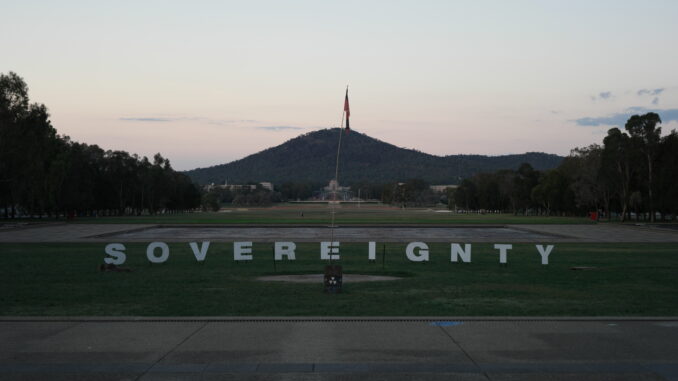
Imagining Australia as a New Republic – Part 5: Protecting Sovereignty and Transparency
Protecting Sovereignty and Transparency
In the last part we explored how fairness and dignity become the foundation of the republic’s economy.
Now we look outward – to how a free and honest Australia protects that fairness in its dealings with the world. Because sovereignty means little if it can be traded away by signatures we never see.
Sovereignty in the Republic
In the new republic, sovereignty is not a flag or a slogan. It is the right and responsibility to make decisions guided by truth, ethics, and the will of the people – not by unseen agreements, foreign pressure, or domestic opportunists.
We remain a nation open to partnership, trade, and cooperation, but never again at the cost of our independence or our integrity.
Every treaty, contract, and memorandum of understanding is public by default. No government can commit Australia to secret deals on defence, data, or resources. The republic belongs to all citizens, and so too must its agreements.
The Sovereignty Review Commission
To achieve this, the constitution establishes a permanent Sovereignty Review Commission – a non-partisan body of legal experts, economists, scientists, and First Nations representatives.
Its job is to review every major international agreement Australia has entered since Federation. Each is tested against three standards:
- Does it protect the wellbeing and rights of Australians?
- Does it preserve our control over essential resources, data, and decision-making?
- Does it serve the environment and future generations, not only current profits?
The Commission publishes its findings publicly.
Where an agreement fails these tests, it recommends reforms or renegotiation, all debated openly in the Houses before any action is taken.
Mini-Story One – The Trade Clause
Years before the republic, an old trade agreement included an “investor-state dispute” clause allowing multinational companies to sue Australia in secret tribunals. Few citizens even knew it existed.
Under the new republic, the Sovereignty Review Commission re-examines the clause. Economists show it has cost taxpayers hundreds of millions, and community advocates reveal how it chilled environmental regulation.
The Houses debate the findings live. Within months, the clause is renegotiated – replaced by a new public-interest rule ensuring that no company can override the will of Australian law.
Markets remain stable, and citizens realise that transparency strengthens the economy rather than frightening investors.
Mini-Story Two – The Data Servers
Another review uncovers that most government and health data are hosted offshore, controlled by foreign cloud providers. This creates hidden risks – privacy breaches, data access disputes, and the possibility of foreign interference.
The Commission’s technology panel proposes a national solution: the Australian Data Trust, a publicly owned, encrypted network using renewable energy.
Private companies may still compete for storage contracts, but the data never leaves sovereign soil. Within two years, Australia becomes a global example of secure digital independence – trusted by citizens and admired by allies.
Transparency in Foreign Policy
In the republic, foreign policy begins with daylight. Parliamentary committees broadcast all treaty negotiations after each round. Defence and intelligence arrangements still protect operational security, but never the motives or costs behind them.
Citizens can see what their nation stands for and who it stands with. Honesty becomes Australia’s greatest soft power.
Transition in Practice
During the transition period, existing treaties remain valid while the Sovereignty Review Commission conducts its audits.
Defence pacts, trade agreements, and corporate concessions are catalogued and prioritised. Partners are notified that Australia’s review process is not withdrawal – it is renewal. Where transparency strengthens trust, most nations welcome the change.
The few that resist exposure lose their grip as the republic’s integrity becomes its most valuable export.
By the fifth year, every major agreement is public, indexed, and available for any citizen to read – a permanent record of how the republic deals with the world in good faith.
Why It Matters
True sovereignty isn’t isolation; it’s self-respect. It means we choose our alliances, our values, and our responsibilities in full view of the people they affect.
It means no secret clause can undo the work of democracy, and no foreign server can hold our memories hostage. It means we can stand with our neighbours – Pacific, Asian, or European – not as dependants, but as equals.
Reflection – in the Author’s Voice
When I think about sovereignty, I don’t imagine walls or flags.
I imagine transparency – a country so honest with itself that no one can ever use its ignorance against it again. I imagine Australians knowing what’s written in our name, proud of the agreements we make because they’re built on fairness, not fear.
Maybe that’s what true independence has always been: not standing alone, but standing clear-eyed in the open.
Imagining Australia as a New Republic – Part 6: Culture, Memory, and the Days We Share
Culture, Memory, and the Days We Share
We’ve built the framework of the republic – democracy from the ground up, integrity in its heart, fairness in its economy, and sovereignty in its dealings with the world.
But a nation is more than its laws. It’s a story we keep retelling – who we’ve been, who we are, and who we still hope to become. Culture is how we remember, and memory is how we heal.
Why Culture Matters
Policy keeps a country functioning. Culture keeps it alive.
The new republic recognises that art, language, music, and ceremony are not decorations around democracy – they’re part of it. They tell the truth in ways statistics never can. Every people needs days that belong to everyone: one for reflection and one for celebration.
In the republic, those days are Reflection Day and Republic Day.
Reflection Day – January 26
Reflection Day is not about guilt. It’s about truth. It’s the day we stop and listen to the stories that began tens of thousands of years before 1788.
We remember the loss and survival of First Nations peoples and the hard lessons of colonisation. We learn, we talk, and we look each other in the eye as equals.
Schools and workplaces hold gatherings instead of barbecues. There are no fireworks – just fires for storytelling, songs in language, and community meals that remind us how connection began long before conflict.
Mini-Story One – The School
On the first Reflection Day of the republic, children at a small primary school gather under a gum tree.
Their teacher introduces Aunty May, a local Elder, who begins in language and then in English: “This land has always spoken. For a long time, people forgot to listen. Today we start listening again.”
The children draw pictures of what they love most about their town – the river, the magpies, the footy oval – and Aunty May helps them write the words in both English and her own tongue.
For the first time, the school song is sung in two languages, and the parents listening know something profound has shifted. It’s not shame that fills the air that day. It’s belonging.
Republic Day – June 1
Republic Day is our national birthday – the celebration of our shared decision to govern ourselves honestly.
It’s a day of music, food, and pride, held six months from Reflection Day so neither overshadows the other. It marks not the beginning of a nation, but the moment we decided to grow up as one.
Parliament opens its lawns for families. Elders and scientists, artists and farmers, stand side by side as the President reads The Preamble aloud, followed by the youth choir singing in multiple languages.
It’s a day to celebrate progress, to honour service, and to dream forward together.
Mini-Story Two – The Park
On the first Republic Day, a community gathers in a riverside park. Children run between stalls displaying crafts and food from every culture.
Nearby, a stage is set for music.
Before the festivities begin, an Elder from the local Nation steps forward with a didgeridoo player beside him. He welcomes everyone to Country, and then invites a young refugee woman to speak. She says, “I came here five years ago with nothing. Today I stand in the sun of a free country that listens.”
The crowd applauds, and an older man wipes his eyes. It isn’t a performance; it’s recognition.
The anthem that follows is gentle, hopeful – and everyone sings, because the words finally make sense.
Everyday Culture
Two days alone cannot hold a nation’s spirit.
Throughout the year, schools teach the story of both days side by side – one about understanding, one about unity. Museums and libraries become open spaces for truth-telling and reconciliation. Public art is funded as public memory: murals, sculptures, songs, and digital archives that record the story of the republic’s making.
Languages once silenced are spoken freely again, from the desert to the suburbs. Our culture stops pretending it’s borrowed and begins sounding like home.
Transition in Practice
Reflection Day and Republic Day are established during the transition years, before the final declaration of the republic. The first Reflection Day replaces Australia Day as a national public holiday, while local councils and communities shape its observance through truth-telling events.
Republic Day is introduced two years later, initially as a voluntary civic celebration, becoming an official holiday after the republic’s first election.
Both days are written into the new Constitution – one to remember, one to rejoice.
Why It Matters
A healthy country doesn’t erase its pain; it faces it and grows stronger. When we remember truthfully, we celebrate honestly. When we celebrate honestly, we belong.
These days remind us that patriotism can be gentle, that pride can be humble, and that maturity is the most beautiful kind of freedom.
Reflection – in the Author’s Voice
When I imagine these two days, I see the balance we’ve been searching for – a nation that can weep in the morning and dance in the evening, that can honour its oldest voices and still laugh with its youngest.
I see a flag rising beside the old gum trees, and for once, nobody argues about who it belongs to.
Maybe that’s what growing up looks like: remembering everything and still choosing to stay kind.
Continued tomorrow…
Link to Part 2:
Imagining Australia as a New Republic – and a Better Nation for us all (Part 1)
Keep Independent Journalism Alive – Support The AIMN
Dear Reader,
Since 2013, The Australian Independent Media Network has been a fearless voice for truth, giving public interest journalists a platform to hold power to account. From expert analysis on national and global events to uncovering issues that matter to you, we’re here because of your support.
Running an independent site isn’t cheap, and rising costs mean we need you now more than ever. Your donation – big or small – keeps our servers humming, our writers digging, and our stories free for all.
Join our community of truth-seekers. Donate via PayPal or credit card via the button below, or bank transfer [BSB: 062500; A/c no: 10495969] and help us keep shining a light.
With gratitude, The AIMN Team


Lachlan; I applaud your vision and commitment and I definitely don’t want to throw a wet blanket over your carefully chosen words however considering the nature of the “governance” that Australia has endured over past decades each one would say “yeah but we are doing all that” and the mainstream media would bury it immediately.
I gues that is exactly what has motivated you to look for change.
I can and must dream of change. To stop dreaming would be to capitulate to the cynicism that keeps us stagnant. While I still draw breath, I won’t lie down just because the trashier corners of the press insist that hope is naïve.
I believe our system of government could/should be far better than it is. But based on existing “Republic” I wonder, is a “Republic” the way to go?
I have trouble reconciling some of the things that have taken place in our country since 1788, just how as a nation we could come to terms with event which may, or may not have taken place thousands of years ago is beyond me, especially as there is no proof they ever occurred?
I’d like to see Australia become a Democratic Federation of States, one in which the the people were governed by the people and for the people.
My dream would be of a forward looking nation, not one that is forever looking back.
That’s an interesting point, Jonangel. Australia already is a democratic federation of states – our people elect representatives at both state and federal levels. The real distinction is that we’re still a constitutional monarchy, with the British monarch as our head of state. Becoming a republic wouldn’t change our democracy or federation; it would simply make our sovereignty fully Australian, with an Australian as head of state.
Lachlan, our federal government only exists as long as the Crown agrees with it’s decisions.
Our basically two party system is little better than the Russian or American systems, unlike Switzerland who can hold a referendum on government with 10% of the population demanding one.
There are no safeguards built into our so called democracy.
We need a better system. That much is very clear.