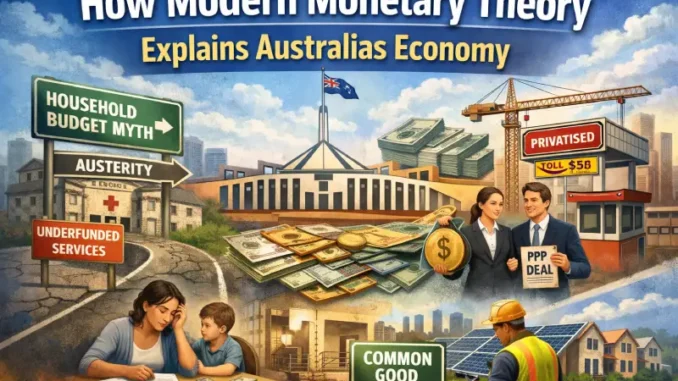
By Denis Hay
Description
Modern Monetary Theory explains why Australia’s budget is not like a household, and how this myth drives privatisation and hardship.
Introduction – Why This Myth Matters
For more than forty years, Australian governments have repeated a claim that sounds sensible but is deeply harmful. It is often said that the federal budget is like a household budget and that Australia must live within its means.
This belief has justified cuts to services, rising inequality, and widespread insecurity. Modern Monetary Theory explains why this claim is false and how it has been used to transfer public wealth into private hands.
New to Modern Monetary Theory?
This guide explains how Australia’s monetary system actually works, why budget myths persist, and how they shape policies like privatisation, austerity, and cost of living pressure.
If you are new, read from top to bottom. If you want detail, use the sections below.
The Problem – Why Australians Are Misled
1. The Household Budget Analogy Is Wrong
Households use money, banks create deposits when they lend, and the federal government issues and guarantees the Australian dollar.
Because Australia is a sovereign currency issuer, it cannot run out of money in the same way a household can. Federal spending does not depend on prior tax collection or borrowing.
Taxes are used to manage inflation and behaviour, not to fund spending.
Footnote: Commercial banks create money in the form of deposits when they issue loans. This activity occurs under government regulation and depends entirely on the state-issued and state-guaranteed Australian dollar.
2. Fear-Based Budget Narratives Enable Austerity
Deficit fear is politically useful. It conditions citizens to accept:
- Underfunded hospitals
- Housing shortages
- Job insecurity
- Aged care neglect
Scarcity is presented as unavoidable, even while public money is freely committed to corporate subsidies, defence projects, and private finance schemes.
The Impact – Everyday Reality
3. Cost-of-Living Pressure Is Policy-Driven
When governments refuse to use fiscal capacity:
- Wages stagnate.
- Private debt rises.
- Public services deteriorate.
Australians are forced to borrow privately for essential goods and services, while the public sector claims it cannot afford solutions.
4. Who Benefits from the Budget Myth
The main beneficiaries are:
- Large corporations.
- Infrastructure financiers.
- Outsourcing firms.
- Political donors.
This myth justifies privatisation and PPPs that lock in profits while shifting risk to the public.
This system rewards financial engineering over public outcomes.
Privatisation and PPPs – Who Pays
5. Why Privatisation Costs More Over Time
Privatisation is sold as efficient. In practice, it almost always costs more.
Once services are privatised:
- Profit margins are built into pricing.
- Contract complexity increases.
- Transparency declines.
- Long-term costs rise.
Public services operate at cost. Private services must extract profit. That difference alone guarantees higher prices over time.
6. How Public-Private Partnerships Socialise Losses
PPPs are presented as risk-sharing arrangements. In reality, they transfer risk to citizens.
Under most PPP contracts:
- Revenue is guaranteed to private operators.
- Demand shortfalls are underwritten by the government.
- Cost overruns revert to the public.
- Profits remain private.
When projects fail, the public bears the costs.
When they succeed, corporations keep the returns.
Evidence Box: Auditor General Findings on PPPs
Australian Auditor-General reports consistently show that Public-Private Partnerships do not deliver better value for money.
Key findings include:
- Higher whole-of-life costs compared to traditional public delivery.
- Risk transfer claims overstated or unsupported by evidence.
- Governments retaining ultimate financial liability.
- Contract renegotiations favouring private operators.
- Reduced transparency and weakened accountability.
The Auditor General has repeatedly warned that PPPs often prioritise budget appearance over long-term public value, exposing taxpayers to hidden costs and ongoing obligations.
Sources:
OECD: Public-Private Partnerships and Value for Money
Infrastructure Australia: Major Infrastructure Project Governance
7. Why Governments Keep Using Them
Governments persist with privatisation and PPPs because:
- Budget myths hide real long-term costs.
- Off-balance sheet optics are politically convenient.
- Accountability is diluted.
- Corporate lobbying is powerful.
This behaviour only makes sense if the public believes governments lack funding capacity.
The Solution – What MMT Makes Possible
8. How MMT Reframes Public Investment
Modern Monetary Theory starts from a simple fact. Australia can always fund what is available for sale in Australian dollars, provided real resources exist.
The true constraints are workers, skills, materials, and environmental limits, not money.
Inflation is managed through taxation, regulation, and productive public investment that expands real capacity, not through austerity or service cuts.
9. The Public Alternative to Privatisation
With monetary sovereignty, Australia can:
- Fund infrastructure directly.
- Retain public ownership.
- Build in-house capability.
- Deliver services at cost, not for profit.
Hospitals, housing, transport, energy, and aged care perform best when designed for public purpose rather than shareholder return.
Privatisation is a political choice, not an economic necessity.
Frequently Asked Questions
Does this mean spending is unlimited?
No. Spending is constrained by inflation and real resources.
Does MMT ignore inflation risks?
No. Inflation management is central to MMT.
Why is this never explained to voters?
Because informed citizens would demand different priorities.
Hostile Myths in 60 Seconds
Myth: MMT means unlimited money printing
Reality: Spending is limited by inflation and real resources, not revenue.
Myth: MMT would cause hyperinflation
Reality: Hyperinflation follows economic collapse, not normal government spending.
Myth: Australia could go broke
Reality: Australia issues its own currency and cannot run out of dollars.
Myth: Taxes fund government spending
Reality: Spending comes first. Taxes manage inflation and behaviour.
Myth: Government must borrow to spend
Reality: Bond issuance is a policy choice, not a funding necessity.
Myth: MMT is radical or ideological
Reality: MMT describes how the monetary system already operates.
Once fear is removed, better policy choices become possible.
Final Thoughts – Why This Matters
The household budget myth has justified four decades of avoidable hardship.
Modern Monetary Theory demonstrates that Australia can afford dignity, security, and opportunity for all without relying on privatisation schemes that drain public wealth.
Economic literacy is democratic power.
Call to Action
If this article helped you better understand how Australia really works, do not leave it here. Please share it with others who are asking the same questions.
Your voice matters. Your experience matters. And your participation matters.
➡ Share this article with family, friends, and your community
➡ Leave a comment below and join the discussion
➡ Visit the Reader Feedback page and share your view
➡ Share a testimonial if our content has helped you think differently
➡ Connect with us on TikTok, LinkedIn and X
Discuss this article in our Facebook group, where Australians share perspectives and ask questions in a calm, respectful space.
A more informed Australia begins with people willing to discuss the issues that shape our future. You can help lead that change.
Support independent journalism
Operating this site costs approximately $2,000 per year, and reader donations have covered $807 so far. Every contribution helps keep this work online, accessible, and independent.
If you find value in these articles, please consider supporting the site. Even a few dollars help sustain this work.
Donate now, one time or monthly.
Already donated? A quick Google review helps others discover the site.
Engaging Question
Which public service should never be privatised in Australia?
This article was originally published on Social Justice Australia
Keep Independent Journalism Alive – Support The AIMN
Dear Reader,
Since 2013, The Australian Independent Media Network has been a fearless voice for truth, giving public interest journalists a platform to hold power to account. From expert analysis on national and global events to uncovering issues that matter to you, we’re here because of your support.
Running an independent site isn’t cheap, and rising costs mean we need you now more than ever. Your donation – big or small – keeps our servers humming, our writers digging, and our stories free for all.
Join our community of truth-seekers. Donate via PayPal or credit card via the button below, or bank transfer [BSB: 062500; A/c no: 10495969] and help us keep shining a light.
With gratitude, The AIMN Team

Nice work Denis.
Presented in a manner that even an economist could understand.
Thanks Steve, I appreciate that.
My aim is to strip away the jargon, so ordinary Australians can see how the system really works.
I just thought I would add a comment to clarify one of the myths.
Here is a plain-English explanation.
The myth
The government must borrow before it can spend.
This sounds logical because it is true for households, businesses, and state governments.
But it is not true for the Australian federal government.
What actually happens
The federal government spends first
When Canberra spends, the Reserve Bank credits bank accounts with new Australian dollars. No prior tax collection or borrowing is required.
Bond sales happen after spending
Government bonds are issued after spending has occurred. They do not fund spending, they exchange one form of government liability (bank reserves) for another (bonds).
Why bonds are issued at all
Bond issuance is a policy choice, mainly to:
Provide a safe interest-bearing asset for investors and super funds
Help the RBA manage interest rates
Maintain conventions inherited from the gold-standard era
Spending does not depend on bond buyers
If no bonds were sold, the government could still spend. The constraint is inflation and real resources, not borrowing capacity.
One-sentence takeaway
The Australian government borrows because it chooses to, not because it needs money to spend.
This is one of the most persistent myths shaping austerity politics in Australia.
No informed people liken a federal budget to a household one.
Nonetheless we currently face inflationary pressure and MMT holds that a government with a sovereign currency must restrain expenditure, or increase taxes.
MMT does not propose debt expansion during inflation.
There are plenty of legitimate misgivings about MMT, but let’s acknowledge that in the current economic conditions, MMT does not solve any issues related to provision of government funded services or infrastructure.
MMT proposes a deficit reduction.
On this question, Keynesian and classical economics and MMT agree.
There has been no evidence of a political will to address inflationary pressure via expenditure reduction or tax increases for decades.
There is no reason to believe this is likely to change.
The practicality of application of MMT is one of its limitations
AC says — No informed people liken a federal budget to a household one.
ABC 3 Oct 2020 — Often politicians and other commenters compare it (federal budget) to a household budget to simplify the ideas.
The Conversation 17 Dec 2014 — Hockey and Abbott are very fond of using household analogies when discussing government finances – Hockey again compared Australia’s economy to a household budget in his Mid-Year Economic and Fiscal Outlook.
USNews 5 Mar 2013 — The federal budget is remarkably complicated and detailed. To bring it down to earth, both President Barack Obama and Republican lawmakers alike, have compared it to a household budget. Countless news articles have demystified it in the same way: explaining spending cuts by talking about eliminating gym memberships, for example, or putting deficits in terms of credit card balances.
Marketplace Feb 2023 — Last month, House Speaker Kevin McCarthy discussed the debt limit and government spending on Fox News. “What I really think we should do is treat this like we would treat our own household,” the California Republican said.
“But, but, but, …” AC will exclaim, “I specifically referred to informed people.”
Trouble is, we’re not dealing with informed people.
We’re dealing with politicians, opportunists and rogues.
It’s a pretty safe bet that with One Nation now high on adrenalin, we’ll see this very same analogy of federal to household budgets before the next election.
AC says — we currently face inflationary pressure and MMT holds that a government with a sovereign currency must restrain expenditure, or increase taxes.
That’s AC’s black and white universe taking control.
Denis has stated that under MMT — Inflation is managed through taxation, regulation, and productive public investment that expands real capacity, not through austerity or service cuts.
In other words, management is flexible.
The only flexibility with inflation that AC is comfortable with is a little gem that reveals exactly where he’s coming from. He has at least twice called for a GST increase — “…to broaden the load of suppressing aggregate demand (ie inflation) I would like the Reserve Bank to have some ability to set the GST above the current minimum.”
What a treasure.
With MMT there’s no “either – or.”
No reliance on the “invisible hand” of the market to produce favourable social outcomes.
You know the one.
The invisible hand that’s attached to corporate greed.
Those who live in a black and white world cannot come to grips with the flexibility that is a plank of MMT.
They need a rock to cling to.
They want rules.
Hard and fast standards such as a GST with no exceptions such as food items.
They are petrified of the untested, even when the solidity of the current system that they cling to is an illusion.
Even when the standards with which they are comfortable have been tested and found wanting.
But it’s not an illusion for the 1% — they’re doing fine.
For the rest, it’s uncertainty.
Uncertainty of employment, of mortgage rates, of a future for their children.
That’s the economy to which AC clings.
And that’s why he opposes MMT.
All very well in theory, but are there any examples of a government following MMT based policies?
One would prefer Keynes… and very wary of MMT bejng a ‘radcial right libertarian nativist trap’, why?
The US anti-immigrant greenwash Tanton Network’s aka Miller, Bannon et al & with Koch Project 2025 (their BS) ‘OverPopulation Project’ both promotes and cites MMT to rebut issues around reducing immigration & tax revenue vs more retirees & tugging on budgets (see increasing old age dependency ratios).
The radical right would like to see budgets, governments, economies and liberal democracy collapse, then reengineer for a low/no tax, small government and privatised services.
Steve’s problem is that his views are anchored in… not much.
Not long ago he was using Russia’s relatively low level of public debt to as an indicator of its economic success
Thanks for the thoughtful comment. I agree on several points, particularly that MMT does not advocate unchecked spending during inflationary periods. Inflation management is central to MMT, and restraint, whether through targeted spending reduction, taxation, or regulation, is part of that framework.
Where I differ is on two issues.
First, while many informed people do not consciously equate the federal budget to a household budget, that analogy is still routinely invoked in political messaging and media framing, and it continues to shape public acceptance of austerity and privatisation. The persistence of the myth matters because it constrains what voters believe is possible.
Second, MMT does not claim to magically solve service or infrastructure shortfalls during inflation. What it does do is clarify the real constraint. The issue is not a lack of money, but political choices about resource allocation, taxation design, and who bears adjustment costs. Deficit reduction under MMT is a tool, not an end in itself.
I agree with you on the political reality. There has been little willingness to use fiscal tools effectively to manage inflation. That is not a failure of MMT as a description of the system, but of politics.
Thanks Andrew, that’s a fair question and an important caution.
On examples first: no government has ever announced it is “doing MMT”, but many have applied MMT-consistent policies in practice. Australia itself did so during COVID, spending at scale without prior tax increases or funding crises. The US New Deal, post-war reconstruction in Europe, Japan’s long-running fiscal approach, and even routine central-bank operations today all reflect the same operational reality MMT describes. MMT’s core claim is descriptive, it explains how sovereign currency systems already function.
On Keynes versus MMT, there’s no real conflict. MMT builds on Keynes, particularly around full employment and demand management, but extends the analysis to modern monetary systems that no longer operate under gold or fixed exchange regimes.
Your concern about far-right misuse is valid. Some actors on the radical right selectively cite MMT arguments to justify exclusionary or collapse-driven agendas. That is a political abuse, not a consequence of MMT itself. MMT explicitly supports strong public institutions, full employment, and public services, the opposite of small-state libertarianism.
In short, MMT is a tool for understanding monetary capacity. What matters is who uses that understanding and for what purpose. I share your concern about bad-faith actors, which is precisely why clear, public explanations matter.
Thanks Steve, that’s a helpful contribution.
You’re right, the household budget analogy is regularly used by politicians and commentators, regardless of whether economists endorse it. My point in the article is not that informed economists believe it, but that the analogy continues to shape public debate and policy justification, particularly around austerity and privatisation.
I also agree with you that MMT is often misrepresented as rigid or binary. One of its strengths is precisely the flexibility of inflation management, using a mix of taxation design, regulation, and productive public investment, rather than defaulting to blunt tools that disproportionately hit ordinary people.
Appreciate you taking the time to ground the discussion with real examples. That kind of context is exactly what helps move the conversation forward.
AC
Let’s keep the discussion focused on the arguments rather than the people making them.
Steve raised specific examples showing how the household budget analogy is commonly used in political and media debate. If there’s a disagreement with those examples or their relevance, it would be useful to address that directly.
Dennis, when someone fairly recently uses the level of public debt as an indicator of economic success, I think it’s relevant to their contribution in a discussion about the relevance of public debt
Nonetheless, I have to point out that I specifically used the term “informed ” to avoid defending politicians who have applied the incorrect analogy, but Steve somehow sought to make the debate (directly with me) about them.
Let’s put the public debt matter to bed.
For the third or fourth time.
Investopedia has a useful article on the debt to GDP ratio.
It provided a good number of points that included this —
The debt-to-GDP ratio is a metric that compares a country’s public debt to its gross domestic product (GDP). It reliably indicates a country’s ability to pay back its debts by comparing what the country owes with what it produces.
A country that’s able to continue paying interest on its debt without refinancing and without hampering economic growth is generally considered to be stable.
Then this — High debt-to-GDP ratios could be a key indicator of increased default risk for a country. Country defaults can trigger financial repercussions globally.
Then concluded with this — THE BOTTOM LINE — The debt-to-GDP ratio is a metric that helps understand a country’s ability to pay back its debts. A lower debt-to-GDP ratio is generally ideal because it signals a country is producing more than it owes, placing it on a strong financial footing.
The following selection tells a story of debt to GDP ratios.
USA — 124%
France — 113%
UK — 93%
China — 88%
Zimbabwe — 87%
Germany — 62%
Australia — 44%
Russia — 16%
Yes, that economic powerhouse Zimbabwe knows more about controlling debt than the leaders of the liberal world order who lecture the world on economic management.
And why are we talking about debt to GDP ratios?
Because AC has nothing of substance to say about MMT, but is compelled to waffle anyway.
This article and relevant Reader’s Replies should replace the High School Economics texbook explanation of traditional ”economics”, the non-science of guessing by overpaid self-important desk jockeys masquerading as government ”experts” (?? x-spurt: a drip under pressure??).
The ”household budget = national budget” idea is generally attributed to Bob Menzies.
Denis, et al. “MMT is a tool for understanding monetary capacity” full stop.
The key words quoted are, “a tool”
and, “for understanding”.
The rest are the what and why!
Failure to understand the length,
width, depth and reality that the tool represents is demomstrated by the diversity of commentary.
Denis et al.
repeat after me, the phrase “Modern Monetory Theory” is a “Lens” through which a soverign issued currency monetory system is understandable.
Here’s an argument for fundamental change to our economic system from the economist Prof. Michael Hudson.
The right wing economists claim that if government were to provide more public healthcare, and more public services, taxes would go up. And because both Republicans and the Democrats have shifted taxes off real estate, off finance, off the 1% onto the 99%, that means that the wage earners taxes would go up.
But of course, it doesn’t have to be that way at all, because, as you point out, the state theory of money says that governments can create their own money. That’s been the case for the last few hundred years. And China has shown, governments don’t have to borrow money from the wealthy people to pay interest.
They can simply print the money, and the junk economics people say, well, if you print your money, that’s inflationary. But it’s no more inflationary than bank credit. Suppose that a government does indeed borrow a billion dollars from wealthy bond holders, and the wealthy bond holders are going to take the money out of the bank and turn it over to the government for spending.
Why does the government need the bond holders to create this money? Or, why do they need banks to suddenly go to their computer and create a billion dollars, to lend to the government, which the government will then redeposit in these very banks? The government is going to create the money in any case, whether it’s lent by the bond holders, or the banks, or just simply printed.
So the pretense is that the government has to borrow from bond holders. Because the bond holders decide what is economically worthwhile. Well, what does this ignore? That the bond holders are the 1%, and what they find economically worthwhile, isn’t using the government to benefit living standards, benefit labor, and to provide social services.
The government’s role is to provide more money for the 1%, via the military industrial complex, and the other government projects.
This brings to mind the power of the 1%, as Bill Clinton found out.
When he was first elected he proposed some social welfare scheme, could have been public health, and the bond holders tapped him on the shoulder. “Introduce that bill and we’ll destroy the economy.”
The bill died on the spot.
It’s all a con, people, and those who oppose MMT with nothing of substance are saying to you — Stick with the con. Trust the economic managers who are oozing wisdom.
Well put, Stephen.
That’s exactly how I see it. MMT is not a policy prescription or an ideology, it’s a descriptive framework, a tool for understanding how a modern monetary system actually operates. What governments then choose to do with that understanding is a separate political question.
Much of the disagreement we’re seeing comes from people arguing past each other, some treating MMT as a set of demands, others as something to be feared, rather than as an explanatory lens. As you say, misunderstanding the scope and limits of the tool inevitably produces confusion in the commentary.
Thanks Cocky.
I agree that a lot of economic teaching still relies on simplified analogies that no longer fit how modern monetary systems actually work. Those shortcuts might feel intuitive, but they often obscure more than they explain, especially once you move away from gold-standard or fixed-currency thinking.
The household budget analogy has certainly been used in Australian political rhetoric for decades, including during the Menzies era, and it’s persisted because it’s emotionally persuasive rather than analytically sound. That longevity is precisely why it remains influential, even when economists themselves know better.
Appreciate you adding the historical context, and for keeping the discussion lively.
If discussion about MMT was limited to-
• the public debt to GDP ratio is not an accurate indicator of economic success
• a government that issues its own currency can’t run out of money
• inflation and resource availability are more serious economic constraints than public debt
…then it would be a tool of analysis
When MMT proponents turn to…
• therefore the government should increase spending
• we can afford to support the following programs…
• there is little/no need to be financially constrained
… the question has moved from analysis to ideology.
MMT in itself does not require increased deficit spending. It does not require more government financial intervention.
It is simply that many proponents use MMT to justify their wish for increased public spending, when in the current economic conditions, MMT requires a reduction in deficit spending.
Thanks for clarifying your position.
On the analytical points, we are largely in agreement. MMT describes the operational reality of a sovereign currency system, including that public debt ratios are not measures of affordability, that currency issuers cannot run out of money, and that inflation and real resources are the binding constraints.
Where we diverge is in the conclusion you draw from current conditions.
MMT does not require increased deficit spending, but nor does it require blanket deficit reduction. It requires appropriate fiscal calibration. That may involve restraint in some areas, increased taxation in others, regulatory intervention, or targeted public investment that expands real capacity and eases inflationary pressure. Those are policy choices, not ideological necessities.
When proponents argue for increased public spending, they are not doing so because of MMT, but because MMT removes the false affordability constraint and shifts the debate to priorities, distribution, and inflation management. That inevitably moves the discussion into politics, but that is true of any economic framework once it is applied.
My purpose in the article is not to prescribe a spending agenda, but to challenge the myths that narrow public debate are routinely used to justify austerity and privatisation regardless of economic conditions.
I think we’ve probably reached the point where the differences here are political judgements rather than analytical ones.
I would word a response to the latest from AC a little differently to Denis.
AC says — “When MMT proponents turn to…
• therefore the government should increase spending
• we can afford to support the following programs…
• there is little/no need to be financially constrained
… the question has moved from analysis to ideology.”
Wrong.
Denis clearly stated ”Scarcity (under the current system) is presented as unavoidable, even while public money is freely committed to corporate subsidies, defence projects, and private finance schemes.”
In short, MMT could allocate resources differently.
AC continues to push the false line that MMT is irresponsible, when in fact it is the current system that continually hands public money to private concerns.
This is the height of irresponsibility.
This is a victory for ideology.
And that is what AC is trying to preserve — a victory for ideology.
To Steve I can only point out that I have legitimate concerns about unrestrained public debt, my position is widely shared by qualified economists.
But I’m not the one in this exchange who has used a relatively low public debt to GDP ratio as a sign of successful economic management.
That was you.
°°°°°°°°°°
I’ll also repeat, more generally, that MMT does not support an expansion in public spending in the current economic circumstances.
MMT requires spending to be reduced, or taxes to be increased.
To this extent I have previously proposed tax increases as a more egalitarian policy than relying on the punishing blunt instrument of higher interest rates.
Even rational MMT proponents can’t argue against this
Denis
“MMT does not require increased deficit spending, but nor does it require blanket deficit reduction. It requires appropriate fiscal calibration. That may involve restraint in some areas, increased taxation in others, regulatory intervention, or targeted public investment that expands real capacity and eases inflationary pressure. Those are policy choices, not ideological
necessities”.
Exactly!
To Steve I can only point out that I have legitimate concerns about unrestrained public debt, my position is widely shared by qualified economists.
AC, hiding behind authority figures.
And this is the bloke who boasted to us of his ability to read widely and distill this into an opinion expressed in his own words.
But here?
Nothing but waffle.
But I’m not the one in this exchange who as used relatively low public debt to GDP ratio as a sign of successful economic management.
That was you.
Errr…no… it was AC who brought that up.
I think, from the confusion, that someone is slowly realising that he wandered in too deep on this topic.
And it was not my opinion, it was the opinion of a respected investment advice organisation, as set out above.
Readers will note that I pointed out a glaring error by AC regarding the allocation of resources under MMT, and there has been no acknowledgement of that.
No refuting, no retracting.
Instead, more waffle.
Here’s a little context for this exchange…
During a discussion about the state of Russian economy, I pointed to indicators such as high inflation, punishingly high interest and mortgage rates, currency devaluation, business investment, military spending as a proportion of GDP, the chronic labour shortage because of the war with Ukraine, I said the economy was dependent on unsustainable military expenditure.
I challenged Steve to provide a single economic indicator that showed the Russian economy was succeeding.
Steve replied with its relatively low level of public debt.
°°°°°°°°°°
And I might as well take this opportunity to indulge in an I told you so
At the time of the above discussion, Russia was experiencing economic growth of 4.3%.
I said it was unsustainable.
It’s economic growth is now 0.6%, with recession widely forecast
No-one is interested in an exchange that took place months ago.
But they might be interested in why AC is no longer willing to discuss MMT.
AC’s manufactured objections to MMT were beautifully captured at an earlier article by Denis, where AC stated — The housing affordability crisis is too urgent to propose we wait until there is some political interest in implementing a (largely) untested economic theory that hasn’t been adopted as policy by any country. (???)
It is untested, risky and unsupported by the vast majority of experts and academics in the economic discipline. (???)
The statement is completely illogical.
It is manufactured to give the impression that objections to MMT have substance.
The crisis is so urgent he says, that… hang on… he says nothing.
So urgent that we do nothing about it?
No action is recommended.
Apart from throwing crap at suggested solutions.
And an MMT solution is risky???
More risky than the disaster we suffer now?
But no real reason for this alleged risk is given.
“Because it’s untested” is not a reason.
Every economic proposal is untested until it’s put into practice.
Don’t rock the boat, is apparently the advice from his “academics in the economic discipline”, but they fail to see that many are outside the boat and barely able to cling to the gunwales.
Try telling a Mum living in her car with her kids, to not rock the boat.
To object that MMT is untested, is the objection of one who does not care about the crisis.
It is the objection we expect from the smug servants of Empire who see no fundamental problem with the system that rewards them so well.
The ones who are happy to wait for market forces to fix the problem because it does not affect them.
And did you pick up on the reference from AC to “economic discipline”?
That’s the discipline that is internalised by students of economics — socialism for the wealthy, discipline for the masses.
Just as David Tyler explained in his recent examination of the workings of the Reserve Bank, discipline for the masses is built into our economic framework.
A framework that is under threat from concepts such as MMT.
A framework that is protected by those it protects.
But AC has found the going a bit tough, because it’s impossible to defend a failed system.
Hence the diversion.
Crisis?
What crisis?
Steve, I’m still interested in whether you maintain that a low public debt to GDP ratio is a sign of economic success?
You specifically used that measure previously, was your position correct then?
And I’m entirely happy to have a quick rewind. When I pointed to the rate of inflation, very high interest rates, currency devaluation, poor investment, proportion of GDP devoted to military expenditure, labour shortage…you dismissed these economic indicators as “meaningless”
Instead you identified the relatively low level of public debt to GDP.
Do you maintain this position?
What you are doing Steve, is demonstrating the accuracy of my observation that your position is “anchored in…not much”
I will not indulge AC’s childish effort to derail a worthwhile discussion, other than to point out that his position on this diversion was refuted months ago.
I shall leave it to others to speculate as to what’s going on behind the scenes with that.
Back to MMT.
Readers will note that I pointed out a glaring error by AC regarding the allocation of resources under MMT, and that there has been no acknowledgement of that.
No refuting, no retracting.
So all that followed was a diversion from the reality that AC does not really understand that into which he plunged head-first. Or is not interested in understanding.
The diversions began from the earliest articles Denis posted on the subject of MMT.
At Why Australia will Never Run Out of Money, AC said — the critical point is that (the) onus is on those proposing to walk away from the economic recommendations of the overwhelming majority of those that make a career out of economic research, to guarantee that there will be no unanticipated or unexpected economic or societal consequences with the adoption of MMT.
He then demanded of Denis — Will you guarantee this?
The mind-numbing silliness of that, from one trying to appear in control of the subject matter, is astonishing.
Does he apply the same standard of certainty from the “academics in the economic discipline” for whom he has so much respect?
Of course not. He would be laughed at if he did.
But his question confirms the point I’ve made here earlier.
AC is not interested in a discussion of an economic proposal — his interest is to cut the discussion short.
His interest is to protect an ideology that exploits the vulnerable.
He does not wish to talk about the Mum living in a car with her kids.
His position is deplorable.
Uhm ….. as an economics sceptic: when has AC made a relevant comment on any financial matter that could NOT be linked to a COALition push point summary??
Bring on the Universal Basic Income (UBI) from Canada that has been shown to create economic savings in health spending.
Steve, I’m simply demonstrating that your credibility on matters economic is low, and your history proves you have more flexibility in your economic advocacy than anyone I’ve come across.
Do you still hold that a low public debt to GDP ratio is a sign of economic success?
Huston, you have a problem.
Those readers who took the trouble to refer to the earlier article from Denis that I mentioned, https://theaimn.net/why-australia-will-never-run-out-of-money/
would have noticed a couple of interesting developments.
The first was an early manifestation of the obsessive behaviour we are seeing here now from AC — six attempts to derail this worthwhile topic with an item of absolutely zero significance, and zero interest to anyone.
At the earlier thread there was eight attempts, including an allegation that I was changing the subject after I refuted his nonsense.
So we have obsessive behaviour events, months apart, focused on the same irrelevant data. Plus another in November, same obsession, with no interest in advancing the discussion.
That’s a serious matter, right there.
Serious for the mental health of the person involved, and serious for the site.
The other item of interest was the quote from an article by Prof. Bill Mitchell who is an advocate for MMT and has global recognition.
A large body of research in social sciences (around the world) has demonstrated that standard economics programs at our universities breed people with sociopathological tendencies who elevate greed above empathy… One 2005 study that was published in the journal Human Relations found that:
Economics students exhibited less altruism and more self-interest in their “first week of their freshman year”.
That is, “differences between students of economics and students from other disciplines were already apparent before students were exposed to training in economics”.
After one year of study these differences were maintained and stable.
*By the final year of study, the emphasis on “achievement, power, hedonism” were sustained and economic students valuation of “benevolence”, which we might think of as being empathy towards others, had declined significantly.
At the time that I posted the Bill Mitchell extract I was not aware that AC has an economics degree.
With honours no less.
His economics training might explain his unwillingness to discuss the mothers who live in cars with their children because of the many failures of the economic system that he does not want disturbed.
The system that he has stated is “generally in pretty good condition.”
I will say no more.
Readers can make their own conclusions.
Of course, there could be a far simpler reason for this obsessive nonsense.
It could merely be that AC has found himself out of his depth with an economics topic, and does not have the character traits necessary to retire gracefully.
Steve, when having a discussion about MMT it is worth noting-
• MMT does not use the public debt to GDP ratio as a measure of economic success
• You are participating in a discussion about MMT, and providing support to the economic theory
• You have previously used the public debt to GDP ratio as a measure of economic success (and dismissed economic indicators such as the rate of inflation, interest rates, investment, currency devaluation, labour market demographics as “meaningless”)
…don’t you think it is reasonable to establish where you now stand on this question, as it is relevant to the discussion?
E Ray Canterbery (sic) has written on this.., tending within to depreciate Friedman and supporting, usually, a post-Keynesian position, noting that much herein merely justifies accepted classical theory of money. So, more… as he notes, findings showed the money supply and the money value of GDP moving “in tandem.” Inflation is always disruptive.
I’d like to know more, widely, with modern day relevance.
Not so long back the ABC featured a report on Nobel Prize winning economist, Prof. Angus Deaton.
Deaton, as a student and as an economist, internalised all the false assumptions that underpin liberal economics. Because that’s what economics is today — the study of liberal propaganda.
After a lifetime of doing damage, as most economists do, (50 years in his case) he has come to his senses.
He says that:
mainstream economics is in disarray,
it ignores the reality of power,
it neglects questions of equity,
its policy recommendations are “little more than a license for plunder”
the growth in corporate power, and the “rapacious health-care sector” is redistributing working-class wages into the pockets of the wealthy.
mainstream economists have largely stopped thinking about ethics and about what constitutes human well-being, that they did not collectively predict the financial crisis and, worse still, may have contributed to it through an overenthusiastic belief in the efficacy of markets, whose structure and implications they understood less well than they thought, and that they have prospered mightily over the past half century, and might fairly be accused of having a vested interest in capitalism as it currently operates.
In other words, this is an admission that the study of economics has been, for a century or more, possibly since the Industrial Revolution, the study of how to prop up a parasitical economic system.
And so those with “a vested interest in capitalism as it currently operates” are a serious problem. And that’s where the antagonism to MMT comes from.
My guess is that much of the antagonism directed at MMT proposals stems from its roots in the social good.
The social good is seen as a threat to the system because of its potential to be a threat to profits. A threat to the vested interests, whether in academia or business.
And so alternative proposals based on the social good rather than perpetual war, are portrayed as a threat to the stability of the economy and ultimately, the stability of society.
That portrayal is false.
They know it’s false.
But it’s a useful diversion.
And so we see the servants of the vested interests spreading fear of the threat among the populace to hide the fact that if the private sector can profit from public money spent on perpetual war, then it can also profit from public money spent on social infrastructure.
After all, someone has to build the infrastructure.
The real reason for the antagonism is that a switch, or even a gradual move away from perpetual war would see a huge change in public awareness.
The public would wake up to the immense potential that exists in investing in society itself.
The potential for plunder would be diminished, and a huge new threat to the vested interests would emerge.
The threat of an aware public.
A switched on public.
A public that would never forget the unnecessary suffering imposed on society by a policy of perpetual war.
Proposals based on the social good, including MMT, would end capitalism as we know it.
Who could not love that?
Steve, the fact that AC refuses to entertain a ‘different’ model says it all.
I’m not an economist either, in fact I happen to think that economics as it is currently undertaken is nothing more than voodoo economics, and having studied economics with Prof Robert Reich, I can tell you that he is no fan of MMT either, as his training does not allow that possibility to emerge.
Im going to borrow the words of a very good friend here for AC to think about “When you have got an opinion, when you have got a belief, when you have got a vested interest, when you care too much, when you feel to agitated about a situation how can you possibly see it with any degree of objectivity, and if you have not got objectivity you have not got perspective, if you have not got perspective you have not got wisdom, if you have not got wisdom how can you make the decisions that need to be made with any sense of certainty that they will be right.”
Now philosophy for an economist will be a challenge, no doubt.
https://billmitchell.org/blog/
https://mythfighter.com/2019/08/06/why-nations-pretend-not-to-understand-monetary-sovereignty/?
Heather, thanks for your interest.
I’m not surprised by your reference to Robert Reich.
I don’t know a lot about him, but Chomsky mentioned in one of his books a deplorable anti-worker policy decision made by Reich when he held a high position in the Dept. Of Labor or something similar. Could have been under Clinton.
I’ve tried a few times to find the reference without luck.
Reich now presents himself as a friend to the downtrodden, but like so many, was no friend when in a position to be useful.
I’m on his mailing list, here’s today’s link FYI….
https://robertreich.substack.com/p/office-hours-is-trump-really-truly?
Then there’s this https://www.youtube.com/watch?v=4u_HwUn4bYQ
He was Secretary of State under Bill Clinton.
That’s how I keep up to date with US news, as I have a personal friend over there.
Thanks for that Heather.
I did a search for “Noam Chomsky Robert Reich” and got a Chomsky article “Rollback” which has a reference to Reich, but it’s a book length article so it’ll take some time.
Did come across this though.
Reich served under President Clinton from 1993 to 1997. He opens his new memoir, Coming Up Short, with an apology on behalf of the Baby Boom generation for failing to build a more just society.
Further to the discussion here, MMT is no panacea the limitations of financing public infrastructure or services.
As I have noted, the major economic theories (classical/neo classical, Keynesian and MMT) all advocate control of aggregate demand and inflation via a reduction in deficit spending.
All accept the role of government in limiting inflation through fiscal policy. But governments have continually demonstrated they no appetite to meet this responsibility.
Punishing and inequitable interest rates imposed by the Reserve Bank allows governments to duck responsibly, to the point were we are experiencing fiscal and monetary policy pulling in opposite directions.
And the fact is that many here seem to ignore that during an inflationary period, MMT does not support additional government spending , unless it is (more than) offset by additional taxation.
°°°°°°°°°°°
It is also reasonable to note that there is little apparent relationship between living standards and the public debt to GDP ratio.
At both ends of the public debt scale are are prosperous and underdeveloped nations.
What can be noted is that many countries with a high debt/GDP ratio are declining economies, they tend to experience a lower birth rate and an aging population.
The case of Japan is often cited by MMT proponents. It has a public debt to GDP ratio of 260%.
A generation ago, the figure was about 90%
In a generation, Japan has increased its debt ratio 3 fold, which coincides with its economic decline.
More generally, it also appears to be a society in decline.
When a critical element of a successful economy is public and business confidence in the future, high and ever increasing public debt may undermine this confidence.
If in another generation the trend line continues, the public debt to GDP ratio of Japan climbs to 400%, will this produce prosperity or will the result be a continuing decline?
In my (reasonably well considered) opinion, following the Japanese experience isn’t worth the risk.
Which is why I believe the onus is on the proponents of Modern Monetary Theory to demonstrate that there is not an unintended outcome or an unforseen risk.
°°°°°°°°°°°°°
And the more recent proponents of MMT, such as Steve, can’t reconcile their previous position with their current one.
AC has a credibility problem.
I originally introduced the debt to GDP figure for Russia to show that his image of a Russia on its knees was faulty, due to Russia’s extremely low debt/GDP figure compared to the major developed economies.
My position is supported by investment analysts at Investopedia who state that a low ratio is a sign of economic health.
Which makes sense to anyone who can think logically.
But despite resisting my position for months, AC has now done a U-turn and supported it by citing the example of Japan with a debt/GDP ratio of 260%.
Japan, AC informs us, has in a generation, “increased its debt ratio 3 fold, which coincides with its economic decline”.
Further, that “it also appears to be a society in decline”, and that to follow the Japanese experience “isn’t worth the risk”.
So logically, AC has linked a high ratio to high risk.
I could not agree more.
Thats great Steve, but you’re a little late in comprehension.
I’ve said repeatedly that a high public debt to GDP ratio is an unquantified risk. There is a potential and significant downside.
MMT doesn’t regard this as a risk. You have recently been posting comments supportive of MMT.
I’m glad you finally agree that you don’t accept the core tenet of MMT.
Now we can move on to why you believe economic indicators such as the rate of inflation, interest rates, currency devaluation, labour market demographics, percentage of GDP devoted to military expenditure, are “meaningless “
Here we see AC assuming to know more about MMT than some of the most credentialed economists in the world.
Who should I believe?
Hmmm… It’s a tough one.
Steve, you just posted that (oddly) you agree with me, the public debt to GDP ratio is an economic indicator (of course there are a number of others).
A lower ratio is preferable (or safer) to higher.
Are you aware of the importance MMT places on the public debt to GDP ratio?
Let me know whether or not MMT proponents see this as important
AC has painted himself into a corner and can see no way out.
First he stated “I’ve said repeatedly that a high public debt to GDP ratio is an unquantified risk. There is a potential and significant downside.”
The logical consequence of this is that Russia’s low debt to GDP ratio is a positive for the Russian economy.
But he cannot bring himself to say that.
Because that would be an admission that I and Investopedia were correct.
Why can he not admit that?
Because he has an obsession.
But in the following comment all was revealed.
“the public debt to GDP ratio is an economic indicator (of course there are a number of others)”.
Indicator of what?
That was an attempt to go nebulous, but in the end reality had its way, as it always does eventually.
“A lower ratio is preferable (or safer) to higher.”
So there it is.
The forced admission that Russia’s low debt/GDP ratio is a positive for the Russian economy.
Which was my point from the beginning months ago.
A consequence of obsessive behaviour is that it limits logical thought.
That is on display here.
AC has tried to present a remark by Denis to the ratio, as a refutation of MMT, and in the process salve his wounded ego after losing the argument about the debt/GDP ratio.
That went well, didn’t it?
In the end, I care nothing about the relationship of the ratio to MMT, and I doubt that Denis has much regard for it also.
But it is nice to see AC concede that Russia’s low debt/GDP ratio is a positive for the Russian economy.
You really are embarrassing yourself now Steve.
For months you have voiced support for MMT.
Now you are advocating an economic indicator that is entirely contrary to MMT. A core thesis of MMT is that the public debt to GDP ratio is not relevant to nation with a sovereign currency.
Now you’re back to saying it is important.
It is pointless to try to corner me via your contradictory ignorance.
I have consistently warned against ever increasing public debt. It is a factor that is likely to undermine long term public and investment confidence in the economy. High public debt is a risk and I have said this repeatedly. You even chided me for my exchange with Denis on this exact subject. But debt the to GDP ratio isn’t simply an indicator of economic success in isolation.
You don’t seem to comprehend that.
On the other hand, actual hard number economic indicators such as the rate of inflation, interest/mortgage rates, currency devaluation, falling share market, investment, the percentage of GDP devoted to military expenditure, labour market demographics…well… you dismissed those universally accepted economic indicators as “meaningless”
Steve, you are genuinely embarrassing yourself
And I’m letting you know that I’m happy to continue to assist you to do this.
AC concedes that Russia’s low debt/GDP ratio is a positive for the Russian economy, and I’m the one embarrassed?
I’m grinnin’ from ear to ear! 🙂
It is of some significance that back in June when AC gave his regular update about the dire situation of the Russian economy, I provided a sample of the news media headlines going back years, that predicted the imminent collapse of the Russian economy, and AC suddenly lost interest in the discussion.
A few days ago I came across an updated list.
It’s even more impressive than the earlier version, as it shows the Empire still struggling to cope with the reality that Russia cannot be strangled by sanctions.
That is what is going on with this discussion here.
This is AC struggling with reality.
He foolishly tried to combine two obsessions, Russia and MMT, hoping for a win on both.
It stands out however, that AC knows little about Russia and little about MMT, so his chances of success are close to zero.
He is alarmed by any threat to the liberal economic order, but has not presented a cogent argument against MMT. His lack of knowledge forces him to simply demand answers to manufactured questions, hoping that this comes across as being in control of the subject.
For example — the critical point is that (the) onus is on those proposing to walk away from the economic recommendations of the overwhelming majority of those that make a career out of economic research, to guarantee that there will be no unanticipated or unexpected economic or societal consequences with the adoption of MMT. Will you guarantee this?
Looks impressive, while being mind-numbingly silly.
You’ll note that this was not just a point, it was “THE CRITICAL POINT”, in other words, the sum of the argument. The clincher.
His only hard example to boost his case against MMT, Japan, turned into a disaster because it destroyed his case against Russia.
Apparently economics students are not taught the danger of fighting wars on two fronts.
The arguments against MMT are arguments to protect the economic system that forces mums and their kids to live in their cars, does nothing to help, and has no intention of doing something to help.
Steve, you really are struggling.
You’ve spent months supporting MMT, so let me ask you directly.
•Do you understand that MMT does not regard the public debt to GDP ratio as an economic indicator or a limit?
•Do you understand that debt to GDP ratio, in isolation, is not an indicator of economic success?
•Do you understand that there are prosperous and underdeveloped economies that have a low public debt to GDP ratio and at the other end of the scale, there are examples of both prosperous and underdeveloped countries that have high debt to GDP ratios?
My contention has always been I prefer prudent economic policy, to a risky one, and have routinely posted my view on this.
You’re typically slow on the uptake.
Meanwhile, you might focus on the relatively low public debt to GDP ratio that Russia had, but you ignore the facts that demonstrate the pressure the economy is under.
According to you, the following economic indicators are “meaningless”.
• Russia’s inflation rate that is 3 time that of Australia (and ours is high by developed nations standards)
• official interest rates are 18%, about 4 times ours.
• mortgage rates are punishingly high
• a currency that has devalued by about 40%
• the value of public companies has fallen by about 40%
• the labour market demographics/shortage, due to its Ukrainian war will take a generation to recover
• it devotes a great proportion of its GDP to the military than any NATO country.
• it’s GDP per capita is far lower than even Greece
• it has a life expectancy that ranks 112th
• it has Europe’s worst outcome on the Gini coefficient (ie wealth distribution)
….so how about you deal with actual economic indicators, as well as understanding the relevance of the public debt to GDP ratio.
This is devastating news about the Russian economy!!
Why wasn’t I told??
And why is it that the US is pleading for a ceasefire in Ukraine??
The US, UK and EU, along with countries including Australia, Canada and Japan, have imposed more than 16,500 sanctions on Russia.
Surely one or two more and Russia will crumble!
What are they thinking?
Steve, the fact is that you are completely unable to reconcile your recent support for MMT with your previous use of the public debt to GDP ratio as your only indicator of Russia’s economic performance.
It is embarrassing for you
your only indicator of Russia’s economic performance.
AC is lying.
Again.
Why would anyone lie in a discussion such as this?
What sort of person does that?
Why this emotional involvement?
AC has a strange fixation on economic data, and despite or perhaps because of his economics training, he has the weird belief that economic data are immutable.
Inflexible.
Enduring.
This is typical of those who, unsure of their place in the world and unsure of the world itself, seek comfort and security by clinging to anything that has the appearance of solidity.
No matter how illusory that solidity might be.
This comes from a failure of modern culture.
Students who are only exposed to training of a technical nature, economists and accountants in particular, miss out on exposure to the accumulated wisdom of humanity.
They never learn of Heraclitus for example, who taught that the only universal constant, is change.
And so despite or because of AC’s economics training, he is unaware that economic statistics are the teachings of Heraclitus on display for all to see.
Economic statistics are variables.
They change.
All countries have economic problems.
The EU is neck deep in adverse economic influences.
Trump’s tariff war had its genesis in economic desperation.
But economic failures are rare, particularly among the developed economies.
Why?
Because the bigger economies have the flexibility to make adjustments.
As Russia did when hit with a truckload of sanctions.
The result is that economic indicators are no more than guides.
Guides that responsible governments take into account.
As Russia has done in the past and will do again.
So AC can relax.
It’s not all doom and gloom.
“AC has a strange fixation on economic data”
Steve, that is absolutely hilarious!!
When having a discussion about economics and economic success or failure, what do you use instead of economic data??
• The vibe?
• A guy at the pub told me?
• I read a confident assertion on a Facebook page I follow?
• All of the above?
The fact is that you hold 2 contradictory views on economics and you can’t reconcile them.
It is very embarrassing for you.
And demonstrates my observation that your (economic) views are anchored in… not much
AC needs to relax, and enjoy life.
The Russian economy is doing OK.
No-one cares about my views on economics.
And one day, not far away, we’ll see the gradual acceptance of different forms of MMT, and those forms put in place the world over.
It’s all happy days!! 🙂
AC still thinks that people care!! 🙂
Not at all Steve, I know you don’t like the fact that Russia ranks 112th for life expectancy.
Or that (unlike Australia) it devotes a far greater proportion of its economy to the military than to health.
Or that its chronic labour shortage is specifically due to the war Putin chose.
Or that after 30 years of Putin’s rule, Russia has Europe’s worst outcome on the Gini coefficient
But I’ll continue to deal with the fact free nonsense you post, particularly about economics and Russia
Have you looked at the extent to which Russian economic development and living standards lag most other former Soviet countries and Warsaw Pact members that have chosen to look west rather than east?
I’m happy to share the information.
But you don’t like facts
But, but…it’s a wonderful world out there!
AC should do himself a favour, shut down the computer, and go outside and smell the roses.
Steve, I happen to be sitting in my favourite beachside cafe, near my beach house (on probably the best part of the beautiful Victorian coast)
I’ve had a couple of swims, the breeze is on shore and the surf isn’t great – so my board remains at home.
I’m reading an entertaining book, and chatting to a couple of friends.
I’ve shared with them a couple of your diatribes, for their entertainment.
So I think you’re projecting, because you are oddly compelled to try to get the last word. And I think it was you who initiated this particular exchange.
Are you in your mum’s basement or your own? Your fingers hovering over the keyboard waiting to reply to my comments?
Try educating yourself about economics and particularly some economic indicators that reflect the success or failure of government policy and society.
Try reading some articles that are critical of Russia, rather than those which reinforce your orientation.
Try using facts, rather than the vibe
…and I’ll give you a challenge you’ll find it very difficult to meet- try not to be pompous and presumptuous
And I think it was you who initiated this particular exchange.
AC cannot help himself.
It was AC who introduced his debt/GDP obsession here on 7 February 2026 at 11:07 pm.
Then at 1.44 on the 8th he stated falsely — But I’m not the one in this exchange who as used relatively low public debt to GDP ratio as a sign of successful economic management. That was you.
And of course, he was quickly corrected, but it gets to the heart of the problem here, that I had earlier put to bed his nonsense about debt/GDP for the umpteenth time at 8 February 2026 at 9:36 am. So this repetition shows us the power of his obsession. It prevents logical thought. It encourages deception.
Because worse still, he misrepresented my position on the ratio. The article I quoted stated A lower debt-to-GDP ratio is generally ideal because it signals a country is producing more than it owes, placing it on a strong financial footing.
A strong financial footing.
No reference to ”successful economic management”.
It’s by subtle alterations such as this that those with no scruples derail worthwhile exchanges of ideas.
AC has let it be known a few times that his practice is to interpret and reword information before presenting it.
We know why.
The scope for deception is close to unlimited.
So it’s worth asking again – Why would anyone lie in a discussion such as this? What sort of person does that?
Steve it is pathetic that (when I made a reasonable and general reply to the post) you responded directly to me.
It is embarrassing and anyone can see your comment-
https://theaimn.net/how-modern-monetary-theory-explains-australias-economy/#comment-20730
…yet you now assert you didn’t initiate the exchange.
But you’re ignoring the following-
Some time ago, when I posted a range of economic indicators to refute your claim that Russia’s economy was strong despite the economic sanctions, you said those indicators were “meaningless”.
You didn’t qualify this.
I challenged you to provide some examples of indicators that supported your claim.
You posted only Russia’s relatively low public debt to GDP ratio. Without qualification. We had an exchange about your use of Russia’s debt to GDP ratio, and it became clear that (even that recently) you were unfamiliar with MMT.
In addition to trying to reduce your pomposity and presumptuous inclination, you might also try to stop embarrassing yourself.
“this exchange” refers to the matter of the debt/GDP ratio that was clearly initiated by AC. He did not dispute the correction at the time, but he will now.
Standby to be entertained.
But this is all secondary to the main event.
Observant readers will have noticed that AC did not contest my assertion that he lies.
Or that his education has hampered his analysis.
Or that change is a constant.
Or that he is emotionally invested.
Instead, in later comments he focused only on his obsession with data.
With “dot point security”.
With an illusion of solidity and a rock to cling to.
It’s quite staggering that after his character and self-image, his very being, was brought into question, his first priority was to indulge a pointless fixation.
That alone, should tell him that his priorities are out of balance.
So out of balance, that he continues to lie.
From his latest, (yes, it’s never-ending) — “you said those indicators were meaningless. You didn’t qualify this.”
Other than about 15 times.
Remember this? “Please pay attention, because this has already been explained once.
They created the false perception that Russia had a weak economy that would crumble under the weight of sanctions. They acted on that false perception. They started an economic war against Russia. And they lost. They lost because Russia did not crumble. And what does this tell us about the stats you keep flogging? They are meaningless.”
Now, for AC that exchange never happened, as he’s trotted out the same nonsense countless times since.
The bad news for AC is that the stats were meaningless back then, and they’re meaningless now.
Because Russia still has not crumbled, the EU is close to broke, and the US is pleading for a cease-fire.
And that’s why the data nonsense, about which nobody cares, will continue.
Until reality overpowers the obsession.
Steve, a couple of hours ago you contested that you started this exchange. I’ve demonstrated you did.
I’ve observed on multiple occasions that you make a big, unqualified, provocative, statement, such as- “meaningless” economic indicators.
You then back off, qualify and retreat after the event and under challenge. You made no qualification at the time about that, or about your use of Russia’s public debt to GDP ratio.
When you’re struggling, you invent the arguments for me, as you are doing again.
This is your proven modus operandi.
You now say- “The bad news for AC is that the stats were meaningless back then, and they’re meaningless now.”
I’ll note that claim by Steve and remind him of it sometime when he complains about interest rates effecting housing affordability, or when inflation causes problems for consumers, or when he comments the (excessive?) resources devoted to military expenditure or when he refers to inequitable wealth distribution.
According to Steve, those indicators, and others that I have used and which are widely accepted, are “meaningless”
And a reminder…Steve has previously talked about Russia’s growth. I said it was unsustainable and driven by its military expenditure.
Now that its growth has fallen to a barely perceptible 0.6% (with recession widely forecast), Steve no longer refers to Russia’s growth.
So Steve was wrong yet again, and proves his economic understanding is anchored in… not much
Observant readers will note that the focus has shifted.
It’s scramble time.
“You made no qualification at the time about that, (that being meaningless statistics) or about your use of Russia’s public debt to GDP ratio.”
I had no need to qualify Russia’s low public debt/GDP ratio.
Why would I?
Finance professionals have declared a low debt to be a healthy economic indicator. And it doesn’t take a genius to work that one out.
It’s only an issue because it threw a spanner into the bad stats narrative. End of story.
As for the meaningless statistics, I said AT THE TIME that they were meaningless because they were presented in dot-point form.
In other words, no context was provided.
That still applies.
If AC was to provide context, paint a picture, weave a story, craft a tale with depth and complexity, he might get somewhere with his stats.
“I’ll note that claim by Steve (that the stats were meaningless then, and meaningless now) and remind him of it sometime when he complains about interest rates effecting housing affordability, or when inflation causes problems for consumers, or…”
Now there’s a contrived argument to file away for when I need a good chuckle. If I ever present economic stats without context, I will deserve everything that’s thrown at me.
“Now that its (Russia’s) growth has fallen to a barely perceptible 0.6% (with recession widely forecast), Steve no longer refers to Russia’s growth.”
AC still does not get it.
If Russia sees economic growth as a problem it will work its way around it. As all developed economies do.
AC forgets that Russia was on its knees after the fall of the Soviet Union. In 30 years it has become, if my memory is correct, the 4th largest world economy based on PPP. An astonishing achievement.
We can safely say that Russia has a wealth of economic expertise on hand to see it through hard times.
I should not have to remind AC that the Western MSM, where AC gets all his information, predicted Russia’s imminent collapse year after year, even as it was becoming a world power.
The subservient MSM wants Russia to collapse, so that’s what they write. I’ll give just one example — “Russia Is Finished” – The Atlantic, May 2001. It really is gutter journalism.
“So (about Russia) Steve was wrong yet again,…”
There’s a lot of coping going on there.
Steve is determined to keep digging that hole!
• “I said AT THE TIME that they were meaningless because they were presented in dot-point form.”
Hilarious Steve. This is so embarrassing for you, because just yesterday you said-
“The bad news for AC is that the stats were meaningless back then, and they’re meaningless now.”
Just yesterday you didn’t refer to a dot point format. You didn’t object to those facts then because they were in dot point format, and you didn’t object yesterday.
You can’t even remember the bulls*** you posted yesterday!
You said only that I “post meaningless data”
Your past objection to my dot point format was that I used…a dot point format (for many of my comments).
••••••••••
In any event, perhaps Steve can explain what addition information or context he requires when I outline-
The following are indicators of Russia’s economic performance –
• 9% inflation
• 18% official interest rates and mortgage rates
• 40% currency devaluation
• 40% share market fall
• Europe’s worst outcome on the Gini coefficient (wealth distribution)
• a low GDP per capita, and not much more than half that of Greece
• devotes more of its economy to the military than any NATO country
• has a chronic labour shortage because Russia sends its working age population to war rather than productive occupations that produce prosperity
• ranks 112th for life expectancy
Keep digging Steve!
••••••••••
And Steve can’t reconcile his recent support for MMT with statements like this-
“Finance professionals have declared a low debt to be a healthy economic indicator.”
Of the dozen or so widely accepted economic indicators I’ve used, Steve uses one that he really seems not to understand, and which is regarded as irrelevant by the economic theory he has recently latched on to.
••••••••••
Today Steve is clearly proving his modus operandi, that when challenged and under pressure, he qualifies his provocation, he retracts, he retreats, he contradicts himself.
He has done so within the space of 24 hours.
•••••••••••
And Steve now posts about the size of Russia’s economy “based on PPP”
Steve can you explain how aggregate PPP is relevant? How it relates to international economic strength?
How is PPP relevant in the context of Russia having Europe’s worst outcome on wealth distribution?
Crikey, the coping’s gone into overdrive today!
What a change of mood!
I don’t know what AC was on with his mates at the beach yesterday, but I want some of it!
I must apologise to readers; we’re covering a lot of ground that was ploughed long ago. I’ll try to keep it light and breezy.
Ha ha, I know, I know, fat chance.
But let’s get down to business.
AC — ”just yesterday you said- “The bad news for AC is that the stats were meaningless back then, and they’re meaningless now.” Just yesterday you didn’t refer to a dot point format.”
Er, yes I did.
But so what?
I didn’t refer to St. Paul’s epistle to the Lilliputians either.
Is there a point to this?
AC —”Steve didn’t originally object to those indicators because they were in dot point form, he said only that I “post meaningless data”
Hmm. That’s a tough one.
Maybe this will help.
From Oct 2024 — AC — “Can you post some stats that demonstrate Russia’s economic success or even that it isn’t struggling or crumbling?”
Steve — Are the reports from the CIA, Forbes and Statista not good enough for AC? He wants stats.
Something so concise that it’s beyond the point where analysis is useful.
Something that demands no interpretation, no thinking.
Something in dot form to ensure that it remains isolated and cannot contribute to a big picture.
Because if there’s one thing AC hates, it’s a big picture.
Unfortunately for AC, the CIA Forbes and Statista have provided the big picture, and for AC, it ain’t pretty.
Shall we proceed?
AC — Steve can’t reconcile his recent support for MMT with statements like this — Finance professionals have declared a low debt to be a healthy economic indicator.
I don’t have to reconcile anything.
Those who live in a black and white world seek security in certainty, no matter how illusory that certainty is.
And so an economic proposal such as MMT, with it’s flexibility, its absence of ideology, strikes fear.
That fear has a strong element of selfishness about it.
AC proudly informed us yesterday that he has a beach house. Good for him. I say, well done. But you will recall that AC has expressed no concern at all for the mums living in cars with their kids, who cannot afford a home, let alone a beach home. Even though I referred to this several times to get a response.
Now, it would be most unfair of me to conclude from this that AC has no feelings for homeless mothers, he may well have a great concern. But you can be absolutely certain that much of the opposition to MMT comes not from economic considerations, but from the well-off who do not want their serenity/security disturbed by changes to our economic priorities. Changes that could see the masses gain some modest increase in serenity/security by way of investments in public infrastructure.
We can also be sure that the mums living in cars with their kids have no fear of MMT.
AC — Steve can you explain how aggregate PPP is relevant?
Another tough one.
Does this help?
From international banker.com 31.10.24
By June, the World Bank had confirmed that, as per its most recent data release from the International Comparison Program (ICP) and using the purchasing power parity [PPP] method of GDP calculation, Russia had overtaken Germany and Japan to become the fourth-largest economy in the world. Soon after, the World Bank also upgraded Russia from “upper-middle-income country” to “high-income country” status…
If PPP is a good enough indicator for the World Bank and international banker.com, it’s good enough for me.
But then, I don’t have an economics degree.
If I had an economics degree I could make stuff up as I go along.
AC — How is PPP relevant in the context of Russia having Europe’s worst outcome on wealth distribution?
PPP is based on what goes into a “basket of goods”, so the following might relieve AC’s stress.
From statista.com — Approximately eight percent of the population of Russia lived below the national poverty line between October and December 2022. Looking at annual figures, Russia’s poverty rate has declined since 2015, when it exceeded 13 percent. Several other Central and Eastern European (CEE) countries, such as Hungary, Romania, and Bulgaria, reported higher poverty rates.
Baskets of goods, poverty rates, I think I see a connection there.
Are we done now? 🙂
Steve , as I’ve repeatedly said, when you said the economic indicators i used were “meaningless”, you didn’t say this was because they were in dot point form.
That’s because (my recollection is) you added provisos and qualifications afterwards, under pressure, when your provocation and exaggeration was called out.
You’ve quoted your reply, so post the link to the entire exchange.
If the exchange proves your first reply was to use the term “meaningless” in the context dot points, I’ll admit I was wrong.
If you used the term “meaningless ” without that qualification, I’ll expect you to admit you are wrong and added the qualification after the event and under pressure.
Over to you.
••••••••••
Although I really have to point out that you didn’t refer to a dot point format on this thread, when you said
“The bad news for AC is that the stats were meaningless back then, and they’re meaningless now.
Because Russia still has not crumbled, the EU is close to broke, and the US is pleading for a cease-fire.
And that’s why the data nonsense, about which nobody cares, will continue.”
I think that’s indicative of your inclination to be loose with the truth
••••••••••
And I’ll certainly reply to your other points later.
For those with a genuine interest in MMT, this article extract is encouraging.
Rethinking Economics, the movement changing how the subject is taught
As the fallout from the 2008 global financial crash reverberated around the world, a group of students at Harvard University in the US walked out of their introductory economics class complaining it was teaching a “specific and limited view” that perpetuated “a problematic and inefficient system of economic inequality”.
A few weeks later, on the other side of the Atlantic, economics students at Manchester University in the UK, unhappy that the rigid mathematical formulas they were being taught in the classroom bore little relation to the tumultuous economic fallout they were living through, set up a “post-crash economics society”.
These small acts of discontent found echoes in campuses around the world in the months that followed, as normally staid economics students demanded a broader and more questioning syllabus that more accurately reflected and challenged the world as it was…
The evidence is slowly emerging that it will be young people who save the planet.
This is only logical when you think about it — they have the most to lose.
I have no doubt that MMT will be one of their tools.
There’s hope for us yet.
Do you have that link, Steve? The one where you have chosen to quote only yourself?
Steve, you introduced the subject of Russia’s aggregate PPP as a talking point, suggesting that its ranking was a great achievement.
I asked you how aggregate PPP relates to international economic strength, not for a cut and paste definition of it.
Perhaps you can just explain how aggregate PPP relates to international trade, or even commodity prices.
Is there a relationship between PPP and wealth distribution?
••••••••••
And Steve, you’ve quoted yourself at length, to justify your claim that the economic data and statistics I posted about Russia were “meaningless”, because they were expressed in dot point form.
Please post the link to demonstrate that this was your immediate objection
My offer stands, if your first response was to object on that basis, I’ll offer an apology.
If, on the other hand, you amended and qualified your position after challenge and pressure, I’ll expect an apology from you.
Although I think your comment on this thread is indicative-
“The bad news for AC is that the stats were meaningless back then, and they’re meaningless now.”