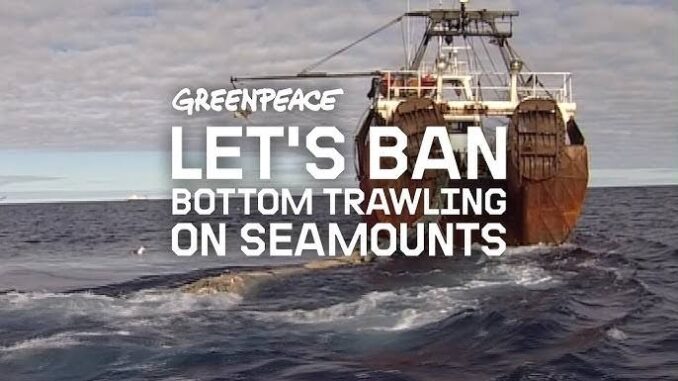
PACIFIC OCEAN, Saturday, 28 June 2025 – Greenpeace Aotearoa activists have confronted a bottom trawler in the South Pacific ocean, east of New Zealand, rebranding it “ocean killer”, after witnessing it haul in a net straining with marine life
Launching from the Greenpeace vessel Rainbow Warrior, activists came alongside the New Zealand-flagged ship, Talley’s Amaltal Atlantis, on the Chatham Rise on Friday afternoon, and painted the message on its hull with non-toxic paint.
Speaking from onboard the Rainbow Warrior, Greenpeace Aotearoa spokesperson Juan Parada says:
“Appalled by the most recent evidence of destruction, people defending the oceans rebranded this Talley’s vessel today to expose the bottom trawling industry for what they are: ocean killers. When Talley’s bottom trawlers drag their heavy trawl nets across the seafloor and over seamounts, they bulldoze everything in their path, including killing precious marine life from coral to fur seals, dolphins and seabirds.
“We’ve all seen the shocking footage of bottom trawling in David Attenborough’s film Ocean, and it’s happening right here, right now.
“Faced with a fishing industry that profits from trashing the ocean, and a government that condones bottom trawling, we’re proud of the peaceful action taken today to call out this destruction and demand that bottom trawling stop.
“The Amaltal Atlantis trawls in the waters of Aotearoa, and has previously received permits to trawl in the High Seas of the South Pacific. Their trail of destruction is wide and long-lasting,” says Parada.
New Zealand is the only country still bottom trawling in the high seas of the Tasman, between Australia and New Zealand.
The at-sea action comes just months after a deep sea expedition led by Greenpeace Aotearoa documented whole swathes of destroyed coral in areas of the Tasman Sea that have been intensively trawled by New Zealand bottom trawlers. This area has been earmarked for one of the first high seas ocean sanctuaries under the Global Ocean Treaty.
Talley’s vessels also trawl in Australia’s waters; the Amaltal Explorer has been trawling for endangered orange roughy off Tasmania, after being allowed back in Australia’s waters last year. In 2018, the Amaltal Apollo trawled in a protected area on the Lord Howe Rise, in the international waters of the Tasman Sea between Australia and New Zealand.
It also comes just weeks after Greenpeace Australia Pacific activists disrupted an industrial longliner between Australia and New Zealand, and revealed the devastating impacts of industrial fishing on marine life in the South Pacific.
Greenpeace Australia Pacific is calling on the Australian government to ratify the Global Ocean Treaty and propose high seas marine protected areas, including large protected areas in the Tasman Sea.
In a statement responding to the protest, Talley’s said it would seek legal action which “may include the arrest of the Rainbow Warrior.”
Dear reader, we need your support
Independent sites such as The AIMN provide a platform for public interest journalists. From its humble beginning in January 2013, The AIMN has grown into one of the most trusted and popular independent media organisations.
One of the reasons we have succeeded has been due to the support we receive from our readers through their financial contributions.
With increasing costs to maintain The AIMN, we need this continued support.
Your donation – large or small – to help with the running costs of this site will be greatly appreciated.
You can donate through PayPal or credit card via the button below, or donate via bank transfer: BSB: 062500; A/c no: 10495969

As the compounding consequences of meeting the challenges of keeping (currently) 8.2 billion humans alive, fed & housed, gainfully occupied & etc. continue to mount, the tally of just what these consequences are makes for a bedtime story guaranteed to keep a dedicated hypersomniac wide-eyed and awake.
The essay refers to David Attenborough’s latest and possibly last documentary, the recently released Ocean, in which footage of bottom trawling shows the utter ruin left behind after these trawling events occur. There are an estimated ~20,000 commercial vessels using this technique, trawling an estimated 4.9 million square kilometres of the ocean floor annually.
That’s for starters. Add in the increasing oceanic acidification. Plus the melting of polar ice-caps and glaciers on all mountain ranges, everywhere. Plus the now-normalised extreme weather events. Add in the rising extinction rates of soil-based microbiota due to industrial farming practices, insectageddons everywhere, ongoing unsustainable losses of tropical, subtropical, and temperate forests… blitzed in favour of mono-cropping or grasslands for beef production, all of which place extraordinary survival pressure on all non-human species, large & small.
Rising temperatures are giving rein to unprecedented rates of permafrost thaw in the northern latitudes, which in turn is releasing increasing amounts of methane, which directly increases the amount of heat trapped in the atmosphere… in time it is expected that the East Siberian Arctic Self, a storehouse of billions of tonnes of methane clathrates, will thaw to such an extent that this methane will gas to atmosphere, at which point, the science suggests, it will essentially be game over for much of life on earth.
Toss in the rising incidents of human and non-human epidemics & pandemics, along with the rising crisis of bacterial resistance to antibiotics and the subsequent possibilities of non-treatable infections, diseases and wounds… all in all a very poor prognosis for future generations of all types of living forms.
As resources become more scarce, competition for acquisition and usage increases, and the resorting to violent confrontations between contesting parties seems certain to be a feature of these existential issues into the foreseeable future.
Glass half full? Or half empty? Optimists may choose the former, others the latter. I’m of the view that the great majority are just idling, fence-sitting, choosing to be distracted, in the face of insurmountable challenges.
Hear, hear, Canguro,
Ban the bottom trawlers.
There are other ways to trawl fish. In 2012, the Dutch super-trawler, Margiris, with onboard freezers, wanted to trawl for baitfish from the Oz economic zone annual migration and take them to to the starving West Africans. The catch was declared sustainable as far as impact on the baitfish, and cameras, by-catch deflectors, net changes, and observers from Oz Fisheries on board secured scientist & govt OK, but pressure from Oz sports fishers saw the Margiris leave town.
The irony then is that 78% of all Oz seafood catch was not for Oz consumption, but exported to high-paying wealthy Asians – still going on.
Thirteen years later Oz and NZ govts have approved bottom trawling, and not a peep from the sports fishers. How effed is that?