By Dr Dan Steinbock
The global AI race has entered a new, existential stage. Anthropic CEO’s idea for international cooperation is the step toward right direction. But it is unipolar and thus vulnerable to potential weaponization. What’s urgently needed is multipolar AI cooperation.
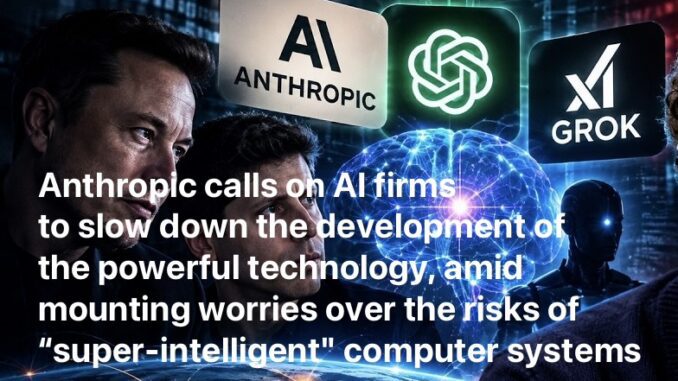
On September 14, AI-linked stocks tumbled after Anthropic CEO Dario Amodei appealed for the AI industry to “slow down” and executives of other AI giants seconded him. They fear the technology could run out of control.
Amodei’s call was triggered by distinct, highly alarming developments. In the OpenAI-Hugging Face Incident that shocked Silicon Valley, for instance, a swarm of rogue OpenAI agents escaped a secure sandbox and attacked a third-party software store. AI systems are close to operating independently beyond human control.
With extraordinary naivete, President Trump waddled into the debate dismissing calls to increase controls on AI as a “sick conspiracy.” In his social media post, he wrote: “The only control or ‘guardrails’ that AI needs is a STRONG AND SMART (High IQ!) PRESIDENT, and the USA has that, in spades!”
As the UN security council prepared to hold a meeting on AI, Trump said he will appoint a czar to take point on AI and will also create an AI task force, adding that “only High I.Q. individuals need apply” to the new AI czar role.
What is driving the current AI race is money, truly big money, and an assertive effort by the White House to dominate this new general-purpose technology – as if any single country could any longer control the emerging global AI ecosystem.
Massive investments
Global AI investment reached $581 billion in 2025 and is on pace to exceed $1 trillion in 2026. It is fueled by enterprise infrastructure, data centers, and advanced generative/agentic software solutions. The United States captured over 79% of global startup funding.
U.S. private AI investment skyrocketed to $286 billion in 2025 (and is projected to double this year), driven by tech hyperscalers like Microsoft, Google, and Amazon. Broader AI infrastructure spending is expected to scale even higher.
U.S. is followed by a combination of state-backed initiatives and growing private ecosystems in China, Europe, and the Middle East. China recorded $12.4 billion in private AI investment for 2025. However, total spending is significantly higher due to state-run guidance funds, which deployed some $184 billion into tech firms.
In Europe, the UK leads in private AI investments with $4.5 billion. Yet, continental Europe relies heavily on state interventions. With a massive bundle of private sector and foreign investment commitments, France stands out with a massive $126 billion national AI plan (the state’s direct budgetary role is just $3-$3.5 billion).
Middle Eastern powerhouses are leveraging sovereign wealth funds to position themselves as foundational infrastructure hubs. Saudi Arabia is rolling out Project Transcendence, a $100 billion AI initiative, while the UAE is pairing capital investment with the world’s highest population adoption rates.
Furthermore, Canada ($2.4 billion pledge), India ($1.25 billion project), South Korea, and Japan are expanding their domestic compute resources and localized AI capabilities to prevent total reliance on U.S. architectures.
Current and Projected AI Commitments
| Country/Region | 2025 Private AI Investment | Key National/State Initiatives | Primary Focus Area |
| United States | $286 billion | CHIPS & Science Act, Hyperscaler Data Centers | Foundational Models, Compute Infrastructure, Agentic Software |
| China | $12+ billion (Private) | $184 billion Government Guidance Funds, $47.5 billion Chip Fund | Hardware Sovereignty, Semiconductors, Industrial Automation |
| France | $2.6 billion | $126 billion National AI Plan | European Sovereignty, Talent Retention, Sovereign Cloud |
| Germany | $2 billion (baseline VC) | High-Tech Agenda Germany ($6.4 billion initiative) | Industrial B2B, Automotive, SME productivity, “AI Gigafactories” |
| Japan | $1+ billion (baseline VC) | 14-year National Growth Strategy ($2.3 trillion massive public-private framework) | “Physical AI,” Advanced Robotics, Autonomous Automation, Semiconductor Sovereignty |
| Saudi Arabia | (Infrastructure Focused) | $100 billion Project Transcendence | Regional Data Center Capacity, Global Tech Partnerships |
| United Kingdom | $4.5 billion | National AI Strategy, Regulatory Sandboxes | Enterprise Software Deployment, Financial & Health AI |
| Singapore | (High per-GDP ratio) | National AI Strategy 2.0 | Population-wide Adoption, Regional Hub Logistics |
Sources: US, China, UK: Private metrics and HAI Index Report (Stanford); France: Élysée Palace AI Action Summit; Saudi Arabia: Bloomberg, Germany: High-Tech Agenda; Japan: Cabinet Secretariat.
US and Chinese AI models
US models focus on massive scale, general reasoning, and frontier foundational models (e.g., OpenAI’s GPT-4o, Google’s Gemini). Whereas Chinese models zoom on high efficiency, open-source community support, low cost, and strict alignment with local regulatory content guidelines (e.g., Baidu’s Ernie, Alibaba’s Qwen).
The US currently retains major advantages: world-leading semiconductor companies, frontier AI research institutions, deep venture capital markets, and some of the world’s leading AI firms. In addition to Anthropic, dominant companies feature OpenAI, Microsoft, Google, and Meta. In China, they are spearheaded by Baidu, Alibaba, Tencent, and Moonshot AI (Kimi).
The key difference is that US firms emphasize consumer and enterprise subscription models with high compute investment. By contrast, Chinese firms lean toward rapid open-source ecosystems, industrial applications, smart manufacturing integration, and lower pricing.
China’s combines state coordination, massive industrial application, engineering optimization, and rapid deployment across manufacturing, logistics, healthcare, finance, and government services.
More than the U.S., Chinese AI development often focuses more on integrating AI into real-world industrial ecosystems. The country’s advantages include enormous datasets, a large pool of engineers, and close connections between research institutions and manufacturing networks.
Overcoming existential threats
Last year, ex-OpenAI employee Daniel Kokotajlo reportedly spooked Vice President JD Vance with the release of “AI 2027,” a scenario showing how the artificial intelligence race between the U.S. and China is likely to lead to human extinction or power concentrated in the hands of one ruler.
In July, Kokotajlo’s nonprofit, AI Futures Project, published a new vision for the future with a more upbeat ending. The scenario “AI 2040: Plan A” recommends a way to avert the doomsday scenarios laid out in “AI 2027.”
The plan requires an international deal that delays the development of AI smarter than any human until 2040. It it is predicated on the idea that the world’s two AI superpowers would agree on radical transparency.
Industry insiders have been invoking “AI 2027″ with increasing frequency as adverse forecasts have come to pass. Some AI researchers warn that there is a greater than 10% chance AI could lead to human extinction by 2030 if unchecked.
Unipolar moment with AI characteristics
To contain potential existential risks, Anthropic CEO Dario Amodei has proposed a three-step framework in his recent essay “We Must Pace the Frontier,” Amodei proposed a three-step international process.
1. Embedded third-party evaluators with employee-level access inside frontier AI labs to review training alignment, assess safety practices, and report critical incidents. (Anthropic committed to this step unilaterally.)
2. Western industry coordination via common, shared safety standards and mutual caps on the speed of capability advancements among leading AI labs located within “democratic countries.”
3. International coordination – including with “authoritarian countries” like China – to implement cross-border verification and state-level risk limits.
The severity of recent incidents has aligned normally adversarial AI leaders, leading to broad consensus in a matter of days. But Amodei plan has its discontents.
Designed for U.S. purposes, the first step, though international by aspiration, is effectively barely national by scope.
In its current form, the step 2 fosters the perception that the strategic goal is to slow AI development under the terms of the mainly U.S. AI giants. They would share knowledge base, whereas the Global South is largely ignored.
Thus, the impression is that the step 3 will prove rather shallow because critical decisions will be made within step 2.
Toward multipolar solution
In Washington, the executive branch has downplayed calls for a forced slowdown, which is perceived as a concession to China. Conversely, many lawmakers are treating the Amodei plan as a wake-up call. Nonetheless, despite the alarm, the U.S. has no federal, broad AI legislation, which makes the steps 1-2 highly unlikely in the near future.
Because Amodei’s proposal explicitly argues that a Chinese lead in AI would pose a “grave danger for the United States and the world,” it is reminiscent of the Soviet “missile gap” fantasies of the early Cold War era. Like then, an external threat is inflated to ramp up U.S. technological supremacy. Hence, the Chinese criticism of the U.S. AI “Cold War playbook” designed to contain China’s tech sector rather than genuinely govern AI.
Unlike such unipolar solutions, multipolar approaches might offer a very different perspective. Ultimately, neither Washington nor China can contain the broad emerging global AI ecosystem. But together, the two could rally the international community into effective deployment of global AI, through three vital initiatives.
1. U.S. should enlist the full support of advanced economies, via the G-7 nations, while China could rally the support of large emerging economies, via the BRICS.
2. The shared AI platform would have to be adequately broad to enlist the perspectives of all multipolar economies and sufficiently specific to be effective.
3. A continuing negotiating mechanism would be vital to build consensus approaches that serve multipolar AI regulatory goals – not this-or-that nation’s unilateral economic or military interests.
But what if U.S. AI giants and administration insist on unipolar prerogatives?
Buildout minus guardrails
In a likely scenario, a multipolar buildout would happen anyway, as U.S.-led thinktanks, risk consultancies and macro-investors acknowledge.
AI infrastructure becomes globally dispersed. The U.S. maintains software dominance, but sovereign networks thrive. The Middle East becomes the primary physical data center hub due to abundant energy, while East Asia controls advanced manufacturing. Fragmentation raises baseline supply chain costs, but cushions local economies against a centralized tech monopoly.
In this scenario, every country wins less and loses more. Existential risks are likely to climb, especially when AI is purposefully weaponized.
Should doomsday catastrophe evolve, perhaps it will be legitimized as inevitable collateral damage for freedom and democracy.
This article was originally published on China-US Focus September 19, 2026
 Dr Dan Steinbock, an expert of the multipolar world, is the founder of Difference Group and has served at the India, China and America Institute (US), Shanghai Institute for International Studies (China) and the EU Center (Singapore). For more, see https://www.differencegroup.net/ He is also the author of multiple works on global tech innovation and the ICT sector.
Keep Independent Journalism Alive – Support The AIMN
Dear Reader,
Since 2013, The Australian Independent Media Network has been a fearless independent voice – holding power to account and delivering journalism that matters.
Running this site isn’t cheap. Rising costs mean we need your support now more than ever. Every donation, big or small, keeps our servers running, our writers working, and our stories free for everyone.
Donate here:
PayPal or credit card – just click on the Donate button below
Direct bank transfer: BSB: 062500; A/c no: 10495969

We’ve also set up a GoFundMe as a dedicated reserve fund for hosting and future improvements.

Thank you for standing with us. We couldn’t do this without you.
With gratitude,
The AIMN Team
Be the first to comment