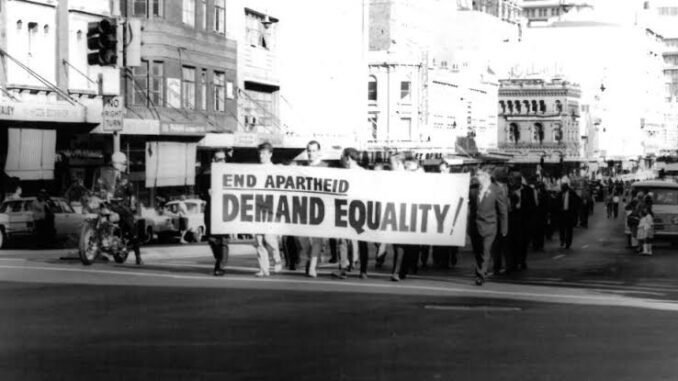
Chapter 15: Apartheid in South Africa and Parallels in Australia
The Birth of Apartheid
In 1948, South Africa’s National Party formalised a system of apartheid – meaning “apartness” in Afrikaans. It entrenched racial segregation that had existed for centuries under Dutch and British colonial rule, turning it into the backbone of national law.
Under apartheid, South Africans were classified by race (white, Black, “coloured,” or Indian) and subjected to radically different rights and restrictions. Whites controlled the government, land, and economy; Black South Africans were denied political rights and forced into second-class citizenship.
Life Under Apartheid
Apartheid dictated nearly every aspect of life:
Pass laws: Black South Africans had to carry identification passes to move through white areas. Being caught without a pass meant arrest.
Bantustans: Millions were forcibly relocated to “homelands” – underdeveloped rural areas meant to contain Black populations.
Education: The Bantu Education Act created separate, inferior schools for Black children.
Work: Black South Africans were restricted to certain jobs, usually the lowest-paid and most dangerous.
Marriage and relationships: Interracial relationships were criminalised under the Immorality Act.
Apartheid was a comprehensive system of racial engineering, designed to maintain white dominance indefinitely.
Violence and Resistance
Like Jim Crow in the U.S., apartheid was enforced with violence:
Police raids, beatings, and imprisonment were common.
Protesters were massacred, as at Sharpeville in 1960, where police killed 69 unarmed demonstrators.
Resistance movements like the African National Congress (ANC) and leaders like Nelson Mandela faced banning, exile, or long prison terms.
Despite repression, resistance grew until apartheid collapsed in the early 1990s, culminating in South Africa’s first democratic elections in 1994.
The Australian Parallels
Australia never had a single law called “apartheid,” but many of its practices mirrored South Africa’s system:
Pass laws vs. Protection permits: Aboriginal people in Queensland, WA, and the NT needed permits to travel, echoing South Africa’s pass books.
Bantustans vs. Reserves/Missions: Just as Black South Africans were relocated to Bantustans, Aboriginal and Torres Strait Islander people were confined to reserves and missions, often far from their ancestral lands.
Bantu Education vs. Segregated schools: Aboriginal children were excluded from public schools or placed in separate, inferior classrooms.
Job restrictions: Aboriginal workers were funnelled into pastoral, domestic, or menial labour, often unpaid or underpaid.
Marriage restrictions: Governments and Protectors could deny marriage across racial lines.
The language differed, but the logic was the same: racial separation and white supremacy enforced through law.
Denial and Mythmaking
One key difference was visibility.
In South Africa, apartheid was explicit, visible, and globally condemned.
In Australia, racial segregation was cloaked in softer words like “protection,” “welfare,” or “guardianship.”
This allowed Australians to tell themselves they were different – that apartheid was “over there.” In reality, the practices were strikingly similar.
International Connections
The parallels between Australia and South Africa were not coincidental:
Both were British colonies shaped by settler dominance.
Both developed legal systems to justify dispossession and control.
Both used racial theories to rank populations and enforce inequality.
Australia even maintained close ties with apartheid South Africa for decades, resisting international calls for sanctions and sporting boycotts well into the 1970s and 80s. This reluctance reflected a shared discomfort: condemning apartheid too strongly risked shining a spotlight on Australia’s own record.
Why These Comparisons Matter
By comparing Australia to apartheid South Africa, we learn two things:
- Australia cannot hide behind the myth of being “more enlightened.” Its practices of segregation and control were, in many ways, apartheid in all but name.
Just as South Africa required truth-telling, reparations, and systemic change to move forward, so too does Australia. Denial may be more subtle here, but the underlying structures are real.
Where This Leads
South Africa and the U.S. are not the only comparisons. Canada and New Zealand, as fellow settler colonies of the British Empire, also imposed assimilation policies, residential schools, and cultural suppression on First Peoples.
The next chapter turns to those stories – and to what they reveal about Australia’s shared place in a global pattern of colonisation.
Continued tomorrow…
Link to Part 14:
From Ignorance to Understanding: Facing the Truth of Colonisation (Part 14)
Link to Part 16:
From Ignorance to Understanding: Facing the Truth of Colonisation (Part 16)
Dear reader, we need your support
Independent sites such as The AIMN provide a platform for public interest journalists. From its humble beginning in January 2013, The AIMN has grown into one of the most trusted and popular independent media organisations.
One of the reasons we have succeeded has been due to the support we receive from our readers through their financial contributions.
With increasing costs to maintain The AIMN, we need this continued support.
Your donation – large or small – to help with the running costs of this site will be greatly appreciated.
You can donate through PayPal or credit card via the button below, or donate via bank transfer: BSB: 062500; A/c no: 10495969


Be the first to comment