By Maria Millers
The FIFA World Cup captured the imagination of many Australians, particularly the young. And while the loss to Egypt on penalties was heartbreaking for the many fans who braved the cold and rain to support them, there remains a sense of pride for this young team which in its makeup is a powerful snapshot of modern Australia.
Football is much more than a sport in Australia, some would say it is a religion and remains one of the country’s most influential institutions. It builds community identity and as we saw in the World Cup it can create a sense of unity and national pride and promotes those important values of teamwork, resilience fair play and determination
The local football club is one of the first places where people from different backgrounds work towards a common goal, making it a powerful symbol of our multicultural society in practice.
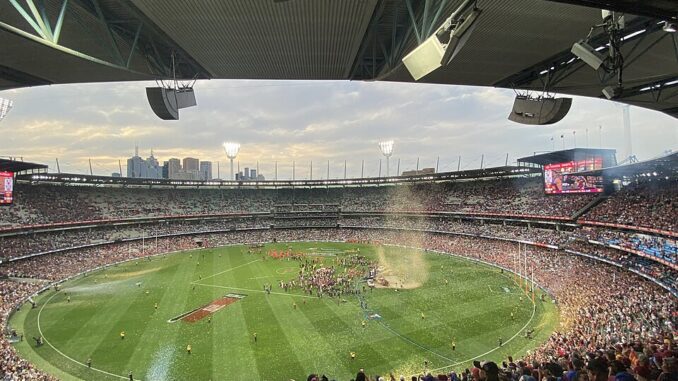
Major events like the AFL Grand Final feel almost like national holidays in Victoria.
Perhaps the greatest opening in Australian sporting literature comes from Bruce Dawe’s Life Cycle a poem that suggests football offers many of the same things religion traditionally has: ritual .community, myth and hope
This is widely regarded as the greatest Australian football poem. It traces a supporter from infancy to old age:
When children are born in Victoria
they are wrapped in club-colours, laid in beribboned cots,
having already begun a lifetime’s barracking.
For many Australians, the weekend revolves around attending the match, discussing selections, watching post-game analysis, and catching up with family or friends and talking football. For families there is the commitment of taking children to play and supporting their club.
Every Saturday thousands of young boys and now increasingly girls take part in community football across different codes.
Enthusiastic parents cheer and encourage from the sidelines, reliving perhaps their own lost dreams.
But in the rough and tumble of the game many young players often experience knocks to the head. These are often not considered significant and yet according to recent research these early insults to the brain can contribute to later problems.
Hoisted shoulder-high at their first League game
they are like innocent monsters who have been years swimming
towards the daylight’s roaring empyrea
Two weeks ago ABC’s Four Corners ran a disturbing program looking at the growing concerns about the impact of concussions on the brains of players across all codes leading to CTE (Chronic Traumatic Encephalopathy).
Thirty-three Australian Rules footballers have been diagnosed with CTE.
Repeated untreated concussions can have serious short-term and long-term consequences, particularly if a person continues to play before they have fully recovered. And over time we have seen players sustaining what appeared to be a significant impact on field being allowed to play on,
Players have only more recently spoken openly about their personal experiences following concussions such as persistent headaches, balance and coordination problems, difficulty concentrating and mood changes including irritability, anxiety, depression and leading to dementia.
We can probably all recall instances of high profile players involved in incidents of drug taking, erratic or violent behaviour and the cases of depression sometimes leading to suicide.
The statistics for ex-players facing neuro degenerate illnesses are unacceptably high. Former Essendon player the late Neale Daniher died from MND ( motor neurone disease) which he fought for 13 years, courageously raising millions for research
In the ABC program the brave parents of Nick Lowden who gave his brain to be analysed after his suicide in 2023 pleaded that ‘something has to change’. In 2017 Nick had been concussed but sent back to play out the game. The autopsy on his brain revealed he was suffering from CTE
The number of players who have developed Parkinson and other neurological diseases is also significant.
Then there are the physical injuries that many players suffer. These injuries often later in life turn into arthritis and other debilitating conditions.
Indeed the sometimes brutal force of play would be viewed as thuggery outside of the game.
Yet the codes promote only the positives of the game but undeniably there are areas of deep concern.
After all we imbue top players with celebrity status and view the game as the visual representation of ideal manhood at its physical best. Just watch the Brownlow Medal night and the red carpet parade of suited up players with glamorous partners all adding to the myth of a sport free from problems.
Hot pies and potato-crisps they will eat,
they will forswear the Demons, cling to the Saints
and behold their team going up the ladder into Heaven,And the tides of life will be the tides of the home-team’s fortunes
– the reckless proposal after the one-point win,
the wedding and honeymoon after the grand final …
But surely it’s time to pose the question: How healthy in a broad sense is the obsession with football? And what are the risks, particularly for those who make it to play at the elite level?
Dr Ann McKee from Boston University believes that the damage can come from repetitive small hits sustained at an early age and therefore argues that contract sport may need to wait until informed consent is possible at say twenty-one.
Second Impact Syndrome is a potentially fatal condition that can occur if someone sustains another concussion before the brain has recovered from the first. It can lead to rapid brain swelling, severe disability or death. It is seen most often in adolescents and young adults.
Hope is offered by Professor McKee whose research could shortly allow diagnosis while the victim is alive.
Gambling is another disturbing aspect surrounding football and other sports. The problem of gambling addiction is rife in Australia and of course gambling on sport is only one area. Its danger lies in its accessibility for young people.
Australians gamble the highest amount per capita globally: more than $30 billion annually.
Australian viewers struggle to watch a sports event free of gambling advertisements and marketing content, both on television and on social media. Yet most Australians – 80% according to a recent You gov poll – want a total ban on gambling ads.
It’s sad that a child knows betting company jingles ahead of club songs or the odds rather than the score. Or that some watch a match not for moments of sporting beauty or excitement but to gamble.
Last week the government’s long awaited bill to reform gambling advertising was introduced to Parliament. It aims to limit children’s exposure to gambling advertisers and ban social media influencers from encouraging people to bet.
But the bill is a watered down version of the comprehensive reforms recommended by the late Peta Murphy. The worry is how much influence was exerted by vested interests at the expense of problem gamblers and society in general.
The importance of football in Australian society cannot be ignored and the positives it brings should be recognized and celebrated. That is however why we should face up to the disturbing elements that undermine the positives. Perhaps there should be less wall to wall media coverage and more critical reporting about the negative aspects of football culture.
Meanwhile for those born into a lifelong commitment:
That passion persisting, like a race-memory, through the welter of seasons,
enabling old-timers by boundary fences to dream of resurgent lions
and centaur-figures from the past to replenish continually the present,
Until finally:
But the dance forever the same – the elderly still
loyally crying Carn … Carn … (if feebly) unto the very end,
having seen in the six-foot recruit from Eaglehawk their hope of salvation
Woorilla Poetry Prize 2026 is open for entries via Submittable, www.woorilla.org.au
Also by Maria
Keep Independent Journalism Alive – Support The AIMN
Dear Reader,
Since 2013, The Australian Independent Media Network has been a fearless independent voice – holding power to account and delivering journalism that matters.
Running this site isn’t cheap. Rising costs mean we need your support now more than ever. Every donation, big or small, keeps our servers running, our writers working, and our stories free for everyone.
Donate here:
PayPal or credit card – just click on the Donate button below
Direct bank transfer: BSB: 062500; A/c no: 10495969

We’ve also set up a GoFundMe as a dedicated reserve fund for hosting and future improvements.

Thank you for standing with us. We couldn’t do this without you.
With gratitude,
The AIMN Team
I also question the ”violence” of all football codes, then I am reminded of the industrial manslaughter of the WWI Western Europe battlefields where Australian troops were slaughtered because the English Generals were incompetent cowards, and think maybe football is ”less damaging”.
Locally, Armidale NSW once had four (4) Rugby Union Wallabies training on a local boarding school field. The school First XV trained with them. These players made their respective reputations with scoring multiple tries including ”up the jumper” that changed the rules; scrum base passes half-way across the field; an incendiary temper when in scrums and simply being very large and very hard to tackle.
Now both Rugby codes are a memory. soccer. proper football, rules the playing fields every Saturday from U6 to Masters Over 60s, then that ”new game” AFL can be seen on the university oval in both gender forms.
Any football code must be better than warfare. Understanding how neural damage occurs and how to prevent/avoid it must be a major interest of the medical fraternity and Club officials.
If only people paid the same attention to how politics dominates their lives, including sports as a political toy – Tasmanian Stadium and Team – maybe everyone would be better off.
https://pearlsandirritations.com/post/2026/07/the-productivity-obsession-has-a-measurement-problem/?utm_source=pi_news&utm_medium=email&utm_campaign=daily-2026-07-09
https://www.theage.com.au/business/the-economy/if-productivity-can-t-be-measured-and-it-can-t-not-really-how-can-we-improve-it-20260707-p60dd8.html
NEC,
too right. Surely, our greatest responsibility lies not just in keeping our sons and daughters safe from the machinations of pyschopaths like Trump, Hegseth and Netanyahu, but also as many souls as we can, including doing what we can to save the Palestinians from the genocidal attentions of Israelis.
Heather,
bringing up the Tasmanian Stadium is extremely pertinent. At what opportunity cost does the Tasmanian government’s bowing to AFL bullying come? What are Tasmanians missing out in improvements to their hospital system in order to get a team in the national league?
Maria Miller,
this is rolled gold genius.
The topic is contemporary and important, you cover it very well, but it is the use of the poem that is superb. As a means to promote the poetry competition, if that is also a motive, the way the poem is woven into the argument promulgated in the article is sheer genius imho.